


AT A GLANCE
- One ocular gene therapy has been FDA-approved, and the large number of ongoing trials brings hope to IRD patients who are waiting for a potential treatment.
- With standard augmentation gene therapy, novel optogenetic therapies, and other advances such as antisense oligonucleotide therapy, retina specialists must remain up to date to provide the best possible care for their patients.
Many clinical gene replacement trials are under way for inherited retinal diseases (IRDs). Other than voretigene neparvovec (Luxturna, Spark), most IRD gene therapy trials are still in phase 1 or 2 with significant work remaining to be done (Table). This article provides an overview of ongoing ocular gene therapy trials to help retina specialists provide patients with educated and up-to-date counseling regarding their possible candidacy for clinical trials (Figure).
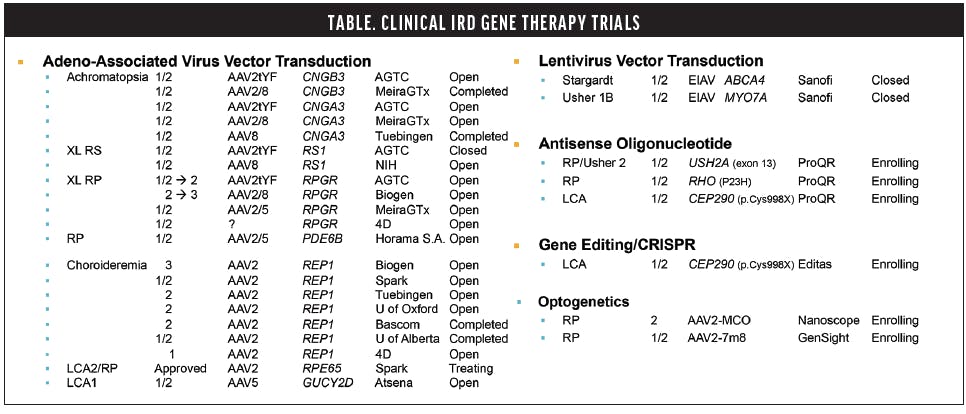
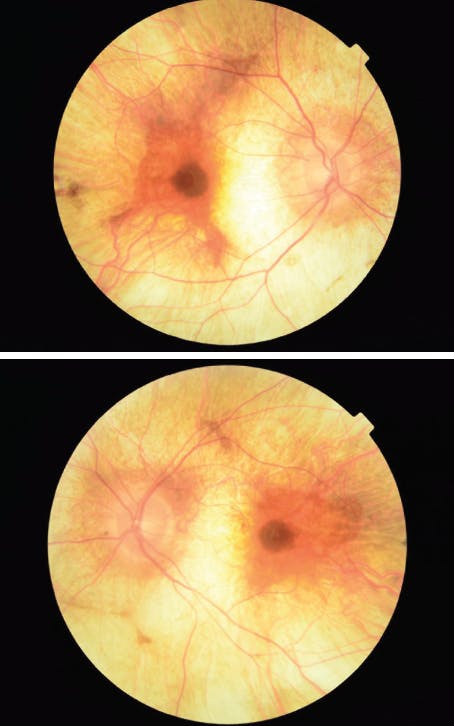
Figure. Retina specialists should follow the gene therapy trials carefully, as they may one day provide a therapy option for patients with IRDs, such as this one with choroideremia.
TRIALS TO WATCH
Retinitis Pigmentosa
AAV-RPGR (MeiraGTx/Janssen) is being evaluated for treatment of RPGR-associated X-linked retinitis pigmentosa (XLRP). Researchers have reported interim results of the phase 1/2 MGT009 clinical trial.1,2 At 9 months, six of seven patients in the low and intermediate dose cohorts demonstrated improved or stable retinal sensitivity in the treated eye compared with baseline. Based on a vision-guided mobility maze, five of six patients demonstrated improvement in walk time for the treated eye at 9 months compared with baseline.
The low and intermediate doses are being evaluated in an ongoing expansion portion of the phase 1/2 study, which completed enrollment in the first half of 2020. The companies are planning a phase 3 pivotal study.
rAAV2tYF-GRK1-RPGR (AGTC-501, AGTC) for RPGR-associated XLRP is being investigated in a phase 1/2 trial. Enrollment is complete, with 28 patients assigned to one of six dose groups.3,4 Data from all 28 patients have demonstrated a favorable safety profile. At 12 months, two of eight patients in groups 2 and 4 showed measurable improvements in visual sensitivity.
Interim 12-month data for groups 5 and 6 show a 50% response rate for patients who met the inclusion criteria for the phase 1/2 expansion trial and the phase 2/3 trials (at least a 7 dB improvement in at least five loci).3
4D Therapeutics is investigating the safety and tolerability of 4D-125 for the treatment of XLRP. The phase 1/2 trial is recruiting up to nine male patients with XLRP and assignging them to one of two dose levels. Patients will be followed for 24 months for safety, with secondary endpoints evaluating efficacy measures at 12 months.5
A phase 1/2 trial of AAV2/5-hPDE6B (HORA-001, Horama) for the treatment of retinitis pigmentosa (RP) associated with the PDE6B gene is under way in France.6 The open-label dose-ranging safety and efficacy trial is recruiting at least 12 adults to be assigned to one of four consecutive cohorts. The primary endpoint is the incidence of adverse events, with 4-year follow-up after the initial 12-month trial. Secondary endpoints include improvements in visual fields, visual function, and quality of life.
An optogenetics trial that uses the AAV2 vector to deliver multi-characteristic opsin (MCO)—light sensitive molecules—to retinal cells is showing promise as a mutation-independent gene therapy for advanced RP. In the phase 1/2a study, 11 patients received a single intravitreal injection of MCO-010 (Nanoscope Therapeutics).7,8 At 12 months, six of seven (86%) high-dose patients gained > 0.3 logMAR (15 letters). Data also showed that shape discrimination accuracy improved to > 90% in all patients compared with baseline, and performance in mobility testing improved by a 50% reduction in the time it took for patients to touch a lighted panel. In June, Nanoscope announced that the FDA had approved the company’s investigational new drug application for a phase 2b optogenetics trial.9
Researchers in the phase 1/2 study of GenSight Biologics’ GS030 gene therapy program reported a case detailing one patient with a 40-year history of RP who experienced partial recovery of visual function after treatment.10,11
GS030 combines delivery of a gene therapy product encoding a photoactivatable channelrhodopsin protein with use of light-stimulating goggles. The patient received the lowest dose of the gene therapy, followed by training with the device 4.5 months later. After 7 months of training, the patient reported signs of visual improvement, with the ability to perceive, locate, count, and touch objects when using the goggles. In addition, electroencephalography suggested that performing the visual perception tests caused neurophysiologic activity in the visual cortex.11
OTHER TRIALS IN THE PIPELINE
Several therapeutics in development are using means other than AAV vectors to achieve delivery.
Sepofarsen (QR-110, ProQR) is an antisense oligonucleotide designed to address the underlying cause of LCA 10 due to the p.Cys998X mutation in the CEP290 gene. The phase 1b/2 study found that the treatment was well tolerated, and patients demonstrated improvement in BCVA, full field stimulus threshold test, and mobility. However, treatment was associated with cataract development.1 The phase 2/3 study completed enrollment of 36 patients with random assignment to one of two dosing groups or a control arm.2
A phase 1/2 clinical trial of the antisense oligonucleotide QR-421a (ProQR) in adults with Usher syndrome and nonsyndromic RP due to USH2A exon 13 mutations demonstrated benefits in visual acuity, visual fields, and OCT imaging. The company is planning pivotal phase 2/3 trials.3
The antisense oligonucleotide QR-1123 (ProQR) is in a phase 1/2 clinical trial for adult patients with RP due to the P23H mutation in the RHO gene. The trial is enrolling approximately 35 patients and will include up to eight single-dose and repeat-dose cohorts. Patients will be followed for 12 months to assess safety, tolerability, and efficacy.4
AGN-151587 (EDIT-101, Allergan/Editas) is the first in vivo CRISPR therapy, according to the developers; it is being evaluated in a phase 1/2 trial including approximately 18 pediatric and adult patients with LCA 10. The actively recruiting trial will assign patients into one of five dosing cohorts. Primary outcomes at 1 year include frequency of treatment-related adverse events, procedure-related adverse events, and incidence of dose-limiting toxicities.5
1. Russell SR, Drack AV, Cideciyan AV, et al. Results of a phase 1b/2 trial of intravitreal (IVT) sepofarsen (QR-110) antisense oligonucleotide in Leber congenital amaurosis 10 (LCA10) due to p.Cys998X mutation in the CEP290 gene. Invest Ophthalmol Vis Sci. 2020;61:866.
2. A study to evaluate efficacy, safety, tolerability and exposure after a repeat-dose of sepofarsen (QR-110) in LCA10 (Illuminate). Accessed June 2, 2021. clinicaltrials.gov/ct2/show/NCT03913143
3. ProQR announces positive results from clinical trial of QR-421a in Usher syndrome and plans to start pivotal trials [press release]. ProQR. March 24, 2021. Accessed June 2, 2021. www.proqr.com/press-releases/proqr-announces-positive-results-from-clinical-trial-of-qr-421a-in-usher-syndrome-and-plans-to-start-pivotal-trials
4. A study to evaluate the safety and tolerability of QR-1123 in subjects with autosomal dominant retinitis pigmentosa due to the P23H mutation in the RHO gene (Aurora). Accessed June 2, 2021. clinicaltrials.gov/ct2/show/NCT04123626
5. Single ascending dose study in participants with LCA10. Accessed June 2, 2021. clinicaltrials.gov/ct2/show/NCT03872479
X-Linked Retinoschisis
A phase 1/2 study at the US National Eye Institute is evaluating three increasing dose levels of an AAV-RS1 vector for the treatment of X-linked retinoschisis. Up to 24 adult patients with VA of 20/63 or worse in one eye will be included. Ocular events reported to date include dose-related inflammation that resolved with corticosteroids. Systemic antibodies against AAV8 increased in a dose-related fashion, but no antibodies against retinoschisin 1 were observed.12
Choroideremia
An ongoing phase 1/2 trial in patients with choroideremia is using an AAV2 vector, AAV2-hCHM (Spark Therapeutics).13 In preliminary 6-month safety data, visual acuity returned to baseline in all but one patient, who gradually returned to within 20 ETDRS letters of baseline by month 6.14 Foveal thinning was observed in this patient. Mean sensitivity, as assessed by light-adapted perimetry, remained unchanged in both treated and control eyes.
A phase 1 dose-escalation study of 4D-110 (4D Molecular Therapeutics) gene therapy is evaluating the safety, tolerability, and preliminary efficacy of a single intravitreal injection at two dose levels in patients with choroideremia.15 4D-110 is an AAV capsid variant carrying a transgene encoding a codon-optimized human CHM gene.
Achromatopsia
Two phase 1/2 open-label multicenter dose-escalation trials are investigating gene therapies for achromatopsia: One trial is evaluating AAV2/8-hG1.7p.coCNGA3 (AAV-CNGA3, MeiraGTx/Janssen) in patients with CNGA3-associated achromatopsia, and another is evaluating AAV2/8-hG1.7p.coCNGB3 (AAV-CNGB3, MeiraGTx/Janssen) in patients with CNGB3-associated achromatopsia.16,17 The primary outcome measure for each of the trials is incidence of treatment-related adverse events at 6 months. Secondary outcome measures include assessments of improvement of visual function, retinal function, and quality of life.
AGTC is also enrolling patients in two nonrandomized open-label phase 1/2 studies evaluating the safety and efficacy of its two gene therapy candidates, rAAV2tYF-PR1.7-hCNGA3 (AGTC-402) for patients with CNGA3-associated achromatopsia and rAAV2tYF-PR1.7-hCNGB3 (AGTC-401) for patients with CNGB3-associated achromatopsia.18,19 Participants were sequentially assigned to one of four dose groups in both studies.
The company recently reported interim 12-month safety and efficacy findings, and both therapies were well tolerated across all dose ranges. Most adverse events were mild to moderate, and no serious adverse events were treatment-related. Four of the 24 treated participants had a five-letter improvement in BCVA at month 12. Five participants had a 1-log10 lux or more improvement in light sensitivity threshold.20 AGTC intends to complete enrollment and has amended the study protocol to allow enrollment of patients as young as age 4 years.20,21
Leber Congenital Amaurosis
A phase 1/2 study sponsored by Atsena Therapeutics is investigating the safety and tolerability of ascending doses of AAV5-hGRK1-GUCY2D, administered via subretinal injection, in patients with GUCY2D-associated Leber congenital amaurosis. The trial is recruiting approximately 15 patients who are at least 6 years old and will assign them to one of five dosing groups. The primary endpoint is the number of patients with adverse events; secondary endpoints include change in BCVA and change in retinal sensitivity as measured by full-field stimulus testing.22
TRIALS IN THE WINGS
The phase 2/3 XIRIUS study of cotoretigene toliparvovec (BIIB112, Biogen) for RPGR-associated XLRP failed to hit its primary endpoint of a statistically significant improvement in the percentage of treated eyes with a ≥ 7 dB improvement from baseline at ≥ 5 of 16 central loci.23 Nonetheless, the company observed positive trends across some secondary endpoints, including low luminance visual acuity.
A phase 1/2 study sponsored by the University of Oxford evaluated a single subretinal injection of AAV2-REP1 in patients with choroideremia and found that two patients with advanced choroideremia and low baseline BCVA gained 21 letters and 11 letters.24 The early improvement in two of the six patients was sustained at 3.5 years, despite progressive degeneration in the control eyes.25 A phase 2 open-label study remains open but not recruiting.26
These data prompted Biogen’s phase 3 study of timrepigene emparvovec (BIIB111/AAV2-REP1), which randomly assigned 170 adult patients with choroideremia to one of three dosing groups. The study’s primary endpoint is the percentage of patients with a ≥ 15-letter improvement in BCVA from baseline at 12 months.27 In June, the company announced that this primary efficacy endpoint was not met.28
A phase 1/2 study evaluated the delivery of AAV2tYF-CB-hRS1 (AGTC) in patients with X-linked retinoschisis. Results supported the general safety and tolerability of the gene delivery platform but did not demonstrate signs of clinical activity at 6 months.29
Sanofi-sponsored lentivirus-based clinical trials for Stargardt and Usher syndrome type 1B were both prematurely terminated.30,31 According to clinicaltrials.gov, the decision was not due to safety concerns, but rather because Sanofi decided to stop development of the product.
FINAL THOUGHTS
Much work remains to be done, but IRD research has advanced monumentally in the past 10 years. With the FDA approval of voretigene, the field of ocular gene therapy has exploded, and the number of trials provides hope for IRD patients who are waiting for a potential treatment.
With standard augmentation gene therapy, novel optogenetic therapies, and other advances such as antisense oligonucleotide therapy, we must remain up to date on recent research to provide the best possible care for our patients.
1. Gene therapy for X-linked retinitis pigmentosa (XLRP) retinitis pigmentosa GTPase regulator (RPGR). Accessed June 7, 2021. clinicaltrials.gov/ct2/show/NCT03252847
2. MeiraGTx announces nine-month data from phase 1/2 trial of AAV-RPGR demonstrating significant and sustained vision improvement in X-linked retinitis pigmentosa (XLRP) [press release]. MeiraGTx. October 3, 2020. investors.meiragtx.com/news-releases/news-release-details/meiragtx-announces-nine-month-data-phase-12-trial-aav-rpgr. Accessed May 26, 2021.
3. Safety and efficacy of rAAV2tYF-GRK1-RPGR in subjects with X-linked retinitis pigmentosa caused by RPGR mutations. Accessed May 26, 2021. clinicaltrials.gov/ct2/show/NCT03316560
4. AGTC reports additional positive data from its phase 1/2 clinical trial in patients with X-linked retinitis pigmentosa [press release]. AGTC. November 11, 2020. Accessed May 26, 2021. agtc.com/agtc-reports-additional-positive-data-from-its-phase-1-2-clinical-trial-in-patients-with-x-linked-retinitis-pigmentosa
5. 4D-125 in patients with X-Linked retinitis pigmentosa (XLRP). Accessed June 24, 2021. clinicaltrials.gov/ct2/show/NCT04517149
6. Safety and efficacy study in patients with retinitis pigmentosa due to mutations in PDE6B gene. Accessed May 27, 2021. clinicaltrials.gov/ct2/show/NCT03328130
7. Nanoscope Therapeutics. Nanoscope’s optogenetic gene therapy restores clinically meaningful vision in 11 patients blinded by retinitis pigmentosa [press release]. June 3, 2021. Accessed June 7, 2021. nanostherapeutics.com/2021/06/03/nanoscopes-optogenetic-gene-therapy-restores-clinically-meaningful-vision
8. Dose-escalation study to evaluate the safety and tolerability of intravitreal vMCO-I in patients with advanced retinitis pigmentosa. Accessed June 16, 2021. clinicaltrials.gov/ct2/show/NCT04919473
9. Nanoscope Therapeutics. Nanoscope Therapeutics announces FDA approval of IND for phase 2b clinical trial of optogenetic gene monotherapy to restore vision in patients with retinitis pigmentosa [press release]. June 23, 2021. Accessed June 23, 2021. prnewswire.com/news-releases/nanoscope-therapeutics-announces-fda-approval-of-ind-for-phase-2b-clinical-trial-of-optogenetic-gene-monotherapy-to-restore-vision-in-patients-with-retinitis-pigmentosa-301318044.html
10. Dose-escalation study to evaluate the safety and tolerability of GS030 in subjects with retinitis pigmentosa (PIONEER). Accessed June 16, 2021. clinicaltrials.gov/ct2/show/NCT03326336
11. Sahel JA, Boulanger-Scemama E, Pagot C, et al. Partial recovery of visual function in a blind patient after optogenetic therapy. Published online May 1, 2021. Nat Med.
12. Cukras C, Wiley HE, Jeffrey BG, et al. Retinal AAV8-RS1 gene therapy for X-linked retinoschisis: Initial findings from a phase I/IIa trial by intravitreal delivery. Mol Ther. 2018;26(9):2282-2294.
13. Safety and dose escalation study of AAV2-hCHM in subjects with CHM (choroideremia) gene mutations. Accessed June 7, 2021. clinicaltrials.gov/ct2/show/NCT02341807
14. Aleman TSSL, Han GK, Pearson DJ. AAV2-hCHM subretinal delivery to the macula in choroideremia: preliminary six month safety results of an ongoing phase I/II gene therapy trial. Invest Ophthalmol Vis Sci. 2017;58:4485.
15. Dose escalation study of intravitreal 4D-110 in patients with choroideremia. Accessed June 7, 2021. clinicaltrials.gov/ct2/show/NCT04483440
16. Gene therapy for achromatopsia (CNGA3) (CNGA3). Accessed June 7, 2021. clinicaltrials.gov/ct2/show/NCT03758404
17. Gene therapy for achromatopsia (CNGB3) (CNGB3). Accessed May 26, 2021. clinicaltrials.gov/ct2/show/NCT03001310
18. Safety and efficacy trial of AAV gene therapy in patients with CNGA3 achromatopsia. Accessed June 7, 2021. clinicaltrials.gov/ct2/show/NCT02935517
19. Safety and efficacy trial of AAV gene therapy in patients with CNGB3 achromatopsia. Accessed June 7, 2021. clinicaltrials.gov/ct2/show/NCT02599922
20. Pennesi ME, Yang P, Lauer A, et al. Twelve-month findings from two phase 1/2 clinical studies of subretinal gene therapy drugs for achromatopsia. Paper presented at: ARVO 2021; May 6, 2021.
21. AGTC announces financial results and business update for the quarter ended September 30, 2020 [press release]. AGTC. November 16, 2020. Accessed May 26, 2021. ir.agtc.com/news-releases/news-release-details/agtc-announces-financial-results-and-business-update-quarter-11
22. Study of subretinally injected SAR439483 administered in patients with Leber congenital amaurosis caused by biallelic mutations in GUCY2D. Accessed June 7, 2021. clinicaltrials.gov/ct2/show/NCT03920007
23. Biogen announces topline results from phase 2/3 gene therapy study for XLRP [press release]. Biogen. May 14, 2021. Accessed June 7, 2021. investors.biogen.com/news-releases/news-release-details/biogen-announces-topline-results-phase-23-gene-therapy-study
24. MacLaren RE, Groppe M, Barnard AR, et al. Retinal gene therapy in patients with choroideremia: Initial findings from a phase 1/2 clinical trial. Lancet. 2014;383(9923):1129-1137.
25. Edwards TL, Jolly JK, Groppe M, et al. Visual acuity after retinal gene therapy for choroideremia. N Engl J Med. 2016;374:1996-1998.
26. REP1 gene replacement therapy for choroideremia (REGENERATE). Accessed June 16, 2021. clinicaltrials.gov/ct2/show/NCT02407678
27. Efficacy and safety of BIIB111 for the treatment of choroideremia (STAR). Accessed June 7, 2021. clinicaltrials.gov/ct2/show/NCT03496012
28. Biogen announces topline results from phase 3 gene therapy study in choroideremia [press release]. Biogen. June 14, 2021. Accessed June 16, 2021. investors.biogen.com/news-releases/news-release-details/biogen-announces-topline-results-phase-3-gene-therapy-study
29. Safety and efficacy of rAAV-hRS1 in patients with X-linked retinoschisis (XLRS). Accessed June 7, 2021. clinicaltrials.gov/ct2/show/results/NCT02416622
30. Phase I/IIA study of SAR422459 in participants with Stargardt’s macular degeneration. Accessed June 16, 2021. clinicaltrials.gov/ct2/show/NCT01367444
31. Study of SAR421869 in participants with retinitis pigmentosa associated with Usher syndrome type 1B. Accessed June 16, 2021. clinicaltrials.gov/ct2/show/results/NCT01505062


_1784132761.jpg?auto=compress,format&w=75)





