


- More than 30 clinical trials for inherited retinal diseases are in the works, including ones for Leber congenital amaurosis, retinitis pigmentosa, choroideremia, and achromatopsia.
- Real-world experience with voretigene neparvovec (Luxturna, Spark) has been very positive to date at multiple centers.
- With inherited retinal diseases, there is a general tendency to lose photoreceptors over time. The progression tends to show an inferior perimacular distribution, with relative retention in the foveal and superotemporal macula.
- Surgeons should be deliberate about where they place the bleb during subretinal gene therapy, balancing considerations of ease of detachment with remaining photoreceptor cells and iatrogenic damage to the fovea.
Allen C. Ho, MD: It has been almost 4 years since the approval of the first-in-human gene therapy, the first and only pharmacologic treatment for an inherited retinal disease (IRD), and the first AAV vector therapy approved in the United States: voretigene neparvovec (Luxturna, Spark) for Leber congenital amaurosis (LCA) caused by biallelic RPE65 mutations. But our other patients with IRDs are counting the days to the approval of the next therapy. (Click here to listen to the podcast of this roundtable.)
DR. HO: WHAT DO WE NEED TO KNOW ABOUT SPARK’S THERAPY? WHAT’S YOUR EXPERIENCE NOW THAT WE ARE SEVERAL YEARS PAST APPROVAL? WHAT ABOUT THE RECENT PUBLICATION SHOWING PERIFOVEAL ATROPHY IN A SUBSET OF PATIENTS?
Mark Pennesi, MD, PhD: Treatment with voretigene neparvovec remains one of the great accomplishments in the field of IRDs. We have treated approximately 15 patients at our site, and we’ve seen some phenomenal results. We now have 5-year data from the original trials showing continued improvement and durability in those patients. The recent study on perifoveal atrophy is something that we need to take seriously and explore.1 That was a retrospective study of a subset of centers, and we need to look at the entire set of treated patients—likely several hundred patients around the world—to understand the frequency of this event.
Aaron Nagiel, MD, PhD: We’ve treated 23 patients at our site, and all of them have done well, especially the children. Those who are between 4 and 10 years of age have seemed to improve remarkably, and the stories that parents tell us about what the kids can do after surgery compared with before are heartwarming. The adults with more advanced disease may not benefit as much, but there is the hope that we can maintain the vision they have, and they all seem happy with their decision to have the surgery.
Artur V. Cideciyan, PhD: The natural history of the disease is quite variable in the sense that some young patients have lost a lot of photoreceptors early in their lives, whereas others retain photoreceptors. But independent of where the stage of disease is when the patient is first seen in the clinic, there is a general tendency to lose photoreceptors over time. The progression tends to show an inferior perimacular distribution, with relative retention in the foveal and superotemporal macula. Whether the recent findings are due to the gene therapy or the natural history of the disease needs to be evaluated further. However, chorioretinal atrophy spatially corresponding to the treatment area and occurring in a matter of months appears to be too fast compared with the slow natural history.
DR. HO: CURRENTLY, VORETIGENE NEPARVOVEC IS DELIVERED SURGICALLY ONLY AT SPECIFIC CENTERS. IF WE GET GENE THERAPIES FOR MORE COMMON DISEASES, WILL SUBRETINAL DELIVERY BE IN THE TOOLBOX FOR ALL RETINA SURGEONS?
Dr. Nagiel: Before we treated our first patients with voretigene neparvovec, we all performed hands-on training in live animals. That made sense for the administration of this novel therapy, particularly in young children. But if gene therapy becomes available for common retinal diseases, this delivery method should expand to all retina surgeons. Many, if not all, retina surgeons already have experience with subretinal tissue plasminogen activator delivery. Something as simple as an educational video and contact information of surgeons who participated in the trials should be enough to prepare surgeons to perform these procedures.
DR. HO: WHAT ARE SOME OF YOUR TIPS AND TRICKS FOR SUBRETINAL DELIVERY?
Andreas Lauer, MD: I’ve realized that you don’t have to go fast to create a bleb. Now that I inject more slowly with less pressure, I feel that the anatomic recovery has been better. Also, there’s immense value in preoperative planning and carefully looking at the anatomic and functional diagnostic tests. In our center, we look at images to pinpoint the target zone and decide where we think the patient will get the best benefit. You should be deliberate about where you place the bleb, and, once in the OR, you need to be delicate, calm, and ready to minimize any complications.
Dr. Nagiel: There is some nuance to how much pressure to apply onto the retina with the cannula. That’s probably one of the most important factors, in combination with the injection pressure. We’ve migrated to using the Microdose Injection Kit (MedOne), which has improved our delivery by allowing full surgeon control of the injection pressure. It allows you to titrate and get that sweet spot of pressure on the retina plus injection pressure to get the bleb to elevate.
I agree that presurgical planning of the target is important. Originally, I thought that the more peripheral or thinner atrophic areas aren’t ideal to start a bleb, but those are usually the easiest places to get the bleb to rise, rather than closer into the macula where the retina is thicker.
Dr. Ho: The tools and the systems have improved, and the collective experiences are going to help all of us improve consistency of surgical delivery. There’s a real difference in the ease of elevating the neurosensory retina using the MedOne syringe system and a 41-gauge cannula. Creating subretinal blebs in younger patients is more challenging than the older AMD patients in whom we are also exploring ocular biofactory gene therapy.
In younger patients, we double check with triamcinolone particles to ensure a posterior vitreous detachment and no residual cortical gel; we also bevel the cannula to create an angle, and we use intraoperative OCT in some cases. I never thought I needed it, but I like using it to get the cross-sectional real-time view to make sure the hyaloid is up.
DR. HO: IS INTRAOPERATIVE OCT REQUISITE FOR SUBRETINAL GENE THERAPY DELIVERY?
Dr. Lauer: Using intraoperative OCT is like using a backup camera to park a car. I’m better at parking when I use other views, and that same concept applies during surgery; the additional view helps me see morphologic changes when creating a subretinal bleb (Figure). One of the morphologic changes I look for is how the tissues respond when the needle is compressed against the retina and the choroid. It helps me understand the depth of the needle and when to start initiating a bleb. Once the subretinal space is created, I know I can continue to propagate that bleb. I should see—both axially with the microscope and in cross-section with the OCT—the growth of the bleb. This helps me understand that the needle is not in the suprachoroidal space or the choroid or creating retinoschisis.
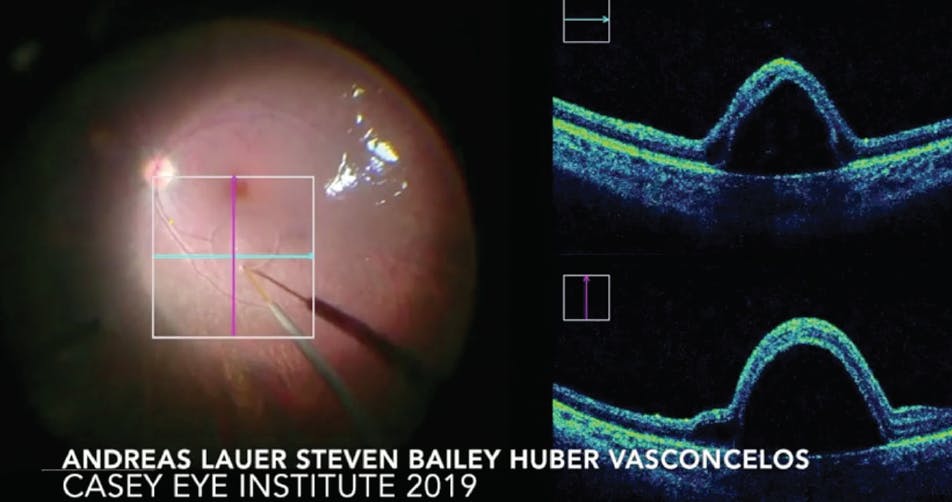
Figure. During subretinal delivery, intraoperative OCT can help the surgeon place the needle properly when creating the bleb and titrate the speed of delivery.
Image courtesy of Andreas Lauer, MD; Steven Bailey, MD; and Huber Vasconcelos, MD
It’s also helpful when monitoring for foveal inversion. The fovea is usually concave and, if the injection is going a bit too fast, the fovea inverts. In that event, intraoperative OCT helps the surgeon titrate the speed of delivery. So intraoperative OCT is a useful tool, as it helps refine the surgery and reduces the risk of complication.
DR. HO: WHAT ARE SOME OF THE OTHER GENE THERAPIES IN THE PIPELINE FOR PATIENTS WITH IRDS?
Jacque L. Duncan, MD: There are more than 30 clinical trials in the works, including gene replacement trials for conditions such as RPGR-associated X-linked retinitis pigmentosa (RP), choroideremia, and achromatopsia associated with CNGA3 and CNGB3. There are clinical trials under way for CEP290, a common cause of LCA or early onset retinal degeneration, and for USH2A, a common cause of either Usher syndrome type 2 or autosomal recessive RP.
There are many others in the planning stages, and innovative approaches are being used for genes that are too big to fit within the AAV delivery virus used with the RPE65 gene. There are ways of skipping over certain mutations with fragments of RNA called antisense oligonucleotides.
Exciting advances are happening with CRISPR-Cas9 for patients with certain CEP290 mutations, and this is the first time CRISPR-Cas9 is being delivered to modify DNA in situ.
For patients who don’t know their genetic mutation, there are also mutation-independent treatments (eg, antioxidants, neurotrophic factors, or the delivery of stem cells) being developed that are meant to prolong the survival of photoreceptors and improve vision.
For patients with advanced vision loss, there are trials using optogenetics, prosthetics, and stem cells. There’s a lot in development, and there will be even more in the future.
DR. HO: WHAT ARE THE MOST PROMISING STRATEGIES FOR SPECIFIC DISEASES?
Dr. Cideciyan: If the goal of the therapy is to improve vision, IRDs with the greatest promise are those in which patients have lots of photoreceptors and relatively little visual function. For those patients, we can try to molecularly intervene to improve function. One gene therapy target showing promise is the CEP290 form of LCA. Another similar disease is retinal ciliopathy with NPHP5 mutations that cause LCA. Fascinating results were shown in a canine model, and human therapies are hopefully on the horizon.
But if the goal of the treatment is to arrest photoreceptor degeneration and stop the loss of vision, then IRDs with a steady but slow progression have the greatest promise, such as the RP class of diseases.
What I find most challenging is the dual goal of simultaneously improving vision and slowing progression. For example, we recently evaluated autosomal-dominant RP patients and, to our surprise, there was not only the expected progression but also an unexpected level of dysfunction. This means that successful gene-specific interventions might be those able to improve vision in the short term and arrest progression in the long term.
Dr. Ho: Gene therapies have come a long way since they came to a standstill in 1999 at the University of Pennsylvania with Jesse Gelsinger, an 18-year-old patient who underwent systemic infusion of a gene replacement for ornithine transcarbamylase deficiency that caused a fulminant systemic inflammation and led to his death. We are still seeing some issues of inflammation.
DR. HO: HOW SHOULD WE BE HANDLING INFLAMMATION IN PATIENTS RECEIVING GENE THERAPY?
Dr. Pennesi: Inflammation is a crucial topic, and we have seen inflammation in almost every gene therapy program to some extent. The best way to treat inflammation is to prevent it from happening, and we are strong proponents of prophylactic steroids, often both oral and topical. But we need more basic science studies to understand what is causing the inflammation. There’s still debate as to what components of the vector bring about an inflammatory response and why some patients have no response whereas others show robust responses.
DR. HO: GIVEN THE RISK OF INFLAMMATION, HOW LONG SHOULD WE FOLLOW PATIENTS FOR EFFICACY AND SAFETY PARAMETERS?
Dr. Cideciyan: If there is inflammation, it often presents within the first month; however, any of the effects that could potentially change the rate of degeneration long term might not be apparent for years. In IRDs, neurons die slowly, and we can look at the death rate with adaptive optics or OCT and determine over many years whether the rate of change of photoreceptor loss is changing due to treatment. In the RPE65 trial, we monitored patients for more than 3 years and determined that there was neither arrest nor acceleration of photoreceptor loss. Thus, areas that showed clear treatment effect degenerated at the same rate as the natural history. With this kind of approach, we should be following patients for 2 to 5 years, minimum, in all clinical trials.
DR. HO: WHAT CHALLENGES ARE LIMITING THE DEVELOPMENT OF GENE THERAPIES FOR IRD PATIENTS?
Dr. Duncan: Myriad genetic mutations can cause retinal degeneration, many of which aren’t very common. Thus, it’s not necessarily feasible for a company to develop a gene-specific treatment for every gene that can cause disease in small numbers of patients.
Other challenges include how to deliver the therapy without causing inflammation or potentially detaching the retina. The photoreceptors may be so delicate that even detaching them for a short period of time with subretinal delivery may not be safe. Still, giving the therapy intravitreally may cause more inflammation and complications.
It’s hard to know for sure exactly what’s happening until you monitor for a long time, and that has been a significant challenge, leading us to develop more sensitive outcome measures to monitor how photoreceptors are faring, both functionally and structurally.
The field is rallying around the fact that we’ve seen some success. The RPE65 story has inspired a lot of interest in the field and motivated people to work collaboratively, so that we can identify greater numbers of patients who might benefit from these types of therapies and participate in trials. We’ve learned a tremendous amount about the genetic causes of disease, yet 30% to 40% of patients still don’t know what genes are to blame for their IRDs.
DR. HO: IS THERE AN IDEAL WAY TO ORDER A MOLECULAR TEST TO BETTER IDENTIFY THESE PATIENTS?
Dr. Nagiel: There are many options now, including free tests, and it can be challenging to know which one to choose. They aren’t the same, and the panels are constantly changing. For example, the free ID Your IRD panel (Invitae) omits the RPGR gene and mitochondrial genes, whereas those genes are included in the free Foundation Fighting Blindness My Retina Tracker program. The ID Your IRD panel does include some rare IRD genes and genes for albinism not included in others. One might think whole exome sequencing would provide complete coverage, but sometimes this strategy can miss large deletions and duplications and deep intronic variants.
Thus, you can choose whichever large panel you prefer, but you should know the limitations of the tests in the context of your patient’s findings. For example, if you’re concerned about X-linked RP, you may not want to go with the ID Your IRD program.
Dr. Pennesi: Genetic testing is a snapshot in time, and it’s a probability. I always explain to my patients that it’s like fishing. If you don’t catch a fish, that doesn’t mean there aren’t fish in the pond. It means that you didn’t catch a fish. A negative result from genetic testing is not necessarily meaningful, especially if it was done several years ago. It might be worthwhile to test again because the technology continues to improve.
Dr. Duncan: I recently saw a young patient who used ID Your IRD and was told he had no mutations. However, it certainly looks like he has X-linked RP, so we have been working with the company to test only the RPGR gene. And never underestimate the value of working with genetic counselors, because they understand the nuances of how to interpret the variants of uncertain significance.
Continuing to monitor patients and remaining in contact with them is very valuable. It can be demoralizing for them to get an inconclusive result, and it’s not unrealistic to suggest to them that the result could be different in the future.
Dr. Ho: Gene therapy is science fact right now, not science fiction. But it’s not a reality for enough people, and this whole ecosystem of collaboration among organizations, surgeons, translational scientists, investors, and industry is a model for other afflictions beyond vision. Your leadership and careful approaches are much appreciated.
1. Gange WS, Sisk RA, Besirli CG, et al. Perifoveal chorioretinal atrophy after subretinal voretigene neparvovec-rzyl for RPE65-mediated Leber congenital amaurosis. Ophthalmol Retina. 2021;S2468-6530(21):00106-8.


_1784132761.jpg?auto=compress,format&w=75)





