


Uveal melanoma is a life-threatening condition leading to systemic metastasis in approximately 25% to 40% of patients by 10 years.1,2 Metastatic disease most often occurs in the liver (89%), followed by lung (29%), bone (17%), and skin (12%).3 In the past, certain clinical and pathologic features of melanoma were shown to be predictive of metastasis, including large tumor size, ciliary body location, diffuse configuration, and histopathologic factors (Figure). More recently, genetic markers have helped to predict prognosis.4
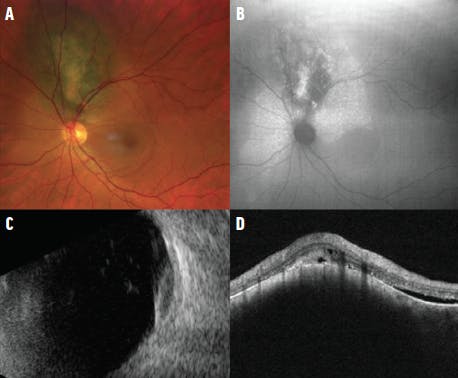
Figure. Fundus imaging shows choroidal melanoma superior to the optic disc in a 49-year-old woman (A). Fundus autofluorescence demonstrates orange pigment in the central part of the tumor (B). B-scan ultrasonography shows characteristic acoustic hollowness (C). OCT overlying the tumor depicts serous retinal detachment (D). This patient had a fine needle aspiration biopsy at the time of plaque radiotherapy for genetic testing, and results came in as chromosome disomy 3, 6, and 8, consistent with TCGA Group A. This low-risk cytogenetic profile suggests a 6% risk for metastasis at 10 years.
The Cancer Genome Atlas (TCGA) is an international project conceived by the US National Cancer Institute and the National Human Genome Research Institute for the investigation of various mutations in different types of cancers.5-7 This team studied 33 human tumors, including uveal melanoma, and profiled them by DNA, RNA, and protein and epigenetic alterations.
UVEAL MELANOMA CLASSIFIED
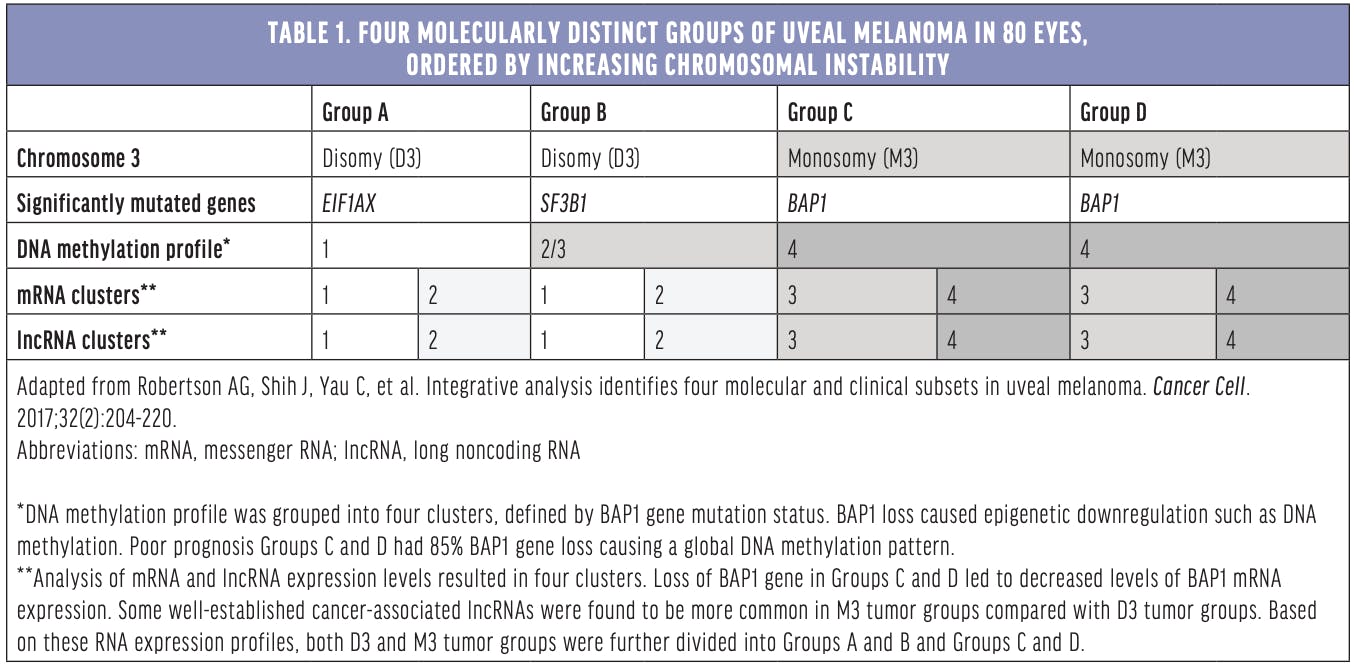
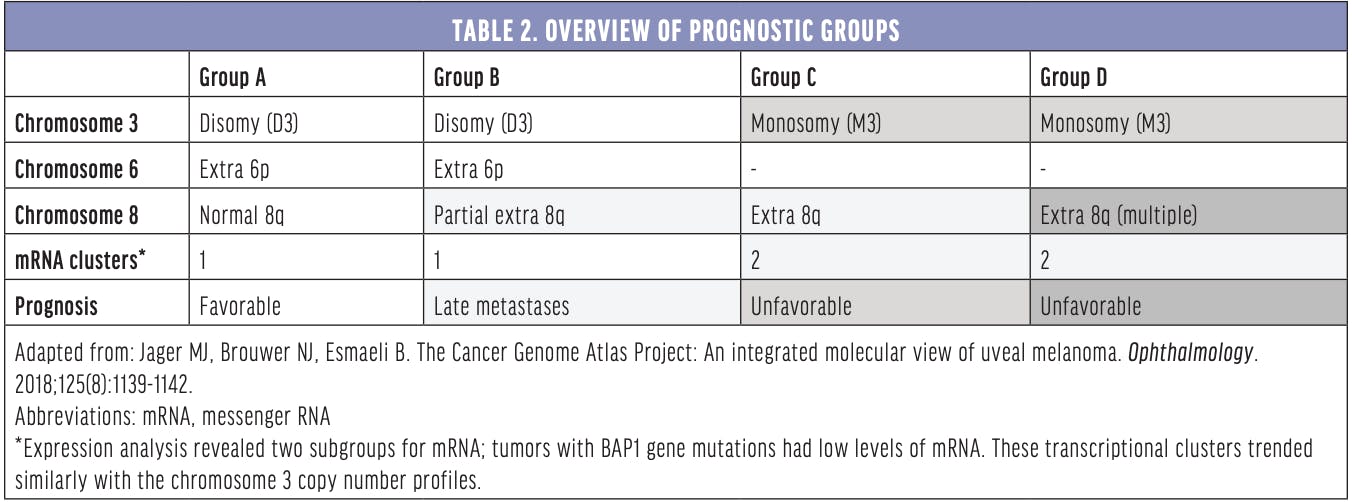
TCGA was used to evaluate a relatively small cohort of 80 eyes with uveal melanoma at the US National Institutes of Health (NIH). The multiplatform analysis, using chromosome copy number alterations, DNA methylation status, RNA expression, protein translation, and immune markers, provided a basic four-group classification (Table 1).4 Subsequently, a simplified, or practical, form of this classification, based on DNA alterations alone, allowed researchers to categorize uveal melanoma into four prognostic groups (Table 2): Group A (chromosome 3 disomy, chromosome 8 disomy), Group B (chromosome 3 disomy, chromosome 8q gain), Group C (chromosome 3 monosomy), and Group D (chromosome 3 monosomy, chromosome 8q multiple gain).8
UVEAL MELANOMA OUTCOMES
In 2019, our team published a validation of the practical TCGA classification of uveal melanoma in 658 consecutive cases. All patients had genetic testing of the tumor for chromosomes 3 and 8.9 The study data revealed that prognosis directly correlated with TCGA group, and the 5-year rate of metastasis increased significantly (P < .001) for each group: 4% for Group A, 20% for Group B, 33% for Group C, and 63% for Group D. Thus, TCGA was highly predictive of metastatic risk in this large cohort.9
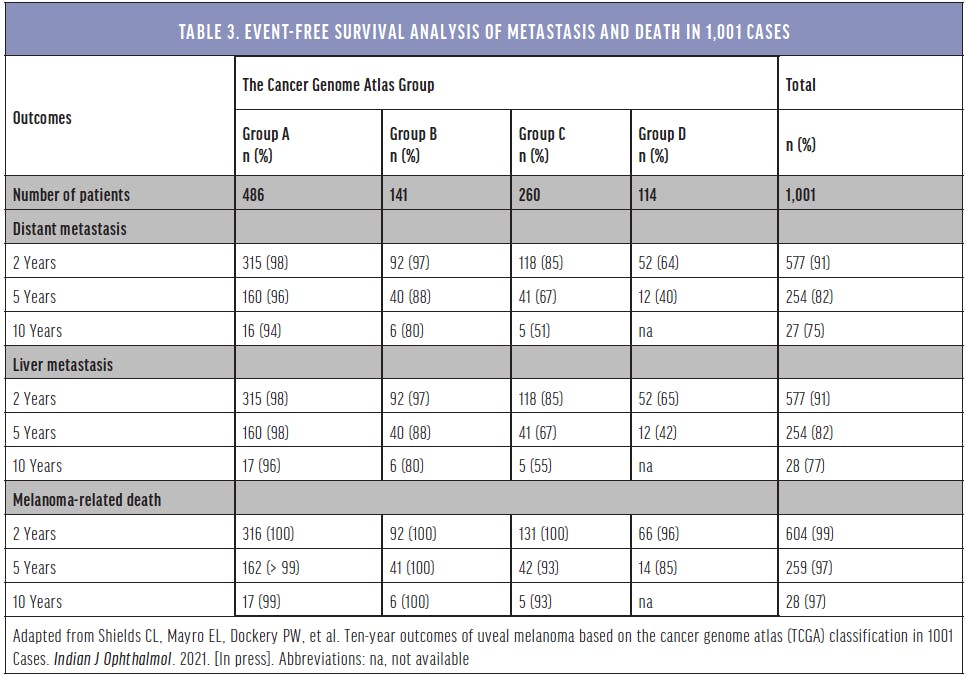
More recently, we explored 5- and 10-year outcomes following treatment of uveal melanoma using TCGA classification in a cohort of 1,001 eyes with uveal melanoma treated with plaque radiotherapy or enucleation over a 22-year period (Table 3).10 Outcomes for melanoma-related metastasis and death by Kaplan-Meier analysis demonstrated that the cumulative percentage of distant metastasis significantly increased based on TCGA group (P < .001): 3%, 9%, 20%, and 46%, for Groups A, B, C, and D, respectively. Findings also revealed shorter mean time to distant metastasis (37.4, 38.7, 27.7, and 21.5 months, respectively, P = .009) and higher percentage of melanoma-related death (< 1%, 0%, 2%, and 7%, respectively, P = .003) at date last seen.10 Kaplan-Meier analysis showed that advanced TCGA groups were associated with a higher risk for distant metastasis at 5 years (4%, 12%, 33%, and 60%, respectively) and at 10 years (6%, 20%, 49%, and not available, respectively).10
CONDITIONAL SURVIVAL
Current survival models estimate a patient’s outcome from a single static time point, usually the date of presentation. However, survival probabilities can change over time. A dynamic evaluation of survival, called conditional survival, is based on survival per an interval of time. This time-dependent statistical information can help guide counseling and decision-making.
Merrill et al evaluated conditional survival in an impressive cohort of 1,151,496 cancer patients from the Surveillance, Epidemiology, and End Results (SEER) registry and showed that, for patients who lived to 5 years, conditional survival probability exceeded 90% for several cancers, including prostate cancer, melanoma, breast cancer, uterine cancer, bladder cancer, Hodgkin lymphoma, rectal cancer, colon cancer, ovarian cancer, and pancreatic cancer.11
In 2020, Zabor et al evaluated metastasis-free survival in 6,863 patients with uveal melanoma and found that nonconditional survival rate was 80% at 5 years, but conditional survival changed.12 For patients surviving 1, 2, 3, and 4 years, for example, the conditional survival rates at 5 years increased to 82%, 87%, 92%, and 96%, respectively. The 10-year nonconditional survival rate was 69%, whereas the conditional survival rate 5, 6, 7, 8, and 9 years after initial diagnosis increased to 87%, 90%, 93%, 96%, and 98%, respectively.12
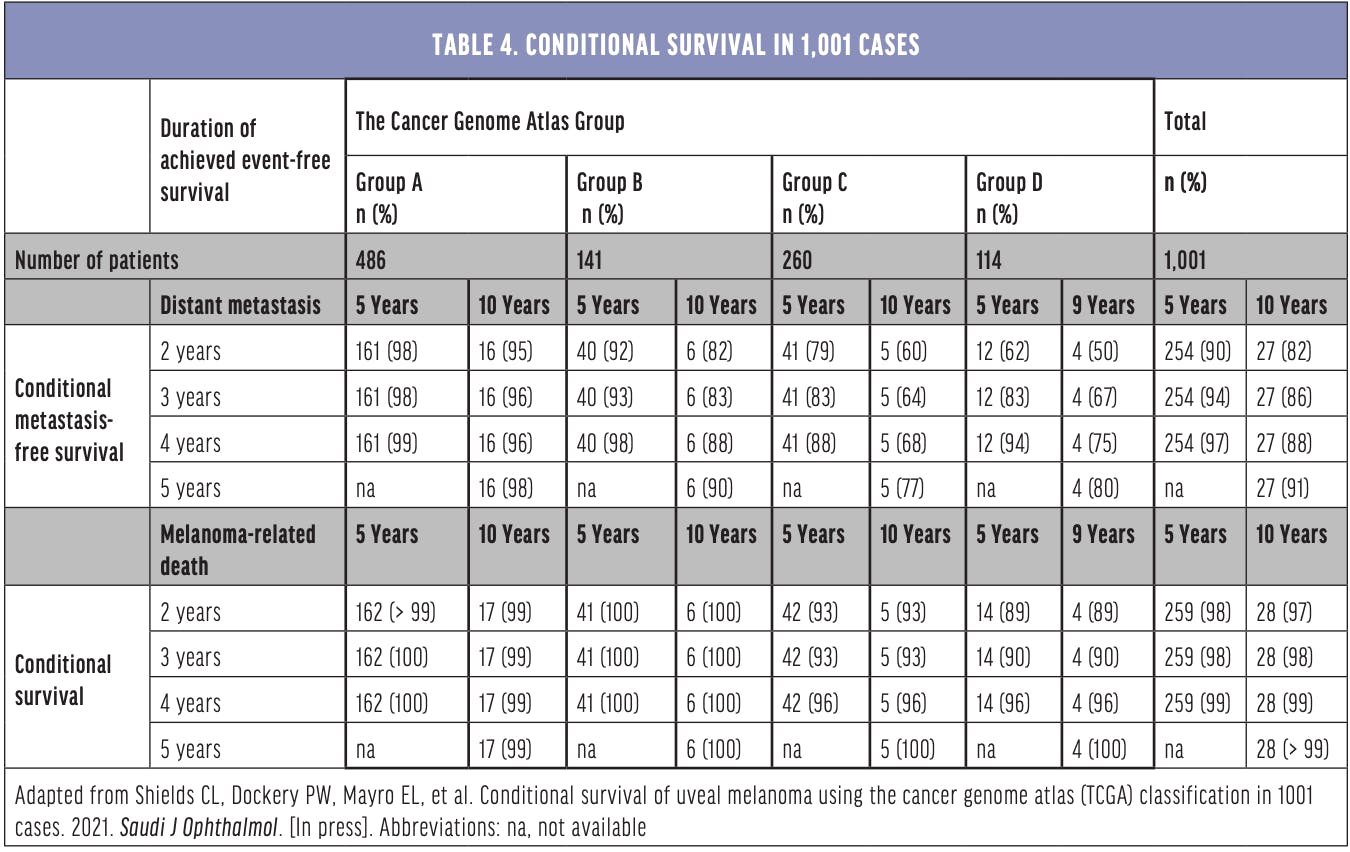
We used TCGA classification to explore metastatic risk based on conditional analysis (Table 4).13 We found that patients who survive 5 years with treated uveal melanoma without metastasis showed dramatic reductions in conditional risk for metastasis for Group A (6% at date first seen vs 2% at 5 years), Group B (20% at date first seen vs 10% at 5 years), Group C (49% at date first seen vs 23% at 5 years), and Group D (68% at date first seen vs 20% at 5 years).13 This suggests that longer survival without metastasis could correlate with an evolving reduction in metastatic risk—an important message to convey to long-term patients. The practical TCGA classification successfully predicted both nonconditional and conditional risk for melanoma-related metastasis and death over time.
CAN WE PREVENT METASTASIS?
Now that we can identify patients at high risk for metastasis, should we treat them with adjuvant chemotherapy to prevent metastasis? Only a few drugs are available that might be beneficial, including tyrosine kinase inhibitors (TKIs), dendritic cell vaccination, and monoclonal T-cell receptors.14-16
Sunitinib (Sutent, Pfizer) is an oral TKI that blocks multiple tyrosine kinases including C-kit proto-oncogene, VEGF, and platelet-derived growth factor receptors and can serve as an antitumor and antiangiogenic molecule.14 Valsecchi et al evaluated 128 patients with high-risk uveal melanoma, 54 of whom received adjuvant sunitinib and 74 of whom served as controls.14 Low-dose adjuvant sunitinib for 6 months was associated with longer survival time, especially notable in patients 60 years or younger.14
Another new class of drugs, immune-mobilizing monoclonal T-cell receptors against cancer (ImmTAC) are being investigated for the treatment of uveal melanoma. Tebentafusp (Immunocore) is the first ImmTAC molecule, a fusion protein engineered to direct cytotoxic T cells toward tumor cells expressing melanocyte lineage-specific antigen, inducing apoptosis.15 Middleton et al evaluated 84 patients with metastatic skin and uveal melanoma and showed that survival with tebentafusp was 65% at 1 year with metastatic melanoma.15
FINAL THOUGHTS
TCGA classification provides excellent prognostication in uveal melanoma and is highly predictive in estimating metastatic risk. Furthermore, encouraging data on conditional survival suggest that once a patient reaches a 5-year threshold without evident metastasis, the rate of future metastasis likely decreases. For patients in the high-risk TCGA Groups C and D, perhaps adjuvant therapies could play a role in reducing risk for metastasis.
Support provided in part by the Eye Tumor Research Foundation, Philadelphia (CLS). The funders had no role in the design and conduct of the study, in the collection, analysis, and interpretation of the data, and in the preparation, review or approval of the manuscript. Carol L. Shields, MD, has had full access to all the data in the study and takes responsibility for the integrity of the data and the accuracy of the data analysis. No conflicting relationship exists for any author.
1. Kujala E, Mäkitie T, Kivelä T. Very long-term prognosis of patients with malignant uveal melanoma. Invest Ophthalmol Vis Sci. 2003;44(11):4651-4659.
2. Shields CL, Furuta M, Thangappan A, et al. Metastasis of uveal melanoma millimeter-by-millimeter in 8033 consecutive eyes. Arch Ophthalmol. 2009;127(8):989-998.
3. Diener-West M, Reynolds SM, Agugliaro DJ, et al. Collaborative Ocular Melanoma Study Group. Development of metastatic disease after enrollment in the COMS trials for treatment of choroidal melanoma: Collaborative Ocular Melanoma Study Group Report No. 26. Arch Ophthalmol. 2005;123(12):1639-1643.
4. Robertson AG, Shih J, Yau C, et al. Integrative analysis identifies four molecular and clinical subsets in uveal melanoma. Cancer Cell. 2017;32(2):204-220.
5. Weinstein JN, Collisson EA, Mills GB, et al. Cancer Genome Atlas Research Network: The cancer genome atlas pan-cancer analysis project. Nat Genet. 2013;45(10):1113-1120.
6. McLendon R, Friedman A, Bigner D, et al. Cancer Genome Atlas Research Network. Comprehensive genomic characterization defines human glioblastoma genes and core pathways. Nature. 2008;455(7216):1061-1068.
7. Hoadley KA, Yau C, Hinoue T, et al. Cell-of-origin patterns dominate the molecular classification of 10,000 tumors from 33 types of cancer. Cell. 2018;173(2):291-304.
8. Jager MJ, Brouwer NJ, Esmaeli B. The Cancer Genome Atlas Project: An integrated molecular view of uveal melanoma. Ophthalmology. 2018;125(8):1139-1142.
9. Vichitvejpaisal P, Dalvin LA, Mazloumi M, et al. Genetic analysis of uveal melanoma in 658 patients using the cancer genome atlas classification of uveal melanoma as A, B, C, and D. Ophthalmology. 2019;126(10):1445-1453.
10. Shields CL, Mayro EL, Dockery PW, et al. Ten-year outcomes of uveal melanoma based on the cancer genome atlas (TCGA) classification in 1001 Cases. Indian J Ophthalmol. 2021;69(7):1839-1845.
11. Merrill RM, Hunter BD. Conditional survival among cancer patients in the United States. Oncologist. 2010;15(8):873-882.
12. Zabor EC, Radivoyevitch T, Singh AD, et al. Conditional survival in uveal melanoma. Ophthalmol Retina. 2020;S2468-6530(20):30395-X.
13. Shields CL, Dockery PW, Mayro EL, et al. Conditional survival of uveal melanoma using the cancer genome atlas (TCGA) classification in 1001 cases. Saudi J Ophthalmol. 2021. [In press]
14. Valsecchi ME, Orloff M, Sato R, et al. Adjuvant sunitinib in high-risk patients with uveal melanoma: Comparison with institutional controls. Ophthalmology. 2018;125(2):210-217.
15. Middleton MR, McAlpine C, Woodcock VK, et al. A TCR/Anti-CD3 bispecific fusion protein targeting gp100, potently activated antitumor immune responses in patients with metastatic melanoma. Clin Cancer Res. 2020;26(22):5869-5878.
16. Bol KF, Van Den Bosch T, Schreibelt G, et al. Adjuvant dendritic cell vaccination in high-risk uveal melanoma. Ophthalmology. 2016;123(10):2265-2267.


_1784132761.jpg?auto=compress,format&w=75)





