


A 26-year-old man presented with decreased vision in the left eye. His medical history included panuveitis due to Toxocara retinochoroiditis 1 year prior, which was confirmed by lab testing. At that time, his left eye was successfully treated topically with 1% atropine every 12 hours and 1% prednisolone every 6 hours for 2 weeks followed by a taper. In addition, the patient was prescribed oral albendazole 400 mg twice daily and prednisone 50 mg once daily for 2 weeks followed by a taper.
At presentation to our center, the patient was 1 month post–cataract surgery in the left eye, and VA was 20/20 OD and 20/100 OS. The examination in the right eye was normal. Indirect fundoscopy in the left eye revealed a peripheral granuloma with consolidation and contraction of the lesion to the optic nerve, producing a peripheral elevated mass with retinal folds extending posteriorly. OCT of the macula showed involvement nasally with disruption of the retinal pigment epithelium layer.
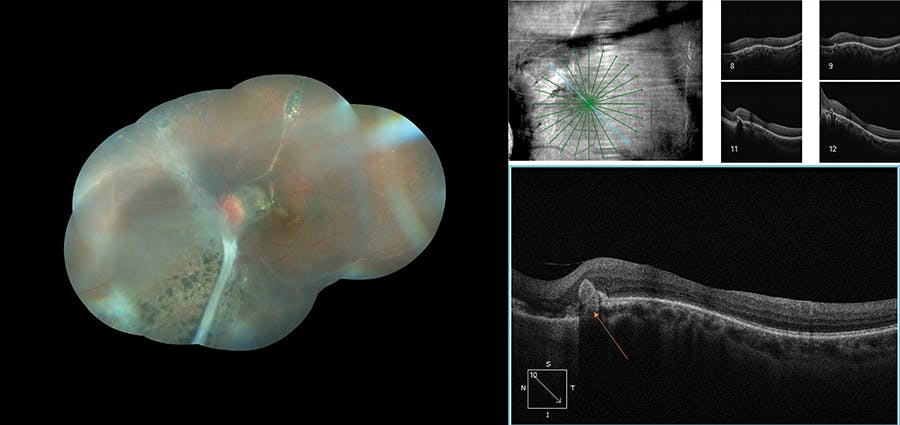
Because the patient was stable with no inflammatory signs in the anterior segment, he was prescribed artificial tears and followed closely.
DISCUSSION
Toxocara retinochoroiditis is usually diagnosed with a patient history of dog or cat exposure and clinical findings such as unilateral progressive vision loss, floaters, leukocoria, and fundoscopy findings of peripheral granuloma (20%-40%), central posterior granuloma (25%-46%), and chronic endophthalmitis (25%).1 Diagnosis is confirmed by laboratory testing.
If you have an image or images you would like to share, email Dr. Nagpal.
Note: Photos should be 400 dpi or higher and at least 10 inches wide.
1. Pivetti-Pezzi P. Ocular toxocariasis. Int J Med Sci. 2009;6(3):129-130.


_1784132761.jpg?auto=compress,format&w=75)





