


The choroid is the most common site for uveal metastasis, and choroidal metastasis is the most common intraocular malignancy. The vast majority of choroidal metastases are a result of primary tumors originating in the breast (40%–53%) or lung (20%–29%).1 Prostate cancer metastasis to the choroid is exceedingly rare, representing approximately 2% of all choroidal metastases.2 Prostate cancer more commonly metastasizes to sites such as bone, lymph nodes, and liver.3
CASE REPORT
A 70-year-old man with a history of metastatic prostate cancer was referred to ocular oncology for evaluation of decreased visual acuity and abnormal findings on fundoscopic examination. The patient’s cancer was initially diagnosed 7 years earlier. At that time, he had mildly elevated prostate-specific antigen (PSA), and a prostate biopsy confirmed a diagnosis of prostatic adenocarcinoma. The patient subsequently underwent a modified radical prostatectomy that revealed poorly differentiated adenocarcinoma involving bilateral lobes with a Gleason score of 4 + 5 = 9. There was also evidence of perineural invasion and a positive left posterior margin.
Given these high-risk features, the patient underwent adjuvant radiation therapy. Despite treatment, his PSA continued to rise, and the patient developed bony metastasis, including to the orbital bone of his right eye. He was treated with hormonal therapy, including leuprolide acetate (Lupron, Abbvie), enzalutamide (Xtandi, Astellas Pharma), and docetaxel (Taxotere, Sanofi-Aventis) without regression of disease.
Seven years after the initial diagnosis, the patient began noticing changes in his vision, including progressively worsening near and distance visual acuity, and he was evaluated by his primary ophthalmologist. His ocular history was significant for a retinal detachment in the left eye several years earlier that was treated with a scleral buckle. Ocular examination revealed VA of 20/60 OD and 20/40 OS with normal IOPs.
OCT of the maculae revealed bilateral choroidal masses with overlying subretinal fluid. Fundus photography demonstrated hypopigmented lesions in the macula bilaterally (Figure 1). Fluorescein angiography (FA) of the right eye demonstrated an area of hypofluorescence involving the fovea and temporal macula (Figure 2A). FA of the left eye demonstrated speckled hyperfluorescence in the temporal macula (Figure 2B).
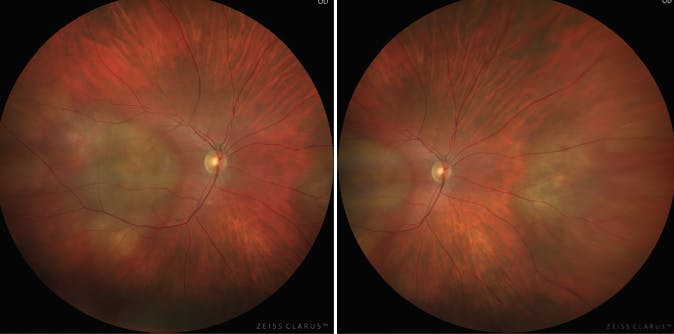
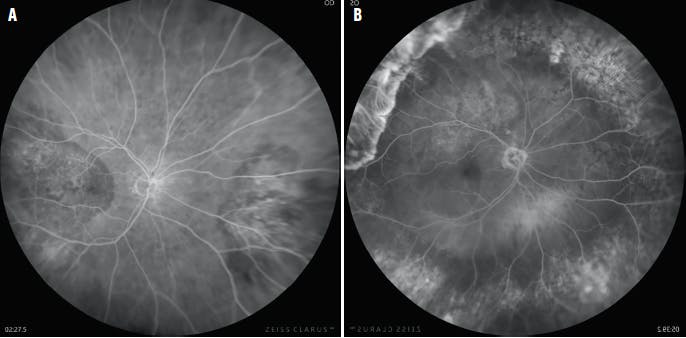
Figure 2. FA of the right eye (A) revealed an area of hypofluorescence involving the fovea and temporal macula, while the left eye (B) had speckled hyperfluorescence in the temporal macula.
The patient was diagnosed with bilateral choroidal metastases and referred to ocular oncology. Ocular oncology confirmed the diagnosis of choroidal metastasis with repeat fundus photos and FA demonstrating large amelanotic posterior pole lesions bilaterally.
Radiation oncology was consulted to create a plan for palliative external beam radiation therapy (EBRT) to prevent further vision loss. The patient received a total dose of 30 Gy in 10 fractions over the course of 14 days, and his visual symptoms began to improve. Three weeks after treatment, his VA had improved to 20/30 OD and 20/40 OS.
DISCUSSION
Prostate cancer is a common malignancy in men that often metastasizes to the bones, lymph nodes, lungs, and axial skeleton. Rarely, prostate cancer metastasizes to the choroid.2 When it does, it is typically unilateral—not bilateral as seen in this case. Metastasis from prostate cancer typically presents as yellow-colored amelanotic lesions. Subretinal fluid and retinal epithelial mottling are typical.
Treatment for choroidal metastasis secondary to prostate cancer typically consists of hormonal therapy or EBRT.4-6 Hormonal therapy includes antiandrogens or luteinizing hormone-releasing hormone agonists. Current literature suggests that EBRT is an effective treatment modality, especially for those who have not responded to hormonal therapy, as seen in this case.
1. Mathis T, Jardel P, Loria O, et al. New concepts in the diagnosis and management of choroidal metastases. Prog Retin Eye Res. 2019;68:144-176.
2. Shields CL, Welch RJ, Malik K, et al. Uveal metastasis: clinical features and survival outcome of 2214 tumors in 1111 patients based on primary tumor origin. Middle East Afr J Ophthalmol. 2018;25(2):81-90.
3. Gandaglia G, Abdollah F, Schiffmann J, et al. Distribution of metastatic sites in patients with prostate cancer: A population-based analysis. Prostate. 2014;74(2):210-216.
4. Barbon JJ, Gonzalez-Tuero J, Gay LL, Perez- Garcia FJ, Sampedro A. Regression of a choroidal metastasis from prostate adenocarcinoma after hormonal therapy. Arch Soc Esp Oftalmol. 2007;82(11):715–717.
5. Albadainah F, Khader J, Salah S, Salem A. Choroidal metastasis secondary to prostatic adenocarcinoma: case report and review of literature. Hematol Oncol Stem Cell Ther. 2015;8(1):34-37.
6. Kapur S, Xiao H. Extraconal orbital soft tissue metastasis secondary to prostate cancer: an unusual presentation. World J Oncol. 2014;5(3):139-143.


_1784132761.jpg?auto=compress,format&w=75)





