


Rhegmatogenous retinal detachment is a sight-threatening condition and one of the most common surgical problems encountered by vitreoretinal surgeons. Although each surgeon’s specific technique may vary, the fundamental strategy for repair should always include the following:
- Finding all retinal breaks by careful intraoperative examination;
- Sealing the breaks with retinopexy, either cryo or laser; and
- Plugging the breaks with tamponade, internal (gas/oil) and/or external (scleral buckle).
The three techniques that incorporate each of these steps are often classified by their approach to tamponade: an internal approach with (1) pars plana vitrectomy (PPV) or (2) pneumatic retinopexy, and an external approach with (3) scleral buckle, which may be combined with PPV.
Scleral buckling, first described in 1949, predates PPV, first performed in 1971.1,2 Today, vitrectomy is by far the more popular technique to repair retinal detachments.3 A few reasons for scleral buckling’s decline in popularity include greater operative time and comparative postoperative morbidity, including but not limited to postoperative pain, unpredictable refractive shifts, diplopia, ptosis, and intraocular injury during external fluid drainage.
So, in 2021, why should the vitreoretinal surgeon continue to stock scleral buckling equipment? Because, although vitrectomy has significant versatility, there are some clinical situations in which the scleral buckle, either alone or in combination with PPV, is the superior technique.
VITREOUS STATUS
Retinal breaks leading to detachments can be separated into two main categories: Either the vitreous remains attached, or it is separated from the retina.
When the vitreous is separated from the retina, the detachment’s causative break is typically either a horseshoe flap tear or an operculated hole. When the vitreous is still attached, the causative break is generally either an atrophic hole (often associated with lattice degeneration) or a retinal dialysis, in which the retina has torn at its insertion to the ora serrata, typically due to trauma.
We suggest that this classification of the vitreous should determine the choice of surgical technique, taking precedent over other factors such as lens status. When the vitreous is separated from the retina, the detachment is typically best repaired with PPV, as the vitreous and hyaloid face are easy to remove. Note that this does not necessarily mean a complete stage 4 posterior vitreous detachment (PVD) must be present; for example, an eye with a retinal detachment and a stage 3 PVD in which the vitreous is still adherent to the optic nerve head may still have a flap tear and thus benefit from vitrectomy. In that case, the PVD can simply be completed intraoperatively.
By contrast, if the vitreous is still attached to the retina, a significant disadvantage of vitrectomy is the difficulty in elevating the hyaloid face from the retina. These situations also tend to occur in younger patients, in whom the hyaloid face may be more adherent, increasing the difficulty of complete hyaloid removal even over attached retina. Leaving significant amounts of vitreous or hyaloid may increase the risk of proliferative vitreoretinopathy (PVR) and, ultimately, redetachment and/or poor visual outcome.3 Therefore, scleral buckling is an excellent technique in these cases. A further advantage of a scleral buckle in an eye with a formed vitreous without significant liquefaction is the ability to use the vitreous itself as a biotamponade to plug the breaks. This can obviate the need for external drainage or intraocular gas, thus leading to faster visual recovery.
So, although patient age often correlates with the use of a scleral buckle, this is because the vitreous tends to be attached and not significantly liquefied in younger patients. We do not consider age as an independent factor in the choice of technique, but rather as a surrogate for determining the extent of vitreous liquefaction, which can be difficult to assess clinically (Figure).4
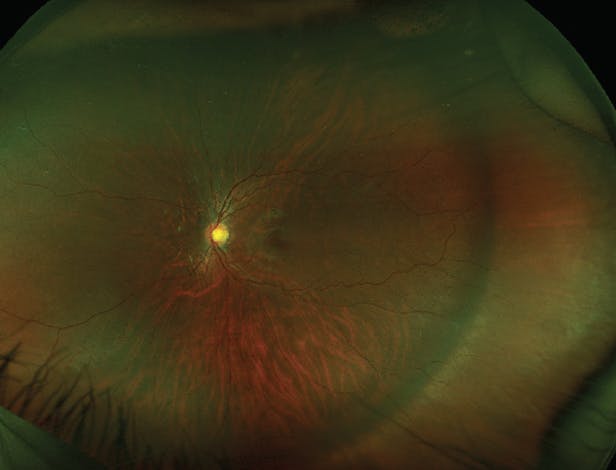
Figure. A 24-year-old woman who had a superior retinal detachment due to lattice with atrophic holes is now status-post scleral buckle.
Figure courtesy of Thomas Wubben, MD, PhD, Kellogg Eye Center
THE PRESENCE OF PVR
Another situation in which a scleral buckle may be beneficial is in eyes with PVR. When PVR occurs, it tends to create anterior traction, which can be difficult to relieve with PPV and membrane peeling alone. When there is at least grade C PVR, we often prefer to perform a combined PPV with scleral buckle, which may obviate the need for potential large, circumferential retinectomies.
A notable exception is in an eye with a rhegmatogenous retinal detachment and attached vitreous, when the PVR is present only subretinally. In that situation, scleral buckling alone may be effective in primary reattachment.5
POSITIONING
Some patients, such as those with severe arthritis or other musculoskeletal disability, may be precluded from the head positioning required for optimal intraocular tamponade. These patients may benefit from a scleral buckle, which does not typically require intraocular tamponade.
LENS STATUS
In the age of minimally invasive, highly effective phacoemulsification, we no longer consider phakic status when devising the surgical strategy for retinal detachments. Although it may be of benefit to the patient to preserve the crystalline lens, and thus accommodation, the first priority is maximizing the chance of primary reattachment of the retina. Therefore, if a patient has a clear crystalline lens but a PVD and flap tear or operculated hole, we typically recommend PPV.
For a pseudophakic retinal detachment, we almost always advocate for PPV, for three reasons:
1. Most pseudophakic retinal detachments have at least partial PVDs, as cataract extraction often changes the vitreous due to mechanical and biochemical factors.6
2. Most pseudophakes have a liquefied vitreous.
3. Pseudophakes can have very small retinal breaks that may be difficult to visualize with indirect ophthalmoscopy, even with optimal dynamic scleral indentation. The higher operative magnification from the surgical microscope, off-axial lighting with the light pipe, and ability to use active vacuum to tent up small breaks can make it easier to identify these very small breaks during vitrectomy.
CONCLUSIONS
The scleral buckle approach to retinal detachment repair is an essential tool in the retinal surgeon’s armamentarium and should remain a foundational component of vitreoretinal surgical fellowship training. Scleral buckles have advantages over vitrectomy such as crystalline lens preservation, earlier visual rehabilitation, and absence of positioning requirements; however, vitreous status is the most important consideration in choosing a scleral buckle technique for primary retinal detachment.
1. Schepens CL. Progress in detachment surgery. Trans Am Acad Ophthalmol Otolaryngol. 1951;55:607-615.
2. Machemer R, Buettner H, Norton EW, Parel JM. Vitrectomy: a pars plana approach. Trans Am Acad Ophthalmol Otolaryngol. 1971;75:813-820.
3. Cowley M, Conway BP, Campochiaro PA, Kaiser D, Gaskin H. Clinical risk factors for proliferative vitreoretinopathy. Arch Ophthalmol. 1989;107(8):1147-1151.
4. Park SW, Lee JJ, Lee JE. Scleral buckling in the management of rhegmatogenous retinal detachment: patient selection and perspectives. Clin Ophthalmol. 2018;12:1605-1615.
5. Ghasemi Falavarjani K, Alemzadeh SA, Modarres M, et al. Scleral buckling surgery for rhegmatogenous retinal detachment with subretinal proliferation. Eye (Lond). 2015;29(4):509-514.
6. Degirmenci C, Afrashi F, Mentes J, Oztas Z, Nalcaci S, Akkin C. Evaluation of posterior vitreous detachment after uneventful phacoemulsification surgery by optical coherence tomography and ultrasonography. Clin Exp Optom. 2017;100(1):49-53.


_1784132761.jpg?auto=compress,format&w=75)





