


AT A GLANCE
- Lean is an operating philosophy that views value from the patient’s eyes, and any part of the patient experience that does not directly contribute to the effective delivery of care is an area for improvement.
- Using the lean philosophy, Austin Retina Associates reduced the distance staff walked by 3.5 miles a day and minimized bottlenecks and flow redundancies.
- A lean architectural design for Retina Specialists of Michigan led to a 15% increase in patient and staff satisfaction, a 30- to 45-minute increase in productivity per clinic, a 50% reduction in staff walking distance, and a 74% reduction in patient wait times.
All retina practices want a healthy staff. But within the hustle and bustle of a busy clinic, many practice owners may not realize that staff members are spending hours of their time simply walking around the clinic, with high patient wait times, low satisfaction, bottlenecks, and low morale as the results.
Five years ago, it became apparent that Austin Retina Associates (ARA) was growing quickly, and with that growth patients were experiencing longer wait times. To overcome this, one of the authors (Stephanie Collins Mangham), brought in FlowOne Lean Consulting to implement lean process improvements and to help increase efficiencies and reduce patient wait times.
After implementing several lean tools such as spaghetti mapping and a waste walk, the leaders at ARA realized that staff members were walking an average of 6 miles a day in the clinic (Figure 1). That translated to approximately 2 hours of pay—just for walking.
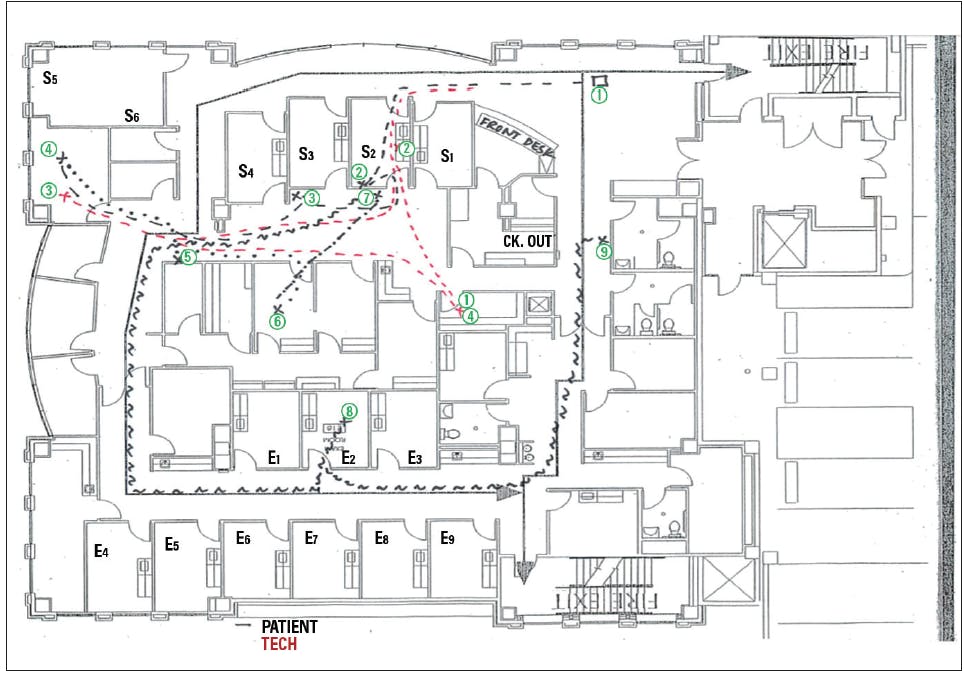
Figure 1. Spaghetti mapping of technician and patient movements revealed a significant amount of time spent traversing the office. The map inspired a new pod system that minimized unnecessary walking.
In an effort to reduce the mileage and increase efficiency, ARA created smaller work areas, or pods, for each physician (Figure 2). Each pod included exam rooms, workup lanes, and diagnostic equipment such as OCT and fluorescein angiography. Each doctor was assigned a core group of technicians who grew to know exactly how that particular physician preferred to run their clinic, which led to further efficiencies that reduced waste.
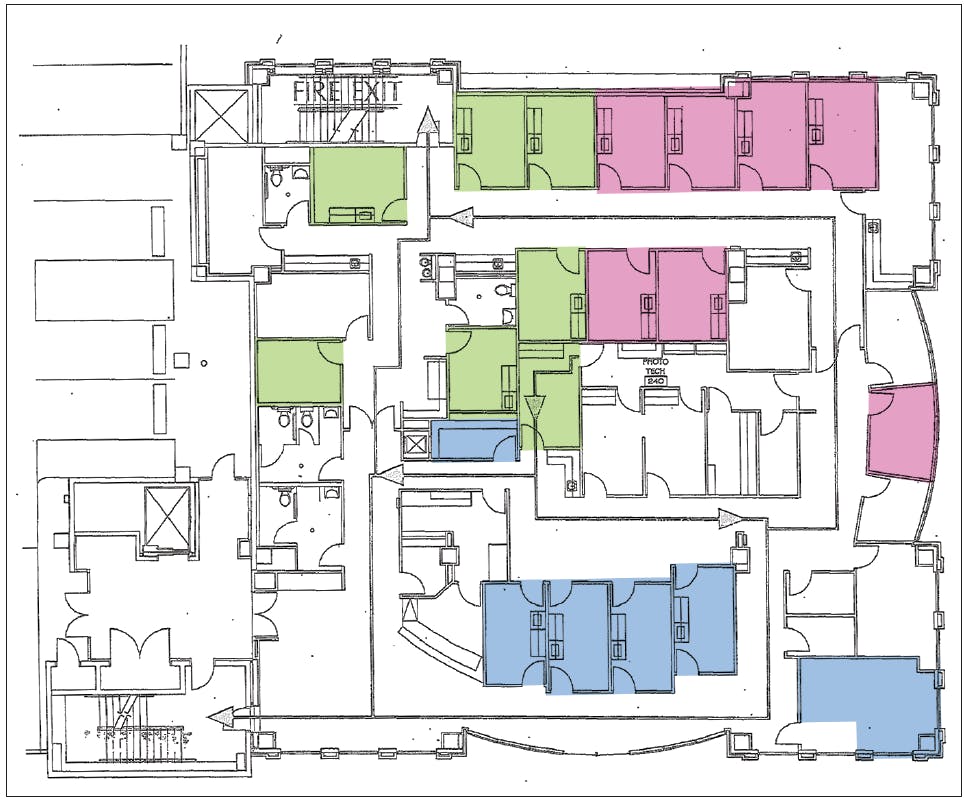
Figure 2. The pods—highlighted in blue, pink, and green—helped to create efficiencies within the office, which cut staff walking time by more than half and improved patient wait times.
Each doctor-team could also test smaller efficiency changes through small-scale trials. If a trial worked, it could be expanded to other doctor-teams to improve the patient experience throughout the practice.
When ARA moved, added equipment, and retrofitted the office into pods, the practice not only reduced the distance staff walked from 10,000 to 3,000 steps each day (a time saving of 70 minutes or 3.5 miles per day), it also reduced bottlenecks and flow redundancies by purchasing more equipment, improving visual lines of communication, and becoming paperless.
Using the lean philosophy, the practice reduced both wait times and visit time by 50% in 3 months. Patients were now spending an average of 55 minutes in the clinic rather than 1 hour and 50 minutes. In addition, patient satisfaction scores jumped from 8 to 9.5 or 10 out of 10, and staff satisfaction went from 6 to 9 out of 10.
Reducing wait times elevated the mood in the practice. Doctors no longer had to apologize to patients throughout the day for the long wait. Patients started complimenting the staff for the kind and efficient care, which elevated the staff’s mood and created a positive clinic environment. Doctors could now stay focused on patient care rather than dealing with negative patient moods resulting from long wait times.
LEAN TOOLS DEFINED
Spaghetti Diagram: A visual representation of the clinic flow, using a continuous colored line, tracing the movement of the patients, the staff, and the physicians in the clinic. The diagram can be drawn on an office floor plan or sketched on a blank piece of paper.
Waste Walk: A clinic flow observation activity, for a planned period of time, to identify real-life examples of seven types of lean wastes in the doctor’s office: motion, transportation, inventory, waiting, defects, over-processing, and over-production.
Lean also resulted in a major culture change; the front-line staff was now empowered to make workflow decisions to increase efficiencies and problem-solve to find solutions. The level of teamwork, collaboration, and increased engagement among the health care personnel changed the culture of the entire practice, which was, and still is, a huge benefit that leadership never anticipated.
ARA no longer uses a top-down approach imposing processes from above because the front-line staff is empowered to make daily decisions and improvements around workflow, as they are closer to the issues that arise in the daily operations in the clinic.
LEAN INTO DESIGN
When the practice leaders at Retina Specialists of Michigan discovered that they had an inefficient workspace, they collaborated with AMDG Architects and FlowOne Lean Consulting to design a new lean facility that addressed the inefficient way patients and staff moved within their old space.
“If you add lean principles when you are shaping a new space in architecture and design, it yields a more powerful solution,” said Peter Baldwin, President of AMDG Architects. “When designing spaces, the challenge is that people tend to ask for the things with which they are familiar. Lean encourages them to think differently so they can gain new insights and implement better solutions and ways of doing things.”
Retina Specialists of Michigan also used staff input throughout the design.
“In many practices, only the physicians and administrative leaders work with the architect to redesign their offices,” Mr. Baldwin said. “That’s a huge mistake. Front-line staff members know more about workflow than anyone else, so you can learn things from them that no one else knows and incorporate the best design solution, as well as get early buy-in from staff members on the new design, which increases morale.”
As a result of the collaboration among the architects, consultants, leadership, and staff members, the clinic saw a 15% increase in patient and staff satisfaction, a 30- to 45-minute increase in productivity per clinic, a 50% reduction in staff walking distance, and a 74% reduction in patient wait times.
SEEING THROUGH A LEAN LENS
Why is lean so effective? This operating philosophy views value from the eyes of the patient, and any part of the experience that does not contribute to the effective delivery of care is an area for improvement. For example, time spent by a physician or other team member consulting with a patient is an added value, whereas time spent looking for supplies or other team members is waste. Ultimately, lean identifies waste and works to create a revised clinic flow that is calm and efficient.
Lean process analysis uses value stream mapping, which analyzes where in the clinic a patient interacts with staff, waits, or moves, and assigns a time to these activities. For example, during a patient visit that took 88 minutes, the process time (value-added time with staff or the physician) might be 41 minutes and the wasted patient time (waiting or moving through the office) might be 47 minutes. Using this information, the practice can reduce or eliminate waste by focusing on the non–value-added moments and identifying opportunities to improve that flow.
To reduce wasted patient wait time, lean design examines factors such as these:
- Front desk efficiencies. Are there potential delay factors at check-in, including whether the front desk staff is moving around to access printers, forms, or other information?
- Supply location. Are supplies located in easy-to-access areas, such as top drawers or wall-mounted shelving, to reduce unnecessary search time?
- Screening and testing processes. Are patients moving back and forth to waiting rooms or the lobby before getting to the physician’s examination room? The whole process can be reengineered for efficiency by using examination and tech rooms interchangeably, so patients don’t need to move unnecessarily.
- Staff location. Are physicians, scribes, and technicians located close to each other for easy communication?
- Patient flow technology. Use of HIPAA-compliant lean software such as eSynchrony (FlowOne Lean Consulting) allows staff members to capture real-time patient visit data and wait times. This facilitates improvement based on unbiased data.
A LEAN ADVOCATE
ARA values lean principles so much, it now employs a full-time lean advocate who deploys lean techniques in all areas of the office, educates new staff members, and assists staff members with metrics and trials to help the practice make continuous improvements.
The biggest benefit ARA has gained from lean is that it has empowered the staff and changed the culture to one that encourages everyone to openly discuss and implement changes together to improve the practice.


