


Mastery of modifiers can lead to clean claims and prompt reimbursement for your practice. The converse is also true: Lack of mastery can lead to trouble. In a review of common denial reasons reported by insurance payers, inappropriate modifiers and a lack of modifiers consistently top the list of reasons for rejections.
There are common scenarios in the retina practice that require consideration of modifier use. Here’s a pop quiz. Can you name the appropriate modifier?
Question: A patient receives focal laser treatment for diabetic macular edema. During the postoperative period, the retina specialist performs an intravitreal injection in the same eye. What modifier should be appended to the CPT code 67028?
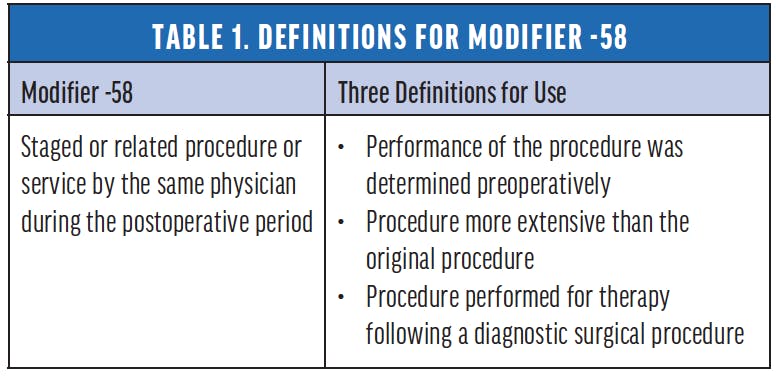
Answer: As outlined in Table 1, modifier -58 has three definitions for use. An injection performed in the global period of a major surgery would meet the definition of therapy following a diagnostic surgical procedure. Submit 67028 -58 and the appropriate eye modifier for this case.
Question: During the global period of panretinal photocoagulation of the left eye for proliferative diabetic retinopathy, the patient presents with complaints of significant visual disturbance in the right eye. The diagnosis is mild nonproliferative diabetic retinopathy with macular edema. Which modifier should be appended to the exam code?
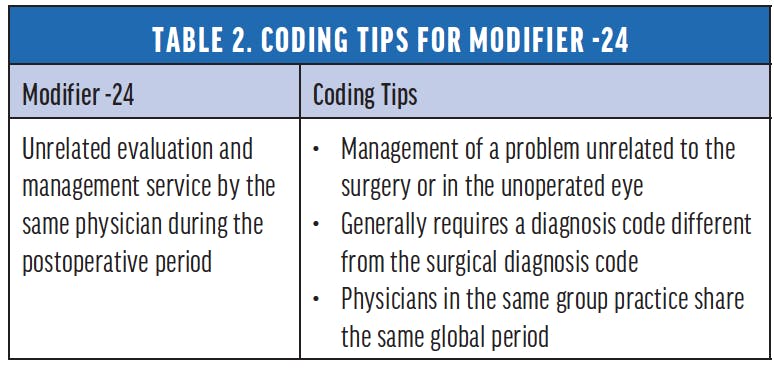
Answer: Bill the appropriate level of Evaluation and Management (E/M) or Eye visit code appended with modifier -24 linked to the ICD-10-CM code for nonproliferative diabetic retinopathy with macular edema, with laterality. This modifier should be used when billing for an unrelated examination in the postoperative period, as in this case when performed in the fellow eye. See Table 2 for more coding tips for modifier -24.
Question: During the global period of cataract surgery in the right eye, the patient is evaluated for and diagnosed with cystoid macular edema. Can the exam be billed with modifier -24?
Answer: If the patient was referred by an outside practice, the retina specialist should bill the examination with no modifier, because this would not be considered postoperative. If referred from within the same practice, the global period applies—and the diagnosis of cystoid macular edema is related to the cataract surgery. In this case, modifier -24 is not appropriate to use, and the office visit is not billable. Any medically necessary testing performed is billable without a modifier.
Question: During the preoperative administration of medication at our ambulatory surgery center, the patient’s blood pressure is extremely elevated. The surgery is then canceled, and the patient is sent to the emergency department. How should the facility and surgeon bill for this case?
Answer: The ambulatory surgery center can bill with the applicable modifier specific for outpatient facilities:
- Modifier -73 when surgery is discontinued before administration of anesthesia.
- Modifier -74 after administration of anesthesia.
- Because the procedure is not initiated, the surgeon has nothing to bill.
Question: An office visit was recently denied by Medicare because the patient is receiving hospice care. What is the correct coding?
Answer: When patients elect hospice coverage, they waive all rights to Medicare Part B payment for professional services related to the treatment and management of their illness while in hospice care. If the reason for the encounter is not related to the illness, append modifier -GW, service unrelated to hospice care.
Question: During an encounter for a Medicare Part B patient accompanied by her son, the son mentions that his mother is residing in a skilled nursing facility (SNF). Fluorescein angiography and fundus photography are performed. How should this be coded?
Answer: When a patient is residing in a SNF, there are three services not covered by Medicare Part B, and the SNF is responsible for payment of the following:
- The technical component of testing services,
- The drugs injected, and
- Postoperative cataract glasses (durable medical equipment).
The retina specialist should bill Medicare for the professional component of the test and should bill the SNF for the technical component of the test. The retina specialist should submit:
- 92235-26 and 92250-26 to Medicare Part B and
- 92235-TC and 92250-TC to the SNF.
Question: During the global period of a complex repair of retinal detachment (CPT code 67113) in the left eye, the patient is taken to the OR for additional surgery for recurrent retinal detachment in the same eye secondary to proliferative vitreoretinopathy in association with a giant tear. What is appropriate coding for the second surgery?
Answer: Modifier -78, unplanned return to the OR by the same physician for a related procedure during the postoperative period is correct. Code as 67113-78-LT.
When modifier -78 is used, the following are true:
- Only the intraoperative portion of the surgery is paid, at 70% of the fee schedule.
- A new postoperative period does not begin; the 90-day postoperative period is completed on the 91st day following the original procedure.
Question: Which modifier should be appended to an exam conducted on the same day as a laser procedure to repair a retinal detachment (CPT code 67105)?
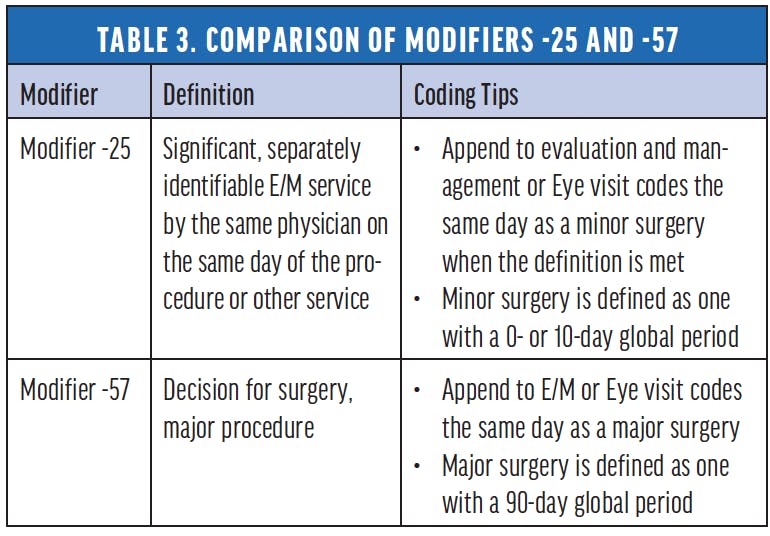
Answer: As of 2017, the global period for CPT code 67105 changed from 90 days to 10 days. Because this is a minor procedure, modifier -25 would be appended to the exam, if the definition for use was met: a significant, separately identifiable E/M service on the same day as a minor surgery. Review your chart documentation and apply this statement: Although it is medically necessary, if the exam is performed solely to confirm the need for the minor procedure, the exam is not separately billable.
If the laser in this example was CPT code 67210, destruction of localized lesion of retina, which has a 90-day global period, modifier -57 would be appended to the exam to indicate the decision for major surgery. See Table 3.
MORE TESTING
Test your coding competence with the AAO’s 100-question Ophthalmic Coding Specialist Retina examination. Unique to retina, the test is available at aao.org/ocs.


