


Cytomegalovirus (CMV) retinitis, caused by a double-stranded DNA virus in the herpesviridae family, is the most common opportunistic ocular infection in patients with advanced AIDS.1 CMV retinitis can occur in the absence of HIV infection, although this is uncommon. The retinitis in these cases is typically associated with relative immunosuppression with systemic corticosteroids, noncorticosteroid immunosuppressive agents, or chemotherapeutics.2 CMV retinitis, in the absence of any systemic or local ocular immunosuppression, is extremely rare.3-5
Here, we present a case of CMV retinitis in a fully immunocompetent patient with significant widespread retinal ischemia in the affected eye.
CASE PRESENTATION
A 71-year-old Black man with a medical history including coronary artery disease, prostate cancer (treated by prostatectomy without chemotherapy or radiation), and quiescent sarcoidosis (off all treatment for 40 years) presented to a retina specialist for evaluation of decreased vision in the right eye for 3 weeks. The patient’s ocular history was significant for cataract surgery with multifocal IOL implantation in both eyes and open-angle glaucoma treated with dorzolamide-timolol (2%/0.5%) and latanoprost (0.005%). He did not have a history of ocular sarcoid.
BCVA at presentation was counting fingers at 2 feet OD and 20/25 OS. IOP was 16 mm Hg in each eye, and a mild afferent pupillary defect was noted in the right eye.
Anterior segment examination of the right eye demonstrated keratic precipitates as well as 1+ cell and 1+ flare in the anterior chamber by Standardization of Uveitis Nomenclature criteria.6 Fundoscopic examination of the right eye was limited due to significant vitreous haze; however, peripheral retinal whitening without any visible intraretinal hemorrhage was present and visible in the inferotemporal quadrant (Figure 1A). A mildly pale, full optic nerve and significant arteriolar attenuation were also noted (Figure 1B).
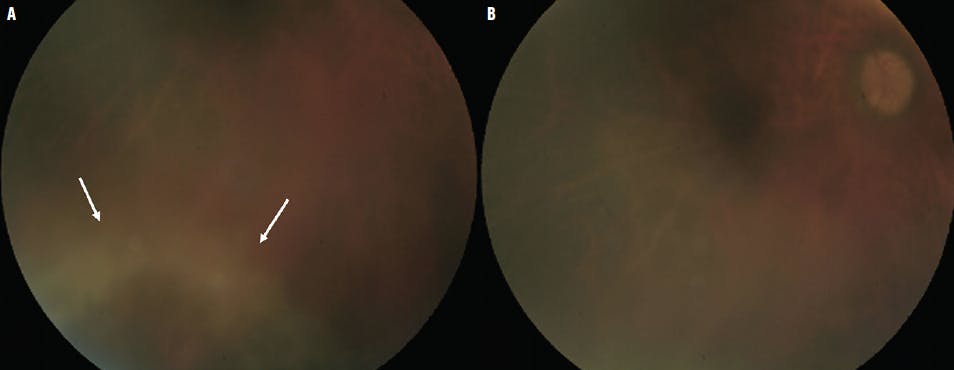
Figure 1. Color fundus photography of the right eye demonstrates peripheral yellow-white lesions (arrows) and retinal hemorrhage (A). A mildly pale, full optic nerve and significant arteriolar attenuation are also noted (B). Vitritis degrades the quality of the images.
Slit-lamp and fundus examination of the left eye showed fullness of the optic nerve head. Fundus autofluorescence showed multifocal hyperautofluorescence of the optic nerve head in each eye, consistent with optic disc drusen (Figure 2). OCT of the macula showed band-like hyperreflectivity in the inner retinal layer and thickening consistent with acute ischemia, similar to findings described in paracentral acute middle maculopathy (Figure 3).7 Fluorescein angiography showed extensive retinal nonperfusion (Figure 4).
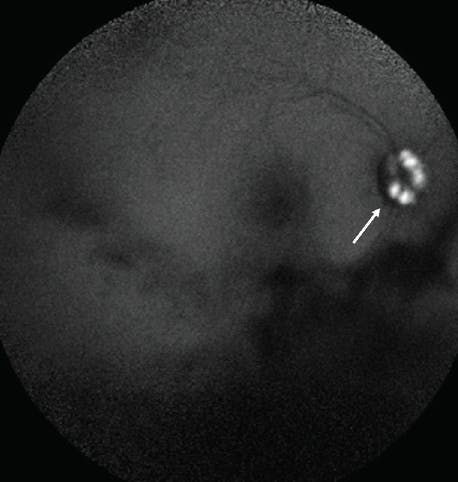
Figure 2. Fundus autofluorescence demonstrates hyperfluorescence of the optic nerve head consistent with optic nerve drusen (arrow).
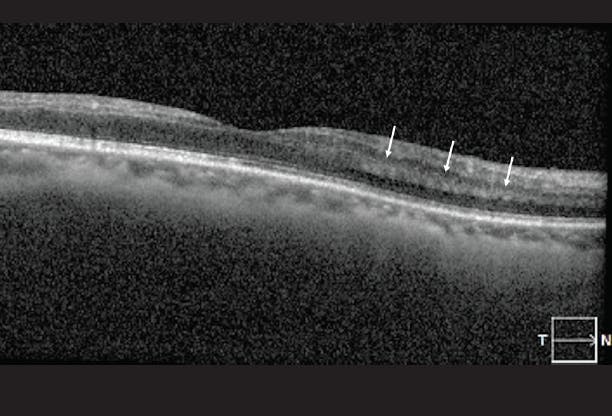
Figure 3. OCT of the right eye demonstrates band-like hyperreflectivity in the inner retinal layer (arrows) consistent with ischemia.
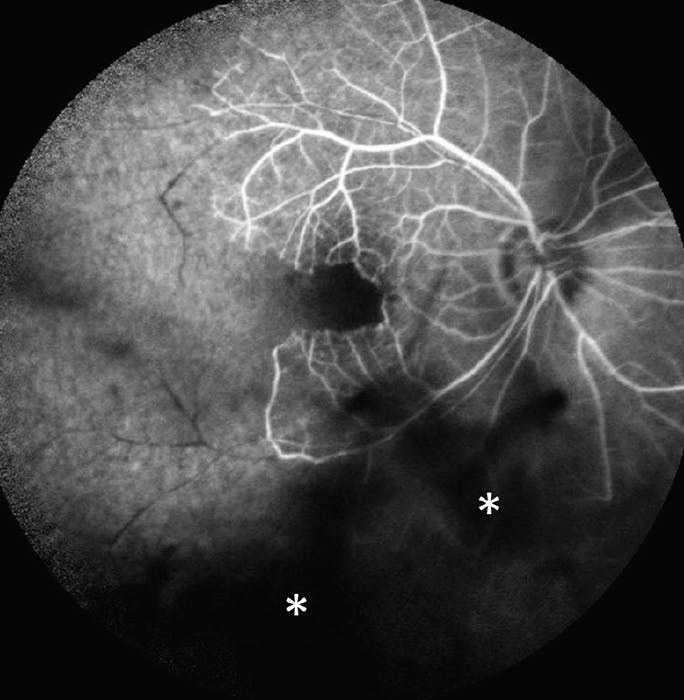
Figure 4. Fluorescein angiography of the right eye demonstrates extensive late-phase peripheral and macular capillary nonperfusion, as well as blocking from vitreous debris (stars).
DIFFERENTIAL DIAGNOSIS AND TREATMENT
The patient underwent diagnostic anterior chamber paracentesis and subsequent intravitreal injection of ganciclovir (4 mg/0.1 mL). Treatment with oral valacyclovir 2 g three times daily and trimethoprim 800 mg/sulfamethoxazole 160 mg twice daily was then initiated.
Aqueous fluid was analyzed via polymerase chain reaction (PCR) for herpes simplex virus 1 and 2, varicella zoster virus, CMV, and Toxoplasma gondii. Serologic testing, including complete blood count with differential, comprehensive metabolic panel, Lyme antibodies, Quantiferon-TB Gold interferon-gamma release assay (Qiagen), rapid plasma reagin, and fluorescent treponemal antibody absorption were unrevealing. Chest radiograph was normal. Qualitative PCR analysis of the aqueous humor for CMV returned positive.
The patient subsequently received four weekly intravitreal injections of ganciclovir and a course of oral valganciclovir 900 mg twice daily for 2 weeks, at which time the dose of oral valganciclovir was reduced to 450 mg twice daily. The patient was also treated with topical prednisolone acetate 1% eye drops four times daily for 2 months, during which time the previously noted anterior chamber inflammation and vitritis improved significantly.
The extensive retinal nonperfusion noted upon initial evaluation persisted. The patient’s vision remains stable at hand motion, with resolution of intraocular inflammation and the associated retinitis.
DISCUSSION
Ocular manifestations of CMV infection in immunocompromised patients have been extensively described. CMV reaches the retina hematogenously and infects the vascular endothelium, subsequently spreading to surrounding retinal cells.1 The ocular examination classically reveals yellow-white retinal lesions beginning in the periphery that follow the vasculature centripetally. Retinal hemorrhage with surrounding whitish granularity is typical. Most patients do not present with vitritis, as they are severely immunosuppressed.
CMV retinitis has been reported in nonimmunosuppressed individuals after administration of local intraocular or periocular corticosteroid injections for other ocular disease; however, ocular CMV infection among patients without immune suppression is extremely rare.3-5
Although our patient had a history of sarcoidosis, he had not received any systemic or local immunosuppressive treatment at the time of his presentation to us or in the several months before presentation.
The extent of retinal ischemia seen in this patient is not typical for CMV retinitis, especially in the absence of widespread retinitis. There have been reports of acute retinal necrosis secondary to CMV with a mixed clinical picture of intraocular inflammation with panretinal occlusive vasculopathy, mostly in immunocompromised patients. One series included five non–HIV-positive patients presenting with granular necrotizing retinitis, vitritis, and severe occlusive vasculopathy.5,8-10
Our patient is likely on the clinical spectrum of those previously reported cases. The presence of optic nerve head drusen may also have predisposed our patient to the development of widespread retinal nonperfusion, as this type of disc change has been associated with decreased perfusion of the optic nerve head.10
CONCLUSION
This case demonstrates the importance of immediate empiric treatment for CMV and continued testing for CMV in aqueous PCR in all patients presenting with retinitis, even those who are immunocompetent.
Authors’ note: Consent to publish this case report was not obtained. This report does not contain any personal information that could lead to the identification of the patient.
1. Port A, Orlin A, Kiss S, Patel S, D’Amico DJ, Gupta MP. Cytomegalovirus retinitis: a review. J Ocul Pharmacol Ther. 2017;33(4):224-234.
2. Gupta S, Vemulakonda G, Suhler E, et al. Cytomegalovirus retinitis in the absence of AIDS. Can J Ophthalmol. 2013;48(2):126-129.
3. Karkhaneh R, Lashay A, Ahmadraji A. Cytomegalovirus retinitis in an immunocompetent patient: A case report. J Curr Ophthalmol. 2016;28(2):93-95.
4. Radwan A, Metzinger J, Hinkle D, Foster C. Cytomegalovirus retinitis in immunocompetent patients: case reports and literature review. Ocul Immunol Inflamm. 2013;21(4):324-328.
5. Schneider EW, Elner SG, van Kuijk FJ, et al. Chronic retinal necrosis: cytomegalovirus necrotizing retinitis associated with panretinal vasculopathy in non-HIV patients. Retina. 2013;33(9):1791-1799.
6. Trusko B, Thorne J, Jabs D, et al. The Standardization of Uveitis Nomenclature (SUN) Project. Development of a clinical evidence base utilizing informatics tools and techniques. Methods Inf Med. 2013;52(3):259-265.
7. Chen X, Rahimy E, Sergott RC, et al. Spectrum of retinal vascular diseases associated with paracentral acute middle maculopathy. Am J Ophthalmol. 2015;160(1):26-34.e1.
8. Pathanapitoon K, Tesavibul N, Choopong P, et al. Clinical manifestations of cytomegalovirus-associated posterior uveitis and panuveitis in patients without human immunodeficiency virus infection. JAMA Ophthalmol. 2013;131(5):638-645.
9. Saran BR, Pomilla PV. Retinal vascular nonperfusion and retinal neovascularization as a consequence of cytomegalovirus retinitis and cryptococcal choroiditis. Retina. 1996;16(6):510-512.
10. Obuchowska I, Ustymowicz A. Blood flow disturbances in the central retinal artery in patients with bilateral optic disc drusen. Sci Rep. 2020;10:1111.


_1784132761.jpg?auto=compress,format&w=75)





