


Elevated IOP is not uncommon after pars plana vitrectomy (PPV), especially in complex cases. Many causes exist, the most common of which are gas mixture– or silicone oil–related IOP elevation, particulate glaucomas, trabeculitis, viscosity glaucoma, and steroid-induced glaucoma. Management varies depending on the underlying etiology.
In Part 1 of this series, we reviewed the management of primary open-angle glaucoma in the retina practice. In this article, we explore the mechanisms of postoperative glaucomas and optimal management approaches.
CAUSES OF POSTOPERATIVE IOP ELEVATION
Perioperative Gas-Related
Elevated IOP in gas-filled eyes after PPV is almost always iatrogenic. The cause is inadvertent or intentional use of a gas concentration greater than the isoexpansive concentration of the gas (25% for SF6 or 18% for C3F8).1 A common mistake is to record the number of cubic centimeters of gas on the surgeon’s preference card or electronic protocol system but fail to calculate the correct gas concentration when a syringe smaller than the usual 60 cubic centimeters is used.
Some surgeons believe that the presence of severe proliferative vitreoretinopathy demands the use of a higher gas concentration. However, no rationale supports this belief. Some surgeons perform total fluid-air exchange followed by estimating the volume of the vitreous cavity (a practice fraught with error) and then injecting 100% SF6 or C3F8. This approach can produce a significantly greater than isoexpansive concentration and high IOP or, conversely, a low gas concentration resulting in a small ineffective gas bubble.
A critical error is caused by prescribing prn pain medications for 1 or more days after surgery using gas. In instances when a gas mixing error is made, the patient calls at night reporting pain, for which the on-call ophthalmologist prescribes medication. However, the pain is secondary to elevated IOP, not to the surgery per se.
In this scenario, the patient takes oral pain medication, which masks the pain. Subsequently, the patient is examined in the office and has no light perception or hand motion vision and a central retinal artery occlusion and/or optic nerve ischemia. This is more likely in vit-buckle patients because they have more postoperative pain, making assessment by the patient or on-call ophthalmologist more challenging.
Intraoperative Silicone Oil-Related
Air–silicone oil exchange can cause overpressurization if one cannula is removed and silicone oil is injected, forcing air back into the console air source. Instead, surgeons should vent the nasal sclerotomy with the supplied vent to hold the valve open. The fill is complete when oil comes out of the vent with the eye rotated and the vent higher than the silicone oil injection cannula.
Injecting too much oil and not checking tactile IOP is another common mistake; oil is incompressible. Glaucoma medications cannot lower IOP that is too high due to the presence of too much silicone oil.
Oil-induced pupillary block in aphakic eyes occurs when the capsule is not completely removed in lensectomy or extracapsular cataract extraction surgery. Capsular fibrosis virtually always closes the inferior peripheral iridectomy needed to enable aqueous to enter the anterior chamber to prevent pupillary block. In these types of lens surgeries, there is no merit to leaving the capsule for subsequent sulcus IOL implantation because it results in epiciliary tissue, hypotony, concave iris, and iridectomy closure via fibrosis.2,3 The presence of iridocapsular adhesions makes subsequent sulcus implantation of an IOL rarely possible.
Particulate Glaucomas
There are several causes of the particulate glaucomas, a term coined by one of us (S.C.). One common etiology is silicone oil emulsification (Figure 1). Silicone oil droplets never absorb; instead, they become embedded in the trabecular meshwork, impeding aqueous outflow, and they often become trapped in the zonules, residual peripheral vitreous, epiretinal membranes, and capsular bag.4
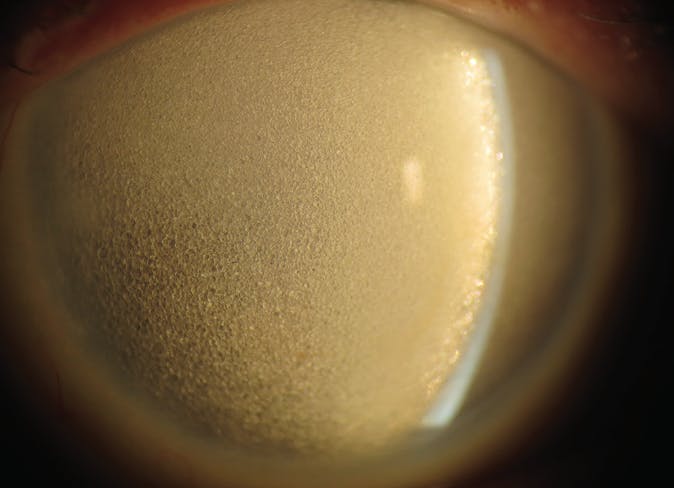
Inflammation reduces interfacial surface tension, causing increased emulsification; thus, many patients require topical steroids for as long as the oil is in the eye. However, long-term topical steroids can induce glaucoma and exacerbate herpes simplex keratitis and other corneal disorders.
Bleeding also reduces interfacial surface tension; hemostasis is crucial in cases with oil but is virtually impossible in diabetic traction retinal detachment cases. An ophthalmic viscoelastic device reduces interfacial surface tension, but viscodissection has fortunately been largely abandoned.5,6 Incomplete silicone oil fill increases the shear angle, thereby increasing emulsification.
Another type of particulate glaucoma, perfluorocarbon liquid (PFCL) droplet-related glaucoma, occurs if medium-term removal of perfluoro-n-octane is inadequate after its use for inferior retinal detachment or nasal, temporal, and inferior giant retinal breaks.7,8 PFCL often becomes trapped in the zonules, residual peripheral vitreous, epiretinal membranes, and capsular bag (Figure 2).
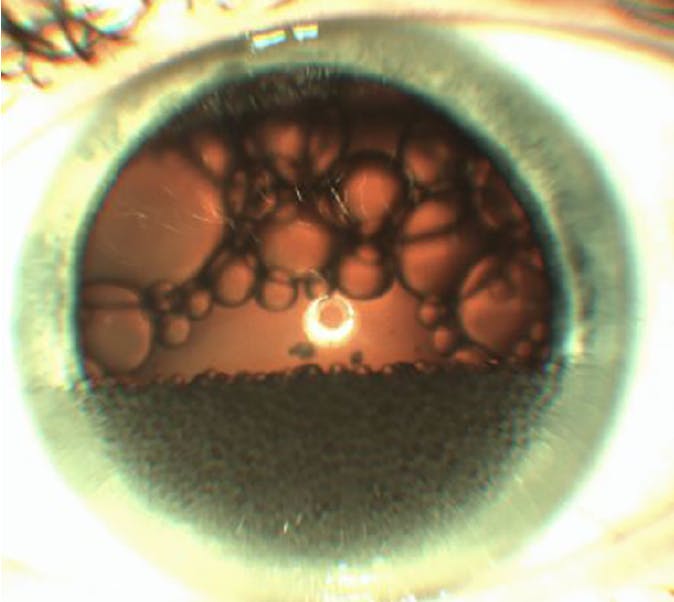
Figure 2. PFCL droplets in the inferior anterior chamber and posterior to the lens before intraoperative removal of medium-term perfluoro-n-octane.
Retained lens particles can become embedded in the trabecular meshwork after lensectomy or complicated phacoemulsification, resulting in particulate glaucoma.9
Finally, erythroclasts (ghost cells) cause particulate glaucoma. This is a good reason to remove as much peripheral vitreous as possible during surgery for dense vitreous hemorrhage, without damaging the peripheral retina or the lens.10
Viscosity Glaucoma
Elevated IOP caused by high protein content in the anterior chamber is known as viscosity glaucoma, another term coined by one of us (S.C.). Increased aqueous humor viscosity is caused by inflammation, anterior segment neovascularization, and retained viscoelastic substances after combined phacoemulsification-vitrectomy.
Inflammation can be caused by iris manipulation, mechanical pupillary dilation, and iris hooks during this type of surgery. Inflammation causes trabeculitis as well, which also reduces outflow.
Use of an ophthalmic viscoelastic device in the anterior chamber is an excellent way to keep silicone oil or gas bubbles out of the anterior chamber in phakic or pseudophakic eyes during vitreoretinal surgery.
Steroid-Induced Glaucoma
This form of glaucoma is delayed days to weeks after vitrectomy. Subconjunctival triamcinolone is more likely to cause elevated IOP than dexamethasone because the duration of the former is greater. Topical difluprednate is associated with a higher rate of steroid-induced glaucoma than prednisolone, but for a 2-week postoperative period it is ideal, unless the patient is a known steroid responder.11
Intravitreal injection of triamcinolone is an excellent technique to enhance vitreous visualization, but care should be taken to remove as much as possible during the vitrectomy.
The dexamethasone intravitreal implant 0.7 mg (Ozurdex, Allergan) should be used with caution in pseudophakic post-PPV eyes and never used in aphakic post-PPV eyes. Injection of the implant in this setting increases the risk of its migration to the anterior chamber, resulting in rapid corneal endothelial damage.12 It is crucial to keep in mind that all patients are steroid responders if the dose is high enough.
Pupillary Block Glaucoma
Aphakic patients managed with iso-expansive gas tamponade must be instructed not to sleep in the supine position to prevent pupillary block glaucoma. Proper positoning is the best approach to manage this complication.
MANAGEMENT APPROACHES
Perioperative Silicone Oil- or Gas-Related
Pars plana tap is the best option to manage perioperative high IOP caused by an excessive oil or gas bubble or higher IOP elevation caused by gas expansion. A 30-gauge needle is ideal for gas, whereas a 23- to 25-gauge needle or cannula inserted with a trocar is required for removal of silicone oil.
Anterior chamber paracentesis causes oil or gas to migrate into the anterior chamber of pseudophakic or aphakic eyes. Medical management in these cases is ineffective.
Particulate Glaucomas
Small lens particles will absorb, but larger amounts must be removed via vitrectomy. A lens nucleus virtually always must be removed because it engenders an inflammatory response. If you choose to conservatively manage nuclear material in the vitreous cavity after complicated cataract surgery, a frosted appearance on the surface of the material is caused by macrophages—an indication for removal.
Because retained PFCL droplets and silicone oil emulsification never absorb, one of us (S.C.) has developed two office-based methods to manage the resultant elevated IOP.4,8
In these techniques, one needle is used to infuse balanced salt solution, and a second is used for droplet egress. This is effective for removal of material from the anterior chamber. The procedure must be performed with the patient supine using an operating microscope or loupes for silicone oil. For PFCL droplet removal, the procedure must be performed while seated at the slit lamp.
In either instance, a tuberculin syringe open to the atmosphere is used as a handle for the egress needle. The balanced salt solution injection needle is connected via a short segment of sterile tubing to a syringe operated by an assistant. The egress needle tip for PFCL removal from the anterior chamber must be bevel up, inserted exactly at the 6 clock position. The needle tip for silicone oil removal must be near the corneal endothelium at the center of the cornea, hence the need for an operating microscope (preferred) or loupes.
Vitrectomy revision and repeated fluid-air exchange using a backflush cannula at the oil-air interface is required for the removal of silicone oil emulsification from the vitreous cavity.
A tube shunt must be placed inferiorly in an oil-filled eye, and the patient should be instructed to avoid supine ocular massage to keep oil from migrating into the tube shunt.
In the particulate glaucomas, medications that reduce aqueous production are more effective than topical agents that increase outflow. If endocyclophotocoagulation is performed, use of a 25-gauge articulated, illuminated probe is better than use of a conventional large-diameter nonarticulated endocyclophotocoagulation device.
Viscosity Glaucoma
Anterior segment neovascularization results in higher viscosity of the aqueous humor; anti-VEGF agents injected into the vitreous cavity or anterior chamber can reduce viscosity and thereby IOP.13 Topical, subconjunctival, or intravitreal steroid injection can also reduce inflammation (flare), aqueous viscosity, and IOP.
Often a short course of topical glaucoma medications is needed in addition to the steroid or anti-VEGF agent until inflammation and/or anterior chamber protein levels are sufficiently reduced.
Repeated paracentesis immediately reduces IOP in viscosity glaucoma as well as particulate glaucomas.
UNDERSTAND THE MECHANISM
A variety of mechanisms can cause elevated IOP after PPV. Understanding them drives selection of optimal treatment strategies. Pars plana tap and paracentesis are excellent but underutilized tools. Office-based removal of retained PFCL droplets and silicone oil emulsification in eyes after oil removal or in phakic or pseudophakic eyes are relatively new techniques that can be very effective.
1. Chen PP, Thompson JT. Risk factors for elevated intraocular pressure after the use of intraocular gases in vitreoretinal surgery. Ophthalmic Surg Lasers. 1997;28(1):37-42.
2. Jonas JB, Knorr HL, Rank RM, Budde WM. Intraocular pressure and silicone oil endotamponade. J Glaucoma. 2001;10(2):102-108.
3. O’Connell SR, Majji AB, Humayun MS, de Juan E Jr. The surgical management of hypotony. Ophthalmology. 2000;107(2):318-323.
4. Al-Jazzaf AM, Netland PA, Charles S. Incidence and management of elevated intraocular pressure after silicone oil injection. J Glaucoma. 2005;14(1):40-46.
5. Costagliola C, Semeraro F, dell’Omo R, et al. Some physicochemical remarks on spontaneous emulsification of vitreal tamponades. Biomed Res Int. 2014;2014:243056.
6. Charles S, Calzada J, Wood B. General posterior segment techniques. In: Vitreous Microsurgery. 5th ed. Lippincott Williams & Wilkins; 2011:53-54.
7. Sigler EJ, Randolph JC, Calzada JI, Charles S. Pars plana vitrectomy with medium-term postoperative perfluoro-N-octane for recurrent inferior retinal detachment complicated by advanced proliferative vitreoretinopathy. Retina. 2013;33(4):791-797.
8. Sigler EJ, Randolph JC, Calzada JI, Charles S. 25-gauge pars plana vitrectomy with medium-term postoperative perfluoro-n-octane tamponade for inferior retinal detachment. Ophthalmic Surg Lasers Imaging Retina. 2013;44(1):34-40.
9. Epstein DL. Diagnosis and management of lens-induced glaucoma. Ophthalmology. 1982;89(3):227-230.
10. Han DP, Lewis H, Lambrou FH Jr, Mieler WF, Hartz A. Mechanisms of intraocular pressure elevation after pars plana vitrectomy. Ophthalmology. 1989;96(9):1357-1362.
11. Jeng KW, Fine HF, Wheatley HM, Roth D, Connors DB, Prenner JL. Incidence of steroid-induced ocular hypertension after vitreoretinal surgery with difluprednate versus prednisolone acetate. Retina. 2014;34(10):1990-1996.
12. Khurana RN, Appa SN, McCannel CA, et al. Dexamethasone implant anterior chamber migration: risk factors, complications, and management strategies. Ophthalmology. 2014;121(1):67-71.
13. Zhou M, Chen S, Wang W, et al. Levels of erythropoietin and vascular endothelial growth factor in surgery-required advanced neovascular glaucoma eyes before and after intravitreal injection of bevacizumab. Invest Ophthalmol Vis Sci. 2013;54(6):3874-3879.


_1784132761.jpg?auto=compress,format&w=75)





