



In traditional vitreoretinal procedures, the surgeon operates looking through the binoculars of a standard operating microscope (SOM). Recent technological advances now allow surgeons to view procedures with a 3D heads-up display (HUD), such as that provided by the Ngenuity 3D Visualization System (Alcon). Another system, Artevo (Carl Zeiss Meditec), came to market last year.
Several studies highlight the advantages of a 3D HUD over a SOM during retina surgery, including enhanced stereopsis, wider depth of field, improved ergonomics, increased magnification with a larger field of view, and decreased endoillumination requirements.1,2
THE (NOT SO) BRIGHT SIDE
In a prospective study by Talcott et al,2 patients were randomly assigned to undergo surgery using a 3D HUD surgical platform or a SOM. The study authors found that the minimum required endoillumination was significantly lower with the 3D HUD (mean 22.70 ± 15.10% standard deviation) compared with the SOM (mean 39.06 ± 2.72%; P < .001) during macular surgery.2
The ability to reduce illumination during vitrectomy is a significant advantage because a macula exposed to high-intensity light at close proximity is susceptible to thermal and photochemical damage. Macular phototoxicity has been correlated with increased light exposure time and intensity, especially with short wavelength and UV light rays.3 In an animal model, light-induced retinal damage was observed from a stationary endoilluminator at a distance of 2 mm from the retinal surface after 10 minutes of exposure. In a human study, 1 hour of exposure to the 150-W tungsten-halogen bulb of an operating microscope caused significant retinopathy.4
Reducing the power of illumination is possibe during 3D HUD surgery. Adam et al found that they could perform a vitrectomy with endoillumination reduced to 10% using 3D HUD, whereas most surgeons operate with the endoilluminator set to 40% when using a SOM.5
Another advantage of the Ngenuity system is its ability to apply digital filters, for example to enhance vitreous visibility or identification of internal limiting membrane (ILM) tissue. Adjustment of the color gains can augment contrast for particular situations. Altering the image with a red filter enhances visualization of ICG stain, and adding a yellow-orange filter enhances the faint staining of brilliant blue G stain. Reducing the red gain minimizes the red reflex, making the image look blue and thereby enhancing visualization of the vitreous.1,3
One of the most innovative features of the 3D HUD software is the ability to adjust the image’s white balance and color parameters intraoperatively in real time.6
Unfortunately, no studies have defined the best parameters for 3D HUD, and only anecdotal experience can determine individual user and operating settings.
With colleagues at the Cole Eye Institute and the Reference Hospital in Ophthalmology in São Luis, Maranhão, Brazil, we performed a study to explore parameters that can be used to improve the visualization of epiretinal membrane (ERM) and the ILM using a 3D HUD during 25-gauge pars plana vitrectomy (PPV).7
STUDY DESIGN
In this observational survey-based study, we evaluated the preferred practice among surgeons using the Constellation Vision System (Alcon) and the Ngenuity. We identified 11 optical parameter profiles (OPPs) with differing brightness, contrast, gamma, hue, and saturation.7 Brightness refers to the absolute value of color (tone) lightness or darkness. Contrast describes the differential between light and dark areas of an image. Gamma is a parameter used to adjust the mid tones of the tonal scale, optimizing the contrast and brightness of those tones. Hue refers to the attribute of visible light as it is differentiated from or similar to the primary colors of red, green, and blue. Saturation defines the brilliance and intensity of a color.
Profile 1 represented the standard parameter setting provided out of the box from the manufacturer. For each of the other 10 OPPs, one parameter was changed while all other parameters were held constant with the values of profile 1 (Figure 1).
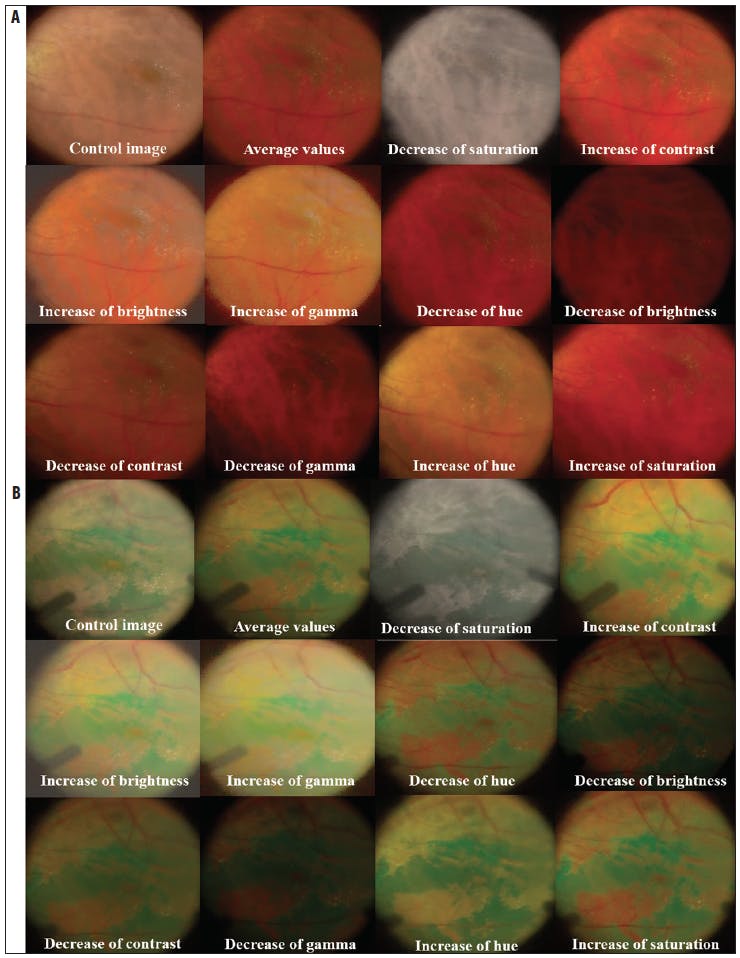
Figure 1. Intraoperative photographs of each OPP during heads-up surgery before (A) and after (B) use of ICG dye.
We video-recorded the images created by each OPP before and after staining the macular surface with ICG.
A questionnaire was used to evaluate each of the OPPs and the overall satisfaction of the 14 graders who assessed the images. After watching the video, each grader was asked to provide a grade on a scale from 1 to 7 for each OPP, with 1 being the worst and 7 the best. After grading each OPP, all graders answered four questions regarding their overall impressions:
- Could this OPP improve the visualization of the ERM before dye application?
- Does this OPP enhance ICG dye for the visualization of the ILM?
- Could this OPP replace ICG dye for the visualization of the ILM?
- Given the option, would you choose any of these OPPs for your surgeries?
FINDINGS
Based on the graders’ responses, higher values of hue and contrast correlated with better visualization of the ERM before dye application and better visualization of the ILM after ICG dye application. Before ICG dye, the average grade for increase in hue was 5.2 (P < .001) and for increase of contrast was 4.5 (P < .001). After ICG dye, the best average grades were for increase of hue (4.9, P < .001) and increase of saturation (4.7, P < .001).
In assessing their overall impression, the graders agreed that the OPPs could enhance the visualization of the ERM and ILM during surgery. However, 71% of the graders stated that OPPs could not be used to replace ICG dye.
FINAL THOUGHTS
Our study demonstrated that the use of certain filters can improve the visualization of specific retinal structures such as the ILM and the ERM during PPV. Still, the technology cannot replace established surgical steps such as the use of ICG dye. Although there was no agreement among participants on an overall best parameter, feedback from the graders suggested that an increase of hue before and after ICG dye should be further explored to improve ILM and ERM visualization.
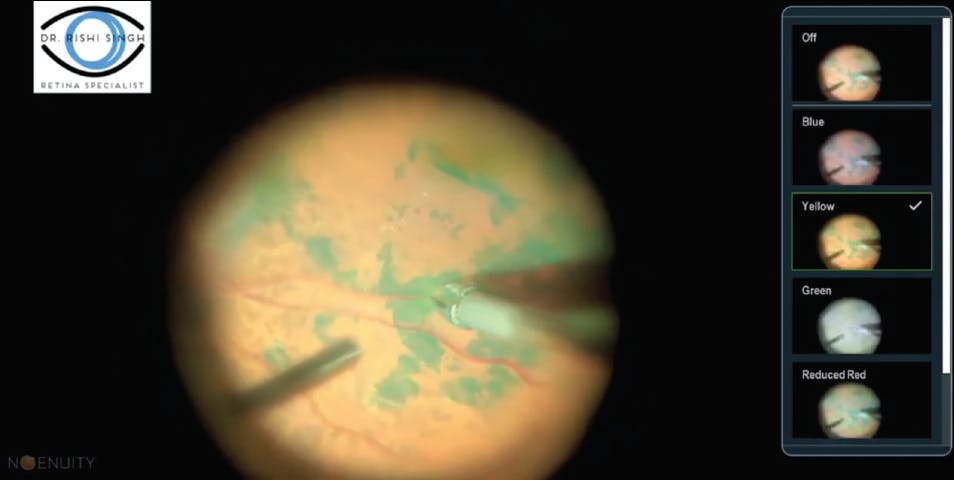
Further facilitating the use of these color channels, the most recent software upgrade (version 1.4) has improved the user’s ability to change color parameters in real time (Figure 2). With this upgrade, users can preview the color channels to determine which is best during surgery. In addition, this latest software version expands the number of channels and image temperature controls for users to further refine the surgical parameters.
The use of specific OPPs to improve visualization of certain structures is a novel approach, the utility of which will be heavily dependent on surgeon preference. Investigation into the full potential of 3D HUD platforms is still in its early stages. Studies such as ours will be instrumental in improving the utility of these platforms in the OR.
1. Charles S. Getting specific about 3-D visualization. Retina Today. 2017;12(8):48-49.
2. Talcott KE, Adam MK, Sioufi K, et al. Comparison of a three-dimensional heads-up display surgical platform with a standard operating microscope for macular surgery. Ophthalmol Retina. 2018;3(3):244-251.
3. Asani B, Siedlecki J, Schworm B, et al. 3D heads-up display vs. standard operating microscope vitrectomy for rhegmatogenous retinal detachment. Front Med (Lausanne). 2020;7:615515.
4. Kuhn F, Morris R, Massey M. Photic retinal injury from endoillumination during vitrectomy. Am J Ophthalmol. 1991;111(1):42-46.
5. Adam MK, Thornton S, Regillo CD, Park C, Ho AC, Hsu J. Minimal endoillumination levels and display luminous emittance during three-dimensional heads-up vitreoretinal surgery. Retina. 2017;37(9):1746-1749.
6. Romano MR, Cennamo G, Comune C, et al. Evaluation of 3D heads-up vitrectomy: Outcomes of psychometric skills testing and surgeon satisfaction. Eye (Lond). 2018;32(6):1093-1098.
7. Melo AGR, Conti TF, Hom GL, et al. Optimizing visualization of membranes in macular surgery with heads-up display. Ophthalmic Surg Lasers Imaging Retina. 2020;51(10):584-587.


_1784132761.jpg?auto=compress,format&w=75)





