


AT A GLANCE
- Because treat-and-extend regimens require fewer visits, patients with unilateral wet AMD receive fewer examinations of their fellow eye.
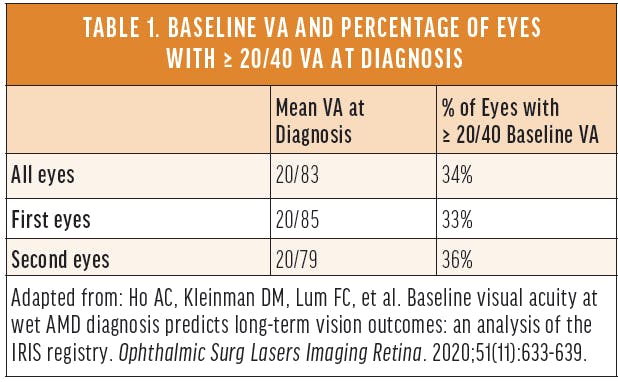
- Patients with at least 20/40 VA at baseline are most likely to maintain that level of vision after 2 years of treatment; however, only 33% of first eyes and 36% of second eyes newly diagnosed with wet AMD have at least 20/40 VA.
- Among eyes with at least 20/40 VA at baseline, 81% maintained 20/40 VA when wet AMD disease activity was detected by the ForeseeHome AMD Monitoring Program (Notal Vision).
The next wave of therapeutic innovation for the treatment of wet AMD is focused on increasing treatment intervals to reduce patient burden and improve compliance. Retina specialists have increasingly employed treat-and-extend (TAE) regimens, which can significantly reduce treatment burden without sacrificing visual gains compared with monthly injection intervals.1
However, fewer visits also mean that patients with unilateral wet AMD receive fewer examinations of their fellow eye. This presents retina specialists with a conundrum: How do we alleviate treatment burden while also monitoring fellow eyes for disease conversion?
FELLOW EYE DETECTION
A 2020 study by Ho et al found that wet AMD patients in the AAO IRIS Registry who presented with higher visual acuity at baseline maintained higher visual acuity at 1 and 2 years.2 Ying et al found similar results in the Comparison of Age-Related Macular Degeneration Treatments Trials (CATT; Figure 1).3 The conclusion by Ho et al—patients with at least 20/40 VA at baseline are most likely to maintain that level of vision at 2 years—gives retina specialists a goal: Detect wet AMD in eyes with at least 20/40 VA to keep vision at a functional level.
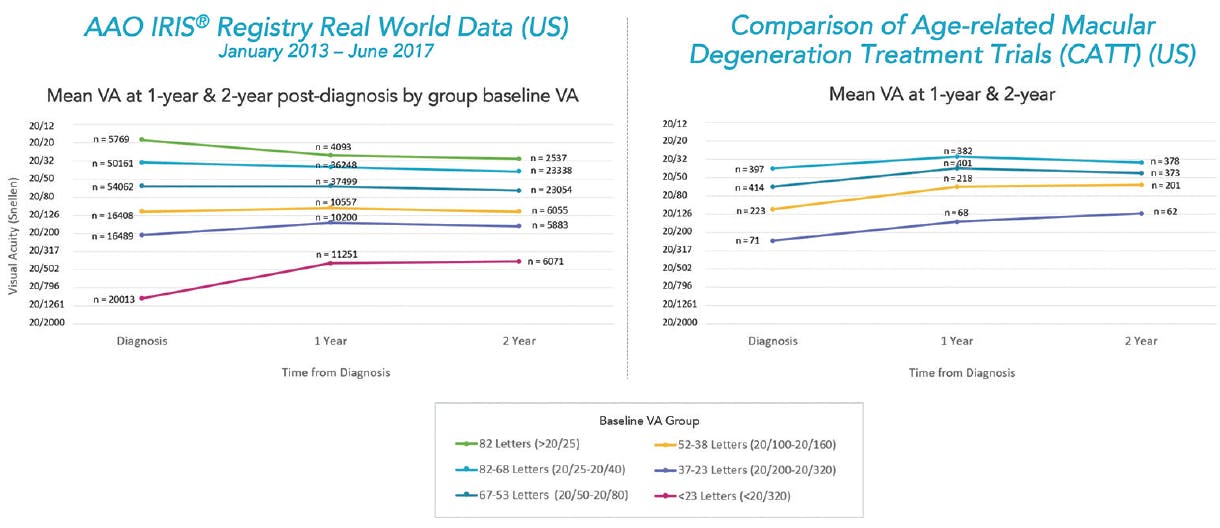
Figure 1. Both the AAO IRIS Registry study and CATT determined that patients with wet AMD whose disease was detected early had better visual function at 1 and 2 years.
(Graphic courtesy of Notal Vision)
Interestingly, 20/40 VA is not an arbitrary cutoff point determined by data. Instead, it is the threshold for reading, watching television, performing daily activities, and, for many states, the visual acuity required to drive.
Unfortunately, real-world data indicate that the vision of patients with newly diagnosed wet AMD is often below this threshold, at a mean of 20/85 and 20/79 for the first and second eyes (Table 1).2 Only 33% of first eyes and 36% of second eyes diagnosed with wet AMD have at least 20/40 VA, suggesting that a majority of fellow eyes, even with frequent visits, are not diagnosed until VA is well below 20/40.
Part of the problem may be the rapid rate at which wet AMD develops. In our experience, some patients who develop contralateral AMD do not demonstrate disease activity on routine examination but present a week later with active disease that has pushed VA below 20/40. Further, expanded use of TAE regimens and the possible proliferation of extended-duration therapies mean that a new method of disease monitoring is needed between office visits.
Patients being treated for wet AMD in one eye often ask how they can prevent vision loss in their other eye, underscoring what quality-of-life surveys have already shown us: Severe vision loss can be as debilitating as conditions such as uncontrolled pain due to cancer, home dialysis, and stroke.4
HOME-BASED AMD MONITORING: THE REAL-WORLD DATA
By Jeffrey S. Heier, MD
Clinicians often have great expectations for drugs and technologies that have been shown to be safe and effective in clinical trials. Unfortunately, many fail to live up to that potential in real-world application. There are many hypotheses for the differences between performance in the trial setting and the clinic; most focus on undertreatment and an inability to follow patients as closely in the real world as in clinical trials.
It is noteworthy, then, when data from a real-world study closely align with those from a clinical trial. A 2021 real-world evaluation of the efficacy of the ForeseeHome AMD Monitoring Program (Notal Vision) for detecting conversion from intermediate to wet AMD found that adding home monitoring to the standard of care was an effective method for identifying potential disease progression.1 The data and conclusions were similar to those found in the pivotal AREDS2-HOME clinical trial that first evaluated the ForeseeHome in patients with intermediate AMD.2
Study Overview
My colleagues and I performed a retrospective review of patients whose data were collected in the electronic health records of the Notal Vision Diagnostic Clinic, ForeseeHome’s monitoring service. We included patients who had a valid device baseline test and at least 20/60 VA in any eye prescribed the ForeseeHome program. A total of 306 patients had confirmed conversion from intermediate AMD to wet AMD.
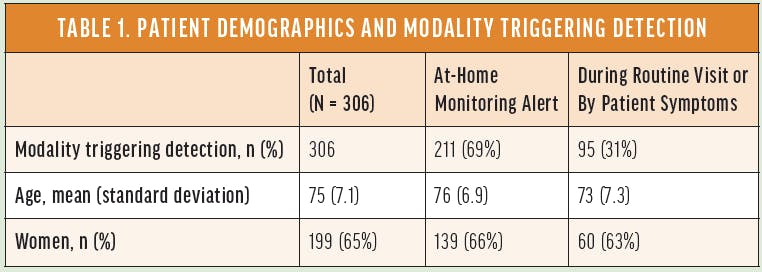
The monitoring regimen in this real-world study comprised use of the ForeseeHome device, routine examination, and examination triggered by symptoms. Of the 306 patients in the study who converted to wet AMD, 69% had their disease detected by the ForeseeHome device (Table 1).
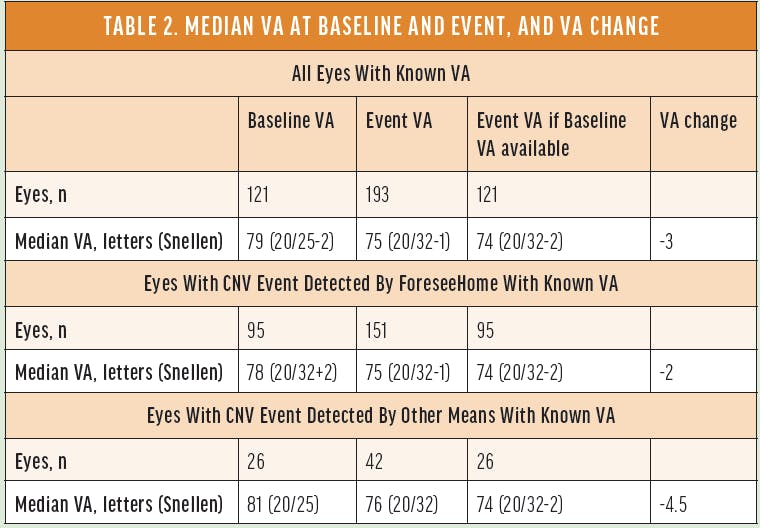
Median baseline VA for all study patients was 79 letters (20/25-2). When progression to wet AMD was detected, median VA was 75 letters (20/32-1), an average VA change of only 3 letters (Table 2).
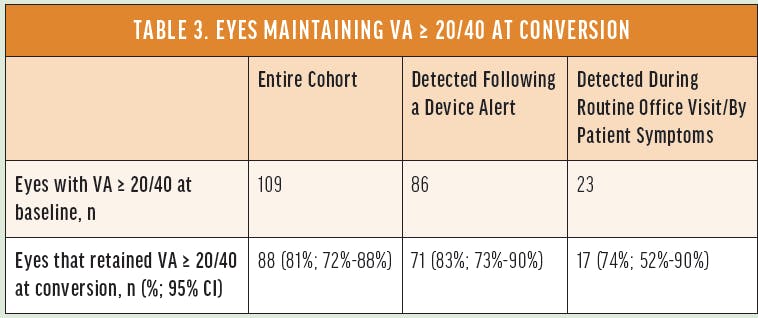
Given that Ho et al found that patients who presented with wet AMD and at least 20/40 VA at baseline maintained that level of visual acuity at 2 years if they underwent intravitreal anti-VEGF therapy,3 we examined the percentage of patients who had at least 20/40 VA at baseline and remained at least at 20/40 when disease was detected.
Of the 109 patients with at least 20/40 VA at baseline, 88 (81%) retained at least 20/40 VA when wet AMD was detected by any method. This real-world finding confirmed the results of the AREDS-2 HOME study, in which 91% of patients maintained this level of functional vision.2 Although the percentage of disease detection in the real world was higher in the device subgroup, there was no statistical difference between the device and routine or symptomatic examination subgroups. The attentiveness and disease awareness raised by the patient education program provided by the remote diagnostic clinic likely contributed to this positive finding compared with standard of care, which typically lacks remote engagement (Table 3).
Clinical Implications
Reliance on in-office examination and patient self-reported symptoms alone exposes patients to the risk of undetected, asymptomatic onset of wet AMD for, potentially, an extended period of time in a real-word setting. A monitoring regimen that includes home-based digital health technology can help fill the systematic gap office-based medicine is confronted with every day.
Continued monitoring (ie, a combination of home-based monitoring and routine/symptomatic clinical examinations) of patients with intermediate AMD may help clinicians detect conversion to wet AMD. Catching disease in patients before visual acuity dips below 20/40 is key to preserving vision in patients through long-term therapy.
In this real-world study, a home-based/examination-based hybrid monitoring program was found to be effective, reinforcing the findings of the clinical trial. The support and disease education a remote diagnostic clinic provides to patients between office visits also helps drive compliance and success. Digital health solutions provided in partnership with traditional office-based care can help protect vision in at-risk patients.
1. Ho AC, Heier JS, Holekamp NM, et al. Real-world performance of a self-operated home monitoring system for early detection of neovascular age-related macular degeneration. J Clin Med. 2021;10(7):1355.
2. Chew EY, Clemons TE, Bressler SB, et al; AREDS2-HOME Study Research Group. Randomized trial of the ForeseeHome monitoring device for early detection of neovascular age-related macular degeneration. The home monitoring of the eye (HOME) study design - HOME study report number 1. Contemp Clin Trials. 2014;37(2):294-300.
3. Ho AC, Kleinman DM, Lum FC, et al. Baseline visual acuity at wet AMD diagnosis predicts long-term vision outcomes: an analysis of the IRIS registry. Ophthalmic Surg Lasers Imaging Retina. 2020;51(11):633-639.
Jeffrey S. Heier, MD
Director, Retina Service and Director of Retinal Research, Ophthalmic Consultants of Boston
Editorial Advisory Board Member, Retina Today
jsheier@eyeboston.com
Financial disclosure: Scientific Advisory Board (Notal)
A VIABLE SOLUTION
Educating patients that early detection is key to saving vision is important, and setting up a remote monitoring regimen that supplements in-office examinations could help physicians detect disease activity early.
Real-world evidence suggests that use of the ForeseeHome AMD Monitoring Program (Notal Vision) is an effective means by which to consistently monitor patients for wet AMD activity. A 2021 study found that patients with intermediate AMD undergoing a monitoring regimen that included the ForeseeHome platform and both routine and symptom-based eye examinations were likely to have greater than 20/40 VA when wet AMD was detected.5 This study confirmed results seen in a pivotal trial assessing the efficacy of the ForeseeHome platform in wet AMD detection.6
In the 2021 study, median VA was 20/25-2 among eyes with a known baseline. At the moment that wet AMD disease activity was detected, median VA was 20/32-1. Among eyes with at least 20/40 VA at baseline, 81% maintained 20/40 VA when wet AMD disease activity was detected by ForeseeHome or routine/symptom-based eye examination (Figure 2).5
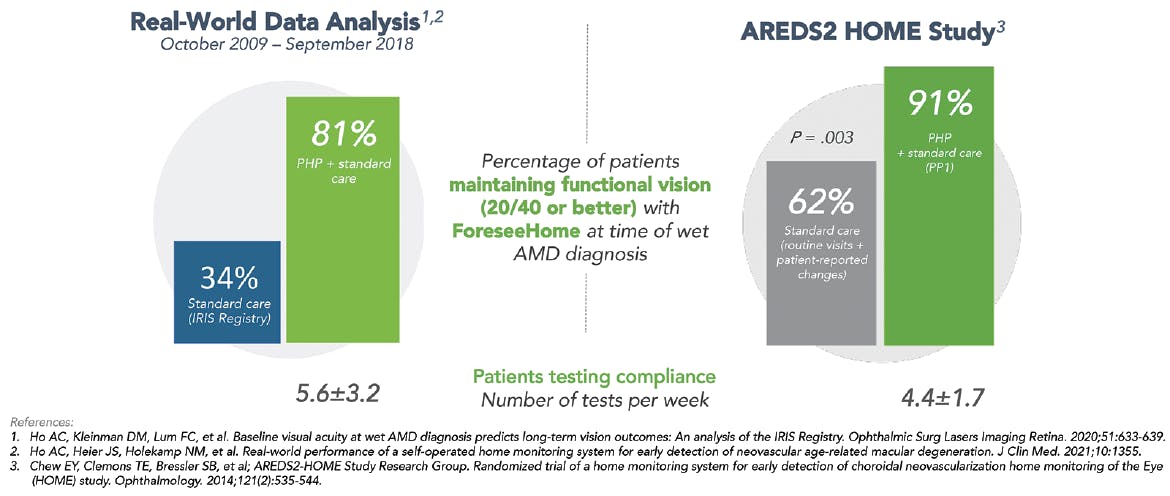
Figure 2. ForeseeHome real-world performance resembled pivotal trial results.
(Graphic courtesy of Notal Vision)
IMPLEMENTATION
Use of a monitoring regimen that includes use of a home-based platform faces two hurdles to implementation: physician hesitancy and patient familiarity.
Clinicians may not prescribe this at-home monitoring program because of the misconception that it will increase their workload and they will be tasked with a daily review of data. In reality, the Notal Vision Diagnostic Clinic, the ophthalmic medical center that provides the ForeseeHome monitoring service, uses artificial intelligence-based technology to determine whether a patient’s test warrants alerting the referring practice that an in-person examination may be prudent.
The Notal Vision Diagnostic Clinic works with practices to implement simple procedures that take minimal time in the examination lane for identifying and referring patients, and the monitoring center manages everything including benefits verification, device provisioning and training, and patient engagement and compliance.
Further, costs associated with the ForeseeHome AMD Monitoring Program are covered by Medicare, as this diagnostic system has been cleared by the US FDA.
As for patients, they may be intimidated by new technology. A short introduction to at-home monitoring early in the visit (eg, by a technician) familiarizes patients with the technology and the program, allowing the clinician to re-emphasize the idea during the patient encounter. Patients who wish to have agency in their disease monitoring may be inclined to try at-home monitoring. In addition, reminding patients that testing can be an easy addition to their daily routine may reduce any perceived barriers to use.
WHY WAIT?
The data are clear: Use of the ForeseeHome platform can help to identify wet AMD early enough that patients are likely to retain good vision if they are adherent to therapy. Given that extended-duration therapy and TAE regimens are becoming increasingly popular, we need an adjunct to clinic-based fellow eye examination to help detect the acute onset of late-stage disease. The Notal Vision Diagnostic Clinic and the ForeseeHome AMD Monitoring Program could help to fill that need.
1. Wykoff CC, Croft DE, Brown DM, et al; TREX-AMD Study Group. Prospective trial of treat-and-extend versus monthly dosing for neovascular age-related macular degeneration: TREX-AMD 1-year results. Ophthalmology. 2015;122(12):2514-2522.
2. Ho AC, Kleinman DM, Lum FC, et al. Baseline visual acuity at neovascular AMD diagnosis predicts long-term vision outcomes: an analysis of the IRIS registry. Ophthalmic Surg Lasers Imaging Retina. 2020;51(11):633-639.
3. Ying G, Maguire MG, Daniel E, et al; Comparison of Age-Related Macular Degeneration Treatments Trials (CATT). Association of baseline characteristics and early vision response with 2-year vision outcomes in the comparison of AMD treatments trials (CATT). Ophthalmology. 2015;122(12):2523-31.e1.
4. Yuzawa M, Fujita K, Tanaka E, Wang EC. Assessing quality of life in the treatment of patients with age-related macular degeneration: clinical research findings and recommendations for clinical practice. Clin Ophthalmol. 2013;7:1325-1332.
5. Ho AC, Heier JS, Holekamp NM, et al. Real-world performance of a self-operated home monitoring system for early detection of neovascular age-related macular degeneration. J Clin Med. 2021;10(7):1355.
6. Chew EY, Clemons TE, Bressler SB, et al; AREDS2-HOME Study Research Group. Randomized trial of the ForeseeHome monitoring device for early detection of neovascular age-related macular degeneration. The home monitoring of the eye (HOME) study design - HOME study report number 1. Contemp Clin Trials. 2014;37(2):294-300.


_1784132761.jpg?auto=compress,format&w=75)




