


AT A GLANCE
- To be classified as complete retinal pigment epithelium (RPE) and outer retinal atrophy, there must be a loss of outer retinal layers, RPE loss, and choroidal hypertransmission of at least 250 µm.
- If the CAM criteria used in clinical trials are useful and reproducible, they would also be helpful when evaluating patients in the clinic.
- Loss of the outer retinal layers causes the inner retinal layers, including the inner nuclear layer and outer plexiform layer, to sink toward Bruch membrane, a feature termed subsidence, which is useful to help clinicians decide whether atrophy is present.
During the Classification of Atrophy Meetings (CAM) program, experts dug into the literature to review the OCT criteria researchers have been using to define macular atrophy—whether from wet or dry AMD, hereditary retinal degenerations, or other conditions. What came from those meetings was a classification system designed to help clinical researchers standardize the definitions of macular atrophy within their trials. Here, Glenn J. Jaffe, MD, shares his thoughts with Retina Today on using CAM OCT criteria in AMD clinical trials, and what future trials might look like.
Retina Today: Tell us about the creation of the CAM criteria.
Glenn J. Jaffe, MD: The CAM criteria have been developed—primarily based on OCT findings with other supportive imaging modalities such as near-infrared reflectance and fluorescein angiography—specifically for macular atrophy.
Macular atrophy is the general term used to describe atrophy that occurs in a variety of settings including AMD, hereditary retinal diseases, and others. Geographic atrophy (GA) is the specific term applied to macular atrophy that occurs in the setting of non-neovascular AMD. The CAM group defined atrophy according to an OCT-based classification. The OCT correlate of GA and macular atrophy that occurs in eyes with neovascular AMD is termed complete retinal pigment epithelium (RPE) and outer retinal atrophy (cRORA). To be classified as cRORA, an eye must show a triumvirate of signs: loss of outer retinal layers, RPE loss, and choroidal hypertransmission of at least 250 µm (Figure). In these eyes, the OCT signal penetrates more deeply into the choroid because the RPE, which normally forms a barrier, is lost, causing the choroidal hypertransmission.1
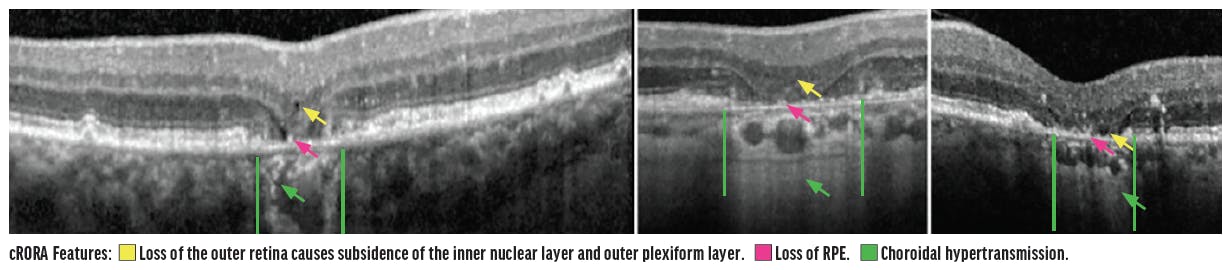
There is an earlier stage of atrophy, known as incomplete RPE and outer retinal atrophy, or iRORA. These eyes have similar characteristics, but they don’t quite meet the full cRORA criteria. For example, there may be patchy loss of the RPE, less than 250 µm of RPE loss, or choroidal hypertransmission less than 250 µm.2 iRORA, and the features that go along with it, will likely be important in many of the trials designed to prevent progression to cRORA. Right now, our treatments are focused on preventing growth of GA or cRORA, but there are also trials under way to investigate progression to iRORA, or from iRORA to cRORA.
We published a paper, CAM Report 5,3 that describes the different features that accompany a higher risk of progression to cRORA, and many of those features are going to be used in upcoming clinical trials. More recently, in CAM Report 6, we determined the ability of readers from four reading centers to assess the different atrophy components, particularly those in the earlier atrophy stages.4
RT: Do you see CAM criteria becoming a standard in AMD trials?
Dr. Jaffe: Clinicians have become increasingly aware of the CAM criteria. But the questions we sought to answer in a study presented at Angiogenesis, Exudation, and Degeneration 2021 was, “Should we be using CAM criteria in clinical trials to assess atrophy, and how well do they work?” We wanted to determine whether those criteria worked in real-world clinical trials. We did that by measuring how well two independent readers at the Duke Reading Center agreed with one another when they were grading the atrophy from clinical trials using CAM criteria—how well they could determine if the atrophy was gradable and, if it was, whether they could grade it reproducibly.
We then looked at whether it was useful to apply CAM criteria in terms of trial endpoints. For example, in macular atrophy trials comparing a drug treatment to placebo, or in trials in which macular atrophy is a safety endpoint, reproducibility must be good enough to separate the treatment group from the control group. Thus, we looked at the reproducibility of the CAM OCT assessments in a GA trial and in a trial of eyes with wet AMD. It turned out that the readers were able, with a high degree of reproducibility, to assess atrophy in both the GA trial and the wet AMD trial, and to make judgments about the atrophy in the different study groups.
RT: How might CAM criteria translate into clinical practice?
Dr. Jaffe: Let’s say you do a trial, and the treatment works for patients with atrophy. To decide whether a patient in your clinic might be a candidate for that treatment, you would need to know whether the patient really has atrophy. If the definitions used in the trial were useful and reproducible, they would also be helpful when evaluating patients in the clinic.
We have also been evaluating baseline features that accompany atrophy that might help us predict how a patient will fare with a given treatment. Would different atrophy patterns predict a different outcome? If they do, applying CAM criteria might be useful as a predictive tool. In addition, if CAM criteria help show that a patient has very little chance of success with the treatment based on their baseline criteria, a clinician might decide not to initiate a long-term treatment regimen.
More research into predictive factors based on CAM criteria could help us understand when one treatment works better than others—ultimately affecting a clinician’s treatment approach. That will become increasingly important as we get more treatments for earlier stages of atrophy. CAM criteria will be quite valuable in the clinic once we have a drug that prevents progression to iRORA or a treatment that prevents conversion from iRORA to cRORA.
RT: How do you see CAM criteria evolving over time?
Dr. Jaffe: We came up with these definitions in the hopes that they would be practical. With further CAM consensus meetings, testing in the clinic, and feedback, we’ve been refining the criteria to make them more reproducible. For example, while choroidal hypertransmission is relatively easy to identify, RPE loss or attenuation can be challenging. With iRORA and cRORA, the retina looks like it sinks down, what we now call subsidence, a feature that can be determined reproducibly.2 In addition, a hyporeflective wedge-shaped structure within Henle’s fiber layer at the margins of the atrophy is another associated feature that can be determined reproducibly. Those features weren’t emphasized in the earlier CAM criteria definitions, but we now know they are additional useful features that can help clinicians decide whether atrophy is present.
We’re now focusing our efforts more on eyes with wet AMD and how to define the criteria. In general, it’s more challenging to grade atrophy in eyes with wet AMD due to associated pathology, such as subretinal hyperreflective material, fibrosis, and intraretinal and subretinal fluid. Thus, we are directing more attention to defining the criteria a little better in those eyes.
1. Sadda SR, Guymer R, Holz FG, et al. Consensus definition for atrophy associated with age-related macular degeneration on OCT: Classification of Atrophy report 3. Ophthalmology. 2018;125(4):537-548.
2. Guymer RH, Rosenfeld PJ, Curcio CA, et al. incomplete retinal pigment epithelial and outer retinal atrophy in age-related macular degeneration: Classification of Atrophy Meeting Report 4. Ophthalmology. 2020;127(3):394-409.
3. Jaffe GJ, Chakravarthy U, Freund KB, et al. Imaging features associated with progression to geographic atrophy in age-related macular degeneration: Classification of Atrophy Meeting Report 5. Ophthalmol Retina. 2020 Dec 22;S2468-6530(20)30490-5.
4. Wu Z, Pfau M, Blodi BA, et al. Optical coherence tomography signs of early atrophy in age-related macular degeneration: inter-reader agreement. CAM Report 6. Ophthalmol Retina. Published online March 23, 2021. doi: 10.1016/j.oret.2021.03.008


_1784132761.jpg?auto=compress,format&w=75)





