


AT A GLANCE
- Two C3 inhibitors, NGM621 (NGM Biopharmaceuticals) and pegcetacoplan (Apellis Pharmaceuticals), and one C5 inhibitor, avacincaptad pegol (Zimura, Iveric Bio), are showing promise as potential treatments to reduce the progression of geographic atrophy.
- Elamipretide (Stealth Biotherapeutics) binds to cardiolipin to stabilize mitochondrial structure and reduce the emission of reactive oxygen species, thereby potentially slowing and reversing the effects of oxidative stress.
- A recombinant AAV2-based investigational gene therapy, GT005 (Gyroscope Therapeutics), is designed to induce the expression of complement factor I.
A number of novel therapeutics targeting geographic atrophy (GA) progression are in the pipeline. Most of them focus on inhibiting the complement pathway or reversing the effects of oxidative stress. This article takes a look at the latest data and the next steps in the research.
NGM621
A novel monoclonal antibody inhibitor of complement C3 cleavage, NGM621 (NGM Biopharmaceuticals), is being developed as a potential treatment to reduce the progression of GA.
The objective of the phase 1 study, results of which were presented at Angiogenesis, Exudation, and Degeneration 2021, was to evaluate the safety, tolerability, pharmacokinetics, and pharmacodynamics of NGM621. In the study, 15 patients received NGM621 administered by intravitreal injection.1 Study participants were 50 years of age or older with GA of 2.5 mm2 or greater in at least one eye and BCVA between 54 and 4 letters in the study eye (Figure 1).
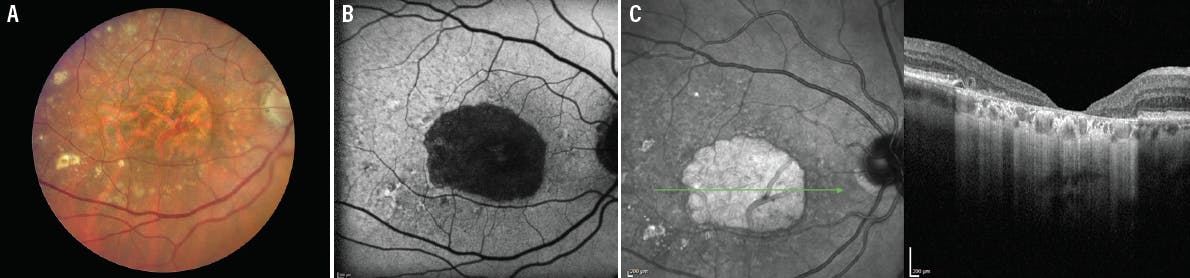
Figure 1. Color fundus photography of the right eye shows signs of advanced GA (A). The corresponding autofluorescence in the same patient shows areas of RPE atrophy that are hypoautofluorescent (dark gray or black), areas of “sick” RPE that are hyperautofluorescent (brighter than background), and areas of healthy RPE that are gray (B). The corresponding near-infrared reflectance image in the same patient shows large choroidal vessels visible through the central area of GA; the green arrow shows complete atrophy of photoreceptors, RPE, and choriocapillaris, also shown in the B-scan on the right (C).
(Images courtesy of Charles Wykoff, MD, PhD)
Four dosing cohorts were evaluated. In three single-dose cohorts, intravitreal NGM621 (2.0 mg, 7.5 mg, or 15.0 mg) was administered to three patients per dose; in a multidose cohort, patients received two 15.0 mg doses 4 weeks apart.
No drug-related adverse events, serious adverse events or deaths, endophthalmitis, intraocular inflammation, or new onset of choroidal neovascularization was observed. The 15.0-mg dose was well tolerated in both the single-dose and multidose cohorts. IOP was not meaningfully affected over time. Serum exposures of NGM621 appeared to be dose-proportional, with total NGM621 serum concentration below that which would be expected to produce systemic complement inhibition. Additionally, all patiets were anti-drug antibody negative at all time points. As expected, GA lesion area and BCVA were generally stable over the 12-week study duration.
The results of this phase 1 dose-escalation study support the further development of NGM621 and indicate that doses of up to 15 mg are well tolerated and have a favorable pharmacokinetic/pharmacodynamic profile in patients with GA.
NGM621 is being further evaluated in the ongoing phase 2 CATALINA study, in which 15.0-mg doses are administered every 4 or 8 weeks compared with sham control.2
PEGCETACOPLAN AND NASCENT GA IN AMD
Pegcetacoplan (Apellis Pharmaceuticals) was recently shown to reduce the enlargement rate of GA lesions in AMD following intravitreal treatment monthly or every other month (29% and 20% reductions, respectively) in the phase 2 FILLY trial.3 Two confirmatory phase 3 trials (DERBY4 and OAKS5) are ongoing.
A post hoc analysis of the FILLY trial examined the impact of pegcetacoplan on nascent GA—a subset of eyes with incomplete retinal pigment epithelium (RPE) and outer retinal atrophy (iRORA) without choroidal neovascularization—and in particular on the progression of nascent GA outside of GA lesions (complete atrophy, known as cRORA).6,7
The analysis included individuals who completed 12 months of treatment from the monthly pegcetacoplan and sham arms and did not develop exudative AMD in the study eye. Regions on the OCT scans beyond 500 µm from the GA border at baseline and months 6 and 12 were evaluated for progression from iRORA to cRORA and progression from large drusen to iRORA and/or cRORA.
At baseline, iRORA was present in 45% and 52% of patients, and large drusen were present in 80% and 73% of patients in the monthly pegcetacoplan and sham groups, respectively. Progression from iRORA to cRORA at 12 months was 50.0% in the monthly pegcetacoplan group and 81.8% in the sham group (P = .02), indicating a 39% reduction in the rate of progression from iRORA to cRORA in patients treated with pegcetacoplan.
At the lesion level, iRORA progression rates showed similar trends, with 37.9% and 64.3% in the monthly pegcetacoplan and sham groups, respectively.
Progression from large drusen to iRORA or cRORA at month 12 was 22.6% and 32.6% at the patient level (P = .34) and 9.2% and 11.8% at the lesion level in the monthly pegcetacoplan and sham groups, respectively.
Overall, these findings suggest that subjects receiving monthly intravitreal injections of pegcetacoplan have a lower rate of progression from nascent GA to GA compared with sham controls. The data seem to support further exploration of the potential of pegcetacoplan for earlier intervention in the course of GA.
ELAMIPRETIDE FOR NONCENTRAL GA
AMD is characterized by progressive mitochondrial dysfunction in RPE cells. Mitochondrial morphology is markedly disorganized in AMD RPE cells compared with normal eyes and is characterized by bleb formation on internal and external membranes.8 Mitochondrial defects result in higher reactive oxygen species levels, disrupting cristae curvature and the organization of respiratory complexes by damaging the cardiolipin protein complex, leading to cell death.
Elamipretide (Stealth Biotherapeutics) binds to cardiolipin to stabilize the mitochondrial structure and reduce emission of reactive oxygen species, thereby potentially slowing and reversing the effects of oxidative stress (Figure 2).
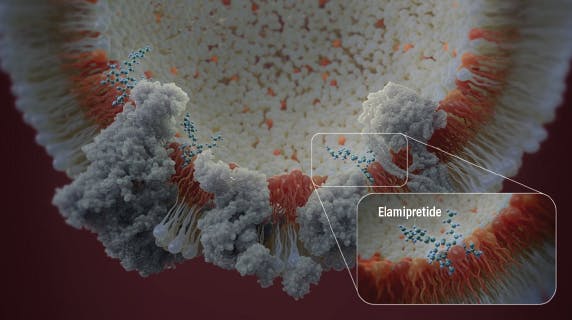
Figure 2. Elamipretide binds to cardiolipin in the mitochondrial membrane, as seen here, and restores mitochondrial structure and function.
(Image courtesy of Stealth Biotherapeutics)
ReCLAIM was an open-label phase 1 clinical trial of subcutaneous elamipretide for the treatment of intermediate AMD. Individuals with noncentral GA and high-risk drusen were recruited. During the 24-week study, 40 patients received daily subcutaneous elamipretide 40 mg.9
Elamipretide was deemed safe and generally well tolerated, although injection site reactions were common. In the noncentral GA subgroup (n = 19), elamipretide-treated patients demonstrated statistically significant improvements in both BCVA and low-luminance visual acuity (LLVA): 4.6 ± 5.1 (P = .003) and 5.4 ± 7.9 (P = .019) letters, respectively.
By the 24-week visit, LLVA had improved by more than 5 letters in 53.3% of patients, more than 10 letters in 33.3% of patients, and more than 15 letters in 6.7% of patients. Although a minimal difference in mean best-corrected reading acuity was seen between the two groups, low-luminance reading acuity through a log-2 neutral density filter improved by an average of -0.52 ± 0.75 logMAR (P < .017) compared with baseline values.
The developers felt that these results supported the initiation of ReCLAIM-2, a phase 2 randomized, placebo-controlled clinical trial of subcutaneous elamipretide in patients with noncentral GA with a primary endpoint of LLVA at 48 weeks.10
Disrupting the C3 Pathway
By Cedric Francois, MD, PhD
C3, a protein that circulates throughout the body in high concentrations, naturally reacts covalently with all cell surfaces in the body.
Think of C3 as a graffiti artist continuously painting all of the cells in the body, indiscriminately. As we age, the graffiti-like painting of C3 gets heavier, while the body becomes less able to clear it effectively.
The mechanisms required to clear an overabundance of C3 are the same as those required for the visual cycle in the retina. Thus, excess C3 forces cells to choose between clearing C3 and maintaining the visual system. The eventual disruption in visual processes (the earliest sign’s being dark adaptation issues) is followed by destruction of retinal cells—like a wildfire in the retina.
To arrest this process, there must be sufficient control of complement to allow cells to remove more C3 than what accumulates. Pegcetacoplan (Apellis Pharmaceuticals), a C3 inhibitor, is showing promise in targeting this complement pathway.
Several specifics of a post-hoc analysis of the FILLY trial support the investigational treatment’s efficacy. For one, the researchers halted treatment at 12 months to correct for covert behavior, ensuring that the lower progression rate seen in the patients treated with pegcetacoplan was not simply a differing rate of progression at baseline.
The analysis also looked at patients with bilateral GA and compared the treated eye with the contralateral eye. The data showed a trend with treatment every other month and a statistically significant reduction in the monthly dosing group in the treated eye compared with the contralateral eye. Using the contralateral eyes as controls reinforced the increased effect of treatment over time in the pegcetacoplan group.
Cedric Francois, MD, PhD
Co-Founder and Chief Executive Officer, Apellis Pharmaceuticals, Waltham, Massachusetts
Financial disclosure: Employee (Apellis Pharmaceuticals)
GT005 GENE THERAPY FOR THE TREATMENT OF GA
Histopathologic and genome-wide association studies point to complement system overactivation as a driver of disease in AMD. However, the body has an intrinsic down-regulator of the alternative pathway, complement factor I (CFI).11,12 A recombinant AAV2-based investigational gene therapy administered subretinally, GT005 (Gyroscope Therapeutics), is designed to induce expression of CFI.
FOCUS is a phase 1/2 open-label study evaluating the safety and tolerability of GT005 in patients with GA secondary to AMD.13 Cohorts 1 through 3 are dose-escalation cohorts for which enrollment is complete. Cohort 4 is a dose-expansion cohort for which enrollment is ongoing.
In interim results from cohorts 1 through 4, presented at Angiogenesis, Exudation, and Degeneration 2021, the three dose levels of GT005 were well-tolerated in 19 patients. No serious adverse events related to GT005 and no safety signal on laboratory parameters were observed. Most surgery-related adverse events were mild. Vitreous sampling showed that, in the 12 to 48 weeks after administration of GT005, nine of 10 patients treated with GT005 had increases in vitreous CFI levels, with an average increase of 146% compared with baseline. Down-regulation of complement activation was also observed downstream from CFI: treatment with GT005 led to a sustained decrease in both local Ba and C3 breakdown products in the range of 41% to 42% at the 24- to 56-week timepoints, and there appeared to be a linear correlation between the increase in CFI levels and the decrease in Ba. Phase 2 trials to further evaluate the potential to slow the progression of GA secondary to AMD are ongoing.
C5 Inhibition for the Treatment of GA
Avacincaptad pegol (Zimura, Iveric Bio), a complement C5 inhibitor, reduced the progression of GA secondary to AMD by approximately 28% compared with sham control in 18-month follow-up of the GATHER 1 phase 3 clinical trial.12,14 This is the only positive pivotal trial with continuous treatment for 18 months in GA. The study met its pre-specified primary endpoint and demonstrated a best-in-class safety profile.
A total of 286 patients were enrolled in the trial. Those in the treatment arm were dosed with either 2 mg or 4 mg avacincaptad pegol. Of those treated with the 2-mg dose, 92.5% had nonsubfoveal GA, as did 97.6% of those treated with the 4-mg dose. The data showed a statistically significant 28.11% reduction in the mean rate of GA growth (P = .0014) for the 2-mg group compared with the control group and 29.97% for the 4-mg group (P = .0021).
After 18 months of administration, avacincaptad pegol was generally well tolerated with no discontinuations or adverse events related to the study drug.
The company has initiated a second phase 3 clinical trial, GATHER 2, and is enrolling approximately 400 patients who will be randomly assigned to receive either monthly administration of avacincaptad pegol 2 mg or sham. Upon achieving the prespecified primary endpoint at month 12, Iveric Bio will file for approval of Zimura in GA.
1. Study of NGM621 in Participants With Geographic Atrophy. Accessed April 12, 2021. clinicaltrials.gov/ct2/show/NCT04014777
2. A study of NGM621 in participants with geographic atrophy (CATALINA). Accessed April 21, 2021. clinicaltrials.gov/ct2/show/NCT04465955
3. Liao DS, Grossi FV, El Mehdi D, et al. Complement C3 inhibitor pegcetacoplan for geographic atrophy secondary to age-related macular degeneration: a randomized phase 2 trial. Ophthalmology. 2020;127(2):186-195.
4. Study to compare the efficacy and safety of intravitreal APL-2 therapy with sham injections in patients with geographic atrophy (GA) secondary to age-related macular degeneration. Accessed April 6, 2021. clinicaltrials.gov/ct2/show/NCT03525600
5. A study to compare the efficacy and safety of intravitreal APL-2 therapy with sham injections in patients with geographic atrophy (GA) secondary to age-related macular degeneration. Accessed April 6, 2021. clinicaltrials.gov/ct2/show/NCT03525613
6. Corradetti G, Corvi F, Nittala MG, et al. Natural history of incomplete retinal pigment epithelial and outer retinal atrophy in age-related macular degeneration. Published online February 1, 2021. Can J Ophthalmol. doi:10.1016/j.jcjo.2021.01.005
7. Guymer RH, Rosenfeld PJ, Curcio CA, et al. Incomplete retinal pigment epithelial and outer retinal atrophy in age-related macular degeneration: classification of atrophy meeting report 4. Ophthalmology. 2020;127(3):394-409.
8. Feher J, Kovacs I, Artico M, Cavallotti C, Papale A, Balacco Gabrieli C. Mitochondrial alterations of retinal pigment epithelium in age-related macular degeneration. Neurobiol Aging. 2006;27(7):983-993.
9. ReCLAIM-2 study to evaluate safety, efficacy & pharmacokinetics of elamipretide in subjects with AMD with non-central GA (ReCLAIM-2). Accessed April 12, 2021. clinicaltrials.gov/ct2/show/NCT03891875
10. Csaky K, Ferris F 3rd, Chew EY, et al. Report from the NEI/FDA endpoints workshop on age-related macular degeneration and inherited retinal diseases. Invest Ophthalmol Vis Sci. 2017;58(9):3456-3463.
11. Liao DS, et al. Complement C3 inhibitor pegcetacoplan for geographic atrophy secondary to age-related macular degeneration: a randomized phase 2 trial. Ophthalmology. 2020;127(2):186-195.
12. Jaffe GJ, Westby K, Csaky KG, et al. C5 inhibitor avacincaptad pegol for geographic atrophy due to age-related macular degeneration: a randomized pivotal phase 2/3 trial. Ophthalmology. 2021;128(4):576-586.
13. Waheed N. FOCUS interim results: GT005 gene therapy phase I/II study for the treatment of geographic atrophy. Presented at: Angiogenesis, Exudation, and Degeneration 2021; February 12, 2021.
14. Iveric Bio announces positive Zimura 18 month data supporting the 12 month efficacy findings: continuous positive treatment effect with favorable safety profile in geographic atrophy secondary to age-related macular degeneration in a phase 3 trial [press release]. Iveric Bio. June 15, 2020. Accessed April 12, 2021. https://investors.ivericbio.com/news-releases/news-release-details/iveric-bio-announces-positive-zimura-18-month-data-supporting-12


_1784132761.jpg?auto=compress,format&w=75)





