_1638887889.jpg?auto=compress,format)

What has been learned about ANX007 to suggest potential benefit in AMD/GA?
The first and most important thing to keep reminding ourselves is that there is currently no treatment available for dry AMD with GA. These are sight-threatening conditions and millions of patients are facing a tremendous unmet medical need in terms of safe and effective therapeutics. The second thing to realize is that, while significant progress has been made in understanding the role of complement in AMD and GA, there are still a lot of unanswered questions. Much has been made about previous unsuccessful attempts at complement targeting; but there are a multitude of possible reasons why those previous attempts did not bear fruit. Since those failures, we have now had two successful phase 3 studies that target complement, bringing excitement back to the idea of complement modulation.
One of the big unanswered questions in complement inhibition is which pathway is, or pathways are, most relevant to AMD pathology? We know that the alternative pathway is involved. In fact, a polymorphism in the gene coding for the complement factor H protein was the first AMD-associated risk allele identified in genome-wide association studies in published literature.1 The key role that factor H plays in regulating C3 activity suggested a prominent role for the alternative complement pathway in AMD, which would seem to be further substantiated by additional studies demonstrating links between genetic mutations that affect C3 activity.2 However, C3 is a key component of all complement pathways, and specific targeting of the alternative pathway was not previously successful in clinical trials.3
Another question we can ask with regard to targeting the classical cascade is whether there is anything to learn from other neurodegenerative diseases in which C1q is implicated? The data to date certainly suggest this is an idea worth exploring. There seems to be a common pathway in neurodegenerative disorders with respect to classical complement activity, as inhibition of C1q has been shown to be protective in multiple animal models of neurodegeneration, including glaucoma, Huntington's disease, Alzheimer disease, frontotemporal dementia, spinal muscular atrophy, and traumatic brain injury. We can infer from the weight of evidence that C1q itself causes inflammation and that it accumulates in sites of inflammation, as has been seen in drusen and in amyloid plaques in Alzheimer disease.
ARCHER Study
ARCHER is a phase 2, multicenter, randomized, parallel-group, double-masked, sham-controlled study designed to review the efficacy and safety of ANX007 (Annexon). Recruitment is currently ongoing. See the figure below for the study parameters. The study investigators will also track safety, BCVA, and other vision outcomes through month 18 of follow-up as secondary outcome measures.
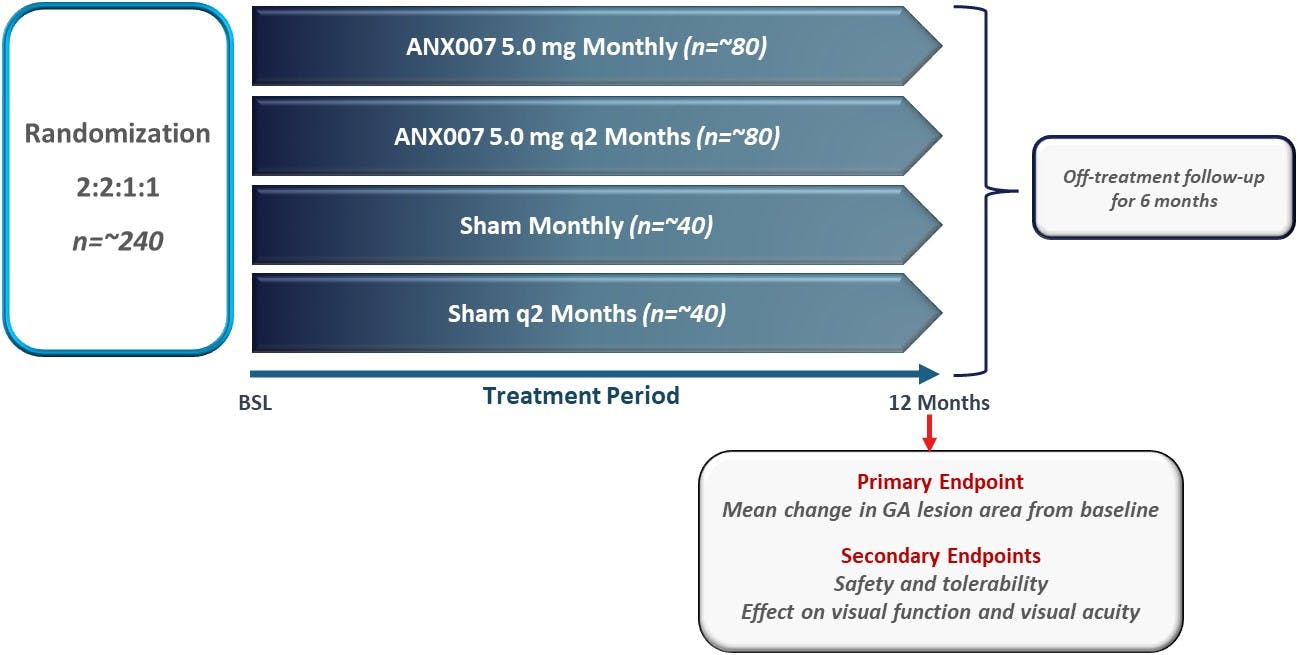
Does that all suggest potential neuroprotective benefit associated with C1q inhibition?
It is not definitive, but that may be the greatest promise associated with ANX007 at this stage. That aspect is very interesting, because it would be beneficial in macular degeneration. It has been established that during normal development, C1q binds to less active synapses, activating the classical complement cascade, which recruits microglial cells to prune the complement-coated synapses away from neurons. These subtractions allow stronger synapses to remain and form appropriate neuronal circuits. In an analogous fashion, in adults, C1q recognizes and tags synapses on stressed neurons, thereby triggering the aberrant removal of functioning synapses, which consequentially robs neurons of trophic support provided by synaptic activity, leading to neuroinflammation and degeneration. In this way, C1q becomes part of the neurodegenerative process, regardless of the inciting etiology. Anti-C1q would obviate that activity, and thus contribute to protecting intact neural pathways.
1. Klein RJ, Zeiss C, Chew EY, et al. Complement factor H polymorphism in age-related macular degeneration. Science. 2005;308(5720):385-389.
2. Armento A, Ueffing M, Clark SJ. The complement system in age-related macular degeneration. Cell Mol Life Sci. 2021;78(10):4487-4505.
3. Holz FG, Sadda SR, Busbee B, et al. Efficacy and safety of lampalizumab for geographic atrophy due to age-related macular degeneration: Chroma and Spectri phase 3 randomized clinical trials. JAMA Ophthalmol. 2018;136(6):666-677.
