


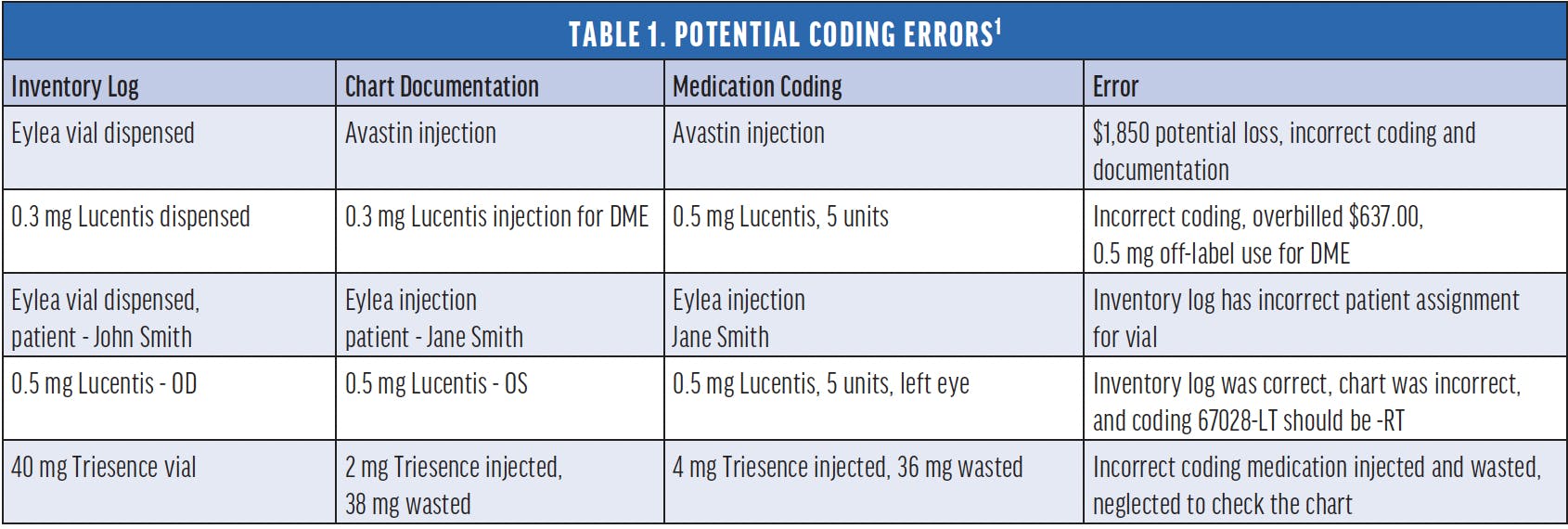
Correctly coding and getting reimbursed for intravitreal injections is a crucial part of every retina practice. However, no matter how hard we try, mistakes happen. Frequent coding errors will inevitably garner underpayments and unwanted attention from audit agencies—something everyone wants to avoid. Submitting the wrong type of medication or inappropriate units, assigning the medication to the incorrect patient, or neglecting to accurately report wastage are errors best uncovered in a timely manner and by the practice, not the payers (Table 1). The tips shared in this article can help your practice identify these mistakes and take action. They do not need to be done in any certain order, but they should be completed frequently to minimize errors when submitting claims.
RECONCILE MEDICATION INVENTORY
Using your medication inventory system, create a report of each medication used during a designated time and reconcile that with the submitted claims. This initial step will reveal any instances in which the wrong medication was billed. You can use the chart records to confirm the actual medication provided per patient and promptly correct any errors.
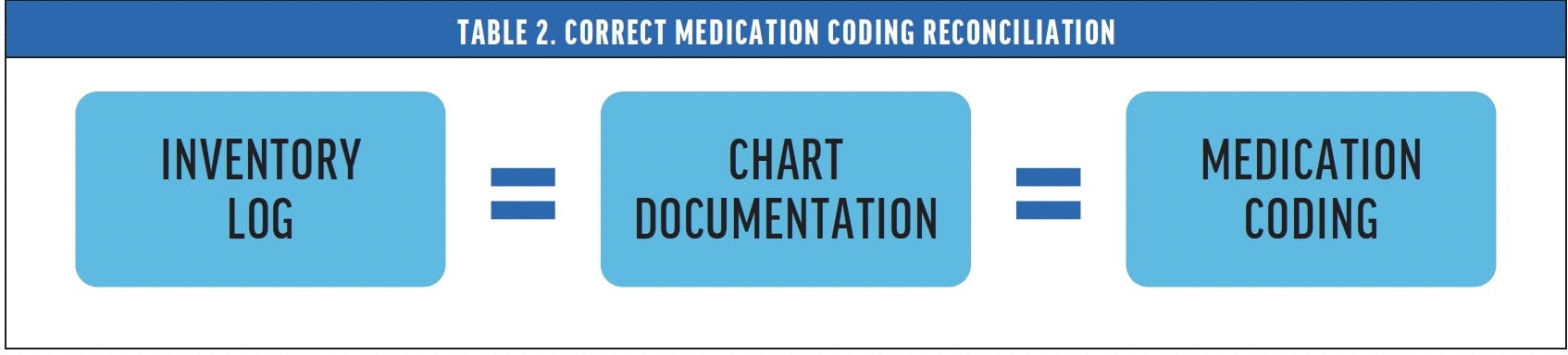
This process can also help to identify any inventory assignment errors. Your inventory counts will be incorrect if a vial of medication was used, documented, and billed, but not assigned appropriately. Routinely reconciling inventory, documentation, and claims will help you catch coding errors in a timely fashion (Table 2).
CONFIRM APPROPRIATE UNITS
One of the most common errors identified in a payer audit of intravitreal injections is incorrect units reported. You can avoid this mistake by reviewing a practice management report that targets the units billed per medication. For example, a report that lists all vials of aflibercept (Eylea, Regeneron) billed in 1 month should report 2 units per eye. Any data entry error of 1 unit on the claim would be obvious, providing you the opportunity to correct the claim.
A focused review of ranibizumab (Lucentis, Genentech) and the appropriate units per dosage might reveal an incorrect reporting of 5 units (0.5 mg) when 0.3 mg was injected. A prompt correction of this claim, updating it to 3 units, will avoid any unnecessary payer reviews.
In addition to the units injected, measurable wastage of 1 unit or greater also must be reported on the claim form. This would be common for medications such as triamcinolone acetonide (Triesence, Alcon) and verteporfin (Visudyne, Bausch + Lomb). The medication dosage that is injected is reported with the appropriate HCPCS code and units, and the wastage is reported on the second line with the -JW modifier appended and remaining units. Targeted reports focused on the HCPCS codes for single-use vials will confirm that all claims accurately report both the dosage and wastage per chart documentation. Using this report, periodically perform an internal audit to confirm correct coding.
SUPPORT MEDICAL NECESSITY
Review the diagnosis linked to the injection code (CPT 67028) and the medication HCPCS code. The diagnosis should be the indication as documented in the chart and consistent with the payer policy. This targeted review can help you identify an incorrect ICD-10-CM link to CPT on the claim. For example, say an injection is performed in the right eye for wet AMD with active choroidal neovascularization (ICD-10-CM H35.3211). If the left eye diagnosis of intermediate dry AMD (ICD-10-CM H35.3122) was incorrectly linked to the injection and medication, the claim could be denied or audited post-payment. Create a system to review claims for these potential mismatched diagnosis codes to proactively reduce denials and limit post-payment audits.
Along with the diagnosis link review, confirm that an anatomical modifier (ie, -RT, -LT, or -50) is correctly reported with CPT code 67028. Anatomical modifiers are required, and a CPT code submitted without one is a red flag. If an intravitreal injection is performed within a few weeks of the fellow eye and reported without an anatomical modifier, this could initiate a review of an injection performed sooner than 28 days.
BE PROACTIVE
To ensure you are coding your medications correctly, create a library of targeted audit reports that can help you identify medication coding errors and correct your claims prior to an external review. As you discover errors, communicate any trends with physicians and staff to help everyone avoid the same mistakes in the future. A well thought out review process will reduce claim errors and unwanted attention from external auditors.
For more resources on coding and reimbursement for the retina practice visit aao.org/retinapm.
1. Woodke JE, Calvillo S. The profitable retina practice: Medication inventory management. American Academy of Ophthalmic Executives. 2019. Accessed October 4, 2021.


