


The extreme swiftness and severity of the COVID-19 pandemic highlighted the importance of building a team of leaders within health care practices. While organizations that embraced various leadership development strategies adapted quickly—and even flourished—in the face of abrupt change, practices in which owners and administrators most often shouldered the burden struggled to continue operating smoothly.
Knowing this, practices must embrace a culture that teaches leadership skills and paves the way for managerial success. You can use the steps outlined in this article to train a strong team of managers that can lighten your workload and better support administrators and owners.
ONBOARD LIKE A PRO
Generally, individuals are promoted into a supervisory or managerial position when they consistently excel in their current role. However, possessing certain technical skills does not guarantee someone will be an effective leader. To help potential new supervisors build the necessary managerial skills, practice leaders should provide management training to employees before they enter into supervisory roles. While creating an onboarding process takes time, it will pay dividends to administrators and owners in the long run. The tips below can help practice owners and administrators set their new managers on the path toward success.
- Recognize that a transition is necessary. Managing at team is not the same as performing individual job duties. Assure new managers that you will support them in their new role.
- Create a training plan. Work with new managers to define the characteristics and skills necessary for success, and create three to five main goals for the first 6 months. Evaluate their progress over this period.
- Provide supplemental training materials. Offer a list of books, articles, podcasts, or other self-directed resources to assist new managers in their transition.
- Lead by example. Invite new managers to observe you executing leadership tasks that may be new to them, such as job interviews, performance evaluations, and meeting facilitation.
- Monitor progress. Schedule regular check-in sessions with new managers to provide coaching, address stress points, and discuss their progress.
FIVE TIPS FOR NEW MANAGERS
Once employees have begun the managerial onboarding process, they would do well to prioritize certain characterisitics as they settle into their new role. Practice leaders can increase the chances that employees will become good managers by instilling the following principles early in the training process.
- Acknowledge that perception is relative. Self-awareness and emotional intelligence are critical for successful leadership. The faster new managers can try to see a situation from another person’s perspective, the more empathetic they will be to staff, patients, and other managers. Empathy encourages involving others to solve problems, thereby building team cohesion.
- Clearly define expectations. An employee engagement survey by Gallup found that more than half of employees do not understand how their managers view their performance.1 This can be especially true of new managers, who may shy away from telling staff what is expected of them. Thus, encourage new managers to implement the following tools to help them set expectations for their team.
- Ensure everyone has a job description. Clearly outlined job duties give managers an objective frame of reference for performance reviews.
- Host regular management team meetings. Regularly scheduled discussions often help managers and team members align their expectations.
- Enact consistent procedures where possible. Carefully defined processes leave no room for ambiguity and help staff avoid errors or miscommunications.
- Adhere to company policies. Managers must set a good example for staff by following the same rules and procedures without complaint.
- Regularly role play scenarios. Working with the management team to role play common issues will help employees feel more comfortable with broaching difficult topics and adhering to set expectations.
- Establish regular feedback. In addition to annual performance evaluations, teach managers how to give feedback that is specifically related to problematic behavior and expectations for improvement.
- Prioritize education. A common mistake made by new managers is jumping in and doing a job themselves because it is faster and easier than training someone else. While this may be true at first, falling into the bad habit of taking over tasks will cause frustration throughout the practice. Often, staff members trying to learn the task become frustrated and never gain the confidence to handle the task on their own. Meanwhile, managers who fall into this pattern find that their time is inevitably consumed by things other than managerial responsibilities. Finally, the administrator becomes upset when the team is not learning and managers are not fulfilling their managerial responsibilities. Administrators and owners can avoid this by actively prioritizing teaching and learning, especially with new managers.
- Ask questions. Often, new managers fear that if they admit they do not know something, it will make them appear weak. This unfortunate misconception leads employees to make decisions based on wrong assumptions or incorrect knowledge. Thus, encourage new managers—especially early in their tenure—to ask how to solve a problem or handle a situation. Then, as a leader, help new managers choose a course of action by asking what they think the practice should do; discussing the pros and cons of different options; and finally, letting managers choose a path forward. Soon, new managers will realize that when they come to you with a problem or issue, they should also have a solution in mind. Once they begin solving problems autonomously, these discussions will become less frequent as managers gain confidence in their problem-solving skills. Furthermore, managers will no longer fear asking questions, which makes the entire team stronger.
- Follow a pattern for better decisions. Sometimes, managers who prefer logical thought may only consider data and forget about the personal impact. Meanwhile, those who lead with emotion may forget to evaluate the financial impact or satisfaction results. In either scenario, the best decisions are made when multiple facets of the prolem are explored together. A good objective problem-solving tool to teach new managers is the acronym N-I-C-Q-L (pronounced “nickel”), which stands for Need, Importance, Consequences, Quantify, and Listen, as described below.
- Need. What is the situation or subjective feedback that necessitates a decision for this question?
- Importance. Where does this topic fall in the current hierarchy of various tasks and deadlines?
- Consequences. What is the best-case and worst-case scenario? What happens if no decision is made?
- Quantify. What are the quantifiable results or impact of the decision, especially financial?
- Listen. What do key stakeholders (or others who will be involved with or impacted by the decision) recommend?
Ultimately, the best decision-making considers all factors. Decision-making patterns such as NICQL help gather these inputs quickly and consistently and allow new managers to make good choices.
ENGAGED TEAMS MAKE THE JOB EASIER
To secure organizational success, owners and administrators must prioritize identifying and training additional leaders within their organization. The reward for developing new managers into successful leaders is that the entire staff will become more engaged. Studies show that engaged teams are safer and more productive, and they create a better work environment (Figure). The best way administrators and owners can lighten their managerial load is to invest in the development of their management team.
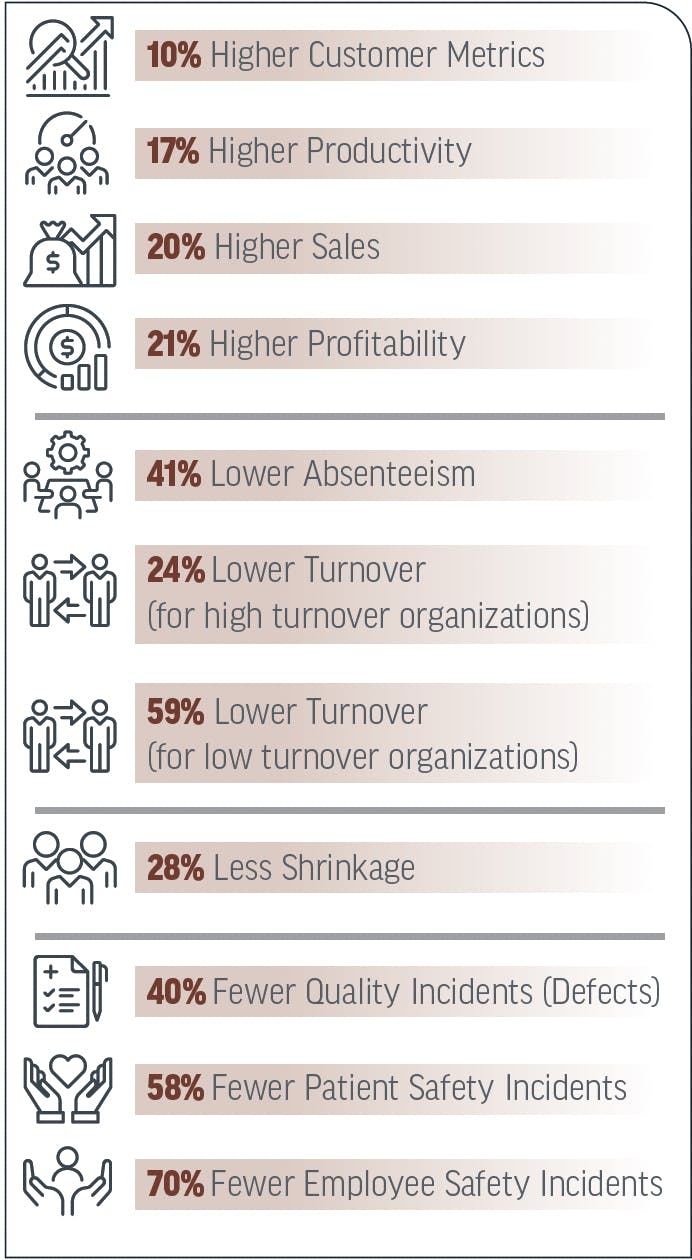
Figure. It can be challenging to quantify why leadership skills are worth the investment. Here, Gallup survey results show the tangible differences between teams that are and are not engaged. Adapted from: Gallup. State of the American Workplace. 2017.
1. Gallup. State of the American Workplace. 2017. Accessed August 26, 2021. www.gallup.com/workplace/238085/state-american-workplace-report-2017.aspx


