


Biologics—large, complex molecules produced by various biotechnologies and living cell processes—are mainstays of pharmacologic therapy. Biosimilars are biological products that, as the name suggests, are structurally highly similar to their corresponding FDA-approved reference products; there are no clinically meaningful differences in safety and efficacy compared with their references.1 Bevacizumab (Avastin, Genentech), ranibizumab (Lucentis, Genentech), aflibercept (Eylea, Regeneron), and brolucizumab (Beovu, Novartis) serve as FDA-approved anti-VEGF biologic reference products, although bevacizumab is approved for nonretinal indications.1
Because biosimilars are not exact formulaic copies of biologic reference products, there is concern about immunogenicity.2 It is important to note that biosimilars are not generic drugs, though both may offer more affordable treatment options for patients.
HOW IT STARTED
Biosimilars weren’t even part of the conversation when Retina Today first launched. In fact, the reference drug ranibizumab (Lucentis, Genentech) was still under FDA review when we published our first issue in March 2006.1
It wasn’t until April 2015 that Retina Today even used the word biosimilar. We reported on the first FDA approval of any biosimilar, filgrastim-sndz (Zarxio, Sandoz) to treat patients with leukemia.2
Anti-VEGF biosimilars debuted in the magazine in 2017.3 The phase 3 trial for FYB201 (Formycon and Bioeq) was still enrolling patients, and the now approved ranibizumab-nuna (Byooviz, Samsung Bioepis/Biogen) wasn’t even in the picture yet.
1. Singh RP, Kaiser PK. Targeting VEGF in AMD. Retina Today. 2006;1(1).
2. Medical Update. Retina Today. 2015;10(3):19.
3. Houston SKS. Biosimilars: Not your typical generic. Retina Today. 2017;12(3):64-65, 71.
Generic drugs are derived from simpler organic pharmacologic chemical reactions. They have the exact same active ingredient and chemical formulation as branded drugs and are bioequivalent (eg, acetaminophen vs Tylenol [Johnson & Johnson]). Biosimilars are more complex, involving reverse-engineered biologic systems and living cell lines; they may also have minor differences in inactive products compared with the biologic reference product (Figure).
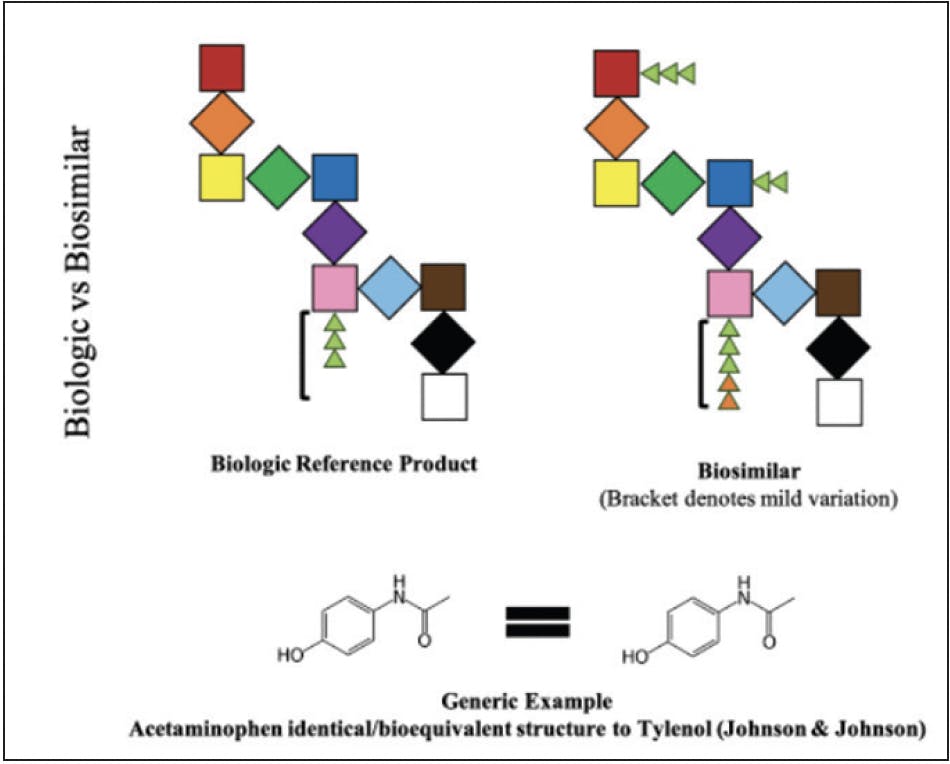
Figure. Biosimilars are reverse-engineered and may have minor differences compared with the biologic reference product.
APPROVAL AND ECONOMICS
The cost and time to develop drugs vary significantly depending on the type.2-4 A biologic reference drug takes 10 to 15 years to develop, costing $1.2 to $2.5 billion. Biosimilars take 8 to 10 years and $100 to $200 million to develop, and generics take 3 to 5 years and $1.0 to $5.0 million to develop.
Once similar pharmacokinetics and pharmacodynamics are established, biosimilars require fewer clinical trials than biologic reference drugs.3 After biosimilarity has been established for a product, it may be approved for all the same indications as the reference drug through extrapolation.3 In theory, these savings pass to the patient, and it is estimated that biosimilars may save more than $100 billion by 2024.4
INDIA’s BIOSIMILAR EXPERIENCE
India’s experience with Razumab (biosimilar ranibizumab, Intas Pharmaceuticals) provides important insight into the ophthalmic biosimilar experience.
Compounding pharmacies are rare in India; furthermore, insurance companies do not always reimburse for anti-VEGF therapy. Thus arose an unmet need for affordable anti-VEGF agents, and researchers in India quickly found themselves on the frontier of biosimilar development. In 2015, the Drug Controller General of India approved Razumab. The RE-ENACT Razumab study was a 12-week retrospective, noncomparative, multicenter study of pooled patients with wet AMD, diabetic macular edema, and retinal vein occlusion. The data showed overall improvements in BCVA and central macular thickness.5
Razumab became the world’s first biosimilar for ranibizumab, and it was rapidly adopted in India. A survey by Sheth et al showed that use of Razumab by vitreoretinal specialists in India grew from 41% in 2018 to 56% in 2020.6 Since then, several biosimilars of bevacizumab have been approved in India, such as Zybev (Zydus Cadila) and Bevatas (Intas Pharmaceuticals), although retina specialists in India have been slower to adopt these.6
Razumab’s rapid adoption in India has not been without controversy. Clusters of sterile endophthalmitis were reported in patients treated with early batches of the drug in 2015 as well as in 2017 and 2019; these reports may have contributed to adoption hesitancy.6,7
BIOSIMILARS IN THE UNITED STATES
Ranibizumab-nuna (Byooviz, Samsung Bioepis/Biogen) is the United States’ first FDA-approved ophthalmic biosimilar. Woo et al conducted a phase 3 randomized controlled trial with wet AMD patients that showed equivalent BCVA, central subfield thickness improvements, and low immunogenicity in the biosimilar group compared with the ranibizumab group.8 These results suggest that ranibizumab-nuna is a viable and safe alternative biosimilar treatment for the biologic reference drug ranibizumab.
However, the cost of the drug remains to be seen, as neither Samsung nor Biogen has commented on its potential pricing strategy. Notably, ranibizumab-nuna will not be brought to the US market until June 2022, due to a licensing agreement with Genentech.9
The buzz surrounding biosimilars continues to build in the United States, propelled in part by two bills signed into law on April 23, 2021: The Ensuring Innovation Act and the Advancing Education on Biosimilars Act.10 The goal of these two bills is to educate health care professionals about biosimilars and promote generic and biosimilar competition.
Numerous ophthalmic biosimilars are in the pipeline and are discussed in this article (Table).
_1639675251.png?auto=compress,format)
Ranibizumab
Another biosimilar on the horizon for this reference agent is FYB201 (Formycon and Bioeq). The phase 3 COLUMBUS-AMD trial met its primary endpoint and showed no significant difference in BCVA improvement or adverse events between FYB201 and ranibizumab for the treatment of wet AMD.11 Formycon and Bioeq announced submission of a biologics license application (BLA) for FYB201 on August 5, 2021. If it’s approved, Coherus BioSciences will exclusively distribute FYB201 in the United States, starting as early as 2022.12
The ranibizumab biosimilar Xlucane (Stada Arzneimittel and Xbrane Biopharma) recently met the primary endpoint of equivalent improvement in BCVA after 8 weeks of treatment of wet AMD in the multicenter phase 3 XPLORE trial; adverse events and immunogenicity were similar between the two treatment groups.13 Xbrane plans to submit a BLA in the second half of 2021, according to the company.13
PF582 (Pfenex) is another ranibizumab biosimilar under investigation, although development has been on hiatus.14
Aflibercept
Formycon and Bioeq are sponsoring the phase 3 MAGELLAN-AMD trial for aflibercept biosimilar FYB203 and are expecting to introduce the product to the US market in 2024.15 MYL1710 (Momenta Pharmaceuticals and Mylan) is being studied in a phase 3 randomized controlled trial for diabetic macular edema treatment.
Other potential aflibercept biosimilars under investigation include ALT-L9 (Alteogen), ABP 938 (Amgen), SB15 (Samsung Bioepis/Biogen), CT-P42 (Celltrion), SOK583A1 (Sandoz), and SCD411 (Sam Chun Dang Pharm).16-21
Bevacizumab
Given the cost-effectiveness, safety, availability, and popularity of off-label bevacizumab, the demand for a biosimilar in the United States may be limited. Nevertheless, at least one is in the works. Bevacizumab-vikg (Lytenava/ONS-5010, Outlook Therapeutics) is an ophthalmic preparation of bevacizumab designed to address the potential complications of off-label use of repackaged bevacizumab. Bevacizumab-vikg showed a favorable safety profile similar to that of bevacizumab in the NORSE THREE phase 3 trial, and the company plans to file a BLA in the first quarter of 2022.22
Importantly, the AAO recently denounced the push by insurance companies for the off-label use of nonophthalmic bevacizumab biosimilars bevacizumab-bvzr (Zirabev, Pfizer) and bevacizumab-awwb (Mvasi, Amgen).23 These biosimilars, approved for intravenous therapy for oncologic indications, have never been tested in the eye.
FUTURE DIRECTIONS
The anti-VEGF biosimilar pipeline is booming, and many promising cost-effective alternatives are working their way through trials. Immunogenicity remains a concern, although current data from phase 3 clinical trials showed similar safety profiles to biologic reference drugs. It is critical that ophthalmic and retina providers educate themselves on the differences between biologics, biosimilars, and generics.
Given the favorable safety profile and widespread availability of current biologic reference anti-VEGF agents in the United States, the future adoption of biosimilars remains to be seen. Retina specialists will have to consider many factors, including immunogenic and overall safety profile, availability, cost, and effectiveness.
1. Food and Drug Administration. Biological product definitions. Accessed October 13, 2021. www.fda.gov/files/drugs/published/Biological-Product-Definitions.pdf
2. Sharma A, Reddy P, Kuppermann BD, Bandello F, Lowenstein A. Biosimilars in ophthalmology: “Is there a big change on the horizon?” Clin Ophthalmol. 2018;12:2137-2143.
3. Food and Drug Administration. Biosimilar development, review, and approval. Accessed October 13, 2021. www.fda.gov/drugs/biosimilars/biosimilar-development-review-and-approval
4. Aitken M, Kleinrock M. Biosimilars in the United States, 2020-2024. Accessed October 13, 2021. www.iqvia.com/insights/the-iqvia-institute/reports/biosimilars-in-the-united-states-2020-2024
5. Sharma S, Khan M, Chaturvedi A. A multicenter, retrospective study (RE-ENACT 2) on the use of Razumab (world’s first biosimilar ranibizumab) in wet age-related macular degeneration. Ophthalmol Ther. 2020;9(1):103-114.
6. Sheth JU, Stewart MW, Khatri M, et al. Changing trends in the use of anti-vascular endothelial growth factor (anti-VEGF) biosimilars: Insights from the Vitreoretinal Society of India Biosimilars of Anti-VEGF Survey. Indian J Ophthalmol. 2021;69(2):352-356.
7. Sharma A, Kumar N, Kuppermann B, Francesco B, Lowenstein A. Ophthalmic biosimilars: lessons from India. Indian J Ophthalmol. 2019;67(8):1384-1385.
8. Woo SJ, Veith M, Hamouz J, et al. Efficacy and safety of a proposed ranibizumab biosimilar product vs a reference ranibizumab product for patients with neovascular age-related macular degeneration: a randomized clinical trial. JAMA Ophthalmol. 2021;139(1):68-76.
9. Biogen. FDA approves Samsung Bioepis and Biogen’s BYOOVIZ (SB11), LUCENTIS biosimilar (ranibizumab-nuna) [press release]. September 20, 2021. Accessed October 13, 2021. investors.biogen.com/news-releases/news-release-details/fda-approves-samsung-bioepis-and-biogens-byooviztm-sb11
10. Govindgari S, Nuernberger C. President Biden signs legislation boosting generic and biosimilar drugs. Accessed September 24, 2021. www.whitecase.com/publications/alert/president-biden-signs-legislation-boosting-generic-and-biosimilar-drugs-help
11. Holz FG, Oleksy P, Ricci F, et al. Efficacy and safety of biosimilar FYB201 compared with ranibizumab in neovascular age-related macular degeneration. Preprint. Published online May 3, 2021. Ophthalmology.
12. Bioeq. FYB201. Accessed September 24, 2021. www.bioeq.com/development-programs/fyb201
13. XLUCANE meets the primary endpoint in the pivotal phase III trial with XLUCANE – regulatory submission in EU and US planned for second half of 2021 [press release]. Accessed September 24, 2021. xbrane.com/en/mfn_news_en/xlucane-meets-the-primary-endpoint-in-the-pivotal-phase-iii-trial-with-xlucane-regulatory-submission-in-eu-and-us-planned-for-second-half-of-2021
14. Eye on Pharma: Pfenex may resume biosimilar development on ranibizumab and pegfilgrastim [press release]. Accessed September 24, 2021. www.centerforbiosimilars.com/view/eye-on-pharma-pfenex-may-resume-biosimilar-development-on-ranibizumab-and-pegfilgrastim
15. Bioeq. FYB203. Accessed September 25, 2021. www.bioeq.com/development-programs/fyb203
16. US National Library of Medicine. Clinical study of ALT-L9 to determine safety, efficacy and pharmacokinetics in neovascular age-related macular degeneration. Accessed October 13, 2021. clinicaltrials.gov/ct2/show/NCT04058535
17. US National Library of Medicine. A study to understand effectiveness and safety of ABP 938 compared to aflibercept (Eylea) in patients suffering with neovascular age-related macular degeneration [neovascular (wet) AMD]. Accessed October 13, 2021. clinicaltrials.gov/ct2/show/NCT04270747
18. US National Library of Medicine. A study to compare SB15 (proposed aflibercept biosimilar) to Eylea in subjects with neovascular age-related macular degeneration (AMD). Accessed October 13, 2021. clinicaltrials.gov/ct2/show/NCT04450329
19. US National Library of Medicine. Study to compare efficacy and safety of CT-P42 in comparison with Eylea in patients with diabetic macular edema. Accessed October 13, 2021. clinicaltrials.gov/ct2/show/NCT04739306
20. US National Library of Medicine. Phase III study assessing the efficacy, safety and immunogenicity of SOK583A1 versus Eylea in patients with neovascular age-related macular degeneration (Mylight). Accessed October 13, 2021. clinicaltrials.gov/ct2/show/NCT04864834
21. US National Library of Medicine. A study to comparing SCD411 and Eylea in subjects with wet age-related macular degeneration (AMD). Accessed October 13, 2021. clinicaltrials.gov/ct2/show/NCT04480463
22. Outlook Therapeutics reports positive safety profile from NORSE THREE open-label safety study for ONS-5010 / LYTENAVA (bevacizumab-vikg) [press release]. Outlook Therapeutics. Accessed September 25, 2021. ir.outlooktherapeutics.com/news-releases/news-release-details/outlook-therapeutics-reports-positive-safety-profile-norse-three
23. Insurance companies are pushing biosimilar drugs that may damage vision [press release]. American Academy of Ophthalmology. Accessed September 25, 2021. www.aao.org/newsroom/news-releases/detail/insurance-companies-are-pushing-biosimilar-drugs


-1_1643042672.jpg?auto=compress,format&w=70)
-1_1643727930.jpg?auto=compress,format&w=70)


_1784132761.jpg?auto=compress,format&w=75)





