




The primary treatment approach for retinal diseases, particularly for wet AMD, has oscillated between medical management (in-office laser treatment, injections, and systemic therapies) and surgical management (subretinal choroidal neovascular membrane removal, macular translocation, and surgical transplantation of the retinal pigment epithelium [RPE]). The introduction of anti-VEGF therapy effectively sidelined the surgical management of wet AMD.1 The widely adopted off-label use of intravitreal bevacizumab (Avastin, Genentech) drove the treatment of wet AMD further into the medical realm.2
A similar treatment trend is occurring with diabetic retinopathy (DR), with a shift from primary surgical correction of proliferative DR complications, such as vitreous hemorrhage and tractional retinal detachments, toward prevention of these complications altogether using anti-VEGF therapies.
PANORAMA is a phase 3 clinical trial assessing patients with moderately severe to severe nonproliferative DR without center-involving diabetic macular edema treated with loading doses of aflibercept (Eylea, Regeneron) followed by fixed-interval injections or sham injections. At years 1 and 2, fewer patients in the aflibercept arms developed a vision-threatening complication due to proliferative DR, including vitreous hemorrhage and tractional retinal detachments, either of which would require surgical intervention.3,4
Potential in-office intravitreal anti-VEGF therapies now in phase 2 and 3 trials include faricimab (Genentech/Roche), conbercept (Chengdu Kanghong Biotech), OPT-302 (Opthea), KSI-301 (Kodiak), and GB-102 (Graybug Vision).5-20 Many of these promise increased durability or sustained release for the treatment of neovascular AMD and DR.
(See Advances in Wet AMD Research and The Diabetic Eye Disease Pipeline in 2021 for more on these therapies.)
Wet AMD SURGICAL INNOVATIONS
The medical retina pipeline is robust, but so is the surgical pipeline—and it’s already proving fruitful. In October, the FDA approved the port delivery system with ranibizumab (Susvimo, Genentech/Roche), expanding our clinical armamentarium for wet AMD. Several other innovations on the horizon have the potential to revolutionize the treatment of retinal disease, and many of them harness the power of gene therapy to provide continuous dosing of medications.
HOW IT STARTED
Retina surgery has changed dramatically since Retina Today’s first issue. Surgeons in 2006 were still hotly debating the utility of 25-gauge surgery, with some concluding that the time saved by the sutureless technique was lost because of the longer surgery time.1,2
Autologous transplantation of retinal pigment epithelium remained a go-to treatment option for many patients with AMD, and meeting lecturers were still trying to figure out when it was appropriate to forego anti-VEGF therapy in favor of the tried-and-true subretinal surgical removal of neovascular membranes.3,4
Oh, and that implantable miniature telescope (SING IMT, Samsara) that’s now in its second generation?5 The FDA’s Ophthalmic Devices Advisory Panel suggested it was “not approvable” in July 2006.6
1. Wimpissinger B, Kellner L, Stolba U, Binder S. Miniaturized instruments in vitreoretinal surgery: the future? Retina Today. 2006;1(2).
2. Eckardt C. 23-gauge surgery replaces 20- or 25-gauge — in most cases. Retina Today. 2006;1(4).
3. Kokame GT. An indication for surgery in the antiangiogenic era. Retina Today. 2006;1(2).
4. MacLaren RE. Autologous transplantation of rpe for the management of acute exudative AMD. Retina Today. 2006;1(2).
5. Samsara Vision: patients blinded by macular degeneration may benefit from implant technology [press release]. May 25, 2021.
6. Koury CB. Implantable telescope not recommended for approval, but there is reason for optimism. Retina Today. 2006;1(4).
RGX-314 (Regenxbio) is a novel adeno-associated virus serotype 8 vector used to deliver a gene encoding for an anti-VEGF antigen-binding fragment. It is designed to produce continuous anti-VEGF therapy to treat wet AMD and DR.21-23 Subretinal delivery of this therapy requires a pars plana vitrectomy (PPV) followed by creation of a subretinal bleb using a 41-gauge needle (Figure).21,24
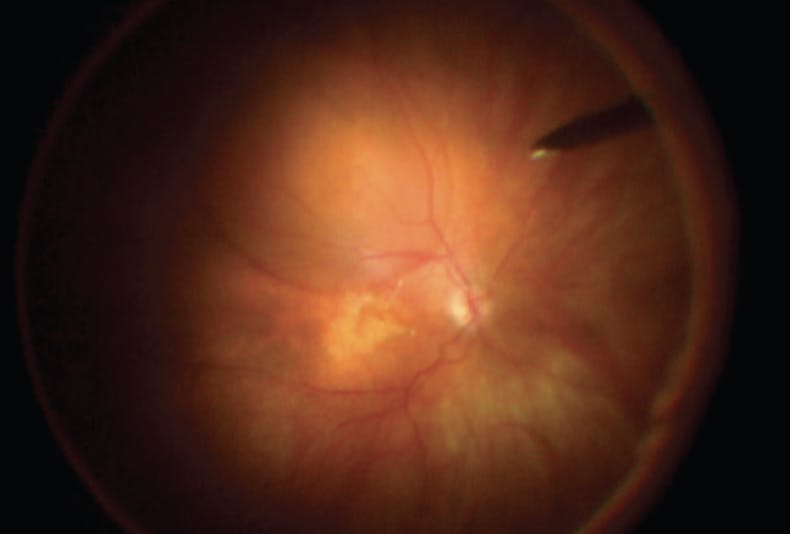
The phase 1/2a clinical trial of patients with wet AMD is complete with 2-year data from all five dose cohorts. Patients in cohorts 3, 4, and 5 showed improved vision and a significant reduction in the need for supplemental anti-VEGF injections. Anti-VEGF protein levels were dose-dependent and durable for at least 2 years.21,24 All six patients in cohort 3 enrolled in the long-term follow-up study, and treatment effect was demonstrated over 3 years with a mean BCVA improvement of +12 letters from baseline. Cohort 3 showed a 66.7% decrease in the rate of annual anti-VEGF injections compared with the 12 months prior to RGX-314 therapy. Cohorts 4 and 5 showed a 58.3% and 81.2% reduction of anti-VEGF injections, respectively, at 1.5 years. Both cohorts experienced stable vision and decreased retinal thickness.24
Notably, no immunologic reactions, drug-related ocular inflammation, or postsurgical inflammation was seen beyond what is anticipated after routine PPV.21 However, retinal pigmentary changes in 69% of patients necessitated a change in the surgical technique to help prevent macular changes.21,25
The phase 2b/3 ATMOSPHERE trial is now recruiting and will randomly assign 300 pseudophakic patients with wet AMD to receive subretinal RGX-314 or monthly intravitreal ranibizumab. The primary endpoint is the change in visual acuity compared with monthly ranibizumab at week 54.26
Oscillating back to medical management, the phase 2 AAVIATE and ALTITUTE trials are assessing in-office suprachoroidal injection of RGX-314.22,23
OUT OF THE PIPELINE AND INTO PRACTICE
_1639674253.png?auto=compress,format)
Figure. These images of the PDS demonstrate excellent postoperative closure of the overlying conjunctiva (A) and good intraocular positioning in the vitreous chamber (B).
The port delivery system (PDS) with ranibizumab (Susvimo, Genentech/Roche) gained FDA approval in October.1 The permanent, refillable intraocular implant is filled with the concentrated formulation in the OR and then surgically implanted through a pars plana incision (Figure). Subsequent refill-exchange procedures are performed in the office.
The approval comes on the heels of positive data from the phase 3 ARCHWAY study, in which patients with wet AMD in the PDS treatment arm achieved and maintained vision gains equivalent to those who recieved monthly ranibizumab injections at weeks 36 and 40 of treatment. Notably, 98.4% of patients in the PDS arm did not require supplemental treatment out to the first refill-exchange at 24 weeks.2
PAGODA and PAVILION are phase 3 randomized trials evaluating the PDS with ranibizumab in the treatment of diabetic retinopathy.3,4
1. FDA approves Genentech’s new treatment for wet age-related macular degeneration (AMD) [press release]. October 22, 2021. Accessed October 25, 2021. www.gene.com/media/news-features/fda-approves-genentech-s-new-treatment-for-wet-age-related-macular-degeneration-amd
2. Holekamp NM, Campochiaro PA, Chang M, et al; all Archway Investigators. Archway randomized phase 3 trial of the port delivery system with ranibizumab for neovascular age-related macular degeneration. Published online September 29, 2021. Ophthalmology.
3. A multicenter, randomized study in participants with diabetic retinopathy without center-involved diabetic macular edema to evaluate the efficacy, safety, and pharmacokinetics of ranibizumab delivered via the Port Delivery System relative to the comparator arm (PAVILION). Accessed August 26, 2021. clinicaltrials.gov/ct2/show/NCT04503551
4. A phase III, multicenter, randomized, visual assessor-masked, active-comparator study of the efficacy, safety, and pharmacokinetics of the Port Delivery System with ranibizumab in patients with diabetic macular edema (Pagoda). Accessed August 26, 2021. clinicaltrials.gov/ct2/show/NCT04108156
GEOGRAPHIC ATROPHY SURGICAL INNOVATIONS
Geographic atrophy (GA) is a disease for which an efficacious surgical intervention might have the greatest impact. Future surgical therapies for GA will rely on early detection followed either by gene therapy to slow the progression of GA or cellular therapy to replace damaged RPE cells.
In the HORIZON and EXPLORE phase 2 clinical trials, GT005 (Gyroscope Therapeutics) is surgically injected into the subretinal space via a pars plana approach.27,28 GT005 is an adeno-associated virus vector designed to deliver a gene encoding for complement factor I.27-29 The FOCUS phase 1/2 is a safety and dose-finding study where GT005 is delivered subretinally using either a transvitreal approach (cohorts 1–4) or the Orbit Subretinal Delivery Device System (Gyroscope Therapeutics) where GT005 is delivered via suprachoroidal cannulation (cohorts 5–7).29 Interim data showed that GT005 was well tolerated at all doses and treatment resulted in sustained increases in vitreous complement factor I levels in the majority of patients.30 There have been no clinically significant GT005-related ocular inflammatory events.30
A phase 1/2a clinical trial at the National Eye Institute is evaluating the feasibility of subretinal transplantation of induced pluripotent stem cell–derived RPE.31 Induced pluripotent stem cells are generated from a GA patient’s somatic cells, differentiated into RPE cells, and grown on a monolayer of biodegradable polylactic-co-glycolic acid scaffold. The cells are then transplanted into the subretinal space of the same patient with the goal of rescuing the overlying neurosensory retina from further degradation.31-33 A PPV is required, and the transplant is placed through a planned retinotomy, requiring a gas tamponade.31
OpRegen (Lineage Cell Therapeutics) uses human embryonic stem cell–derived RPE cells that are transplanted subretinally in patients with GA. The phase 1/2a trial includes four cohorts, the first three of which are complete. Data show that the treatment was well tolerated with no unexpected adverse events and no inflammatory events. At 15 months, treated eyes had a statistically significant improvement in BCVA compared with the fellow eyes. Early OCT imaging suggests the possible resolution of incomplete RPE and outer retinal atrophy after treatment.34
FINAL THOUGHTS
Inevitably, the primary treatment of retinal diseases will continue to oscillate between medical and surgical interventions as new approaches emerge. We have an arsenal of therapeutics, many of which are surgical, on the horizon that may provide a longer duration of therapy and perhaps even permanent solutions to these challenging diseases.
1. Gragoudas ES, Adamis AP, Cunningham ET, Feinsod M, Guyer DR; VEGF Inhibition Study in Ocular Neovascularization Clinical Trial Group. Pegaptanib for neovascular age-related macular de-generation. N Engl J Med. 2004;351(27):2805-2816.
2. Michels S, Rosenfeld PJ, Puliafito CA, Marcus EN, Venkatraman AS. Systemic bevacizumab (Avastin) therapy for neovascular age-related macular degeneration twelve-week results of an uncontrolled open-label clinical study. Ophthalmology. 2005;112(6):1035-1047.
3. Boyer DS. Treatment of moderately severe to severe nonproliferative diabetic retinopathy with intravitreal aflibercept injection: 52-week results from the phase 3 PANORAMA study. Invest Ophthalmol Vis Sci. 2019;60(9):1731-1731.
4. Lim JI. Intravitreal aflibercept injection for nonproliferative diabetic retinopathy: year 2 results from the PANORAMA study. Invest Ophthalmol Vis Sci. 2020;61(7):1381-1381.
5. A phase III, multicenter, randomized, double-masked, active comparator-controlled study to evaluate the efficacy and safety of faricimab (RO6867461) in patients with diabetic macular edema (YOSEMITE). Accessed August 9, 2021. clinicaltrials.gov/ct2/show/NCT03622580
6. A phase III, multicenter, randomized, double-masked, active comparator-controlled study to evaluate the efficacy and safety of faricimab (RO6867461) in patients with diabetic macular edema (RHINE). Accessed July 15, 2021. clinicaltrials.gov/ct2/show/NCT03622593
7. A phase III, multicenter, randomized, double-masked, active comparator-controlled study to evaluate the efficacy and safety of faricimab in patients with neovascular age-related macular degeneration (TENAYA). Accessed July 15, 2021. clinicaltrials.gov/ct2/show/NCT03823287
8. A phase III, multicenter, randomized, double-masked, active comparator-controlled study to evaluate the efficacy and safety of faricimab in patients with neovascular age-related macular degeneration (LUCERNE). Accessed July 15, 2021. clinicaltrials.gov/ct2/show/NCT03823300
9. Safety and efficacy study of conbercept in diabetic macular edema (DME) (Sailing). Accessed July 17, 2021. clinicaltrials.gov/ct2/show/NCT02194634
10. A multicenter, double-masked, randomized, dose-ranging trial to evaluate the efficacy and safety of conbercept intravitreal injection in subjects with neovascular age-related macular degeneration (AMD) (PANDA-1). Accessed July 15, 2021. clinicaltrials.gov/ct2/show/NCT03577899
11. A multicenter, double-masked, randomized, dose-ranging trial to evaluate the efficacy and safety of conbercept intravitreal injection in subjects with neovascular age-related macular degeneration (AMD) (PANDA-2). Accessed July 15, 2021. clinicaltrials.gov/ct2/show/NCT03630952
12. A phase 3, multicentre, double-masked, randomised study to evaluate the efficacy and safety of intravitreal opt-302 in combination with ranibizumab, compared with ranibizumab alone, in participants with NAMD. Accessed July 15, 2021. clinicaltrials.gov/ct2/show/NCT04757610
13. A phase 3, multicentre, double-masked, randomised study to evaluate the efficacy and safety of intravitreal OPT-302 in combination with aflibercept, compared with aflibercept alone, in participants with NAMD. Accessed July 15, 2021. clinicaltrials.gov/ct2/show/NCT04757636
14. Phase 1b/2a study of OPT-302 in combination with aflibercept for persistent central-involved diabetic macular edema. Accessed July 15, 2021. clinicaltrials.gov/ct2/show/NCT03397264
15. A phase 2b/3, prospective, randomized, double-masked, active comparator-controlled, multi-center study to investigate the efficacy and safety of repeated intravitreal administration of KSI-301 in subjects with neovascular (wet) age-related macular degeneration. Accessed July 15, 2021. clinicaltrials.gov/ct2/show/NCT04049266
16. A prospective, randomized, double-masked, active comparator-controlled, multi-center, two-arm, phase 3 study to evaluate the efficacy and safety of intravitreal KSI-301 compared with intravitreal aflibercept in participants with visual impairment secondary to treatment-naïve diabetic macular edema (DME). Accessed July 15, 2021. clinicaltrials.gov/ct2/show/NCT04611152
17. A prospective, randomized, double-masked, active comparator-controlled, multi-center, two-arm, phase 3 study to evaluate the efficacy and safety of intravitreal KSI-301 compared with intravitreal aflibercept in participants with visual impairment secondary to treatment-naïve diabetic macular edema (DME). Accessed July 15, 2021. clinicaltrials.gov/ct2/show/NCT04603937
18. A phase 2a multicenter study evaluating the safety, tolerability, and pharmacodynamics of sunitinib malate depot formulation (GB-102) in subjects with diabetic macular edema (DME) and retinal vein occlusion (RVO). Accessed July 15, 2021. clinicaltrials.gov/ct2/show/NCT04085341
19. A phase 1/2 multicenter study evaluating the safety, tolerability, and efficacy of an intravitreal depot formulation of sunitinib malate (GB-102) in subjects with neovascular age-related macular degeneration. Accessed July 15, 2021. clinicaltrials.gov/ct2/show/NCT03249740
20. A phase 2b multicenter dose-ranging study evaluating the safety and efficacy of sunitinib malate depot formulation (GB-102) compared to aflibercept in subjects with neovascular (wet) age-related macular degeneration (ALTISSIMO Study). Accessed July 15, 2021. clinicaltrials.gov/ct2/show/NCT03953079
21. Avery RL. Two year results from the subretinal RGX-314 gene therapy phase 1/2a study for the treatment of nAMD, and an update on suprachoroidal trials. Presented at: AAO 2021; February 13, 2021; Virtual.
22. RGX-314 gene therapy administered in the suprachoroidal space for participants with neovascular age-related macular degeneration (nAMD) (AAVIATE). Accessed October 29, 2021. clinicaltrials.gov/ct2/show/NCT04514653.
23. RGX-314 gene therapy administered in the suprachoroidal space for participants with diabetic retinopathy (DR) without center involved-diabetic macular edema (CI-DME) (ALTITUDE). Accessed October 29, 2021. clinicaltrials.gov/ct2/show/NCT04567550
24. Regenxbio. Regenxbio announces additional positive interim phase I/IIa and long-term follow-up data of RGX-314 for the treatment of wet AMD [press release]. February 16, 2021. Accessed October 25, 2021. regenxbio.gcs-web.com/news-releases/news-release-details/regenxbio-announces-additional-positive-interim-phase-iiia-and
25. Ho A. Subretinal gene therapy for exudative AMD. Presented at: Hawaiian Eye; May 10, 2021; Virtual.
26. A randomized, partially masked, controlled, phase 2b/3 clinical study to evaluate the efficacy and safety of RGX-314 gene therapy in participants with nAMD (ATMOSPHERE). Accessed July 15, 2021. clinicaltrials.gov/ct2/show/NCT04704921
27. HORIZON: a phase II, open-label, outcomes-assessor masked, multicentre, randomised, controlled study to evaluate the safety and efficacy of two doses of GT005 administered as a single subretinal injection in subjects with geographic atrophy secondary to age-related macular degeneration. Accessed July 15, 2021. clinicaltrials.gov/ct2/show/NCT04566445
28. EXPLORE: a phase II, outcomes assessor-masked, multicentre, randomised study to evaluate the safety and efficacy of two doses of GT005 administered as a single subretinal injection in subjects with geographic atrophy secondary to age-related macular degeneration. Accessed August 26, 2021. clinicaltrials.gov/ct2/show/NCT04437368
29. FocuS: first in human study to evaluate the safety and efficacy of GT005 administered in subjects with dry AMD. Accessed September 6, 2021. clinicaltrials.gov/ct2/show/NCT03846193
30. Interim results from a first-in-human phase I/II gene therapy study (FOCUS) of GT005, an investigational AAV2 vector encoding complement factor I (CFI), in patients with geographic atrophy (GA) [press release]. Accessed November 9, 2021. gyroscopetx.com/wp-content/uploads/2021/09/FOCUS-Data-Retina-Society-2021-Presentation_FINAL.pdf
31. A phase I/IIa trial for autologous transplantation of induced pluripotent stem cell-derived retinal pigment epithelium for geographic atrophy associated with age-related macular degeneration. Accessed July 15, 2021. clinicaltrials.gov/ct2/show/NCT04339764
32. Ohmine S, Dietz AB, Deeds MC, et al. Induced pluripotent stem cells from GMP-grade hematopoietic progenitor cells and mononuclear myeloid cells. Stem Cell Res Ther. 2011;2(6):46.
33. Buchholz DE, Hikita ST, Rowland TJ, et al. Derivation of functional retinal pigmented epithelium from induced pluripotent stem cells. Stem Cells. 2009;27(10):2427-2434.
34. Ip M. OpRegen trial: phase I/IIa dose escalation study of human embryonic stem cell–derived retinal pigment epithelium cells transplanted subretinally in patients with advanced AMD. Presented at AAO 2021; November 12, 2021; New Orleans, LA


-1_1643727930.jpg?auto=compress,format&w=70)


-1_1643042672.jpg?auto=compress,format&w=70)

_1784132761.jpg?auto=compress,format&w=75)





