


We report the case of a patient receiving pazopanib for metastatic renal cell carcinoma (RCC) who experienced rhegmatogenous retinal detachment (RRD) and retinal tears. The main purpose of this report is to provide an example of the possible association between treatment with pazopanib (Votrient, Novartis) and retinal findings, which in this case may be associated with delayed healing after retinal laser retinopexy.
THE CASE
A 69-year-old man with a history of hypertension and metastatic RCC presented with myodesopsias and decreased best-corrected distance visual acuity (CDVA; 20/63) in the left eye 4 months after starting treatment with pazopanib. He had been diagnosed with RCC stage T3aN0M0 in 2015 and underwent radical right nephrectomy of his right kidney. One year later, a routine CT scan revealed liver and bilateral lung metastasis, and 50 mg sunitinib (Sutent, Pfizer) daily was initiated. Early hematological toxicity (mild leukopenia and thrombocytopenia) forced a brief suspension of sunitinib, which was reintroduced after normalization.
The patient was in remission for 30 months while receiving sunitinib, but recurrent perianal mucositis motivated the switch to nivolumab (Opdivo, Bristol-Myers Squibb). In June 2020, the patient went to the hospital with an iatrogenic pneumonitis related to nivolumab, successfully treated with high doses of steroids. A daily dose of 600 mg pazopanib was then initiated in August 2020, which was increased to 800 mg daily 2 months later.
Upon presentation to our clinic 2 months after initiating the increased dosage, a superior macula-sparing RRD with a retinal tear at the 1:00 clock position in the left eye was evidenced on fundoscopy. The patient underwent uncomplicated pars plana vitrectomy (PPV) with retinal tear cryoablation and 0.8 mL SF6 gas. Two weeks after surgery, the retina was flat with a vestigial gas bubble and a pale white cryotherapy scar in the superior temporal quadrant.
The day after the 2-week follow-up, the patient went to the hospital with complaints of decreased visual acuity in the right eye, bilateral photopsia, and myodesopsias. A broad peripheric macula-sparing RRD—from the 6:00 to 10:00 clock position and from the 2:00 to 5:00 clock position—with mild hemovitreous and multiple small peripheric breaks was observed in the right eye; the left eye presented with a macula-sparing retinal redetachment in the inferior and temporal sectors. Laser retinopexy was performed on the temporal quadrant in each eye to stop the progression and avoid macular involvement.
The patient consulted with an oncology specialist, who recommended suspending pazopanib. The patient underwent bilateral PPV 5 days after the emergency retinopexy, at which time the right eye detachment had progressed from the laser barricade temporally to involve the macula. A 360° cryoablation and endolaser retinopexy in the inferior and temporal sectors were performed in the right and left eye, respectively, followed by air-fluid exchange and injection of 0.8 mL SF6 gas in each eye.
The day after this procedure, the patient’s retinas were flat, with cryoablation scars in the periphery of the right eye and inferior laser scars in the left eye with a pale white appearance. Intraocular gas fill was approximately 80% in each eye, and the patient was instructed to adhere strictly to the positioning care.
One week later, both retinas remained flat, with a gas fill of 30% to 40%. Five weeks after bilateral PPV, the patient was recovering visual acuity and the retinas remained flat without vestigial gas (Figure). In the left eye, the inferior laser scars started to show dark pigmentation inferiorly but maintained a pale white color in the temporal sector. In the right eye, the cryoablation scars remained pale white.
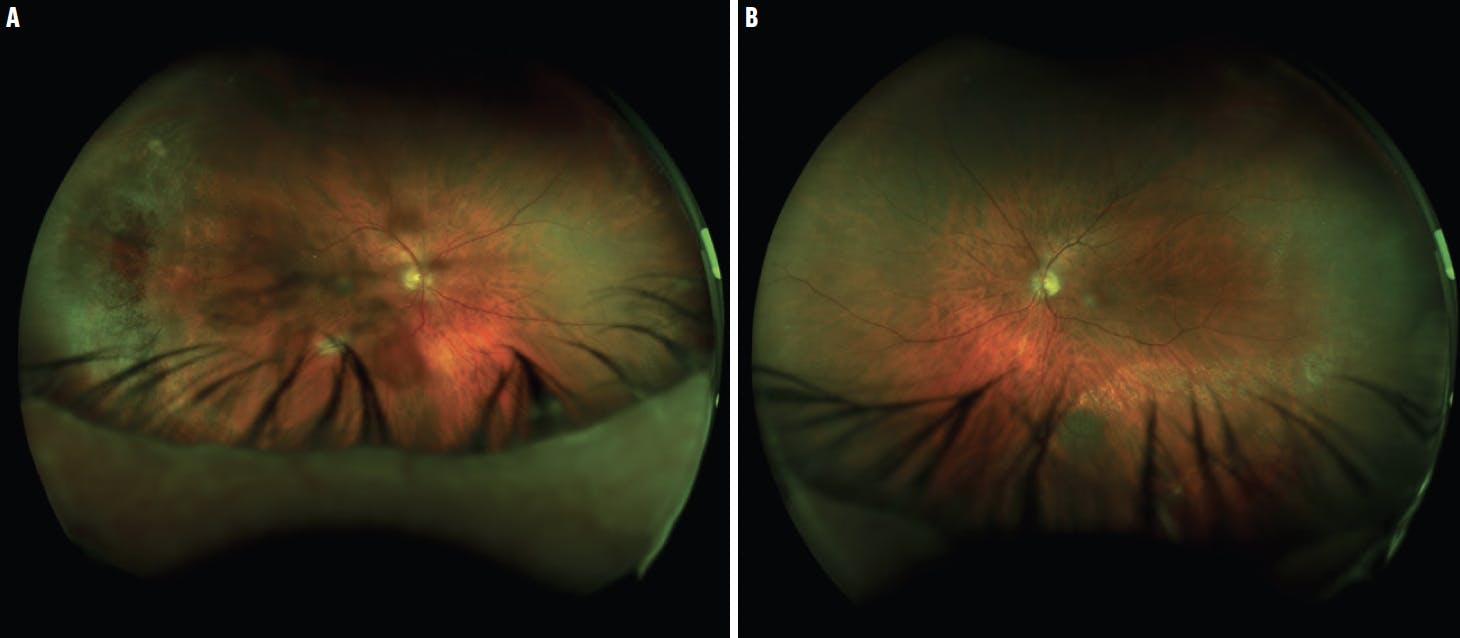
Figure. Six weeks after bilateral PPV of the right (A) and left (B) eyes, the left eye shows pale white laser scars temporally.
Pazopanib was reintroduced 6 weeks after the second surgery, without any known complication. The final CDVA was 20/100 OD and 20/50 OS. A bilateral nuclear sclerosis was exacerbated after surgery.
PAZOPANIB AND RRD
Pazopanib, an anti-VEFG drug that consists of an oral multitargeted tyrosine kinase inhibitor, is primarily used to treat advanced cancers. It also inhibits the platelet derived growth factor receptor, stem cell factor receptor, and fibroblast growth factor receptor. Inhibition of these pathways may interrupt angiogenesis, cell proliferation, cell migration, and vascular permeability, all of which slows tumor growth. Pazopanib has been shown to be effective for the treatment of advanced or metastatic RCC and is associated with fewer systemic side effects than other anti-VEGF drugs.1
Fraunfelder et al reported a possible link between pazopanib and retinal detachments and tears.2 Impaired wound healing has also been postulated as a side effect, and a previous report hypothesized that pazopanib therapy may delay retinal scar formation after retinopexy.3 It is generally recommended that treatment with pazopanib be interrupted at least 1 week before any scheduled major surgery.4
Lifton et al also reported a possible effect of pazopanib on retarding the retinal scarring process after laser photocoagulation.3 Similar to our case, the patient presented with a retinal detachment, and laser scars remained white 2 months after the first intervention, which may indicate abnormal retinal healing. Nonetheless, the authors admit that the pigmentary changes in the retina after photocoagulation may be impaired in patients receiving pazopanib, since the drug appears to affect melanin production.
CONCLUSION
Although this report does not prove a direct link between pazopanib and retinal detachment, it does support the hypothesis that pazopanib may slow wound healing, particularly in the eye, and contribute to various retinal complications after ocular surgery.
1. Frampton JE. Pazopanib: a review in advanced renal cell carcinoma. Target Oncol. 2017;12(4):543-554.
2. Fraunfelder FT, Fraunfelder FW. Oral anti-vascular endothelial growth factor drugs and ocular adverse events. J Ocul Pharmacol Ther. 2018;34(6):432-435.
3. Lifton J, Chow A, Moshfeghi, AA. Failed laser retinopexy in a patient undergoing pazopanib therapy. [published online ahead of print June 12, 2019]. Retin Cases Brief Rep.
4. Eisen T, Sternberg CN, Robert C, et al. Targeted therapies for renal cell carcinoma: review of adverse event management strategies. J Natl Cancer Inst. 2012;104:93-113.


-1_1643042672.jpg?auto=compress,format&w=70)

-1_1643727930.jpg?auto=compress,format&w=70)


_1784132761.jpg?auto=compress,format&w=75)





