

CASE PRESENTATION
Background. A 69-year-old woman presented with a macula-off retinal detachment and VA of 6/60. In cases such as this, my typical approach might consist of a 27-gauge, three-port vitrectomy without perfluorocarbon liquid (PFCL), and I would leave the patient phakic. I tend to use retinotomy to drain the retinal break.
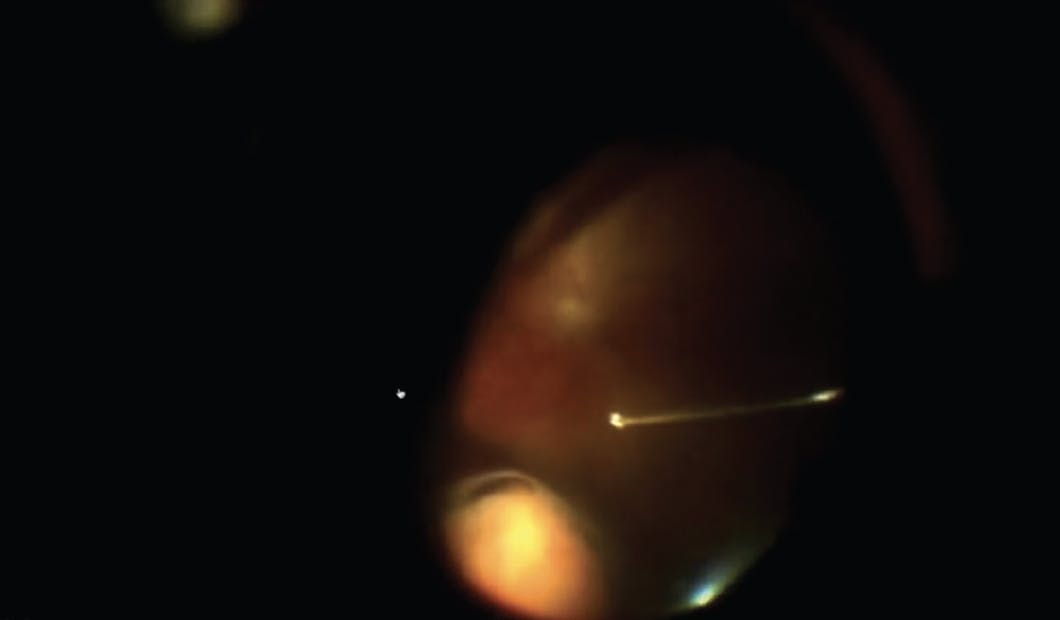
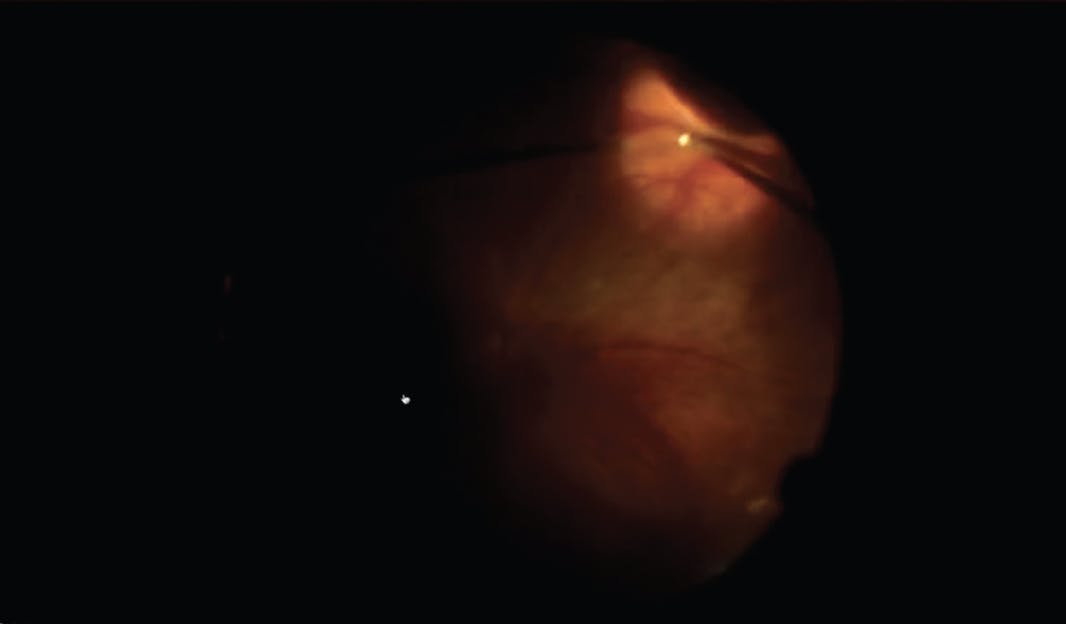
Surgery. With the patient under local anesthesia, I used the entry valved system provided with the 29-Gauge Spotlight Directional Chandelier (29G SDC; Vitreq, a Beaver-Visitec International company). The nice thing about the 29G SDC is that it doesn’t move or rotate the eye like other chandeliers do. In this case the macula-off detachment was a bit bullous, so I used self-indentation to control my movements and ensure that I would not catch the retina (Figure 1). I like to avoid the use of PFCL so that there are less concerns about toxicity and subretinal PFCL accumulation. In this case, I completed the maneuvers in the mid-periphery without removing the lens (Figure 2), which is the safest way to perform this surgery in my opinion.
I used diathermy to mark the breaks and then I applied cryotherapy with CryoTreq (Figure 3). The advantages of the CryoTreq are that it doesn’t require time consuming preparations and it is immediately available.

DISCUSSION
This case was a simple macula-off retinal detachment in which I could drain the retina through the break. Paired with a straightforward 27-gauge, three-port vitrectomy, I was able to easily perform cryotherapy with the single-use CryoTreq to treat the retinal break.
Having access to a nimble cryotherapy unit like the CryoTreq is also helpful because now I can go around 360º without worrying about endangering or risking the lens. Lastly, I find it helpful to use the chandelier while indenting the periphery.
CONCLUSION
Cryotherapy for the treatment of retinal tears and detachments is getting easier thanks to disposable, handheld devices such as the CryoTreq. In my experience, it enhances 27-gauge vitrectomy and helps me to ensure safe, effective surgery while providing my patients with the best possible care.
