


AT A GLANCE
- Annular array ultrasound permits phase focusing on a variety of depths, improving axial and lateral resolution that enhance diagnostic capabilities.
- For advanced mapping of abnormalities, pay attention to the pathology’s proximity to known structures, such as recti muscles and the optic nerve, which are easily identified orbital landmarks during ultrasonography.
- We can now store real-time ultrasounds as still images or movie segments for review, comparison, and transmission.
Initially designed for opaque ocular media, ophthalmic ultrasound imaging has been in the ophthalmologist’s toolbox for more than 70 years. Improvements in image quality, resolution, hardware, and software have expanded its use in today’s vitreoretinal clinics. Annular array devices are the most recent development. These multisonic element probes permit phase focusing on a variety of depths (especially at the higher frequency of 20 MHz), improving axial and lateral resolution. These improvements add important information to the diagnostic interpretation at the vitreoretinal interface, ocular wall, and orbit. When focusing on the retina, relatively minimal elevations (approximately 80 µm axial x 130 µm lateral) are discernable (Figure 1).
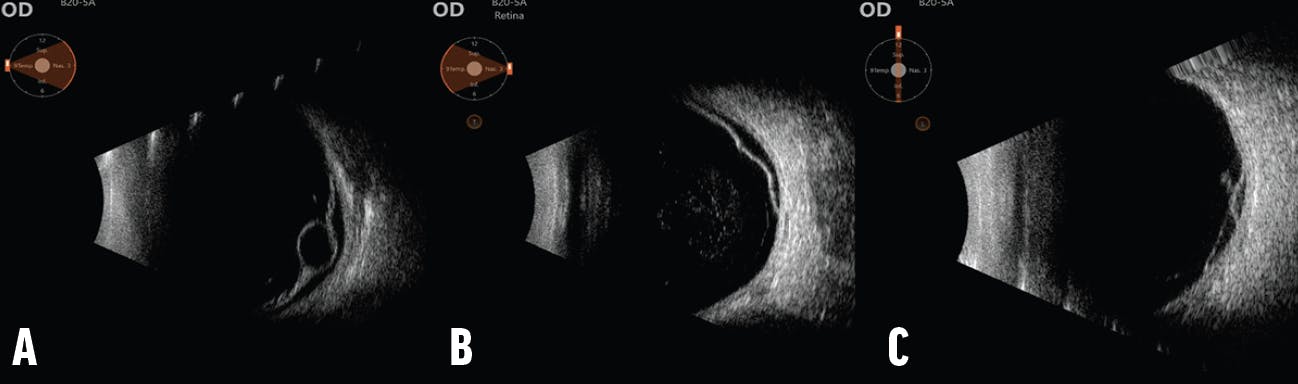
Figure 1. Images acquired with an annular array probe can discern relatively minimal retinal elevations, such as a retinal microcyst in chronic retinal detachment (A); a retinal tear in retinal detachment (B); and a tractional membrane and hemorrhage in tractional retinal detachment (C).
Using ultrasound to examine the ocular wall, clinicians can easily differentiate the retina, choroid, and scleral layers. Additionally, improved choroidal and orbital ultrasound imaging, coupled with real-time clarity, permits easier detection and visualization of vascular pulsations.
Despite these advances, some disadvantages remain. In our experience, clear media differentiation of subtle changes within the vitreous are diminished with most annular probes because the focus is localized to specific areas of interest; areas adjacent to this focus are harder to visualize. Thus, we scan with a single element probe and then switch to an annular array to better visualize areas that require additional resolution (Figure 2). The ability to change quickly from one type of probe to another has significantly improved our sonographic interpretation and pattern recognition.
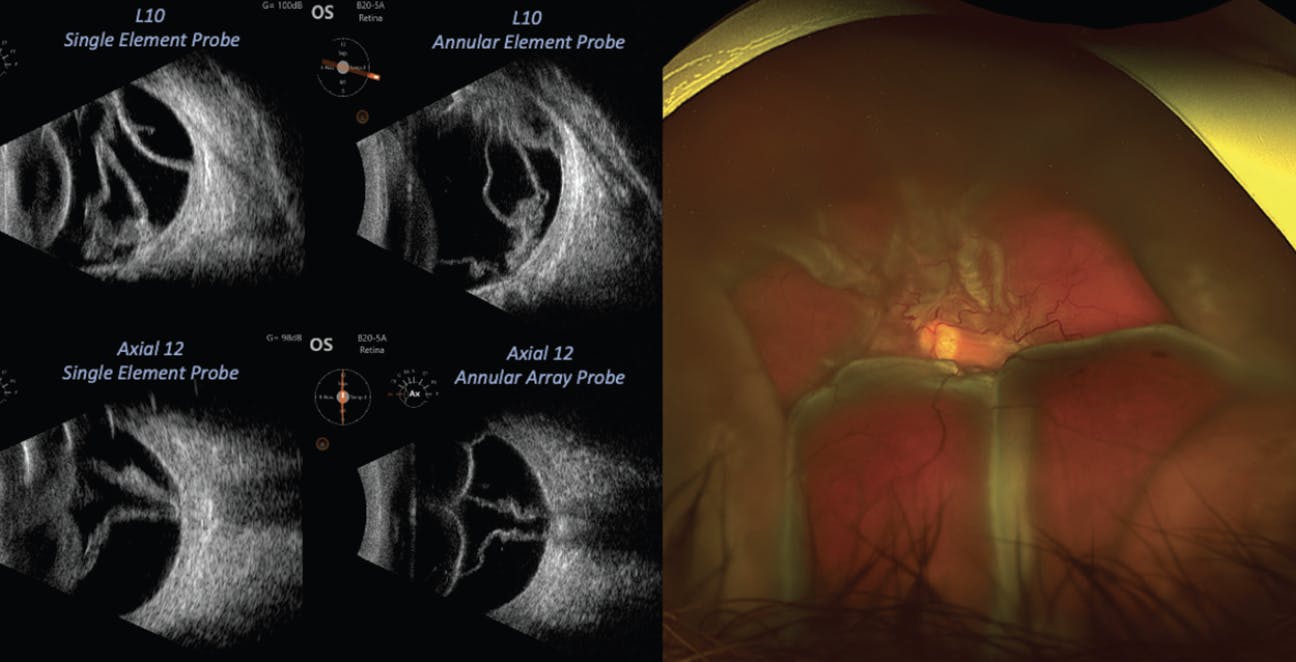
Figure 2. This retinal detachment was scanned with a single element probe and an annular array probe at the L10 meridian and axial 12 of the posterior pole. The annular probe provides additional resolution and identification of subtle pathological changes.
B-SCAN BASICS
The criteria required for interpretation of B-scan ultrasonography remains unchanged: real-time imaging, gray scale interpretation, and 3D thinking. Each adds an essential element to the ultrasound evaluation. The most difficult to master is 3D thinking, which requires real-time mental assembly of the cross-sectional images to recreate a topographic map of the globe and orbit. Changes in probe position during scanning must be accompanied by the correct screen orientation, which is critical for pattern recognition and accurate interpretation.
Ultrasound manufacturers mark their probes to establish the beginning of the scan trace that is projected in the superior portion of the screen. Based on that location, the bottom of the screen represents the end of the scan trace, the left side of the screen is closest to the probe, and the right side of the screen is furthest from the probe. This orientation must be recognized each time the probe is moved during an examination and prior to pattern recognition evaluation. Cross sections of pathologic abnormalities are then mentally reconstructed and interpreted.
Movement and gray scale evaluations complete the examination process. Motion in real-time dynamic ultrasonography is extremely helpful in differentiating many ocular pathologies. For example, the mercurial movement of a formed vitreous separation is quite different from the more uniform and slower movement of a complete and newly formed rhegmatogenous retinal separation.
The next step is recognizing intraocular abnormalities in unfamiliar cross-sectional images. Pattern recognition is the key to diagnostic interpretation and requires experience, especially in complex, combined abnormalities. There are a variety of helpful techniques to aid interpretation. For example, practicing mental cross sections of known objects or reverse reconstruction by drawing what the screen might look like from a particular probe position can be useful.
Gray scale is more difficult to interpret because the probe must be perpendicular to the tissue of interest. Probe positioning becomes paramount in placing the area of interest at the center of the display. Simultaneous A-scan during B-scan capture often helps to ensure the strongest reflections for comparison with those of known strong reflectors, such as the retina or Tenon’s capsule/orbital fat.
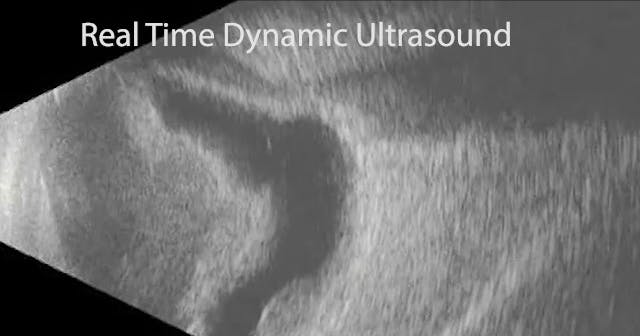
Dynamic Ultrasound of a Separated Posterior Hyaloid
EXAMINING THE GLOBE AND ORBIT
Various techniques for examining the globe and orbit exist, many of which involve direct scleral contact. We have always favored closed-lid examination rather than scleral contact. Here, we provide a step-by-step description of a posterior B-scan ultrasound examination via closed-lid techniques.
1. Briefly review and confirm the patient’s history and ocular examination reports. Take the appropriate precautions for any history of open-globe injury or surgery.
2. Carefully explain the steps to the patient and place the patient in a seated or slightly reclined position.
3. Apply ophthalmic lubricant gel to the clean ultrasound probe prior to scanning.
4. For transverse imaging, ask the patient to gaze inferiorly while you place the probe on the superior lid with the manufacturer’s mark in a nasal direction. With minimal pressure on the globe, tilt the probe to visualize the inferior portions of the eye from the most anterior areas behind the iris in a sweeping fashion back to the optic nerve insertion, fully scanning for any pathology inferiorly. Remember that the top of the screen display represents the nasal and inferior portions of the globe. The bottom of the display shows the temporal and inferior portion of the globe. The center of the display screen represents the 6 clock position. Once you complete the sweep and find no topographic abnormalities, scan the remaining quadrants in a similar fashion. We usually perform a similar transverse scan from the bottom lid. We ask the patient to gaze superiorly and position the probe on the bottom lid to scan superiorly. The top of the screen now represents the superior nasal portions of the globe and the bottom of the screen displays the superior temporal portions. Scan the nasal and temporal areas in a similar fashion, but place the manufacturer’s mark vertically in these two probe positions for correct screen orientation and tracking.
5. Radial imaging is easier to master, considering the probe mark is always directed toward the center of the cornea and pointing to the meridian of interest. The top of the screen displays areas near the back of the iris and ciliary body and the bottom displays the posterior structures with the shadow of the optic nerve. Ask the patient to gaze upward and place the probe at the 6 clock position on the lower lid. Scan the superior globe from the 1 to the 11 clock position to evaluate the vitreous base and radially back to the posterior globe. Move the probe to the 3, 6, 9, and 12 clock positions to access the remainder of the globe (Figure 3). These sweeping real-time examinations are useful in detecting peripheral pathology, such as flap tears and minimal retinal separations.
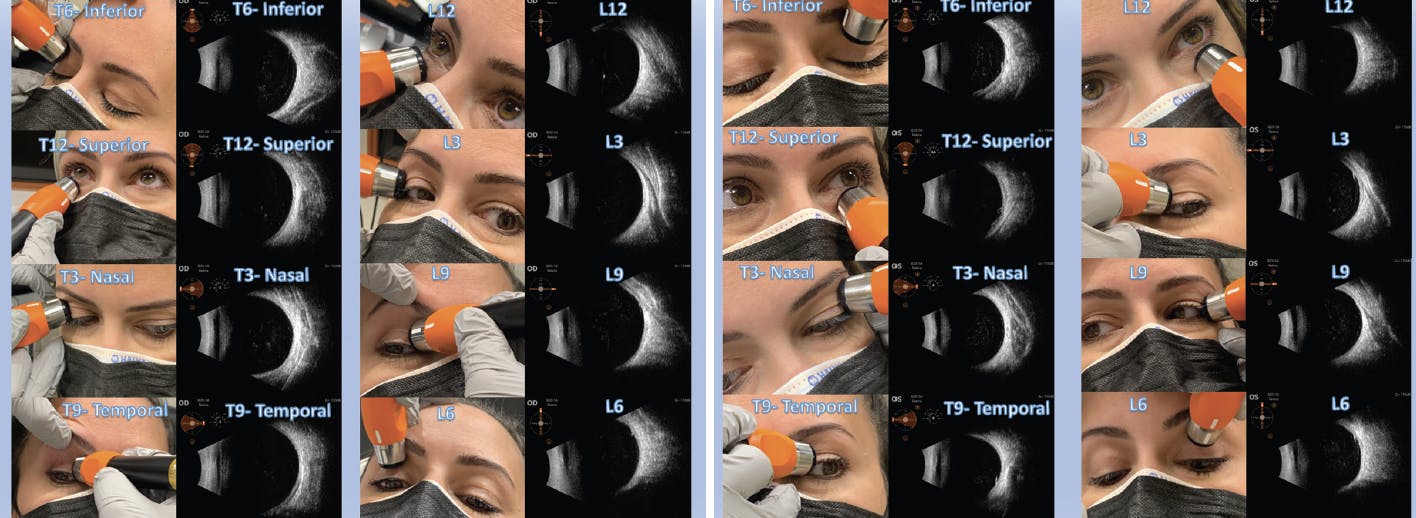
Figure 3. These probe positions correspond with the noted scans and gaze of the right (left) and left (right) eyes.
ULTRASOUND TIPS
We do not examine the posterior globe through probe positions that involve the cornea or anterior segment because avoiding the natural lens or pseudophakic implant is important to prevent artifact reflections. For advanced mapping of abnormalities, pay close attention to the pathology’s proximity to known structures, such as recti muscles and the optic nerve, which are easily identified orbital landmarks. Often, gentle simultaneous scleral depression during the ultrasound evaluation of the anterior retina can help to localize clock hour positions.
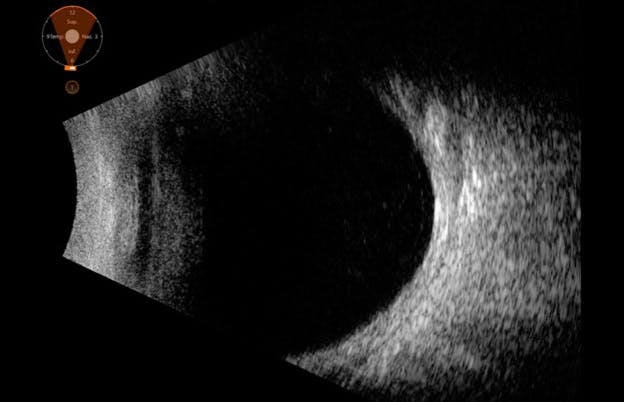
Dynamic Ultrasound of a Horseshoe Tear
Ultrasound equipment continues to improve, and we can now store real-time examinations as still images or movie segments for review, comparison, and transmission. This allows for remote analysis when probe positions are recorded. Newer devices also include automatic scan location detection technology.
Practice with clear media abnormalities, such as retinal and vitreous separation and traction retinal detachment, prior to routine visual examination; this will help you compare structures and improve your interpretation skills.
ULTRASOUND MASTERY
Ocular examination with ultrasound of the globe and orbit is a critical part of imaging for retina specialists. While the technique requires training and experience, the information it provides is well worth the time it takes to master the modality. Ultrasound remains a valuable tool to manage patients with complex vitreoretinal pathology.

_1784132761.jpg?auto=compress,format&w=75)





