


More than 170 years ago, German physician and physicist Hermann von Helmholtz invented the ophthalmoscope, and it remains the most indispensable tool we have in our offices.1 When we started medical school together 38 years ago in Toronto (Figure), the ophthalmoscope was the only imaging tool we were taught! Sure, it’s gone through upgrades since that first iteration, but at its core, the ophthalmoscope hasn’t changed all that much. What’s perhaps most interesting about this brief look into the past is just how cyclical history can be. Back in the 1800s, the ophthalmoscope was challenging to use, and some clinicians even wondered if it was harmful for diseased eyes.1 Not only that, but the minute the ophthalmoscope was introduced, ophthalmologists began tinkering with it; 50 years later, there were at least 140 different models.2 The ophthalmoscope was touted as the one imaging device that “revolutionized the development of ophthalmology” and brought forth “a new epoch” in eye care.1,2
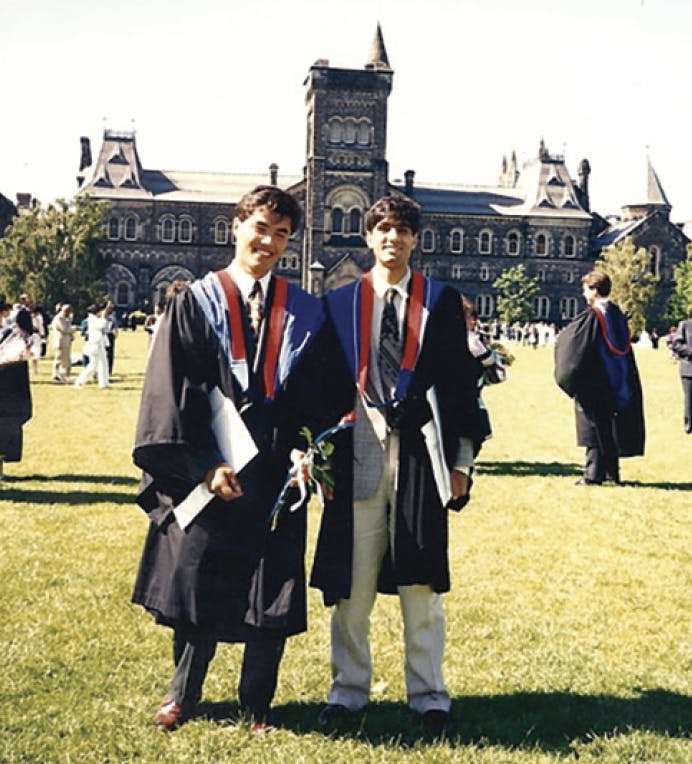
Figure. David R. Chow, MD, FRCSC, (left) and David Sarraf, MD, (right) graduated from University of Toronto Medical School together in 1990 and have been close colleagues ever since.
Sound familiar? Our language may not be quite as flowery, but we are often boasting about new imaging tools that transform the way we diagnose, treat, and follow patients. OCT angiography (OCTA), still in its infancy, is providing information we never thought we could access before. Still, many clinicians at the 50th annual Aspen Retinal Detachment Society meeting admitted that OCTA is challenging to interpret, limiting its clinical utility. But remember, ophthalmologists like to tinker, and OCTA is already improving.
And speaking of that trusty ophthalmoscope that has been a mainstay for nearly 2 centuries—it might actually be obsolete soon. At least in the OR, we now have 3D heads-up displays, and the latest model is finally breaking from the tried-and-true approach with a fully digital system.
So, how are you visualizing the eye? Our toolbox is packed: fundus images, OCT, fluorescein angiography, ultrasound, endoscopy, OCTA, and, one day, artificial intelligence.
In this issue, we focus on what’s sitting in your office and OR right now, and how you can best integrate it into your care. While we wrap our heads around the clinical utility of OCTA, fluorescein angiography remains an important imaging option, and ultrasound is a fantastic tool when your view isn’t great with the ophthalmoscope. OCT is our newest toy that we just can’t stop tinkering with—now research shows it can capture retinal changes associated with systemic disease, and artificial intelligence is already showing promise for analyzing OCT biomarkers of wet AMD. Many of our ORs are a high-tech space with big screens and digital overlays.
We have come a long way since the ophthalmoscope ushered in “the new era in ophthalmology.”1 Now, digitization is promising yet another revolution in how we visualize our patients’ eyes, and how we care for them too.
1. Ivanišević M. First look into the eye. Eur J Ophthalmol. 2019;29(6):685-688.
2. Keeler CR. The ophthalmoscope in the lifetime of Hermann von Helmholtz. Arch Ophthalmol. 2002;120(2):194-201.

_1784132761.jpg?auto=compress,format&w=75)





