


AT A GLANCE
- Advances in OCT machines have led to higher image resolution and faster acquisition speeds.
- Researchers are linking OCT findings to a broad array of cardiovascular and systemic conditions.
- OCT angiography, which provides depth-resolved segmentation of the different capillary layers of the retina, has led to a better understanding of the different patterns and stages of macular ischemia.
- Retinal ischemic perivascular lesions are spectral-domain OCT biomarkers of subclinical ischemia and are associated with coexisting cardiovascular disease.
OCT imaging has revolutionized the clinical practice of retina. By providing a noninvasive ‘optical biopsy’ of the retinal layers, it is now an essential component of every ophthalmologist’s diagnostic armamentarium. Since OCT’s wide implementation in clinical practice more than 2 decades ago, advances in technology have enabled faster acquisition speed and better visualization of the retinal microvasculature, vitreous, and choroid. This has broadened our understanding of retinal and macular pathology. Here, we discuss some of the novel OCT findings associated with systemic conditions with an emphasis on cardiovascular disease (Figure 1).

Figure 1. Advanced retinal imaging may be able to help clinicians detect retinal complications associated with cardiovascular conditions. Illustration by Irene Younan.
THE ISCHEMIC CASCADE IN THE MACULA
OCT angiography (OCTA), which provides depth-resolved segmentation of the different capillary layers of the retina, has led to a better understanding of the various patterns and stages of macular ischemia. For example, in severe retinal vascular occlusions, the inner two-thirds of the retina, which is supplied by the retinal blood supply, is affected. However, in less severe or transient infarctions, the middle retinal layer at the level of the deep capillary plexus may be selectively affected while sparing the inner retinal layer.
On spectral-domain OCT (SD-OCT) scans, this manifests as a hyperreflective band involving the inner nuclear layer (INL) in the middle retina, a sign known as paracentral acute middle maculopathy (PAMM).1-3 PAMM lesions persist for weeks and ultimately atrophy. After the acute phase, contraction of the focal infarct in the INL is often accompanied by a compensatory upward expansion of the outer nuclear layer into the plane where the outer plexiform layer would be expected, leading to a wavy appearance of the middle retinal layers on SD-OCT B-scans (Figure 2).4,5
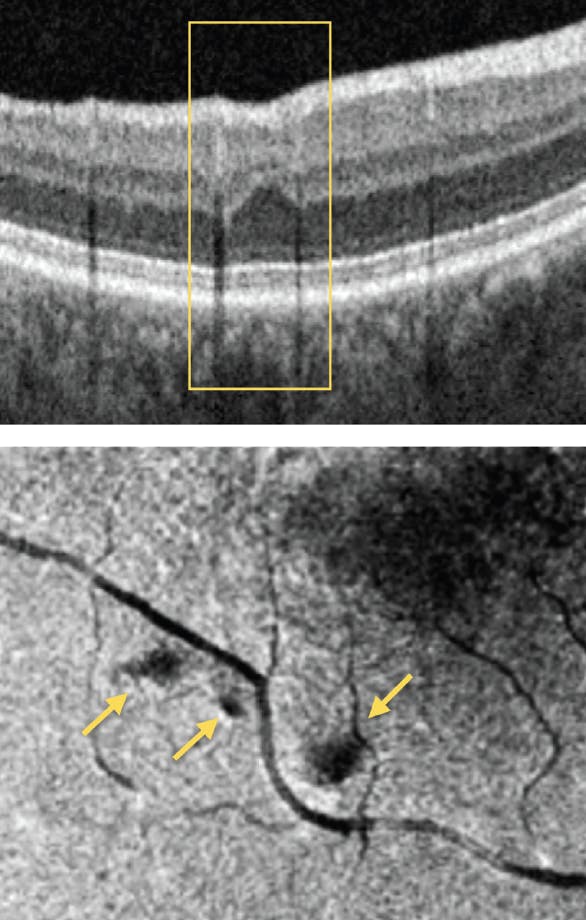
Figure 2. This SD-OCT scan (top) demonstrates a RIPL (yellow box). Note the focal loss of the INL with a compensatory expansion of the outer nuclear layer. In a 3D reconstruction en face view of the middle retina (bottom), the RIPLs (yellow arrows) appear as dark spots.
MATTERS OF THE HEART
The retina, a neural tissue with high metabolic demand and a complex blood supply, often provides evidence of underlying systemic cardiovascular conditions. Capitalizing upon our ability to detect subtle signs of subclinical ischemia in the retina using SD-OCT, we examined whether lesions reminiscent of PAMM, which we termed retinal ischemic perivascular lesions (RIPLs), are prevalent in individuals with cardiovascular disease.4 We analyzed SD-OCT scans from 160 individuals with and without ischemic heart disease, and we noted an increased number of RIPLs in the eyes of patients with heart disease. After adjusting for age, sex, and smoking status, the presence of at least one RIPL was associated with an odds ratio of having cardiovascular disease of 2.34 (confidence interval, 1.16–4.74).
This novel OCT imaging biomarker also correlated with the atherosclerotic cardiovascular disease (ASCVD) risk score calculator, a national guideline developed by the American College of Cardiology that is the standard for assessing a patient’s 10-year risk of experiencing a cardiovascular event. Individuals with intermediate or high ASCVD risk scores had a higher number of RIPLs compared with patients with low or borderline ASCVD risk scores.
Relying on a noninvasive eye scan to detect cardiovascular disease is certainly attractive for many reasons. Cardiovascular disease is the number one cause of death in the world, claiming more than 18 million lives every year.6 Fortunately, lifestyle modifications and medical management can alter the course of disease, and early detection of cardiovascular disease, prior to a catastrophic event, is critical.
An SD-OCT scan is a noninvasive and accessible imaging modality. Therefore, RIPLs could potentially serve as an entry point for the management of cardiovascular health and to identify those who may benefit from additional targeted diagnostic testing.
OTHER FINDINGS
In addition to cardiovascular disease, associations between SD-OCT or OCTA features and other systemic diseases, such as Alzheimer disease (AD), multiple sclerosis (MS), and Parkinson disease (PD), have recently been described. Studies using OCTA imaging have detected reduced capillary perfusion density of the superficial and deep capillary plexuses in eyes of patients with clinical and preclinical AD.7 Patients with PD showed thinning of the inner retinal layers on SD-OCT. OCTA imaging has also documented reduced optic nerve head flow index in patients with MS compared with healthy controls.7 While these findings have yet to be confirmed in larger cohorts, researchers are hopeful that OCTA imaging may one day serve as a noninvasive biomarker of AD, PD, and MS and inform early treatment decisions.
In addition, researchers are now applying artificial intelligence and deep learning to retinal photographs to identify underlying systemic conditions and cardiometabolic risk factors.8,9 An analysis of 97,895 retinal fundus images from 54,813 patients showed a significant association between low retinal microvascular density and vascular branching complexity and higher risk of mortality and cardiometabolic disease.8 Similarly, using only retinal scans and minimal personal information, a deep learning approach predicted the risk of heart attack with a 74% sensitivity and 71% specificity.9
These studies underscore the wealth of information that can be extracted from retinal imaging, including OCTs. Thus, OCT imaging, which has transformed the clinical practice of ophthalmology, can also serve in the management of patients far beyond the eye clinic.
1. Bakhoum MF, Freund KB, Dolz-Marco R, et al. Paracentral acute middle maculopathy and the ischemic cascade associated with retinal vascular occlusion. Am J Ophthalmol. 2018;195:143-153.
2. Scharf J, Freund KB, Sadda S, Sarraf D. Paracentral acute middle maculopathy and the organization of the retinal capillary plexuses. Prog Retin Eye Res. 2021;81:100884.
3. Sarraf D, Rahimy E, Fawzi AA, et al. Paracentral acute middle maculopathy: a new variant of acute macular neuroretinopathy associated with retinal capillary ischemia. JAMA Ophthalmol, 2013;131(10):1275-1287.
4. Long CP, Chan AX, Bakhoum CY, et al. Prevalence of subclinical retinal ischemia in patients with cardiovascular disease - a hypothesis driven study. EClinicalMedicine. 2021;33:100775.
5. Yu S, Wang F, Pang CE, Yannuzzi LA, Freund KB. Multimodal imaging findings in retinal deep capillary ischemia. Retina. 2014;34(4):636-646.
6. American Heart Association. 2021 Heart disease and stroke statistics update fact sheet at-a-glance. Accessed March 3, 2022. www.heart.org/-/media/phd-files-2/science-news/2/2021-heart-and-stroke-stat-update/2021_heart_disease_and_stroke_statistics_update_fact_sheet_at_a_glance.pdf
7. Pellegrini M, Vagge A, Desideri LF, et al. Optical coherence tomography angiography in neurodegenerative disorders. J Clin Med. 2020;9(6):1706.
8. Zekavat SM, Raghu VK, Trinder M, et al. Deep learning of the retina enables phenome- and genome-wide analyses of the microvasculature. Circulation. 2022;145(2):134-150.
9. Diaz-Pinto A, Ravikumar N, Attar R, et al. Predicting myocardial infarction through retinal scans and minimal personal information. Nature Machine Intelligence. 2022;4:55-61.

_1784132761.jpg?auto=compress,format&w=75)





