





Retinal detachments (RDs) associated with giant retinal tears (GRTs; Figure) are challenging to manage surgically given the 40% to 50% rate of proliferative vitreoretinopathy (PVR), leading to redetachments. Modern techniques using widefield visualization, small-gauge pars plana vitrectomy (PPV), endolaser, perfluorocarbon liquids, and silicone oil have improved outcomes, but the role of adjuvant scleral buckling (SB) in GRT-associated detachments remains a debated topic.1-19
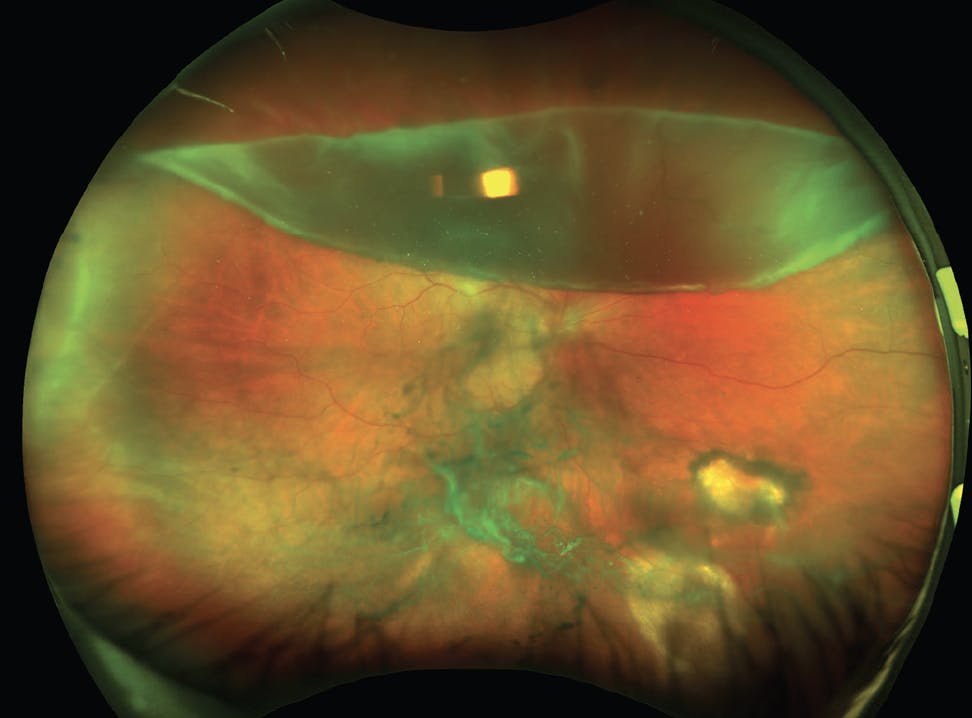
Figure. This widefield color fundus photograph demonstrates a superior giant retinal tear in the right eye of a patient with partial posterior vitreous detachment and inferotemporal chorioretinal scars.
We sought to determine the practice patterns for treating GRT-related detachments by an international cohort of surgeons in a real-world setting, and to compare anatomic and visual outcomes in eyes with GRT-associated RDs that were treated with PPV alone versus PPV with SB.
WHAT DID WE FIND?
A total of 195 patients (200 eyes) were included in the study, with 96 patients (101 eyes) who had undergone PPV and 99 patients (99 eyes) who had PPV with SB. Baseline demographics and ocular characteristics were similar between the two groups.
Single-surgery anatomic success (SSAS) rates at 6 months did not differ between the two groups. Approximately 82.2% of the PPV group and 87.9% of the PPV with SB group remained attached at 6 months after primary repair. Of the 183 eyes (PPV: 92, PPV with SB: 91) with at least 1 year of follow-up, overall SSAS at 1 year was also not statistically different across groups (PPV: 77.2%, PPV with SB: 85.7%). The mean time to first redetachment was 8 and 6 months in the PPV and PPV with SB groups, respectively (P = .8).
Although overall SSAS did not differ at 1 year, a significantly higher 1-year SSAS was achieved with PPV with SB (88.5%) versus PPV (56.3%) in patients younger than 18 years (P = .03). A comparison of baseline characteristics for children versus adults showed that children were more likely to have a history of trauma, worse presenting BCVA, macula-involving detachments, larger detachments, larger GRT, a single retinal tear, and longer total follow up.
At 6 months, SSAS rates were similar between eyes with and without PVR in both the PPV and PPV with SB groups. However, at 1 year, SSAS was different among eyes with and without PVR (P = .047). Among PPV eyes, SSAS was 62.5% and 76.9% for eyes with and without PVR, respectively; among PPV with SB eyes, SSAS was 60% and 88.7% for eyes with and without PVR, respectively.
In eyes that received silicone oil tamponade, there was a higher 1-year SSAS in PPV with SB (90.7%) than PPV alone (76.8%; P = .07). A comparison of baseline characteristics revealed that eyes that received silicone oil (compared with gas tamponade) were younger and had a history of trauma, worse presenting BCVA, macula-involving detachment, larger detachment size, GRT measuring 91° to 179°, and delayed time to primary repair.
SSAS over the entire follow-up period was not statistically different between the PPV (73.3%) and the PPV with SB (83.8%) groups. High proportions of eyes remained attached at the final follow up (PPV: 92.1%, PPV with SB: 94.9%).
The development of postoperative complications between the two surgical groups was similar. The most common etiology for redetachment was PVR grade C or worse for both groups (PPV: 70.4%, PPV with SB: 93.8%). Development of postoperative ocular hypertension occurred in 17.2% and 24.2% of the PPV and PPV with SB groups, respectively. Development of epiretinal membrane occurred in 20.2% of the PPV and PPV with SB groups each. Of phakic patients, 71.1% and 84.6% of the PPV and PPV with SB groups, respectively, developed postoperative cataract. Of these eyes, 90.6% and 90.9% underwent lens extraction surgery over the course of the follow up. Other less common complications included choroidal detachments (3% for both groups), residual subretinal fluid not involving retinal breaks (PPV: 8%, PPV with SB: 7.1%), cystoid macular edema (PPV: 5.1%, PPV with SB: 9.1%), and diplopia (one patient in PPV group).
WHAT DOES THIS MEAN?
Contrary to the trend away from the use of SB in cases of RD, we found that PPV and PPV with SB were both common approaches for the treatment of GRT-related detachments.
In our study, SSAS was high (> 75%) for both surgical groups at 6 months and 1 year. Importantly, SSAS was not different at either time point for eyes treated with PPV alone versus PPV with SB, except in children younger than 18 years.
We hypothesize that the addition of SB in pediatric eyes increases the anatomical success rate by reducing vitreoretinal traction when complete vitreous shaving is difficult in the presence of a natural lens. Furthermore, the vitreous of children with GRTs is often tenacious with strong vitreoretinal interface adhesions, making posterior vitreous detachment induction and complete vitreous removal challenging.20-22
In adults, GRT, by virtue of its size, may reduce vitreoretinal traction and act as a relaxing retinectomy.23-29
This study supports the use of PPV with SB in children and PPV alone in adults as an option for treating GRT-related detachments.
1. Glaser BM. Treatment of giant retinal tears combined with proliferative vitreoretinopathy. Ophthalmology. 1986;93(9):1193-1197.
2. Norton EW, Aaberg T, Fung W, Curtin VT. Giant retinal tears. I. Clinical management with intravitreal air. Trans Am Ophthalmol Soc. 1969;67:374-393.
3. Peyman GA, Rednam KR, Seetner AA. Retinal microincarceration with penetrating diathermy in the management of giant retinal tears. Arch Ophthalmol. 1984;102(4):562-565.
4. Glaser BM, Carter JB, Kuppermann BD, Michels RG. Perfluoro-octane in the treatment of giant retinal tears with proliferative vitreoretinopathy. Ophthalmology. 1991;98(11):1613-1621.
5. Al-Khairi AM, Al-Kahtani E, Kangave D, Abu El-Asrar AM. Prognostic factors associated with outcomes after giant retinal tear management using perfluorocarbon liquids. Eur J Ophthalmol. 2008;18(2):270-277.
6. Chang S, Lincoff H, Zimmerman NJ, Fuchs W. Giant retinal tears. Surgical techniques and results using perfluorocarbon liquids. Arch Ophthalmol. 1989;107(5):761-766.
7. Scott IU, Murray TG, Flynn HW Jr, Feuer WJ, Schiffman JC; Perfluoron Study Group. Outcomes and complications associated with giant retinal tear management using perfluoro-n-octane. Ophthalmology. 2002;109(10):1828-1833.
8. Kertes PJ, Wafapoor H, Peyman GA, Calixto N Jr, Thompson H. The management of giant retinal tears using perfluoroperhydrophenanthrene. A multicenter case series. Vitreon Collaborative Study Group. Ophthalmology. 1997;104(7):1159-1165.
9. Leaver PK, Billington BM. Vitrectomy and fluid/silicone-oil exchange for giant retinal tears: 5 years follow-up. Graefes Arch Clin Exp Ophthalmol. 1989;227(4):323-327.
10. Goezinne F, LA Heij EC, Berendschot TT, et al. Low redetachment rate due to encircling scleral buckle in giant retinal tears treated with vitrectomy and silicone oil. Retina. 2008;28(3):485-492.
11. Batman C, Cekiç O. Vitrectomy with silicone oil or long-acting gas in eyes with giant retinal tears: long-term follow-up of a randomized clinical trial. Retina. 1999;19(3):188-192.
12. Kumar V, Kumawat D, Bhari A, Chandra P. Twenty-five-gauge pars plana vitrectomy in complex retinal detachments associated with giant retinal tear. Retina. 2018;38(4):670-677.
13. Pitcher JD 3rd, Khan MA, Storey PP, et al. Contemporary management of rhegmatogenous retinal detachment due to giant retinal tears: A consecutive case series. Ophthalmic Surg Lasers Imaging Retina. 2015;46(5):566-570.
14. Rodriguez M, Lin J, Townsend JH, et al. Giant retinal tears: clinical features and outcomes of vitreoretinal surgery at a university teaching hospital (2011-2017). Clin Ophthalmol. 2018;12:2053-2058.
15. Ting DSW, Foo VHX, Tan TE, et al. 25-years trends and risk factors related to surgical outcomes of giant retinal tear-rhegmatogenous retinal detachments. Sci Rep. 2020;10(1):5474.
16. Ghosh YK, Banerjee S, Savant V, et al. Surgical treatment and outcome of patients with giant retinal tears. Eye (Lond). 2004;18(10):996-1000.
17. Verstraeten T, Williams GA, Chang S, et al. Lens-sparing vitrectomy with perfluorocarbon liquid for the primary treatment of giant retinal tears. Ophthalmology. 1995;102(1):17-20.
18. Li KX, Carducci N, Moinuddin O, et al. Contemporary management of complex and non-complex rhegmatogenous retinal detachment due to giant retinal tears. Clin Ophthalmol. 2021;15:1013-1022.
19. Ghasemi Falavarjani K, Alemzadeh SA, Modarres M, et al. Outcome of surgery in patients with giant retinal tear: 10 years experience. Eye (Lond). 2017;31(9):1284-1289.
20. Raman R, Kalluri Bharat RP, Bhende P, Sharma T. Managing paediatric giant retinal tears. Eye (Lond). 2021;35(11):2913-2914.
21. Hasan N, Azad SV, Kaginalkar A, et al. Demography, clinical profile and surgical outcomes of paediatric giant retinal tear related retinal detachments. Eye (Lond). 2021;35(11):3041-3048.
22. Wenick AS, Barañano DE. Evaluation and management of pediatric rhegmatogenous retinal detachment. Saudi J Ophthalmol. 2012;26(3):255-263.
23. Asaria RH, Kon CH, Bunce C, et al. How to predict proliferative vitreoretinopathy: a prospective study. Ophthalmology. 2001;108(7):1184-1186.
24. Cowley M, Conway BP, Campochiaro PA, Kaiser D, Gaskin H. Clinical risk factors for proliferative vitreoretinopathy. Arch Ophthalmol. 1989;107(8):1147-1151.
25. Starr MR, Obeid A, Ryan EH, et al. Retinal detachment with inferior retinal breaks: Primary vitrectomy versus vitrectomy with scleral buckle (PRO Study Report No. 9). Retina. 2021;41(3):525-530.
26. Totsuka K, Inui H, Roggia MF, Hirasawa K, Noda Y, Ueta T. Supplemental scleral buckle in vitrectomy for the repair of rhegmatogenous retinal detachment: A systematic review of literature and meta-analysis. Retina. 2015;35(11):2423-2431.
27. Gonzalez MA, Flynn HW Jr, Smiddy WE, Albini TA, Tenzel P. Surgery for retinal detachment in patients with giant retinal tear: etiologies, management strategies, and outcomes. Ophthalmic Surg Lasers Imaging Retina. 2013;44(3):232-237.
28. Hoffman ME, Sorr EM. Management of giant retinal tears without scleral buckling. Retina. 1986;6(4):197-204.
29. May DR. Buckle-less repair of giant retinal tears. Ophthalmology. 1992;99(8):1181-1182.

_1784132761.jpg?auto=compress,format&w=75)





