


AT A GLANCE
- 3D visualization in the OR can provide a superior operative view compared with that of an analog operating microscope and is a great tool for teaching.
- Everyone has the same view when using a heads-up display system, and it can be challenging, if not impossible, for the assistant to perform specific maneuvers sitting at a 90° angle.
- Ideally, 3D visualization systems would have a dedicated OR where the necessary equipment would remain stable.
Technological advances have significantly affected how we approach ophthalmic surgery, particularly with the advent of 3D visualization systems with heads-up displays. Here, we discuss the benefits of this relatively new technology—and what to watch out for when using it in the OR.
THE OPTIONS
When first introduced into ophthalmic surgery, 3D heads-up displays used projectors and retractable screens. Since then, they have upgraded to one of two systems: active or passive.1 With the active system, the 3D image is produced by alternating images for the right and left eyes at a high speed; the user wears electronic glasses that suppress the image in the fellow eye.2 The only OR device that uses an active 3D visualization is the Beyeonics One (Beyeonics Surgical), which we do not have experience with (see Augmented Reality in the OR).
Augmented Reality in the OR
By Jorge A. Fortun, MD

I have been a proponent of digitally-assisted surgery since it’s early introduction with TrueVision (Leica Microsystems), which became Ngenuity (Alcon). Since then, I have used Ngenuity and now the Artevo 800 (Carl Zeiss Meditec) in my OR. I also had the opportunity to trial the Beyeonics One (Beyeonics Surgical), which was a very different experience from what I’m used to with a traditional operating microscope and even the current 3D heads-up display systems.
While the headset gets a lot of attention because it looks futuristic, the real advancement involves the mechanics behind the system. The Beyeonics One is the first fully digital microscope, and it feels like the obvious next step forward in the field of digitally-assisted surgery.
When trialing the system, I did not pick and choose my cases; instead, I tackled any and all retina surgeries—complex retinal detachments, secondary IOL exchanges, macular surgery, and even combined cases. In doing so, those aspects of the system that felt strange at first quickly became intuitive. For example, head motions replace the foot pedal to carry out certain commands such as zoom and focus, and those became second nature after a few cases. In addition, the headset allows for a unique pan feature, which enables the surgeon to move the image with head motions, creating a truly immersive experience—an augmented reality.
One of the potential pitfalls of the Beyeonics One is the risk of low adoption due to the learning curve necessary to become familiar with the experience. However, I didn’t find the learning curve to be overly steep, and motivated surgeons who want to take advantage of the inherent potential of the fully digital system won’t either. For example, the fellows in my clinic who tried Beyeonics One took to it quickly with little-to-no learning curve.
The current model provides everything a surgeon expects from an advanced operating microscope, with the addition of improved visualization and unique immersive features. The system also offers a 90° viewing option (currently in 2D) to address the now well-known issue with the surgical assistant’s view when using heads-up display systems. Continued innovation will improve the system’s integration with EHRs, intraoperative OCT, and other imaging modalities. And don’t forget that the Beyeonics One comes with a smaller footprint compared with other 3D heads-up display systems.
Jorge A. Fortun, MD
Associate Professor of Clinical Ophthalmology; Medical Director, Bascom Palmer Eye Institute at Palm Beach Gardens, Florida
Editorial Advisory Board Member, Retina Today
jfortun@med.miami.edu
Financial disclosure: None acknowledged
To use the Beyeonics One, the surgeon wears a head-mounted display that relies on augmented reality to provide an image. As described by Anat Loewenstein, MD, MBA, the image displayed is the same as what would be seen through a microscope, which differs from the image seen on a 3D monitor.3 The system uses 3D stereoscopic cameras that project high-resolution video into the head-mounted monitor, which gives the surgeon a unique immersive view. The surgeon can use head gestures and a footswitch to change views or toggle through various overlays—a significant advantage over some of its competitors.4
With passive 3D systems, two images are mixed horizontally while the user wears polarized 3D glasses that separate the images.2 These systems include the Ngenuity (Alcon), and the Artevo 800 (Carl Zeiss Meditec). Here we discuss the pros and cons of these systems using information obtained through literature review, colleague collaboration and discussion, and personal experience with the Ngenuity system (for more on the Artevo, see A New 3D Digital Experience).
A New 3D Digital Experience
By Luis C. Escaf, MD, and David R. Chow, MD, FRCSC


The Artevo 800 (Carl Zeiss Meditec) is a 3D digital surgery microscope that uses two 4K cameras as the source for the image, which is displayed on a 55” 4K 3D monitor. When using the system, surgeons can choose between two visualization modes: digital and hybrid. In digital mode, all the light captured by the cameras is used to produce the surgical image on the TV display; in hybrid mode, the eyepieces can be used interchangeably with the 3D heads-up display. Upcoming studies will reveal ways to maximize visual performance metrics on this system. As with other 3D visualization systems, the key to achieving the proper lateral resolution is maximizing magnification while depth of field is maximized at lower magnifications in digital mode.
According to our data (pending publication), the Artevo can provide a higher depth of field with the digital mode compared with the hybrid mode and the traditional ophthalmoscope. The surgeon will notice a significant advantage when performing posterior vitrectomy because structures at the posterior pole plane and mid-vitreous are in sharp focus. Even in high magnification settings, where depth of field is reduced, the digital mode achieves higher values compared with those of the traditional ophthalmoscope, creating a more comfortable membrane peeling experience.
Additionally, the digital mode achieves better light transmission, which may result in reduced light intensity necessary for surgical maneuvers.
A significant advancement with the Artevo 800 is the integration of intraoperative OCT (iOCT). The DISCOVER trial found that iOCT revealed residual membrane that required peeling in 19.6% of cases.1 Conversely, 10% of surgeons thought there was residual membrane, but iOCT revealed a complete peel. Additionally, patients for whom iOCT was used required less re-staining and peeling maneuvers.1 The DISCOVER trial showed that surgeons thought iOCT was useful in 51% of cases.2 In cases of Type 2 macula hole, iOCT can help to confirm the liberation of the macular hole edges (Figures 1 and 2).
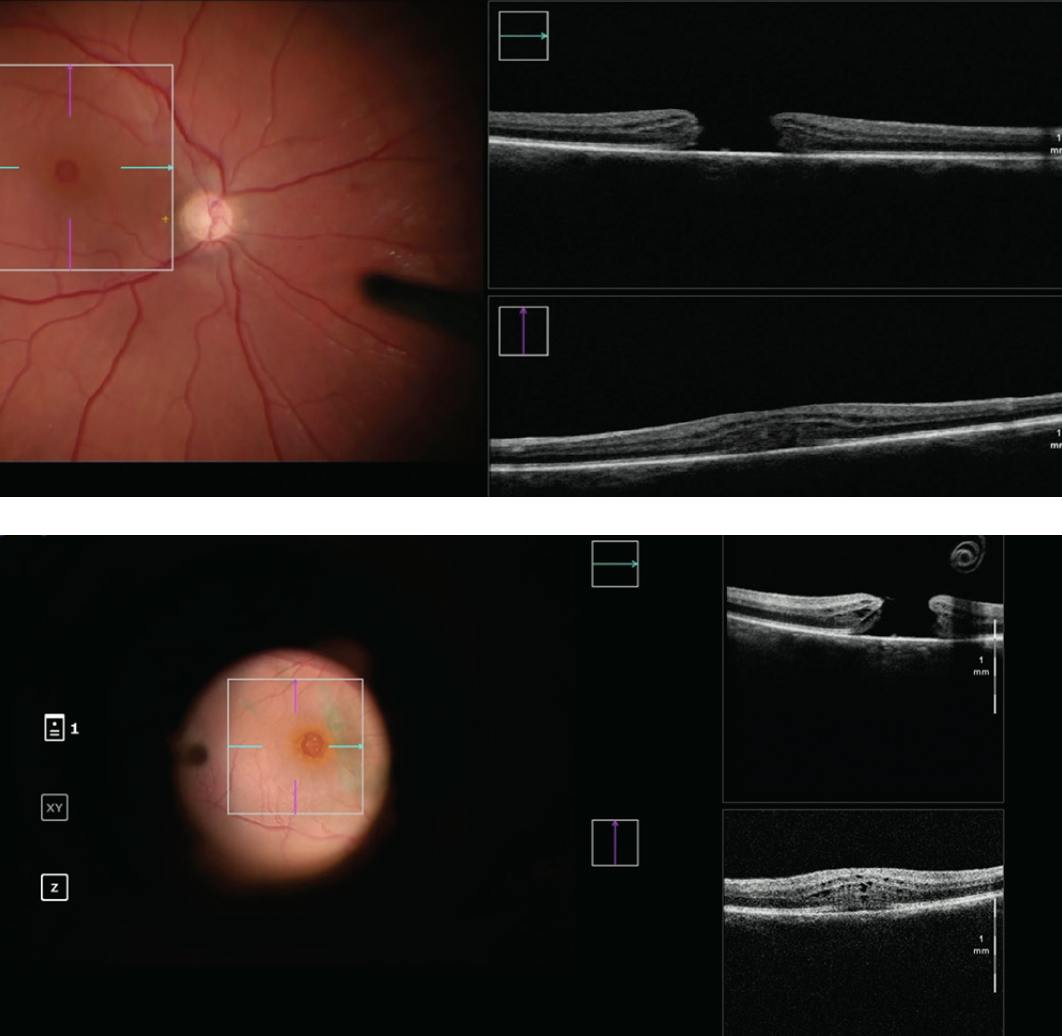
Figure 1. The top image reveals a macular hole with flat edges and tight retinal pigment epithelium adhesions at the borders. The bottom image shows the surgical visualization of the hole after ILM flap (rug technique) and iOCT, on which the macular hole edges are now lifted.
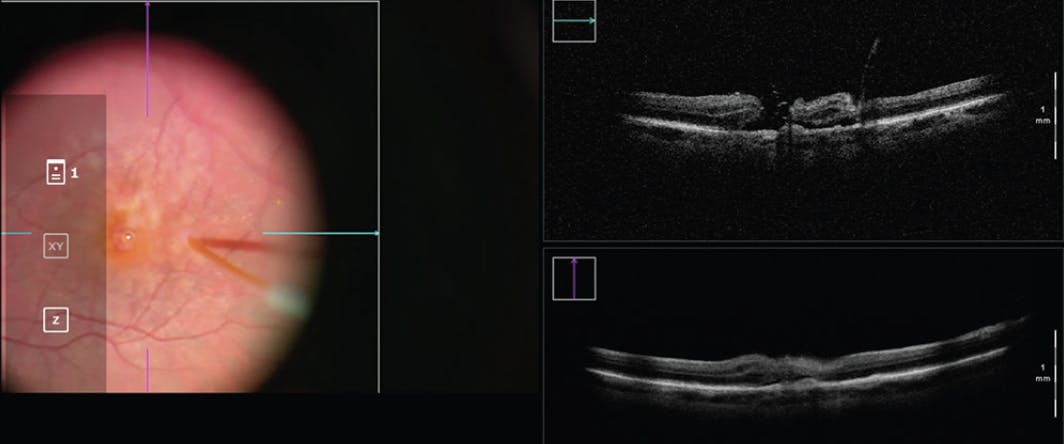
Figure 2. Simultaneous use of surgical visualization and iOCT helps when performing a subretinal balanced salt solution delivery to break the retinal pigment epithelium adhesions of the temporal edge of a macular hole. Note the small air bubble in both views that confirms the flow between the injection site and the hole.
With the introduction of digital microscopes and 3D visualization, we are in a new era of surgical technology. Adequate magnification, optimized heads-up display viewing distance, and certain parameters specific to each system can provide surgeons with enhanced lateral resolution, depth of field, and depth resolution.
1. Tuifua TS, Sood AB, Abraham JR, et al. Epiretinal membrane surgery using intraoperative oct-guided membrane removal in the DISCOVER study versus conventional membrane removal. Ophthalmol Retina. 2021;5(12):1254-1262.
2. Yee P, Sevgi DD, Abraham J, et al. iOCT-assisted macular hole surgery: outcomes and utility from the DISCOVER study. Br J Ophthalmol. 2021;105(3):403-409.
David R. Chow, MD, FRCSC
Assistant Professor, University of Toronto, Toronto Retina Institute, Canada
Editorial Advisory Board Member, Retina Today
davidrchow@me.com
Financial disclosure: Consultant (Alcon, Allergan/AbbVie, Bayer, DORC, Genentech/Roche, Katalyst)
Luis C. Escaf, MD
Retina Fellow, University of Toronto, Toronto Retina Institute, Canada
lescaf@gmail.com
Financial disclosure: None
THE HEADS-UP EXPERIENCE
The most widely-discussed benefit of 3D visualization technology in the OR is the superior operative view compared with that of an analog operating microscope. For example, the Ngenuity provides five times the extended depth of field, 48% increased magnification, and 42% finer stereopsis compared with a standard operating microscope.5 This improved view tends to remain consistent from the posterior pole out to the retinal periphery without requiring consistent intraoperative zoom or focus adjustments.6 Once donning the 3D glasses, everyone in the OR has the same view as the primary surgeon.1
From an educational standpoint, the shared view of the operative field provides unique advantages, including the ability to display operative overlays, such as intraoperative OCT.2,6 In an academic institution, these systems have the particular benefit of assisting in trainee education (Figure). Given that most complex surgeries in ophthalmology are intraocular and require depth perception for full anatomical understanding, the ability to project a 3D video is a significant advantage. Similarly, research shows that OR staff feel more engaged, attentive, and able to anticipate the needs of the surgeon when using 3D visualization, thus providing safer and more efficient patient care.7
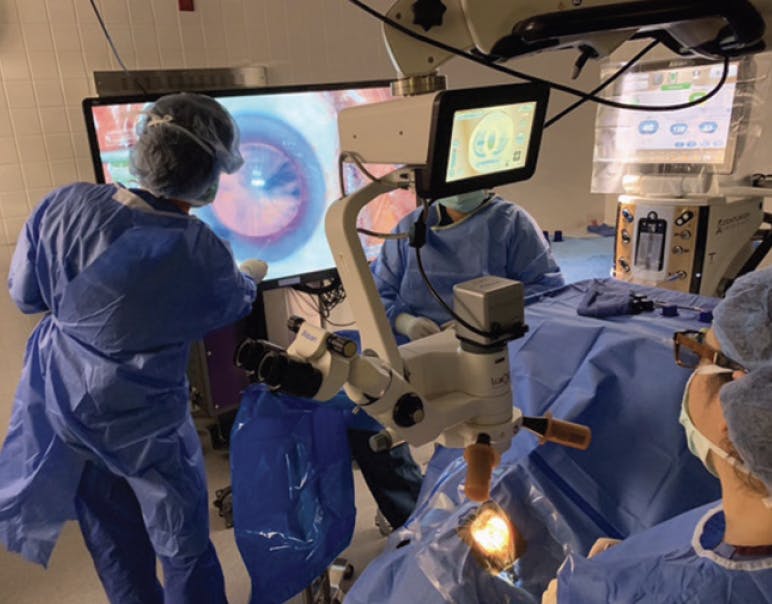
Figure. With the help of the 3D heads-up display, Dr. Asghari can train residents and students during cataract surgery. Image courtesy of Brett Regan (Alcon).
Another benefit of 3D visualization systems is the improved ergonomics compared with those of a standard operating microscope. Many studies document the increased work-related musculoskeletal fatigue and other disorders that ophthalmologists experience.8,9 A 3D heads-up display system can improve surgeon ergonomics and decrease fatigue by allowing a greater degree of freedom to operate in a neutral, physiologic position.8,9 One study found that 91.7% of participants preferred the ergonomics of the heads-up system compared with traditional microscopes.10 However, experienced surgeons tend to adapt their posture while operating to avoid musculoskeletal problems, and we did not find ergonomics to be an advantage or disadvantage for our group.
From a patient safety standpoint, an often-discussed benefit of 3D visualization is the decreased risk of retinal phototoxicity.2,5,6,8,11,12 Operating microscope phototoxicity is a known risk of any ocular surgery, and 3D systems require much lower light intensity without compromising surgeon visibility.5,8 The improved view can also decrease the need for injecting retinal dyes, which can also lead to toxicity.2,8
PITFALLS
In our OR, one disadvantage of the 3D visualization system is the inconvenience for the primary surgical assistant. Typically, the view through the assistant’s analog oculars is rotated 90° to provide an accurate view of the patient’s eye, making certain tasks, such as scleral depression and suture cutting, easy. Conversely, everyone has the same view when using a heads-up display system, and it can be challenging, if not impossible, for the assistant to perform specific maneuvers sitting at a 90° angle. The assistant must adjust to viewing an image on the screen that is 90° different from the patient’s position. Manufacturers have suggested the assistant sit next to the primary surgeon; while this improves the view, the assistant loses direct access to the patient in the sterile field. The assistant could use the traditional analog microscope oculars, but this eliminates the benefits of using the 3D system in the first place.
We have also found that these systems lead to a decrease or loss of precise hand-eye coordination. For example, rather than precisely placing a handed instrument into the field, we must glance away from the monitor and look directly at the patient’s eye to first determine the instrument’s position relative to the eye prior to proceeding.
The large monitor can also create positioning concerns in the OR, and it can be a challenge to give the anesthesia provider the necessary patient access without obstructing the view of the surgeon.13 Many users have reported headache, nausea, and visual disturbances, particularly with the use of intraoperative laser photocoagulation.8,13,14
Of course, one of the most restrictive aspects of implementing this technology, and the largest obstacle encountered within our institution, is the associated cost and space constraints.
CLINICAL TIPS
Overall, 3D heads-up display systems can make a great addition to the OR for staff and trainee education. However, the setup and teardown can be cumbersome, prone to error, and has been known to cause delays in the OR. Ideally, the system would have a dedicated OR where the necessary equipment remains stable. More user-friendly systems that provide better visualization for both the surgeon and assistant, without compromising direct patient access, will be a welcome addition to the surgical suite.
1. Palácios RM, Maia A, Farah ME, Maia M. Learning curve of three-dimensional heads-up vitreoretinal surgery for treating macular holes: a prospective study. Int Ophthalmol. 2019;39(10):2353-2359.
2. Maiti A, Majumdar J. Ten things you should know about 3D viewing system in ophthalmology. April 1, 2021. Accessed February 16, 2022. www.eophtha.com/posts/ten-things-you-should-know-about-3d-viewing-system-in-ophthalmology
3. Henahan S. Visualizing the future. EuroTimes. April 1, 2018. Accessed February 16, 2022. www.eurotimes.org/visualising-the-future
4. Beyeonics. Beyeonics One-surgical microscope. Accessed February 16, 2022. beyeonics.com
5. Nattis A. 3D cataract surgery - The ophthalmology resident’s guide. May 25, 2021. Accessed February 16, 2022. eyesoneyecare.com/resources/3d-cataract-surgery-the-ophthalmology-resident-guide
6. Agranat JS, Miller JB, Douglas VP, et al. The scope of three-dimensional digital visualization systems in vitreoretinal surgery. Clin Ophthalmol. 2019;13:2093-2096.
7. Adam M, Ho A. The pros and cons of heads-up surgery. Rev Ophthalmol. September 12, 2017. Accessed February 16, 2022. www.reviewofophthalmology.com/article/the-pros-and-cons-of-headsup-surgery
8. Moura-Coelho N, Henriques J, Nascimento J, Dutra-Medeiros M. Three-dimensional display systems in ophthalmic surgery – a review. Eur Ophthalmic Rev. 2019;13(1):31.
9. Bin Helayel H, Al-Mazidi S, AlAkeely A. Can the three-dimensional heads-up display improve ergonomics, surgical performance, and ophthalmology training compared to conventional microscopy? Clin Ophthalmol. 2021;15:679-686.
10. Eckardt C, Paulo EB. Heads-up surgery for vitreoretinal procedures. Retina. 2016;36(1):137-147.
11. Stem MS, Thanos A, Eliott D, et al. Heads-up 3-D visualization in complex vitreoretinal surgery. Retina Today. 2017;12(5):44-48.
12. Asani B, Siedlecki J, Schworm B, et al. 3D heads-up display vs. standard operating microscope vitrectomy for rhegmatogenous retinal detachment. Front Med. 2020;7:615515.
13. Rizzo S, Abbruzzese G, Savastano A, et al. 3d surgical viewing system in ophthalmology: perceptions of the surgical team. Retina. 2018;38(4):857-861.
14. Chhaya N, Helmy O, Piri N, Palacio A, Schaal S. Comparison of 2D and 3D video displays for teaching vitreoretinal surgery. Retina. 2018;38(8):1556-1561.

_1784132761.jpg?auto=compress,format&w=75)





