


When coding office visits, retina specialists have two types of codes to choose from: the evaluation and management (E/M) codes or the eye visit family of codes. With the significant changes to E/M documentation guidelines and value in 2021, now is a good time to rethink some of your coding patterns for various scenarios. Below are some helpful tips to help you decide how to properly code patient visits.
RETINA CASE STUDIES
1. A new patient is seen for a comprehensive eye examination. The diagnosis is an epiretinal membrane in the right eye, stable. The plan is to continue to monitor the patient and schedule a follow-up in 3 months.
Coding options: E/M overall MDM, low, or CPT code 99203 ($114), or eye visit code 92004 ($152).
2. An established patient has a problem-focused examination for nonproliferative diabetic retinopathy with vitreous hemorrhage in the left eye. The plan is to schedule a vitrectomy for the next available appointment.
Coding options: E/M overall MDM, low, or CPT code 99214 ($130), or eye visit code 92012 ($91).
MASTER THE CRITERIA
Continue to review the new E/M guidelines that went into effect January 1, 2021, including the E/M Coding & Documentation Guidelines for 2021.1 The bottom line is that your documentation should include:
- A medically relevant history and examination, and
- A code selection based on medical decision making (MDM) or total physician time.
Eye visit code criteria, however, did not change. The CPT code guidelines continue to focus on:
- History, general medical observation, and chief complaint;
- Required examination elements per intermediate and comprehensive levels;2 and
- Initiation or continuation of diagnostic and treatment programs.
SCENARIOS THAT RULE OUT EYE VISIT CODES
There are nine scenarios in which submitting an E/M code would be advantageous.
1. When the ICD-10-CM code is not a covered diagnosis.
Example: A hydroxychloroquine sulfate (Plaquenil, Concordia Pharmaceuticals) examination with no maculopathy is reported with ICD-10-CM diagnosis code Z79.899, other long-term (current) drug therapy, and M06.9 (rheumatoid arthritis). Many payers will deny claims when a system disease (eg, M06.9) is linked to an eye visit code.
2. When the place of service is not the office.
Example: When the patient is seen in the emergency department, be sure to use the E/M family of codes 99281-99285, emergency department visit.
Note: For a place of service that is somewhere other than your office or outpatient services, continue to follow the 1997 guidelines. The visit must meet history, examination, and MDM requirements.
3. When the frequency of patient visits is exceeded.
Example: Some commercial and other payers may have frequency edits for eye visit codes and only allow reimbursement annually, per patient.
4. When E/M is required for medical diagnoses per payer policy.
Example: Some commercial and other payers may require that clinicians report vision diagnoses with eye visit codes and report other medical diagnoses with E/M codes.
5. When the patient visit is subject to downcoding based on diagnosis per payer policy.
Example: Some commercial and other payers may downcode comprehensive codes to an intermediate code based only on the ICD-10-CM code(s) reported.
6. When the commercial or Medicaid plan still recognizes consult codes.
Example: Some payers may continue to recognize E/M consultation codes (CPT 99241-99245). Consultation codes should be reported by the retina specialist when a consult is requested for a problem. These codes should not be reported if a transfer of care has been accepted before the initial evaluation.
Note: Medicare does not recognize consultation codes.
7. When there is a telemedicine visit.
Example: The pandemic waiver that allowed the use of eye visit codes for telemedicine visits is no longer valid. Report E/M codes based on MDM, or total physician time.
8. When there is a prolonged patient visit.
Example: When the physician total time during one patient visit exceeds the total for level 5 and prolonged services can be billed, E/M would be preferred over eye visit codes.
9. When there is an increased payer allowable.
Example: When the payer allowable for the level of E/M code is higher than the eye visit code. For example, if a new patient comprehensive eye examination was performed with a moderate level of MDM, report the level 4 E/M 99204 instead of the comprehensive eye visit code 92004 based on the Medicare fee schedules.
2022 FEE SCHEDULE COMPARISON
Each year when the fee schedules are published, clinicians can compare the E/M and eye visit codes for various scenarios. The table outlines the average 2022 Medicare fee schedule, not adjusted for geographic practice cost index.
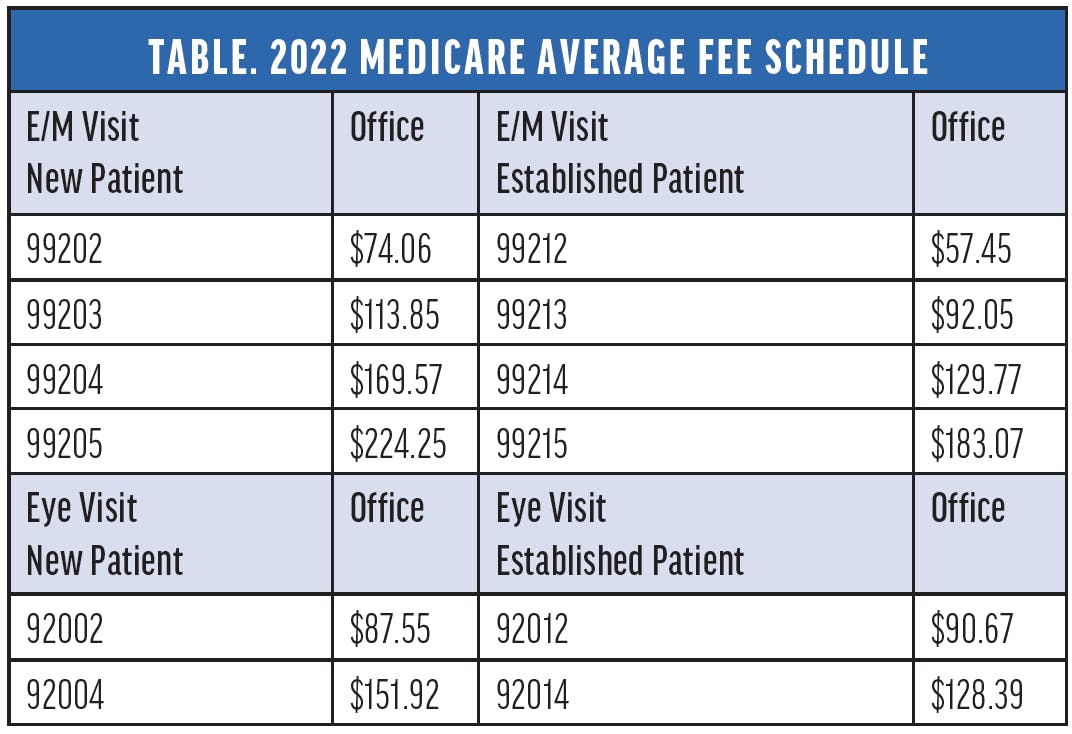
Using the table, it is imperative that retina practices create a quick reference guide for the Medicare fee schedule for the region. In addition, a display of the top insurance payers should be available for analysis.
NUANCED BY PAYER
Fee schedules and policies vary per insurance payer. Staying up to date and creating internal guides will assist clinicians in determining the appropriate level of E/M versus eye visit code. Additional resources can be found at aao.org/em and aao.org/coding.
1. Woodke J. E/M coding and documentation guidelines for 2021. Retina Today Business Matters. 2020;3(4):6-7,11.
2. Eye Visit Code Checklist. American Academy of Ophthalmology. Accessed March 2, 2022. www.aao.org/Assets/f924affe-c407-4044-9794-a39787c139d1/637564307201030000/eye-visit-code-cl-nov2020-pdf

_1784132761.jpg?auto=compress,format&w=75)





