


AT A GLANCE
- Despite its excellent safety profile, intravitreal delivery of certain retina medications poses inherent limitations.
- When delivering viral vectors, a subretinal approach appears to sequester the vector in the subretinal space with limited egress from the retinotomy.
- Compared with subretinal delivery, suprachoroidal delivery obviates the need for a vitrectomy, the creation of a retinotomy, or the use of air tamponade.
The first intravitreal injection was performed in 1911 by Ohm to repair a retinal detachment using air.1 The technique became more widespread in subsequent decades as a primary method for intraocular drug delivery in the setting of endophthalmitis. However, it wasn’t until the advent of anti-VEGF medications that intravitreal injection became a mainstream technique. It goes without saying that, for most retina specialists, it remains the most common intraocular procedure.
Despite its excellent safety profile, intravitreal delivery of certain medications poses inherent limitations. This has been addressed recently through the development of novel alternative delivery methods—such as suprachoroidal and subretinal—that possess key advantages.
INTRAVITREAL DELIVERY WOES
Intravitreal drug delivery has three key advantages: (1) it can be done via an inexpensive in-office procedure, (2) it can provide therapeutic levels of medication over weeks to months, and (3) it has an excellent safety profile with endophthalmitis the only major (yet rare) complication.
For the delivery of antibiotics, it is a clear winner, but the need for frequent anti-VEGF injections creates a significant treatment burden for patients. Furthermore, intravitreally delivered steroids or adeno-associated virus (AAV)-based gene therapies may come with serious potential side effects.
Early in the use of intravitreal steroid delivery, it became clear that cataract and elevated IOP were considerations that could limit its use. The SCORE study demonstrated that the 4 mg triamcinolone group had significantly higher rates of cataract surgery and elevated IOP.2 Although the advent of sustained-delivery steroid formulations may ameliorate some of these concerns, they remain inherent to the side effect profile.3 For example, the fluocinolone acetonide intravitreal implant 0.19 mg (Iluvien, Alimera Sciences) has an incisional glaucoma surgery rate of up to 4.8%.4
In a similar fashion, the advent of AAV-based gene therapy has required the development of novel approaches to provide access to the subretinal space for transduction of the photoreceptors or retinal pigment epithelium (RPE) cells. Subretinal delivery is thought to also limit the inflammatory response to the viral vector. In the phase 1/2 trial of intravitreal AAV8-RS1 gene therapy for X-linked retinoschisis, there was a clear dose-dependent trend in anterior and vitreous inflammation.5 Recently, a case of severe inflammation and hypotony was reported from the INFINITY trial of intravitreal injection of ADVM-022 (Adverum) for diabetic macular edema, resulting in even more scrutiny of intravitreal gene therapy.6
SUBRETINAL DELIVERY
Retinal surgeons are generally familiar with the subretinal delivery of tissue plasminogen activator via a subretinal cannula. This technique is often performed in the setting of large submacular hemorrhages where the subretinal space is accessible. However, even when the retina must be intraoperatively detached for gene therapy delivery, this technique has several advantages, including the use of a three-port vitrectomy.
Two important surgical steps include (1) the induction of a posterior vitreous separation to avoid any subsequent traction on the retinotomy site and (2) the initiation of the bleb near the arcades using gentle pressure to avoid foveal blowout (Figure). When delivering viral vectors, this approach appears to sequester the vector in the subretinal space with limited egress from the retinotomy, especially when followed by air-fluid exchange. Any vector that leaks into the vitreous cavity can be removed via either extended vitreous washout or air-fluid exchange. Not only does this limit inflammatory sequelae, it may also be the only method capable of efficiently delivering vector to the photoreceptor and RPE cells. Of note, this does not apply to gene therapy for neovascular AMD, where the transduced cells serve as a biofactory for anti-VEGF protein and need not be located in the subretinal space.
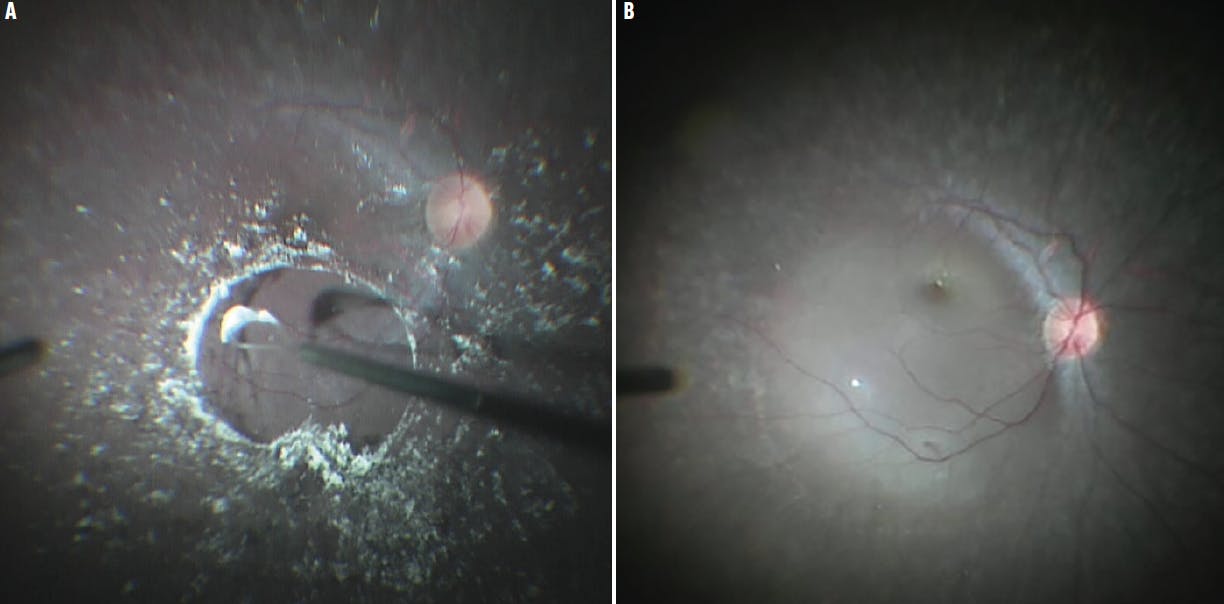
Figure. During subretinal delivery of voretigene neparvovec-rzyl in the left eye of a child, posterior vitreous separation can be aided using a 25-gauge Finesse Flex Loop (Alcon) after staining the cortical vitreous with triamcinolone (A). The 0.3 ml bleb of subretinal voretigene was delivered via a retinotomy along the superior arcade and encompasses most of the macula (B).
SUPRACHOROIDAL DELIVERY
An attractive alternative to both subretinal and intravitreal drug delivery has been the suprachoroidal approach. Compared with subretinal delivery, suprachoroidal delivery obviates the need for a vitrectomy, the creation of a retinotomy, or the use of air tamponade. Compared with intravitreal injections, the suprachoroidal approach may avoid some of the toxicities relating to exposure of the anterior segment, such as cataract and elevated IOP for steroids and inflammation for viral vectors. In the setting of gene or cell-based therapy, the suprachoroidal approach can even be used to access the subretinal space via a catheter.7 However, the most straightforward delivery approach is via direct injection using a short (guarded) needle, in a procedure similar to an intravitreal injection.
The US FDA’s recent approval of the triamcinolone acetonide injectable suspension (Xipere, Bausch + Lomb and Clearside Biomedical) for macular edema in noninfectious uveitis has officially put the suprachoroidal drug delivery approach on the map. This approval was based on the results of the phase 3 PEACHTREE study, which randomly assigned 160 patients to suprachoroidal injection of triamcinolone acetonide suspension (CLS-TA) or sham.8 Strikingly, 47% of the treatment arm experienced a 3-line gain compared with 16% in the sham group, with a corresponding reduction in central foveal thickness.
Other studies are testing its use in the setting of macular edema due to retinal vascular disease. The TANZANITE study has shown promising results with the use of suprachoroidal CLS-TA in combination with intravitreal aflibercept (Eylea, Regeneron) compared with aflibercept alone for the treatment of retinal vein occlusion.9 These studies use Clearside’s proprietary SCS microinjector.
In addition to its obvious advantages for steroid delivery, the suprachoroidal approach may prove useful for gene therapy. Initial efforts used a suprachoroidal catheter to deliver cell therapy via a cannula passed through the suprachoroidal space.7 Although these early studies were plagued by surgical complications, suprachoroidal delivery remains a creative and attractive possibility for the delivery of AAV-based gene therapies. The focus has shifted toward using the suprachoroidal tissues as biofactories to produce proteins such as anti-VEGF. Regenxbio’s phase 2 AAVIATE and ALTITUDE studies have shown promising results with AAV8 encoding an anti-VEGF antibody fragment injected into the suprachoroidal space via the SCS microinjector. The study goals are to generate sustained intraocular anti-VEGF levels and avoid issues affected by subretinal and intravitreal delivery of the vector.
CONCLUSION
With the approval of voretigene neparvovec-rzyl (Luxturna, Spark Therapeutics) in 2017 and the triamcinolone acetonide injectable suspension in 2021, it’s clear that the subretinal and suprachoroidal approaches have solid footing in the vitreoretinal armamentarium. It will be exciting to see how these delivery techniques evolve as they are used with novel therapies.
1. Grzybowski A, Told R, Sacu S, et al. 2018 update on intravitreal injections: Euretina expert consensus recommendations. Ophthalmologica. 2018;239(4):181-193.
2. Scott IU, Ip MS, VanVeldhuisen PC, et al; SCORE Study Research Group. A randomized trial comparing the efficacy and safety of intravitreal triamcinolone with standard care to treat vision loss associated with macular Edema secondary to branch retinal vein occlusion: the Standard Care vs Corticosteroid for Retinal Vein Occlusion (SCORE) study report 6. Arch Ophthalmol. 2009;127(9):1115-1128. Erratum in: Arch Ophthalmol. 2009;127(12):1655.
3. Sivaprasad S. Sustained-release steroid options for DME therapy. Retina Today. 2021;16(6):34-36.
4. Campochiaro PA, Brown DM, Pearson A, et al; FAME Study Group. Sustained delivery fluocinolone acetonide vitreous inserts provide benefit for at least 3 years in patients with diabetic macular edema. Ophthalmology. 2012;119(10):2125-2132.
5. Cukras C, Wiley HE, Jeffrey BG, et al. Retinal AAV8-RS1 gene therapy for X-linked retinoschisis: initial findings from a phase I/IIa trial by intravitreal delivery. Mol Ther. 2018;26(9):2282-2294.
6. Adverum Biotechnologies reports a adverse reaction of hypotony in the INFINITY trial evaluating ADVM-022 in patients with DME [press release]. Eyewire. April 29, 2021. Accessed December 1, 2021. eyewire.news/news/adverum-biotechnologies-reports-a-adverse-reaction-of-hypotony-in-the-infinity-trial-evaluating-advm-022-in-patients-with-dme
7. Ho AC, Chang TS, Samuel M, Williamson P, Willenbucher RF, Malone T. Experience with a subretinal cell-based therapy in patients with geographic atrophy secondary to age-related macular degeneration. Am J Ophthalmol. 2017;179:67-80.
8. Yeh S, Khurana RN, Shah M, et al; PEACHTREE Study Investigators. Efficacy and safety of suprachoroidal CLS-TA for macular edema secondary to noninfectious uveitis: Phase 3 randomized trial. Ophthalmology. 2020;127(7):948-955.
9. Campochiaro PA, Wykoff CC, Brown DM, et al; Tanzanite Study Group. Suprachoroidal triamcinolone acetonide for retinal vein occlusion: results of the tanzanite study. Ophthalmol Retina. 2018;2(4):320-328.


_1784132761.jpg?auto=compress,format&w=75)





