


New CPT Code Descriptors
67141 Prophylaxis of retinal detachment (eg, retinal break, lattice degeneration) without drainage; cryotherapy, diathermy.
67145 Prophylaxis of retinal detachment (eg, retinal break, lattice degeneration) without drainage; photocoagulation.
Each new year brings with it changes related to retina coding and reimbursement; this year, those changes are focused on retinal detachment prophylaxis codes and a new treatment for AMD. A comprehensive understanding of these changes will avoid costly denials and inappropriate reimbursement.
RETINAL DETACHMENT PROPHYLAXIS
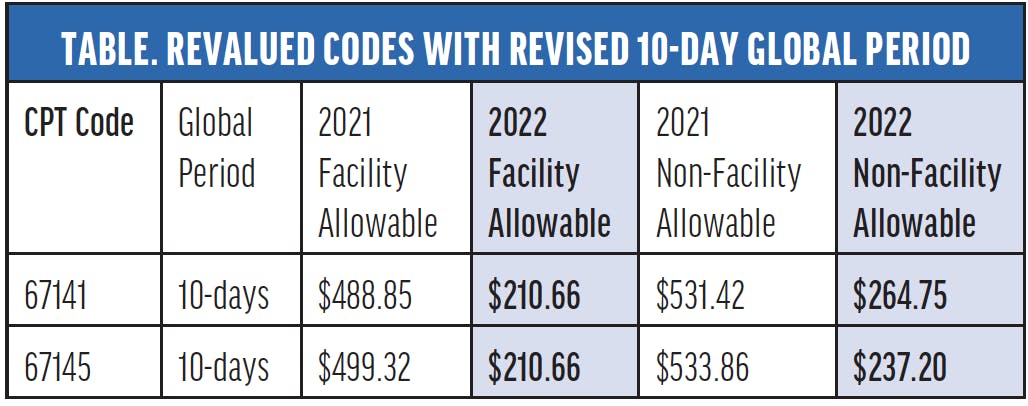
The most significant change affecting retina practices is the descriptor and value for CPT codes 67141 and 67145. These two codes were revised, and the language “one or more sessions” was removed from the descriptor. Additionally, the codes were revalued, and the global period was revised from 90 days to 10 days (Table).
Impact On Coding
With the change in the global period, these two codes are now considered minor procedures, a significant change when examinations are performed on the same day. The -57 modifier, decision for major surgery, would no longer be used and the -25 modifier should be considered. A significant, separately identifiable examination would need to be performed and documented to append the -25 modifier. Although medically necessary, if the examination was performed to confirm the need for the prophylaxis of retinal detachment by cryotherapy or laser, it would not be billable separately.
Payer Nuances
Although CMS has revised the global period from 90 days to 10 days, some payers may delay implementation. For example, when CPT code 67228 was assigned a 10-day global period in 2016, many payers continued with a 90-day global period. In fact, some Medicaid payers continue to recognize CPT code 67228 as major surgery with a 90-day global period. If the payer assigns a 90-day global period, the same-day examination would be billed with the -57 modifier.
NEW TREATMENT FOR AMD
Last year, the FDA approved the port delivery system (PDS) with ranibizumab (Susvimo, Genentech/Roche) for patients with wet AMD who previously responded to at least two intravitreal injections of anti-VEGF. This device provides continuous delivery of the anti-VEFG agent via an implant. After the initial fill and implant, a refill-exchange procedure is provided at approximately 6 months.
The initial procedure, including the fill and implant, is done in an ambulatory surgical center or hospital outpatient department. The facility submits CPT code 67027 for the procedure, along with a generic HCPCS code J3490, J3590, or C9399 for the medication. For the CMS 1500, report the NDC in item 24a in 5-4-2 format, 50242-0078-55, and the medication name, dosage, and invoice amount in item 19. If performed in a hospital outpatient department, the facility should also submit C1889 for the implant.
The physician claim for the initial fill and implant should submit CPT code 67027 and the appropriate anatomical modifier (eg, -RT or -LT).
For the refill-exchange procedure, typically provided in-office, the physician should report CPT code 67028 and the anatomical modifier. The medication is reported with generic HCPCS code J3490 or J3590. Submit the NDC in item 24a in 5-4-2 format, 50242-0078-12, and the medication name, dosage, and invoice amount in item 19.
NEW YEAR, NEW COMMITMENTS
Throughout 2022, a commitment to mastering coding changes and their impact on payer policy will be key—particularly as we look forward to more FDA approvals. The AAO will be providing education at aao.org/retinapm and at a Codequest near you. The schedule can be found at aao.org/codequest.


_1784132761.jpg?auto=compress,format&w=75)





