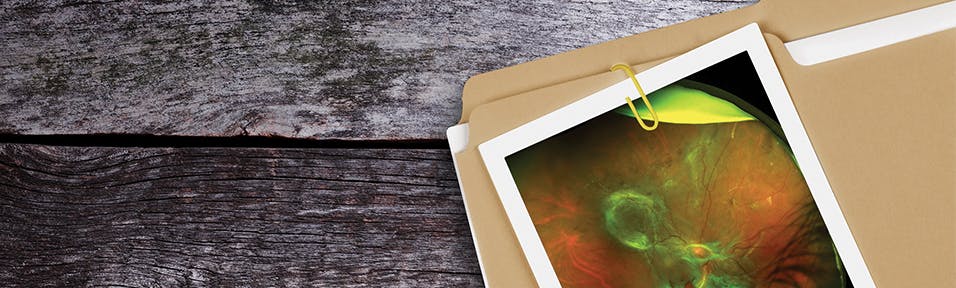


Repair of diabetic tractional retinal detachment (TRD) is one of the most challenging procedures that vitreoretinal surgeons will perform. The complexity of the surgery is even more pronounced when a combined tractional and rhegmatogenous retinal detachment (RRD) is suspected, owing to the mobility of tissues and underlying retina. The following is a case of combined diabetic TRD/RRD for which an illuminated infusion chandelier was employed to assist with visualization during bimanual dissection.
Case Report
A 48-year-old man with an 18-year history of type 2 diabetes presented for evaluation of decreased vision in the left eye for several months. The patient was insulin-dependent. His most recent HbA1c level was 7.0% 6 months prior to this visit, but it had been as high as 14% in previous years. His VA was 20/50 in the right eye and hand-motions vision in the left eye.
Dilated fundus examination of the right eye revealed proliferative diabetic retinopathy (PDR) with extensive peripheral panretinal photocoagulation and an early extramacula-involving TRD inferiorly with flat fibrovascular proliferation around the arcades. Dilated fundus examination of the left eye revealed PDR with a combined TRD/RRD involving the entire macula with subretinal fluid extending to the equator without a posterior vitreous detachment (PVD) (Figure 1). There was prior panretinal photocoagulation in the far anterior periphery. In addition, there was extensive fibrovascular proliferation along the superior and inferior arcades, extending to the optic nerve head. A retinal break was suspected along the inferotemporal arcade adjacent to the fibrovascular sheets. Subretinal hemorrhage was noted inferiorly.

Figure 1. Preoperative imaging is shown of the left eye. A color fundus photograph shows a macula-off combined TRD/RRD with extensive fibrovascular proliferation (A). A vertical macular OCT shows the presence of subretinal fluid within the macula (B).
Intravitreal bevacizumab was administered to the left eye preoperatively, with the plan for surgical intervention within 3 to 5 days. Observation was also discussed with the patient. Given his young age and despite a guarded visual prognosis, surgery was recommended.
A 25-gauge Bi-Blade vitrectomy was performed using the Stellaris Elite Vision Enhancement System (Bausch + Lomb). An lighted infusion was used, allowing for bimanual vitrectomy without the need for an additional trocar for the chandelier (Figure 2). Intraoperative examination revealed a macula-off total combined diabetic TRD/RRD with extensive fibrovascular proliferation around the arcades.

Figure 2. Lighted infusion is placed overtop the pre-existing inferotemporal trocar for additional illumination during the surgery.
Initially, a peripheral vitrectomy was performed to relieve the anterior-posterior traction from the posterior pole (Figure 3). Careful peripheral shave vitrectomy was performed under 360º of scleral depression. Intravitreal triamcinolone was injected into the vitreous cavity to assist with vitreous removal and identification of the posterior hyaloid to highlight fibrovascular membranes and identify areas of vitreoschisis. Afterward, a large sheet of posterior fibrovascular membranes remained.

Under a contact lens viewing system, a combination of the vitreous cutter, internal limiting membrane (ILM) forceps, and gripping forceps was used to initiate a posterior hyaloid dissection starting at the optic nerve head, using an “inside-out” approach. An edge of the hyaloid was initially created using the ILM forceps (Figure 4). The edge of the plane was then propagated using the gripping forceps off the optic nerve head. Once this dissection plane was created from the optic nerve, the wide-field viewing system was used with both unimanual and bimanual forceps and the vitreous cutter to carefully peel, lift, and segment around all areas of vitreoretinal traction and fibrovascular proliferation (Figure 5). Caution was used during this step to minimize iatrogenic breaks. Additional intravitreal triamcinolone was used to identify any residual vitreous gel or vitreoschisis.

Figure 4. The 25-gauge ILM forceps are used under high magnification with a contact lens to create a dissection plane along the optic nerve head.

Figure 5. Bimanual vitrectomy is performed with a lighted infusion using forceps and the vitreous cutter.
A fluid-air exchange was then performed, and subretinal fluid was drained through the mid-peripheral breaks. The pre-existing subretinal hemorrhage was successfully evacuated via the retinal breaks using the soft tip and tilting of the eye to allow migration of the viscous subretinal fluid and subretinal hemorrhage via the most posterior retinal breaks. The eye was then filled with 1000-cST silicone oil. At 5 months postoperatively, the patient’s VA was 20/60, and the retina was flat under silicone oil tamponade (Figure 6A and B). Scan the QR code to watch a video of this case.

Figure 6. Postoperative imaging of the left eye at 6 months shows flat retina under silicone oil without any active fibrovascular proliferation (A) and resolution of subretinal fluid on OCT (B).
Discussion
Surgical interventions for combined diabetic TRD/RRDs are some of the most challenging scenarios that vitreoretinal surgeons encounter. Multiple issues that are inherent to the management of diabetic TRDs must be addressed in addition to the traditional considerations for RRDs. Preoperative counseling with the patient is paramount, because even surgeries that are successful anatomically may have poor visual outcomes owing to macular ischemia. Although less common with small-gauge surgery and preoperative anti-VEGF, poor anatomic and visual outcomes do occur and may even worsen with surgical intervention.
The presence of pre-existing retinal breaks in combined TRD/RRDs often necessitates a more aggressive surgical approach. Furthermore, in these combined TRD/RRDs, the mobility of the underlying retina significantly increases the risk of iatrogenic breaks. Dissection is more difficult because the retina is bullous, and no countertraction is present when fibrovascular tissue is lifted. Nevertheless, it is critical that all hyaloidal membranes and fibrovascular proliferation around the retinal breaks are isolated and segmented, otherwise persistent traction will keep these breaks open, and the retina will not reattach. Unlike in TRDs, if a rhegmatogenous component is present, it is important to remove all fibrovascular tissue and all traction near retinal breaks to allow retinal reattachment. Failure to lift or dissect the hyaloid past these areas is likely to increase the risk of surgical failure. Reoperations fare poorly in these eyes; therefore, the ideal time to perform the dissection is during the initial surgery. With this aggressive surgical approach, however, iatrogenic breaks tend to occur more frequently, and it is important to identify and mark these breaks when they occur to allow the adequate dissection of nearby fibrovascular tissue and to treat with laser at the conclusion of the case.
One of the most important aspects of diabetic TRD surgery is identifying the correct plane when lifting the hyaloid. In this case, it was decided to go with an “inside-out” approach in which dissection was initiated at the optic nerve head under a contact lens viewing system and then extended toward the periphery. Even in severe cases where placoid tissue is obscuring the optic disc and retina within the arcades, it generally begins operating proximal to the optic nerve head, as we have found the shear-force dynamics of inside-out dissection are favorable for minimizing iatrogenic retinal breaks, particularly when there is a known rhegmatogenous component. The peripapillary retina is quite thick, so some force around the optic nerve typically does not create posterior breaks; however, retinal breaks are possible if there is excessive force or peeling or if forceps are directed to an area not at or adjacent to the optic nerve. Performing this step under a contact lens helps to better identify the anatomy to limit the chance of a posterior break during this step.
In preoperative planning, the decision for a scleral buckle should be considered, but not without caution. In this case, most of the vitreoretinal traction and preoperative retinal breaks were noted in the posterior pole, such that traditional placement of a scleral buckle along the equator would support the vitreous base but would not support the retinal breaks. The need for a scleral buckle should be balanced with the degree of expected membrane dissection for the TRD, as longer operative times may increase the degree of corneal edema, which can add another level of difficulty to the membrane dissection in an already complex scenario. Additionally, anterior segment ischemia may ensue in these eyes with poor perfusion. While a scleral buckle generally is not a favorable adjunct in these diabetic eyes, select cases may benefit from it; therefore, it should not be universally excluded.
The use of a lighted infusion, such as Bausch + Lomb’s, is advantageous for bimanual vitrectomy, as it typically obviates the need for an additional sclerotomy that would be used for the chandelier. As with a traditional chandelier, it is helpful to have an assistant who can guide the illumination to areas of intended dissection. When the lighted infusion is used, care should be taken during the vitrectomy, as the vacuum of the cutter may outpace the lighted infusion compared to that of a traditional infusion. Once the bimanual dissections are completed, we often switch from the lighted infusion to the traditional infusion.
Unlike in diabetic TRD cases, endotamponade for retinal breaks is necessary for combined TRD/RRD cases, and a long-acting gas tamponade such as perfluoropropane (C3F8) or silicone oil based is often considered, along with the number and size of retinal breaks, the extent of fibrovascular proliferation, the risk of postoperative bleeding, and the status of the fellow eye. Gas is generally preferred; oil will not “save you” but can be helpful in certain cases, as detailed previously.
Conclusion
The repair of combined diabetic TRD/RRDs remains one of the most challenging procedures that vitreoretinal surgeons will encounter, given the difficulty of safely removing adherent fibrovascular tissue from the surface of thin ischemic and mobile retina without causing iatrogenic breaks. By using a combination of operative techniques and tools, such as the illuminated infusion in this case, the best management practices for TRDs and RRDs are employed and provide a good foundation for surgical success.
Watch Related Case Videos on Eyetube
