

Submacular hemorrhage is a devastating complication of wet age-related macular degeneration (AMD). Patients who present with submacular hemorrhage often have profound vision loss, which can be permanent owing to the toxic effects of heme on the photoreceptors and retinal pigment epithelium.1 The severity of hemorrhage with wet AMD can vary from thin hemorrhage that clears with anti-VEGF injections to dense hemorrhage that leaves large areas of subretinal fibrosis.2,3 In cases with severe hemorrhage, tissue plasminogen activator (tPA) can be injected into the subretinal space to help liquefy and displace the submacular hemorrhage. Herein, I report a surgical case of a submacular hemorrhage requiring vitrectomy and subretinal tPA.
Case Report
A 77-year-old woman presented to the retina clinic with decreased vision in the left eye for 1 day. VA was 20/25 in the right eye and counting fingers in the left eye. IOPs were 15 mm Hg and symmetric in both eyes.
The anterior segment was clear in both eyes with phakic lenses. Posterior-segment examination of the right eye revealed a posterior vitreous detachment and high-risk macular drusen. Posterior-segment examination of the left eye revealed a posterior vitreous detachment and a large submacular hemorrhage. OCT of the right eye revealed drusen without evidence of choroidal neovascular membrane, subretinal fluid, or intraretinal fluid. OCT of the left eye showed a large area of submacular hemorrhage located in the subretinal space.
The patient was diagnosed with dry AMD in the right eye and wet AMD in the left eye. She received an anti-VEGF injection in the left eye under sterile technique. Given the dense submacular hemorrhage and sudden vision loss that she experienced, we elected to proceed with vitrectomy with subretinal tPA.
The patient was brought to surgery the following day. A core and peripheral pars plana vitrectomy was performed. The area of large subretinal hemorrhage was visible in the posterior pole (Figure 1). A 41-gauge subretinal cannula was then connected to a syringe of tPA (concentration of 12.5 μg/0.1 mL). The subretinal cannula was slowly brought to the surface of the macula, aiming toward the superior macula. The cannula was gently advanced into the subretinal space by first creating a “dimple” (Figure 2) and then gently pushing the tip through the retina to introduce the cannula into the subretinal space.
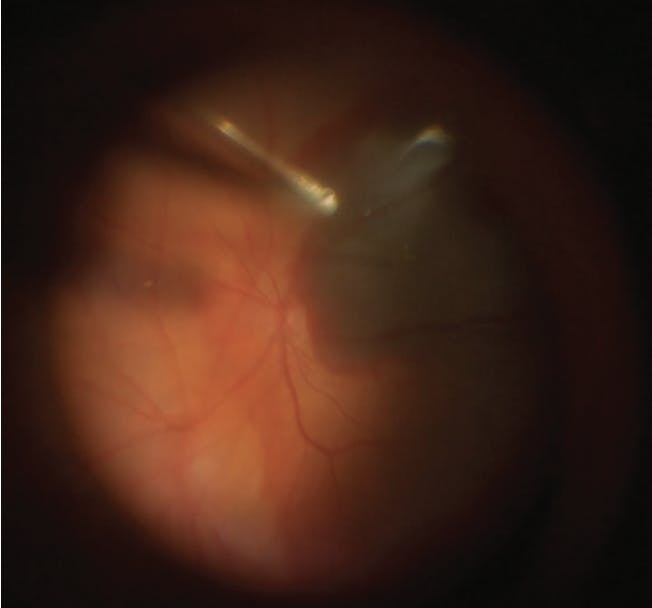
Figure 1. An intraoperative visualization during pars plana vitrectomy reveals subretinal hemorrhage in the macula.
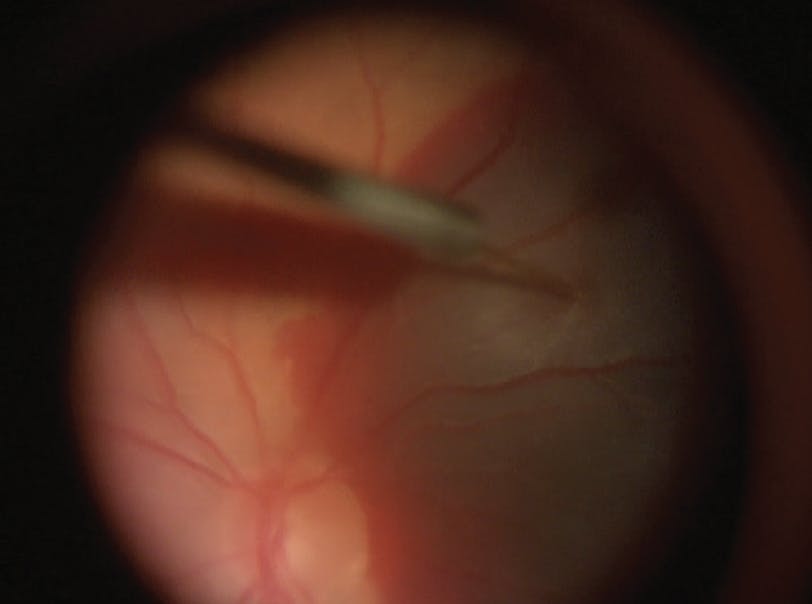
Figure 2. A 41-gauge subretinal cannula is used to dimple the retina to advance the cannula into the subretinal space.
Once the cannula was in a good position, tPA was slowly injected by a skilled assistant. Care was taken to slowly inject the solution to allow for slow expansion of the subretinal space and the creation of a subretinal bleb (Figure 3).
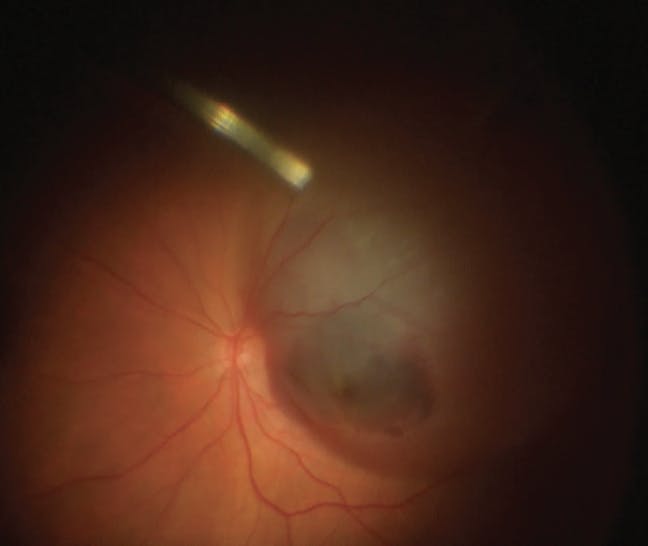
Figure 3. Intraoperative view after injection of subretinal tPA into the subretinal space is shown. A large subretinal bleb created after tPA instillation is visible.
After successful injection of subretinal tPA, a fluid-air exchange was performed (Figure 4), followed by a gas-air exchange. The eye was left with a 20% SF6 gas fill, and the patient was instructed to position face-down or left-side-down for 3 to 5 days to allow for dispersion of the subretinal hemorrhage away from the fovea.
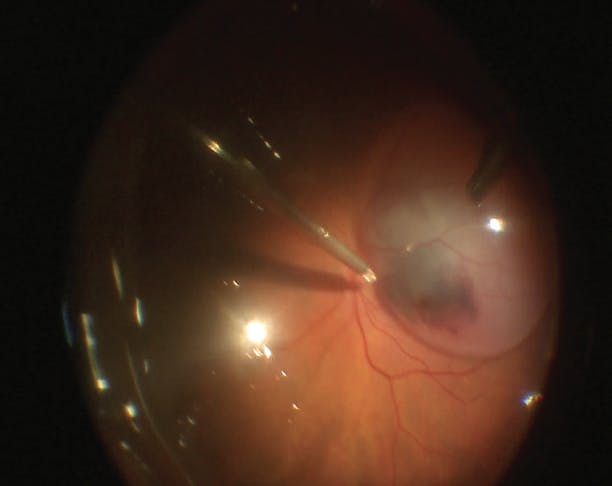
Figure 4. A fluid-air exchange is performed, followed by a gas-air exchange. A 20% SF6 gas was used in this case, and the patient was positioned face-down/left-side-down to allow the hemorrhage to disperse away from the fovea.
At the patient’s last follow-up visit 16 months later, her VA had improved to 20/100. She was continued on intravitreal anti-VEGF therapy for control of underlying wet AMD. Scan the QR code to watch a video of this case.
Discussion
Submacular hemorrhage remains a devastating complication of wet AMD. To date, there have been no prospective, randomized controlled trials evaluating the best treatment for large submacular hemorrhage, as this remains a relatively rare condition not often seen in the typical retina office. While thin hemorrhages often will clear with sequential anti-VEGF injections, larger hemorrhages may benefit from a more procedural intervention. Visual prognosis remains guarded, however, regardless of approach in these severe cases.3
In-office management of submacular hemorrhage includes injection of intravitreal tPA followed by injection of intravitreal gas. The patient is then instructed to assume a face-down position to allow for the submacular hemorrhage to be displaced. This is an elegant procedure that can be performed immediately in the office in conjunction with anti-VEGF therapy. While favorable results are achieved with intravitreal tPA and pneumatic displacement, there remain concerns about the ability of tPA to penetrate into the subretinal space. Some studies suggest that direct injection of tPA into the subretinal space can produce improved results over intravitreal tPA.4

Subretinal tPA can be injected in multiple different ways. In this case, a skilled assistant slowly injected the tPA while the primary surgeon held the cannula in place. tPA can also be injected by connecting the syringe to the viscous fluid injection line and using the foot pedal to slowly inject the mixture into the subretinal space. Good outcomes have also been reported with injecting an air and tPA mixture to help displace submacular hemorrhage away from the fovea.5 In some institutions, the use of intraoperative OCT has been paramount to ensuring correct placement of tPA.6 After injection of subretinal tPA, a gas fill can help displace hemorrhage away from the macula by having the patient assume a face-down or surgical-side-down position, to displace the hemorrhage away from the central macula.
Complications can occur during the injection of tPA, namely creating a large retinal opening, hemorrhage from the retinal vessels, or inadvertent vitreous injection of tPA.7 Additionally, macular holes have been reported, particularly with forceful injection.7,8 These can be challenging to close, so primary prevention is key.
Conclusion
This was a case of submacular hemorrhage from wet AMD treated by subretinal tPA with pneumatic displacement. This procedure remains an elegant and effective way to help clear hemorrhage from the central macula.
Watch Related Case Videos on Eyetube
1. Gillies A, Lahav M. Absorption of retinal and subretinal hemorrhages. Ann Ophthalmol. 1983;15(11):1068-1074.
2. Shultz RW, Bakri SJ. Treatment for submacular hemorrhage associated with neovascular age-related macular degeneration. Semin Ophthalmol. 2011;26(6):361-371.
3. Lu AQ, Prensky JG, Baker PS, et al. Update on medical and surgical management of submacular hemorrhage. Expert Rev Ophthalmol. 2020;15(1):43-57.
4. Hillenkamp J, Surguch V, Framme C, et al. Management of submacular hemorrhage with intravitreal versus subretinal injection of recombinant tissue plasminogen activator. Graefes Arch Clin Exp Ophthalmol. 2010;248(1):5-11.
5. Sharma S, Kumar JB, Kim JE, et al. Pneumatic displacement of submacular hemorrhage with subretinal air and tissue plasminogen activator: initial United States experience. Ophthalmol Retina. 2018;2(3):180-186.
6. Ehlers JP, Petkovsek DS, Yuan A, et al. Intrasurgical assessment of subretinal tPA injection for submacular hemorrhage in the PIONEER study utilizing intraoperative OCT. Ophthalmic Surg Lasers Imaging Retina. 2015;46(3):327-332.
7. Novelli FJD, Preti RC, Monteiro MLR, et al. A new method of subretinal injection of tissue plasminogen activator and air in patients with submacular hemorrhage. Retina. 2017;37(8):1607-1611.
8. Obeid A, Talcott KE, Ali FS, et al. Macular hole following subretinal tissue plasminogen activator for submacular hemorrhage secondary to neovascular AMD. Ophthalmic Surg Lasers Imaging Retina. 2019;50(9):e257-e259.
