


Ocular trauma cases are often challenging for vitreoretinal surgeons, as these eyes may have a variety of anterior and posterior segment abnormalities.1 Furthermore, the management strategies and timing of intervention for many of the complications associated with ocular trauma are debated.1 Given the array of complications that may be present, surgeons should be prepared to address various challenging scenarios, and, ideally, should be well-versed in a variety of surgical techniques in order to manage them.
We present a patient with a traumatic white cataract and an iris defect after prior primary ruptured globe repair. This case demonstrates two useful surgical techniques: Sutureless scleral fixation of a 3-piece IOL and iris repair.
Case Report
A 47-year-old woman with a history of corneoscleral laceration of the left eye requiring ruptured globe repair 4 years ago presented for evaluation of a white cataract in the left eye. Snellen VA was 20/15 in the right eye, and the examination of the right eye was unremarkable. The visual acuity in the left eye was counting fingers. Anterior-segment examination of the left eye revealed inferior corneal stromal scarring, a large inferior iris defect with tissue loss, and inferior contraction of the lens capsule with zonular loss and vitreous prolapse. A white cataract precluded a view of the fundus (Figure 1). B-scan ultrasonography revealed a posterior vitreous detachment, vitreous opacities, and a localized retinal detachment inferiorly, anterior to the equator.
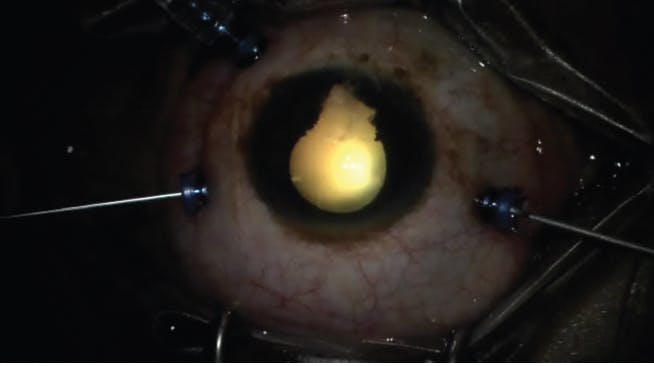
Figure 1. A white cataract, which is retroilluminated by the light pipe, and large inferior iris defect are shown.
Trocars were placed for a standard 25-gauge pars plana vitrectomy (PPV). As the lens was too dense to remove with the 25-gauge vitrector, the superotemporal sclerotomy was enlarged, and a 23-gauge fragmatome (Bausch + Lomb) was used to perform a pars plana lensectomy via a transconjunctival approach. Subsequently, a 25-gauge PPV was performed. Inferiorly, there was a chronic-appearing localized anterior retinal detachment. No retinal breaks were present. All traction was relieved from the detached retina. Given the chronicity, localized position, and the absence of a retinal break, no further intervention was performed for the detachment. The vitreous base was shaved to create a scleral depression for 360°.
Next, attention was turned to the anterior segment. A corneal wound was created with a keratome, and a 3-piece CT Lucia lens (Carl Zeiss Meditec) was injected into the anterior chamber. The haptics were externalized 2 mm posterior to the limbus at the 6-o’clock and 12-o’clock positions through 30-gauge sclerotomies using 30-gauge TSK needles (Figure 2). The tips of the haptics were flanged with handheld cautery. The haptics were then buried under the conjunctiva. Using a 10-0 Prolene suture on a long, curved needle, the surgeon repaired the iris defect using a Siepser sliding knot (Figure 3).2 The corneal wound was closed with a 10-0 nylon suture. The trocar cannulas were removed, and the sclerotomies were confirmed to be watertight without sutures.
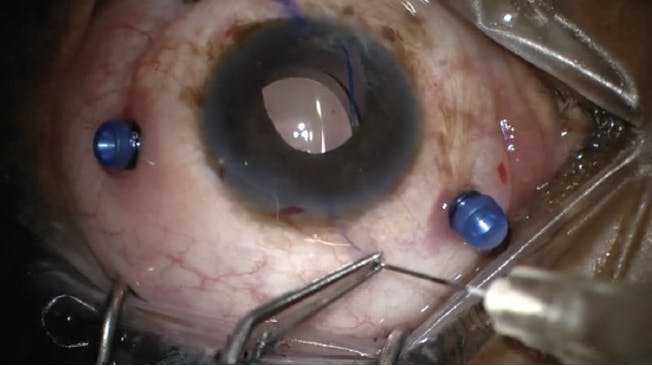
Figure 2. Transscleral and transconjunctival externalization of the superior haptic 2 mm posterior to the limbus is shown. The inferior haptic has been externalized and the terminal bulb created.
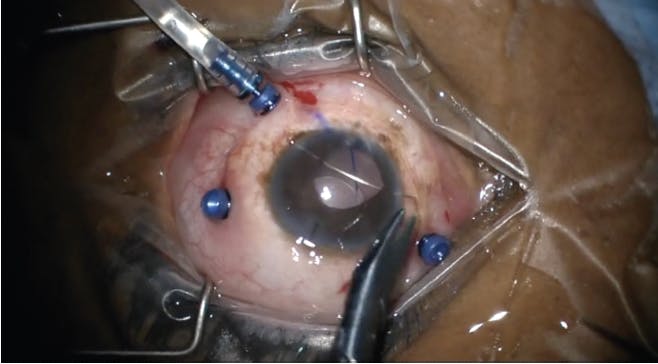
Figure 3. Passage of a 10-0 Prolene suture on a long, curved needle through two foci in the iris defect is shown. These two points were joined to reconstruct the pupil margin with a knot tied by the Siepser sliding knot technique.
At the patient’s most recent appointment 1 month after surgery, her VA was 20/80 with pinhole to 20/40 in the operative eye. The lens was in good position. The inferior anterior detachment was asymptomatic and remained stable without progression. The patient was happy with her visual outcome and cosmetic appearance (Figure 4). Scan the QR code to watch a video of this case.
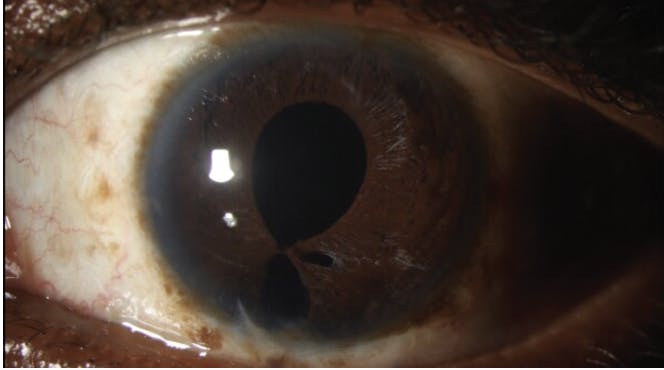
Figure 4. One month postoperative, a slit lamp photograph shows the pupil restored to a more normal contour by the Prolene suture.
Discussion
Many surgical approaches to secondary IOL implantation in eyes without adequate capsular support have been described.3 Options include sulcus placement, anterior chamber IOL, iris fixation (iris sutured or iris claw), or scleral fixation (sutured or sutureless).3 A benefit to using scleral-fixated IOLs (SFIOLs) over other approaches is that scleral fixation allows for placement of the IOL in the physiologic position posterior to the iris, which may decrease the risk for complications, such as iritis, uveitis-glaucoma-hyphema syndrome, and corneal decompensation.3 Scleral fixation may also be performed in the absence of a capsular bag or adequate iris tissue, which limits the feasibility of other approaches in certain patients, such as the patient described herein.3
When choosing to fixate an IOL to the sclera, the surgeon has two choices for technique, each with many described variations: Sutured SFIOL or sutureless SFIOL. Advantages of a sutureless approach include decreased operative time and elimination of the risk of suture exposure or breakage.4 A sutureless approach is also more amenable to being performed transconjunctivally.3 Avoiding a peritomy is desirable because this may better preserve the conjunctiva for future procedures in patients with comorbidities such as glaucoma. Performing a peritomy may also be difficult in an eye with prior trauma or surgery. For the experienced surgeon, sutureless fixation may also be technically easier.4 The primary disadvantage to the sutureless approach is that fixating the haptics to the sclera allows for only two points of fixation, whereas suturing the lens affords the option for more points of fixation, as in the four-point fixation technique commonly performed with the Akreos AO60 (Bausch + Lomb).4 In theory, this may lead to decreased stability and higher rates of decentration in sutureless SFIOLs compared to sutured SFIOLs. Nevertheless, research to date does not appear to substantiate this theory. Data directly comparing outcomes between sutured and sutureless SFIOLs are limited. While some studies have shown that sutureless SFIOLs have more favorable visual outcomes,5 the majority of retrospective studies indicate that both approaches have long-term durability and safety,3 with comparable visual outcomes.4,6
The second useful technique demonstrated by this case is a Siepser sliding knot for iris repair. Iris defects may cause glare, photophobia, and visual distortion.7 They are also often cosmetically unacceptable for patients.8 Although our patient’s iris defect was asymptomatic in the presence of a white cataract, we were concerned that we might induce symptoms by removing the cataract without addressing the iris defect. Our surgical approach demonstrates a technique for iris repair described by Siepser in 1994,2 in which a suture is passed on a long needle into the anterior chamber through a corneal paracentesis, through the two points of iris tissue that the surgeon wishes to bring together, and out through a second paracentesis. Each throw of the knot is performed externally and repositioned back into the anterior chamber in a sliding fashion until the knot is fully tied and secured. Since publication of Siepser’s technique, many modifications have been proposed,9 but the basic technique remains one of the most popular methods for iris repair today. The postoperative slit lamp photograph (Figure 4) of our patient demonstrates the excellent results that can be achieved with a single suture.
Conclusion
Ocular trauma can cause many abnormalities in both the anterior and posterior segments. Consequently, these cases are often challenging to manage surgically. Our patient had a history of ruptured globe repair 4 years prior to presenting to our institution with a traumatic white cataract and a large iris defect. The patient underwent PPV and lensectomy with secondary IOL implantation (Yamane technique)10 and iris repair (Siepser sliding knot technique). This case demonstrates the utility of these techniques for managing two common sequelae of ocular trauma.
Watch Related Case Videos on Eyetube
1. Agrawal R, Shah M, Mireskandari K, Yong GK. Controversies in ocular trauma classification and management: review. Int Ophthalmol. 2013;33(4):435-445.
2. Siepser SB. The closed chamber slipping suture technique for iris repair. Ann Ophthalmol. 1994;26(3):71-72.
3. Patel LG, Starr MR, Ammar MJ, Yonekawa Y. Scleral fixated secondary intraocular lenses: a review of recent literature. Curr Opin Ophthalmol. 2020;31(3):161-166.
4. Shahid SM, Flores-Sánchez BC, Chan EW, et al. Scleral-fixated intraocular lens implants-evolution of surgical techniques and future developments. Eye (Lond). 2021;35(11):2930-2961.
5. Jang KH, Kong M, Moon BG, Son G. Comparison of scleral fixation of intraocular lens: sutureless intrascleral fixation versus conventional sutured scleral fixation. Retina. 2021;41(4):761-767.
6. Sindal MD, Nakhwa CP, Sengupta S. Comparison of sutured versus sutureless scleral-fixated intraocular lenses. J Cataract Refract Surg. 2016;42(1):27-34.
7. Schoenberg ED, Price FW Jr. Modification of Siepser sliding suture technique for iris repair and endothelial keratoplasty. J Cataract Refract Surg. 2014;40(5):705-708.
8. Tsao SW, Holz HA. Iris mattress suture: a technique for sectoral iris defect repair. Br J Ophthalmol. 2015;99(3):305-307.
9. Lian RR, Siepser SB, Afshari NA. Iris reconstruction suturing techniques. Curr Opin Ophthalmol. 2020;31(1):43-49.
10. Ayres B, Al-Mohtaseb Z, Safran S, Shah M. Pearls for the Yamane technique. Retina Today. 2020. Available at: https://retinatoday.com/articles/2020-mar/pearls-for-the-yamane-technique. Accessed: June 29, 2022.
