_1646069253.png?auto=compress,format)
I. Age-Related Macular Degeneration
Background
Age-related macular degeneration (AMD) is one of the most common irreversible causes of blindness in the elderly population, affecting more than 200 million people globally in 2020.1,2 AMD is the most common cause of vision loss in the 65 years and over age group, with a prevalence that increases from 24% in the 65 to 74 age group, to more than 44% in the 70 to 95 age group.1,3 The etiology and pathogenesis of AMD is complex. While AMD is strongly associated with age, multiple other factors including genetic, metabolic, functional, and environmental factors all contribute to chronic changes leading to disease progression.2 Despite decades of basic and clinical research, the underlying pathogenesis of AMD is still poorly understood.2,4 Some of the early characteristics of the disease include a thickening of the Bruch’s membrane, pigmentary changes, and accumulation of deposits on the apical (subretinal drusenoid deposits) and basal (drusen) surface of the retinal pigment epithelium (RPE) in the form of drusen and drusenoid deposits. These deposits are the result of the impaired transport of nutrients and waste products to and from the retina, and compromise the ability of RPE cells to protect the neurosensory retina and support its metabolic needs, leading to progression of the disease and eventually vision loss.4,5
Classification of AMD
The early and intermediate stage of non-neovascular (or “dry”) AMD is characterized by a build-up of protein and lipid aggregates between the Bruch’s membrane and the RPE, called drusen. These deposits impair the ability of the RPE cells to regulate the transport of nutrients and waste products to and from the sensory retina. Although the formation of intermediate and large drusen increases the risk of dry AMD progression, the pathogenesis of drusen is still not completely understood.6 The late dry stage of AMD is calledgeographic atrophy (GA) and is characterized by the loss of RPE cells in the macula, atrophy of the sensory retina and photoreceptor death.4,5,7 On OCT, the endpoint of atrophy is termed complete retinal pigment epithelial and outer retinal atrophy (cRORA), which must fulfill all the following criteria: (1) a region of hypertransmission of at least 250 μm in diameter, (2) a zone of attenuation or disruption of the RPE of at least 250 μm in diameter, and (3) evidence of overlying photoreceptor degeneration, in the absence of signs of an RPE tear. The term incomplete RORA (iRORA) was also introduced for those cases that do not fulfill all the above criteria.8 GA represents a significant unmet medical need, as it is irreversible, and is a leading cause of vision loss and legal blindness in the elderly. Currently, GA affects approximately 1.5 million people in the United States, and approximately 5 million globally.9
In neovascular AMD, differentiated from the dry form of the disease by the presence of neovascularization (NV) within or beneath the retina,10–12 NV can originate from the choriocapillaris, penetrate through Bruch’s membrane, proliferate in the space between the Bruch’s membrane and the RPE, and sometimes invade the subretinal space. The NV can also arise from the level of the deep retinal capillary plexus.10,11 The new blood vessel growth and vascular leakage is driven mainly by an overexpression of vascular endothelial growth factor (VEGF). The leakage can result in hemorrhage, exudation, and consequent vision loss.11 Clinically, wet AMD presents with the rapid appearance of subretinal fluid, intraretinal fluid, hemorrhage (retinal, subretinal, or sub-RPE), lipid exudates, gray/yellow-like discoloration, a plaque-like membrane, RPE detachment, and/or an RPE tear.10 In the late stages of wet AMD, the NV leads to fibrous scar formation, termed disciform scar, that can cause permanent retinal damage and eventually legal blindness.10,11
Macular neovascularization (MNV) subtypes
Improvements in detection methods (specifically, more precise measurements of retinal thickness and localization of NV to above or below the RPE) have revealed complexities within the disease, resulting in the need for expanded MNV classification into several subtypes. Consensus from the ophthalmologic community currently categorizes neovascular membranes into 3 main subtypes: type I MNV, formerly called occult choroidal NV (CNV), type II MNV, formerly referred to as classic CNV, and type III MNV, which refers to retinal angiomatous proliferation (RAP).12 The term “macular” NV replaced the traditional term “choroidal” NV, to better reflect the fact that not all neovascular membranes (e.g., type III MNV) originate from the choroid.13 Although we used the “MNV” terminology and agree that moving forward clinical trials should classify and report all occurrences of NV using the latest consensus, the term CNV is still used quite regularly in scientific publications. For the sake of accuracy, when referencing previous publications, we stayed true to the way it was reported initially by the investigators.
Type I MNV is characterized by the initial ingrowth of blood vessels from the choriocapillaris into the sub-RPE space. This can lead to retinal pigment epithelial detachments (PEDs), identified as structural splitting within the Bruch’s membrane, which physically separates the RPE from the remaining Bruch’s membrane.12 Type I MNV often corresponds with poorly defined, or occult, neovascular lesions on fluorescein angiography (FA).14–16 During OCT imaging, the lesion shows shallow irregular RPE elevation (SIRE)17 and the presence of a moderately reflective material that separates the RPE from the underlying Bruch’s membrane (double-layer sign, DLS).18 Hyporeflective intra- or subretinal fluid can also be present, although it is often absent in subclinical or quiescent lesions.19,20
Type II MNV is characterized by NV that originally starts in the choroid, but extends beyond the Bruch’s membrane and the RPE, eventually proliferating in the subretinal space. These lesions can also occur in non-AMD diseases that affect the RPE.12 Type II MNV corresponds with well-defined, or classic, neovascular lesions on FA.14 Schneider et al. conducted a retrospective review of angiograms in 54 eyes of patients with type I (occult) MNV secondary to recent exudative AMD. At baseline, 40 (74%) eyes had type I MNV with no type II (classic) MNV. The other 14 (26%) eyes had type I MNV with a type II component that covered less than 50% of the lesion. In the first group, 9 out of 40 (23%) eyes progressed from a type I MNV to a predominantly type II MNV over a mean follow-up period of 7.6 months. In the second group, 10 of the 14 eyes completely developed type II MNV over a mean follow-up period of 8.7 months. This study showed a 30% rate of conversion from type I to type II MNV in eyes with AMD over a 6- to 12-month follow-up period.21 On OCT, the NV is seen as a hyperreflective material above the RPE and is termed subretinal hyperreflective material. Hyporeflective subretinal fluid and/or intra-retinal fluid, and retinal cysts, are also often found.12
RAP, or type III MNV is characterized by NV that originally starts from the retinal circulation and then grows toward the outer retina, termed downgrowth. Typically, RAP starts in the deep capillary plexus. Retinal vessels increase blood flow, and over time this leads to permanent remodeling of these vessels as they adapt to the heavier blood flow. NV can lead to leakage and bleeding; signs of hemorrhage and cystoid spaces can also be present. Clinically, eyes may have fluid in the subretinal space, intraretinal fluid, and PED development. On OCT, the hyperreflectivity representing the new vessels extends from the middle retina towards the RPE and often penetrates it, and is associated with intraretinal edema, hemorrhage, and telangiectasis.12
Progression to and development of MNV
The advanced forms of AMD, GA, and MNV, while previously considered distinct entities, are not necessarily mutually exclusive and can affect the same eye simultaneously. Both late types of AMD share similar risk factors, including age, smoking, low intake of antioxidants, elevated body mass index, reduced physical activity, family history of AMD, hypertension, pigmentary changes, large soft drusen, and subretinal drusenoid deposits. In a post-mortem study of 46 eyes with GA, MNV was identified on histology in 15 of those eyes.22 In another histopathological study of 63 eyes with clinical MNV, 22 also had areas of RPE atrophy on histology. Overall, 11% of eyes of patients with AMD had histological evidence of both MNV and RPE atrophy.23 Thus, the correct classification of each specific AMD form is not always straightforward when both late subtypes are present. Some eyes might have clear evidence of GA, with a quiescent, nonexudative MNV, leading to underdiagnosis of the “wet” component. On the other hand, active areas of NV, with substantial hemorrhages and exudates, can obscure the visualization of areas of GA; while the resulting MNV-associated macular atrophy can overlap existing areas of GA.24 Both scenarios lead to a potential underestimation of the actual prevalence of the GA/MNV phenotype.25
GA is a progressive disease, with an average growth rate of 0.33 mm/year (square-root transformation) or 1.66 mm2/year.26 However, there is a significant variation based on baseline characteristics. One of those factors is the size of the GA lesion, with a larger baseline area being correlated with a faster growth rate. In addition, non-foveal GA lesions grow at a significantly greater rate than foveal lesions (2.05 mm2/year versus 1.28 mm2/year, respectively) and those with non-foveal GA lesions progress to foveal GA in 5.6 years, on average.18,27 Other factors associated with GA growth include characteristics of the lesions, (e.g., diffuse trickling, lesion circularity, and lesion perimeter), location in relation to the foveal center, multifocality, circularity, bilaterality, presence of subretinal drusenoid deposits, perilesional alterations in fundus autofluorescence, and certain genotypes.28–30 Such information is relevant when designing and interpreting the results of clinical trials, because different baseline characteristics of the study will have an impact on outcomes. For example, square-root transformation methods are often used to describe clinical trial results, as they decrease the impact of baseline lesion size in calculating lesion growth progression, allowing for better comparison among trials.26 However, the US FDA does not allow the use of square root transformation as an outcome measure in GA registration studies. Finally, the statistical method to assess efficacy should also be standardized. Using a model of repeated measures (or mixed-effects repeated measures model, MRMM) is preferred when comparing different treatment groups as this analysis only uses the observed data not necessitating data imputation for any possible missing data points. Of note, such analysis is valid under the assumption that the missed data happened at random, and therefore an assessment of the potential magnitude and direction of its impact is needed.31 Accordingly, a MRMM is a better way to impute missing data than the old method of the last observation carried forward.
The incidence of MNV in an eye with pre-existing GA varies from 3.4% to as high as 50%, depending on the study and length of follow-up.32–35 Arguably the most significant predictive factor for the development of MNV in an eye with GA is a history of MNV in the fellow eye.36 The 2-year incidence of MNV in eyes with GA is 18% in patients with a history of MNV in the fellow eye, compared to only 2% in its absence.34
II. The Complement Cascade, GA, and MNV
Complement in AMD
The immune system is made up of two immune processes: adaptive and innate immunity. These two immune processes work closely together to detect and eliminate pathogens. While the adaptive immune system assists the host to combat pathogens on a chronic basis, the innate immune system provides immediate responses to the intrusion of any pathogen.37,38
Of the many effector mechanisms within the innate immune system, the complement cascade plays a predominant role. The complement cascade helps to recognize, tag, and eliminate any foreign particles.39 At baseline, the complement system is inactive, and remains so until infectious organisms, injury to tissue, or other danger signals elicit a response.40 Once active, a response involves one or any combination of the 3 pathway activation mechanisms (classical, lectin, and alternative). All 3 complement pathway mechanisms lead to either inflammasome (pro-inflammatory molecule) recruitment and stimulation, or the formation of membrane attack complex (MAC, C5b-9).37
Aside from its crucial and beneficial roles within the immune response, the complement system has been deemed a key component in the pathogenesis and progression of AMD, specifically GA. Studies have demonstrated that genetic factors, and specific subphenotypes have an influence on GA development and growth.28–30 Specific to the complement system, genome-wide association study (GWAS) studies showed polymorphisms in CFH and CFI lead to an increased risk of AMD.41 Other studies confirmed an age-dependent increase in the upregulation of complement protein genes (and related accumulation of MAC) within the retina.42 An abnormal and overactive complement system often leads to damage of healthy retinal tissue, which can then lead to AMD and GA.43,44
Dysregulation of the complement system is thought to be central to the pathogenesis of GA. There are multiple complement proteins, which when over-activated, lead to abnormal destruction of cell membranes and damage to retinal cells. One of these proteins, C3, is a vital protein within the complement system. All 3 complement pathway mechanisms converge at C3 convertase, which cleaves C3 into C3a and C3b. As the cascade continues downstream, dysregulation and overactivation of C3 can lead to initiation and progression of disease.45 Similarly, C5 is further downstream from C3, involved in the recruitment of inflammasomes and formation of MAC.46 C5 cleaves into C5a and C5b, and C5a is upregulated in the RPE and choroid in mouse models of NV. As the key terminal effector of the complement system, C5 is an attractive therapeutic target, since abnormalities within this protein play a major role in the pathogenesis of AMD.47 Like C3 and C5, many other complement proteins—e.g., complement factor H (CFH), complement component 1 (C1), complement factor B (CFB), complement factor D (CFD), and complement factor I (CFI)—are found in the retina and may contribute to the development and progression of AMD.44,45,48–51
Moreover, there is evidence of the involvement of the complement cascade in the formation of drusen.52 The overactivity of specific proteins within the complement system, including C3, C5 and CFH, may lead to the formation and/or progression of drusen. In summary, complement proteins are involved in the development and progression of AMD and GA in multiple ways, making the complement cascade an attractive target for AMD therapies.
Rates of MNV in GA trials targeting different complement factors
As data begin to emerge from clinical trials evaluating multiple complement-inhibiting therapies to treat GA, it is notable that some studies, while showing a positive effect in reducing the rate of GA growth, also appear to show an increased rate of new-onset MNV in treated patients. In this review, we examine MNV development rates from these studies, to understand the extent, nature, and cause of this phenomenon more fully.
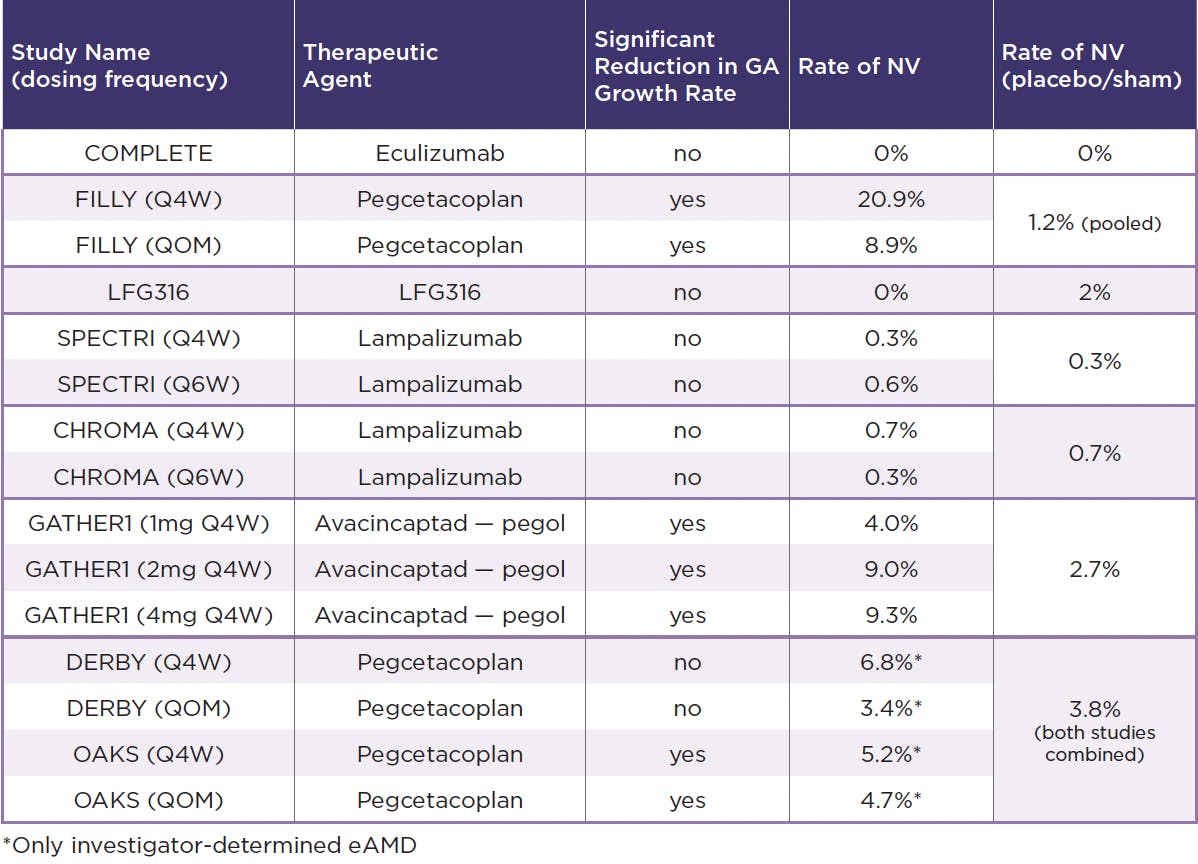
The phase 2 COMPLETE study (2013) evaluated the effect of eculizumab, a systemic C5 inhibitor, on the growth of GA. Sixty patients were randomized 2:1 to receive either intravenous (IV) eculizumab or placebo (saline) over a 6-month period and were evaluated off treatment for an additional 26 weeks (total study time: 52 weeks). The study did not show any significant reduction in GA progression, and none of the eyes demonstrated any wet AMD during the 6-month treatment period or the subsequent 6 months observation follow-up (NCT00935883).53
LFG316, an anti-C5 monoclonal antibody, was evaluated in a phase 2 study (2015) with subjects with GA secondary to AMD. This was a 2-part study: Part A and Part B. Part B of the study was cancelled due to lack of efficacy in Part A. The primary outcome measure of Part A was GA lesion growth measured by fundus autofluorescence (FAF) from baseline to day 505. Out of 99 subjects in Part A who received LFG316 5 milligrams (mg), no subjects had MNV in the study eye. Out of 51 subjects in Part A who received sham treatment, 1 (2%) had CNV in the study eye (NCT01527500).
The phase 3 SPECTRI study (2018) evaluated lampalizumab, a CFD inhibitor, in subjects with GA secondary to AMD. Subjects were randomized 2:1:2:1 to receive 10 mg of intravitreal lampalizumab every 4 weeks, sham procedure every 4 weeks, 10 mg of lampalizumab every 6 weeks, or sham procedure every 6 weeks, through 96 weeks. The primary outcome was the mean change in GA lesion area from baseline to 48 weeks. At week 48, no significant benefit of lampalizumab treatment was observed when compared to sham treatment. In this study, 1 (0.3%) out of 318 subjects in the sham group, 1 (0.3%) out of 329 subjects in the lampalizumab every-4-weeks group, and 2 (0.6%) out of 323 subjects in the lampalizumab every-6-weeks group developed MNV in the study eye (NCT02247531).54 The phase 3 CHROMA study (2018) had a study design identical to that of SPECTRI. Similar to SPECTRI, no benefit of lampalizumab treatment was observed when compared to sham treatment. In this study, 2 (0.7%) out of 300 subjects in the sham group, 2 (0.7%) out of 298 subjects in the lampalizumab every-4-weeks group, and 1 (0.3%) out of 303 subjects in the lampalizumab every-6-weeks group developed CNV in the study eye(NCT02247531).54
Interestingly, the rates of CNV development in both the LFG316 and lampalizumab studies were lower than the natural history of MNV development in AMD patients.
The phase 2 FILLY study (2015) evaluated intravitreal pegcetacoplan, a C3 inhibitor, in subjects with GA secondary to AMD. Subjects were randomized 2:2:1:1 to pegcetacoplan monthly, pegcetacoplan every-other-month, sham injection monthly, or sham injection every-other-month over a 12-month period and were evaluated off treatment for an additional 6 months (total time: 18 months). The primary outcome measure was the least square (LS) mean change from baseline in square root GA lesion size in the study eye at month 12, which the study met in both the monthly and every-other-month treatment groups. Patients receiving pegcetacoplan monthly showed a 29% average decrease of GA growth (P=.008) over 12 months while those receiving pegcetacoplan every-other-month showed a 20% average reduction (P=.067) when compared to sham. The results also showed that 18 (20.9%) out of 86 study eyes in the monthly dosing group and 7 (8.9%) out of 79 study eyes in the every-other-month dosing group that were treated with pegcetacoplan reported an adverse event (AE) of exudative AMD (eAMD) vs. 1 (1.2%) out of 81 study eyes in the sham-treated group.55 Interestingly, when patients were stratified based on history of eAMD in the contralateral eye, the rates were strikingly different. When positive, the rates of eAMD in the study eye were 33% and 12% for the pegcetacoplan monthly and every-other-month groups, respectively, compared to 17.9% and 3.9% in patients without such history. A post hoc analysis showed that 36.9% of patients had evidence of DLS at baseline, which is highly suggestive of a subclinical MNV. Patients that developed eAMD during the study were more likely to have the DLS at baseline than the patients who did not develop eAMD (73.1% vs 32.5%, P<0.0001).56 The FILLY study is the first time the AE of eAMD, without including non-exudative MNV, was used in a clinical trial. The rationale to exclude non-exudative MNV could be that these lesions do not require a therapeutic intervention and do not prompt a withdrawal from the study. Additionally, it has been suggested that non-exudative type I MNV might even be beneficial in preventing GA progression.57 On the other hand, when using the eAMD nomenclature, subclinical occult MNV (type 1) is excluded, and the reported numbers are consequently lower than otherwise. Hence the importance of understanding such distinction for proper comparison between different trials.
The phase 2/3 GATHER1 study (2020) evaluated avacincaptad pegol (ACP), an anti-C5 aptamer, in subjects with GA secondary to AMD. This was a 2-part study. In Part 1, subjects were randomized 1:1:1 to ACP 1 mg, ACP 2 mg, and sham. In Part 2, subjects were randomized 1:2:2 to ACP 2 mg, ACP 4 mg, and sham. Both parts were studied over a 12-month period and the primary efficacy endpoint was the mean rate of change in GA area over 12 months as measured by FAF. Both the ACP 2 mg and 4 mg treatment arms met their prescribed efficacy endpoints with reductions of 27.4% (P=.0072) and 27.8% (P=.0051) of GA growth compared to the sham-controlled groups, respectively. CNV development was seen in 3 (2.7%), 1 (4.0%), 6 (9.0%), and 8 (9.6%) study eyes of patients in the sham, ACP 1-mg, 2-mg, and 4-mg groups, respectively.24 Over the total 18-month follow-up period, CNV was reported by investigators in the fellow eyes of 3 subjects (1.0%), and in the study eye of 1 subject (0.9%) in the sham cohort, 1 subject (3.8%) in the ACP 1-mg cohort, and 4 subjects (4.8%) in the ACP 4-mg cohort. No subjects in the ACP 2-mg cohort arm had CNV during the extended follow-up period. All incidences of CNV, with or without exudation, were reported as an AE.
Recently, top-line results from the phase 3 DERBY and OAKS trials were announced, evaluating intravitreal pegcetacoplan, an investigational therapy targeting C3, in 1,258 adults. The primary efficacy endpoint for both studies was change in total area of GA lesion(s) in the study eye from baseline to month 12 (in mm2) as measured by FAF. OAKS meet the study endpoint, showing 22% (P=.0003) and 16% (P=.0052) reductions in monthly and every-other-month treatment groups, respectively. In contrast, DERBY did not meet the prescribed endpoint only demonstrating 12% (P=.0528) and 11% (P=.0750) reductions for monthly and every-other-month treatments, respectively. For both studies combined, the total of investigator- and reading center-reported new-onset eAMD were 6.4%, 5%, and 3.8% of patients in the pegcetacoplan monthly, every-other-month, and sham groups, respectively.58 Cases of MNV detected by the reading center by FA at Month 12, but not reported by investigators as adverse events, are also reported.
Rationale for Higher Rates of NV
The observed elevation in rates of NV in patients treated for GA in complement inhibition clinical trials was unexpected. It may be that a surveillance bias is at play here, as patients in a trial are followed more closely, leading to the detection of subclinical NV that would otherwise go undiagnosed. Another possibility is that current imaging techniques allow the detection of NV that would not be identified with older diagnostic techniques. However, if those hypotheses are correct, we would also see an increase of NV conversion in the control group within these studies, and that has not been the case.
Interestingly, it may be that the increased occurrence of NV is correlated with clinical efficacy. In studies in which the growth of GA was not significantly reduced, there was no observed increase in the incidence of NV. Conversely, studies that did show a significant clinical effect on GA, slowing the progression of disease, also reported higher NV or eAMD rates (Table 1). A rationale behind such a relationship is that, as the area of atrophy grows in the control group, the number of cells producing VEGF-A also decreases, reducing VEGF-A levels inside the eye. In the treated patients, as the treatment for GA succeeds in slowing disease progression, the surviving cells continue to produce VEGF-A, potentially explaining why the treated groups would have a higher rate of conversion to wet AMD. Another possibility is that by reducing the production of C3a and C5a, there are fewer pro-inflammatory M1-like polarized macrophages and more M2-like polarized pro-angiogenic macrophages. M1 macrophages are the predominant subset involved in the inflammatory phase of an injury, facilitating the disruption of endothelium tight junctions and recruitment of neutrophils and monocytes. M2 macrophages play a role in inflammation resolution and in promoting angiogenesis to enhance wound healing at later stages. A drug-induced macrophage phenotypical switch may increase the pro-angiogenic milieu in the retina, leading to NV or onset of exudation of previously quiescent lesions.59 In this regard, we should acknowledge that NV may be the mechanism of rescue or benefit of the complement therapy in the trials showing positive results. There are anecdotal reports of reduced risk of MNV developing in areas that are atrophic with loss of RPE and choriocapillaris.34 Additionally, the presence of type I MNV has been associated with a slower progression of the areas of atrophy suggesting a possible protective effect.60 It can be argued that the occurrence of MNV might be seen as a biomarker of the viability of the RPE cells and photoreceptors, and possible evidence that the treatment was able to, at least to some extent, prevent cell death and consequent atrophy seen in the natural history of GA in untreated patients. The probable relationship between GA, MNV and the complement cascade highlights the importance of avoiding any imbalance in the incidence of nonexudative MNV at baseline between treatment and sham arms.
III. MNV diagnosis in current clinical trials of complement inhibitors in GA
MNV development during GA clinical trials is a noteworthy ocular AE, worthy of further investigation. An analysis of the methodology for MNV diagnosis reveals varying criteria used to establish a conclusive diagnosis of MNV. This variation may lead to misalignment of results among clinical trials testing similar therapeutics. Establishing common criteria for MNV diagnosis within these trials will make results easier to compare, especially when it involves interpretation of the final safety outcomes.
Diagnostic techniques
There are several imaging techniques used to identify MNV. Considerable progress has been made within the last 20 years in this field, and once-imprecise techniques have been superseded by advanced imaging, allowing for a higher level of confidence in the diagnosis of MNV.61
FA has been historically used to diagnose and categorize MNV. FA utilizes fluorescein dye to image dynamic blood flow throughout the retina and choroid. FA presents drawbacks, however. Fluorescein dye is invasive, requiring injection into the patient, and can lead to side effects, including anaphylaxis.62 Other ocular complications such as subretinal hemorrhages may obscure FA imaging. Finally, MNV subtypes with poorly defined boundaries, may not show up clearly in FA imaging until the latter portion of the exam, termed late leakage of undetermined origin or type 2 (occult) MNV.63
Indocyanine green angiography (ICGA) is a complementary technique for vasculature imaging, used intermittently in current practice. ICGA can detect type I MNV that is difficult to observe by FA as well as retinal angiomatous proliferation, the defining characteristic of type III MNV. ICGA is also used to image polypoid lesions and branching vascular networks in polypoidal choroidal vasculopathy. In general, ICGA imaging is not used in clinical trials of dry AMD.
While FA is still considered by many to be the gold standard to diagnose MNV, OCT has experienced an increased role as a first-line imaging method for MNV patients, particularly if used in combination with FA.64 OCT is a noninvasive analysis that provides critical information about retinal health by collecting cross-sectional images of the retina at micrometer resolution. Used as a complement to FA, the 3-dimensional imaging nature of OCT has led to MNV into several subtype characterizations.12
As imaging techniques and other diagnostic tools have improved over time, MNV detection and diagnosis has evolved as well. Specifically, advanced OCT angiography imaging now enables ophthalmologists to accurately identify not only MNV occurrence, but also more precise localization of the depth of NV, leading to improvements in assessing MNV subtypes.65 OCTA captures images noninvasively and is performed concurrently with traditional OCT imaging. OCTA can image blood flow in 3 dimensions, allowing for enhanced specificity in MNV diagnosis. One drawback to OCTA imaging is that it is not yet readily available in all practices and clinics making its widespread use in GA clinical trials limited,66 which is unfortunate as detecting subclinical MNV is aided by OCTA analysis. The other drawback is that OCTA alone does not show leakage characteristic of eAMD. Therefore, a multimodal approach with OCT (which shows fluid) and FA (which may show leakage) is optimal.
Criteria for the diagnosis of MNV in clinical trials for GA
Give the rapid and constant increase in AMD knowledge, the Consensus on Neovascular Age-Related Macular Degeneration Nomenclature (CONAN) Study Group has highlighted the fact that any nomenclature system will need periodic revision.12,13 As the terminology changes, different clinical trials after an update will use a terminology different than used in the past, an inconsistency that can lead to difficulties in comparing results. MNV has emerged as a potential adverse event linked to emerging treatments for dry AMD, and, to fully understand the frequency and nature of this phenomenon, it is important that clinical trials of new agents in dry AMD report all cases of AMD-related neovascular membranes, detailing specific subtypes, to provide a consistent picture of the frequency and nature of these events and allow the scientific community to compare their results with past and future studies.
In addition to the 3 types of NVs previously mentioned, additional classifications have been proposed. One such additional pathology is termed non-exudative MNV, a term that has been adopted by consensus and which describes NV that occurs without intraretinal or subretinal fluid within the macula.12 Continuous analysis and revision of terminology and nomenclature will be needed as detection methods advance.
The adoption of standard MNV definitions reporting the MNV presence and occurrence within the context of trials for GA in AMD patients would promote more comparable metrics, equivalent to the diabetic retinopathy severity scale (DRSS) used to grade diabetic retinopathy.67 Physicians at participating trial centers must be educated on the most updated criteria for MNV diagnosis, not just because of the evolving landscape of MNV nomenclature, but also because of the subtle pathogenic hallmarks that may not always provide a conclusive diagnosis. As many clinical trials rely only on study investigators to determine MNV, having a common training to evaluate MNV is imperative. For example, as previously stated, there is a subset of MNV that does not include exudation. Conversely, there have also been reports of exudation that are not caused by MNV.68,69 Hence, the terms exudation and MNV should not be used interchangeably.
Lastly, OCTA can identify areas of nonexudative NV in a significant subset of patients with AMD without symptoms or any clinical evidence of macular fluid.70 The prevalence of this quiescent MNV has been reported as 15.9% in patients that had a history of wet AMD in the fellow eye.71 The subtle signs (DLS and SIRE) and absence of symptoms of this subtype of MNV should not be taken lightly as it has been shown that 20% to 80% of these lesions eventually progress to exudative MNV with leakage and associated vision loss.60,71–74 While mean time to onset of exudation of these subclinical lesions is approximately 8 months,20,72 some lesions can remain silent for years.74
Placed in the context of clinical trial AE reporting, these pathogenic manifestations present several questions regarding what constitutes a severe ocular AE. Does leakage or exudation without a clearly defined MNV count as an AE? Conversely, does MNV that does not present with leakage or exudation count as an AE? It is important that clinical trials adhere to similar definitions of MNV for the purposes of AE reporting, so that physicians can make the best possible risk/benefit assessment for their patients. It is our view that, pending further studies evaluating long-term outcomes in these patients, all types of MNV, with or without exudation, should be classified as an AE and reported accordingly. A standardized choice of appropriate imaging methods (in particular, OCTA) would need to be made in clinical trials at all sites to accurately determine the presence or absence of MNV, exudative or otherwise. This approach would provide the most thorough reporting of MNV, whether in the initial patient enrollment stages, or during the trial, when tracking the occurrence of AEs, allowing for more transparent disclosure of all MNV occurrences.
IV. Treatment protocols for MNV in GA patients during a trial
With established criteria for MNV diagnosis in place, we then must establish standardized criteria that should trigger treatment for the MNV and either continuation or withdrawal from the trial. A standardized treatment regimen or algorithm should be established and applied for the appropriate treatment of all MNV types, guiding when and by whom the decision to start anti-VEGF therapy should be made to secure the best possible outcome for the patient.75 In situations where MNV is suspected by a masked investigator, OCT and additional imaging studies, including FA and if possible OCTA, should be performed. Images should be sent to a central masked reading center, which should evaluate them promptly, so as to avoid any delays in treatment. With the diagnosis made by independent unbiased parties, treatment regimens should be employed by physicians with expertise in the management of MNV, and ideally, those familiar with the patient’s history. With a prospective treatment algorithm in place, MNV would be identified promptly during the trial, and the best course of treatment for the patient could be determined. In recent phase 3 trials targeting the complement system, patients developing MNV received on-label anti-VEGF intravitreal injections and remain enrolled in their respective studies (NCT04435366).76
Should non-exudative MNV be treated with anti-VEGF injections? Considering that a significant percentage of these lesions eventually progress into exudative MNV, they certainly need to be watched closely for progression.77 In the past we would watch for “disease progression” in these non-exudative lesions before starting therapy. The definition of disease progression included decrease in vision, increase in the area of MNV, hemorrhage, or exudation. Note that this definition goes beyond simply looking for exudation. There is not enough scientific evidence yet on when this specific MNV subtype should be treated with anti-VEGF therapy. While there is a current assumption that they should be closely monitored and only treated after conversion to an exudative lesion, there are no data comparing the clinical outcomes of early treatment versus observation.20,72,78
V. Conclusions
With several phase 3 clinical trials targeting the complement system, the treatment of GA may be about to see important progress, similar to that seen in wet AMD with the advent of anti-VEGF therapies. Emerging therapeutics are showing promising results in slowing disease progression, i.e., growth of outer retinal atrophy. The incidence of new-onset MNV within these trials is providing useful insights into the pathogenesis of GA and the role that the complement cascade plays in angiogenesis. It is of utmost importance that protocols follow defined criteria when describing the AE of MNV. This approach will allow for a more informed comparison between trials, but even more importantly, will provide the scientific community with a truer picture of the relationship between GA, complement therapies, and MNV.
1. Kumar-Singh R. The role of complement membrane attack complex in dry and wet AMD - From hypothesis to clinical trials. Exp Eye Res. 2019;184:266-277. doi:10.1016/j.exer.2019.05.006
2. Nowak JZ. Age-related macular degeneration (AMD): pathogenesis and therapy. Pharmacol Rep. Published online 2006:11.
3. Stahl A. The Diagnosis and Treatment of Age-Related Macular Degeneration. Dtsch Ärztebl Int.:11.
4. Al-Zamil W, Yassin S. Recent developments in age-related macular degeneration: a review. Clin Interv Aging. 2017;Volume 12:1313-1330. doi:10.2147/CIA.S143508
5. Boulton M, Dayhaw-Barker P. The role of the retinal pigment epithelium: Topographical variation and ageing changes. Eye. 2001;15(3):384-389. doi:10.1038/eye.2001.141
6. Vander JF. The Age-Related Eye Disease Study Severity Scale for Age-Related Macular Degeneration: AREDS Report No 17. Yearb Ophthalmol. 2006;2006:118-121. doi:10.1016/S0084-392X(08)70301-0
7. Ferris FL, Wilkinson CP, Bird A, et al. Clinical Classification of Age-related Macular Degeneration. Ophthalmology. 2013;120(4):844-851. doi:10.1016/j.ophtha.2012.10.036
8. Guymer RH, Rosenfeld PJ, Curcio CA, et al. Incomplete Retinal Pigment Epithelial and Outer Retinal Atrophy in Age-Related Macular Degeneration. Ophthalmology. 2020;127(3):394-409. doi:10.1016/j.ophtha.2019.09.035
9. Boyer DS, Schmidt-Erfurth U, van Lookeren Campagne M, Henry EC, Brittain C. THE PATHOPHYSIOLOGY OF GEOGRAPHIC ATROPHY SECONDARY TO AGE-RELATED MACULAR DEGENERATION AND THE COMPLEMENT PATHWAY AS A THERAPEUTIC TARGET. Retina. 2017;37(5):819-835. doi:10.1097/IAE.0000000000001392
10. Gheorghe A, Mahdi L, Musat O. AGE-RELATED MACULAR DEGENERATION. Romanian J Ophthalmol. 2015;59(2):74-77.
11. Hobbs SD, Pierce K. Wet Age-Related Macular Degeneration (Wet AMD). StatPearls Publishing; 2022. Accessed January 26, 2022. https://www.ncbi.nlm.nih.gov/books/NBK572147/
12. Spaide RF, Jaffe GJ, Sarraf D, et al. Consensus Nomenclature for Reporting Neovascular Age-Related Macular Degeneration Data: Consensus on Neovascular Age-Related Macular Degeneration Nomenclature Study Group. Ophthalmology. 2020;127(5):616-636. doi:10.1016/j.ophtha.2019.11.004
13. Sharma A, Parachuri N, Kumar N, et al. Terms non-exudative and non-neovascular: awaiting entry at the doors of AMD reclassification. Graefes Arch Clin Exp Ophthalmol. 2021;259(6):1381-1383. doi:10.1007/s00417-021-05164-6
14. Chen L, Li M, Messinger JD, Ferrara D, Curcio CA, Freund KB. Recognizing Atrophy and Mixed-Type Neovascularization in Age-Related Macular Degeneration Via Clinicopathologic Correlation. Transl Vis Sci Technol. 2020;9(8):8. doi:10.1167/tvst.9.8.8
15. Hariri A, Heussen FM, Nittala MG, Sadda SR. Optical Coherence Tomographic Correlates of Angiographic Subtypes of Occult Choroidal Neovascularization. Invest Ophthalmol Vis Sci. 2013;54(13):8020-8026. doi:10.1167/iovs.13-12302
16. Liakopoulos S, Ongchin S, Bansal A, et al. Quantitative optical coherence tomography findings in various subtypes of neovascular age-related macular degeneration. Invest Ophthalmol Vis Sci. 2008;49(11):5048-5054. doi:10.1167/iovs.08-1877
17. Fleckenstein M, Keenan TDL, Guymer RH, et al. Age-related macular degeneration. Nat Rev Dis Primer. 2021;7(1):31. doi:10.1038/s41572-021-00265-2
18. Fleckenstein M, Mitchell P, Freund KB, et al. The Progression of Geographic Atrophy Secondary to Age-Related Macular Degeneration. Ophthalmology. 2018;125(3):369-390. doi:10.1016/j.ophtha.2017.08.038
19. Carnevali A, Cicinelli MV, Capuano V, et al. Optical Coherence Tomography Angiography: A Useful Tool for Diagnosis of Treatment-Naïve Quiescent Choroidal Neovascularization. Am J Ophthalmol. 2016;169:189-198. doi:10.1016/j.ajo.2016.06.042
20. Mentes J, Yıldırım S. Optical Coherence Tomography Characteristics of Quiescent Type 1 Neovascularization in Eyes with Nonexudative Age-related Macular Degeneration. Turk J Ophthalmol. 2019;49(2):84-88. doi:10.4274/tjo.galenos.2018.58908
21. Schneider U, Gelisken F, Inhoffen W. Natural course of occult choroidal neovascularization in age-related macular degeneration: development of classic lesions in fluorescein angiography. Acta Ophthalmol Scand. 2005;83(2):141-147. doi:10.1111/j.1600-0420.2005.00443.x
22. Sarks SH. Ageing and degeneration in the macular region: a clinico-pathological study. Br J Ophthalmol. 1976;60(5):324-341. doi:10.1136/bjo.60.5.324
23. Green WR, Enger C. Age-related macular degeneration histopathologic studies. The 1992 Lorenz E. Zimmerman Lecture. Ophthalmology. 1993;100(10):1519-1535. doi:10.1016/s0161-6420(93)31466-1
24. Jaffe GJ, Westby K, Csaky KG, et al. C5 Inhibitor Avacincaptad Pegol for Geographic Atrophy Due to Age-Related Macular Degeneration. Ophthalmology. 2021;128(4):576-586. doi:10.1016/j.ophtha.2020.08.027
25. Kaszubski P, Ben Ami T, Saade C, Smith RT. Geographic Atrophy and Choroidal Neovascularization in the Same Eye: A Review. Ophthalmic Res. 2016;55(4):185-193. doi:10.1159/000443209
26. Wang J, Ying GS. Growth Rate of Geographic Atrophy Secondary to Age-Related Macular Degeneration: A Meta-Analysis of Natural History Studies and Implications for Designing Future Trials. Ophthalmic Res. 2021;64(2):205-215. doi:10.1159/000510507
27. Colijn JM, Liefers B, Joachim N, et al. Enlargement of Geographic Atrophy From First Diagnosis to End of Life. JAMA Ophthalmol. 2021;139(7):743-750. doi:10.1001/jamaophthalmol.2021.1407
28. Grassmann F, Fleckenstein M, Chew EY, et al. Clinical and genetic factors associated with progression of geographic atrophy lesions in age-related macular degeneration. PloS One. 2015;10(5):e0126636. doi:10.1371/journal.pone.0126636
29. Grassmann F, Harsch S, Brandl C, et al. Assessment of Novel Genome-Wide Significant Gene Loci and Lesion Growth in Geographic Atrophy Secondary to Age-Related Macular Degeneration. JAMA Ophthalmol. 2019;137(8):867-876. doi:10.1001/jamaophthalmol.2019.1318
30. Fleckenstein M, Grassmann F, Lindner M, et al. Distinct Genetic Risk Profile of the Rapidly Progressing Diffuse-Trickling Subtype of Geographic Atrophy in Age-Related Macular Degeneration (AMD). Invest Ophthalmol Vis Sci. 2016;57(6):2463-2471. doi:10.1167/iovs.15-18593
31. Miller ME, Morgan TM, Espeland MA, Emerson SS. Group comparisons involving missing data in clinical trials: a comparison of estimates and power (size) for some simple approaches. Stat Med. 2001;20(16):2383-2397. doi:10.1002/sim.904
32. Sarks JP, Sarks SH, Killingsworth MC. Evolution of geographic atrophy of the retinal pigment epithelium. Eye Lond Engl. 1988;2 ( Pt 5):552-577. doi:10.1038/eye.1988.106
33. Schatz H, McDonald HR. Atrophic macular degeneration. Rate of spread of geographic atrophy and visual loss. Ophthalmology. 1989;96(10):1541-1551. doi:10.1016/s0161-6420(89)32694-7
34. Sunness JS, Gonzalez-Baron J, Bressler NM, Hawkins B, Applegate CA. The development of choroidal neovascularization in eyes with the geographic atrophy form of age-related macular degeneration. Ophthalmology. 1999;106(5):910-919. doi:10.1016/S0161-6420(99)00509-6
35. Five-year follow-up of fellow eyes of patients with age-related macular degeneration and unilateral extrafoveal choroidal neovascularization. Macular Photocoagulation Study Group. Arch Ophthalmol Chic Ill 1960. 1993;111(9):1189-1199. doi:10.1001/archopht.1993.01090090041018
36. Risk factors for choroidal neovascularization in the second eye of patients with juxtafoveal or subfoveal choroidal neovascularization secondary to age-related macular degeneration. Macular Photocoagulation Study Group. Arch Ophthalmol Chic Ill 1960. 1997;115(6):741-747. doi:10.1001/archopht.1997.01100150743009
37. Dunkelberger JR, Song WC. Complement and its role in innate and adaptive immune responses. Cell Res. 2010;20(1):34-50. doi:10.1038/cr.2009.139
38. Hato T, Dagher PC. How the Innate Immune System Senses Trouble and Causes Trouble. Clin J Am Soc Nephrol CJASN. 2015;10(8):1459-1469. doi:10.2215/CJN.04680514
39. Dobó J, Kocsis A, Gál P. Be on Target: Strategies of Targeting Alternative and Lectin Pathway Components in Complement-Mediated Diseases. Front Immunol. 2018;9. Accessed January 26, 2022. https://www.frontiersin.org/article/10.3389/fimmu.2018.01851
40. Vignesh P, Rawat A, Sharma M, Singh S. Complement in autoimmune diseases. Clin Chim Acta Int J Clin Chem. 2017;465:123-130. doi:10.1016/j.cca.2016.12.017
41. Fritsche LG, Igl W, Bailey JNC, et al. A large genome-wide association study of age-related macular degeneration highlights contributions of rare and common variants. Nat Genet. 2016;48(2):134-143. doi:10.1038/ng.3448
42. Geerlings MJ, de Jong EK, den Hollander AI. The complement system in age-related macular degeneration: A review of rare genetic variants and implications for personalized treatment. Mol Immunol. 2017;84:65-76. doi:10.1016/j.molimm.2016.11.016
43. Xu H, Chen M. Targeting the complement system for the management of retinal inflammatory and degenerative diseases. Eur J Pharmacol. 2016;787:94-104. doi:10.1016/j.ejphar.2016.03.001
44. Gehrs KM, Jackson JR, Brown EN, Allikmets R, Hageman GS. Complement, age-related macular degeneration and a vision of the future. Arch Ophthalmol Chic Ill 1960. 2010;128(3):349-358. doi:10.1001/archophthalmol.2010.18
45. Walport MJ. Complement. First of two parts. N Engl J Med. 2001;344(14):1058-1066. doi:10.1056/NEJM200104053441406
46. Kim BJ, Mastellos DC, Li Y, Dunaief JL, Lambris JD. Targeting complement components C3 and C5 for the retina: Key concepts and lingering questions. Prog Retin Eye Res. 2021;83:100936. doi:10.1016/j.preteyeres.2020.100936
47. Liu K, Ma L, Lai TYY, et al. Evaluation of the association of C5 with neovascular age-related macular degeneration and polypoidal choroidal vasculopathy. Eye Vis Lond Engl. 2019;6:34. doi:10.1186/s40662-019-0161-2
48. Rossi V, Bally I, Lacroix M, Arlaud GJ, Thielens NM. Classical complement pathway components C1r and C1s: purification from human serum and in recombinant form and functional characterization. Methods Mol Biol Clifton NJ. 2014;1100:43-60. doi:10.1007/978-1-62703-724-2_4
49. Parente R, Clark SJ, Inforzato A, Day AJ. Complement factor H in host defense and immune evasion. Cell Mol Life Sci CMLS. 2017;74(9):1605-1624. doi:10.1007/s00018-016-2418-4
50. Pilotti C, Greenwood J, Moss SE. Functional Evaluation of AMD-Associated Risk Variants of Complement Factor B. Invest Ophthalmol Vis Sci. 2020;61(5):19. doi:10.1167/iovs.61.5.19
51. Dreismann AK, McClements ME, Barnard AR, et al. Functional expression of complement factor I following AAV-mediated gene delivery in the retina of mice and human cells. Gene Ther. 2021;28(5):265-276. doi:10.1038/s41434-021-00239-9
52. Johnson LV, Leitner WP, Staples MK, Anderson DH. Complement activation and inflammatory processes in Drusen formation and age related macular degeneration. Exp Eye Res. 2001;73(6):887-896. doi:10.1006/exer.2001.1094
53. Yehoshua Z, de Amorim Garcia Filho CA, Nunes RP, et al. Systemic complement inhibition with eculizumab for geographic atrophy in age-related macular degeneration: the COMPLETE study. Ophthalmology. 2014;121(3):693-701. doi:10.1016/j.ophtha.2013.09.044
54. Holz FG, Sadda SR, Busbee B, et al. Efficacy and Safety of Lampalizumab for Geographic Atrophy Due to Age-Related Macular Degeneration: Chroma and Spectri Phase 3 Randomized Clinical Trials. JAMA Ophthalmol. 2018;136(6):666. doi:10.1001/jamaophthalmol.2018.1544
55. Liao DS, Grossi FV, El Mehdi D, et al. Complement C3 Inhibitor Pegcetacoplan for Geographic Atrophy Secondary to Age-Related Macular Degeneration. Ophthalmology. 2020;127(2):186-195. doi:10.1016/j.ophtha.2019.07.011
56. Wykoff C. Safety of intravitreal pegcetacoplan in geographic atrophy: results from the DERBY and OAKS trials. Oral presentation at: Retina Society Annual Meeting; September, 2021; Chicago, IL.
57. Dhrami-Gavazi E, Balaratnasingam C, Lee W, Freund KB. Type 1 neovascularization may confer resistance to geographic atrophy amongst eyes treated for neovascular age-related macular degeneration. Int J Retina Vitr. 2015;1(1):15. doi:10.1186/s40942-015-0015-6
58. Boyer D. Safety of intravitreal pegcetacoplan in geographic atrophy: results from the DERBY and OAKS trials. Oral presentation at: American Society of Retina Specialists Annual Meeting; October, 2021; San Antonio, TX.
59. Hong H, Tian XY. The Role of Macrophages in Vascular Repair and Regeneration after Ischemic Injury. Int J Mol Sci. 2020;21(17):E6328. doi:10.3390/ijms21176328
60. Heiferman MJ, Fawzi AA. Progression of subclinical choroidal neovascularization in age-related macular degeneration. PloS One. 2019;14(6):e0217805. doi:10.1371/journal.pone.0217805
61. Invernizzi A, Pellegrini M, Cornish E, Yi Chong Teo K, Cereda M, Chabblani J. Imaging the Choroid: From Indocyanine Green Angiography to Optical Coherence Tomography Angiography. Asia-Pac J Ophthalmol. 2020;9(4):335-348. doi:10.1097/APO.0000000000000307
62. Yannuzzi LA, Rohrer KT, Tindel LJ, et al. Fluorescein angiography complication survey. Ophthalmology. Published online 005-001 1986. Accessed January 26, 2022. https://www.meta.org/papers/fluorescein-angiography-complication/3523356
63. Gass JD. Unusual retinal pigment epitheliopathy and choroidopathy. Graefes Arch Clin Exp Ophthalmol Albrecht Von Graefes Arch Klin Exp Ophthalmol. 1998;236(1):75. doi:10.1007/pl00012734
64. Gualino V, Tadayoni R, Cohen SY, et al. OPTICAL COHERENCE TOMOGRAPHY, FLUORESCEIN ANGIOGRAPHY, AND DIAGNOSIS OF CHOROIDAL NEOVASCULARIZATION IN AGE-RELATED MACULAR DEGENERATION. Retina Phila Pa. 2019;39(9):1664-1671. doi:10.1097/IAE.0000000000002220
65. von der Emde L, Thiele S, Pfau M, et al. Assessment of Exudative Activity of Choroidal Neovascularization in Age-Related Macular Degeneration by OCT Angiography. Ophthalmologica. 2020;243(2):120-128. doi:10.1159/000503609
66. Ghanchi FD, Fulcher C, Madanat Z, Mdanat F. Optical coherence tomography angiography for identifying choroidal neovascular membranes: a masked study in clinical practice. Eye. 2021;35(1):134-141. doi:10.1038/s41433-020-01285-0
67. Yonekawa Y, Modi YS, Kim LA, Skondra D, Kim JE, Wykoff CC. American Society of Retina Specialists Clinical Practice Guidelines on the Management of Nonproliferative and Proliferative Diabetic Retinopathy without Diabetic Macular Edema. J Vitreoretin Dis. 2020;4(2):125-135. doi:10.1177/2474126419893829
68. Hilely A, Au A, Freund KB, et al. Non-neovascular age-related macular degeneration with subretinal fluid. Br J Ophthalmol. 2021;105(10):1415-1420. doi:10.1136/bjophthalmol-2020-317326
69. Bacci T, Essilfie JO, Leong BCS, Freund KB. Exudative non-neovascular age-related macular degeneration. Graefes Arch Clin Exp Ophthalmol. 2021;259(5):1123-1134. doi:10.1007/s00417-020-05021-y
70. Roisman L, Zhang Q, Wang RK, et al. Optical Coherence Tomography Angiography of Asymptomatic Neovascularization in Intermediate Age-Related Macular Degeneration. Ophthalmology. 2016;123(6):1309-1319. doi:10.1016/j.ophtha.2016.01.044
71. Solecki L, Loganadane P, Gauthier AS, et al. Predictive factors for exudation of quiescent choroidal neovessels detected by OCT angiography in the fellow eyes of eyes treated for a neovascular age-related macular degeneration. Eye Lond Engl. 2021;35(2):644-650. doi:10.1038/s41433-020-0936-7
72. Bailey ST, Thaware O, Wang J, et al. Detection of Nonexudative Choroidal Neovascularization and Progression to Exudative Choroidal Neovascularization Using OCT Angiography. Ophthalmol Retina. 2019;3(8):629-636. doi:10.1016/j.oret.2019.03.008
73. Capuano V, Miere A, Querques L, et al. Treatment-Naïve Quiescent Choroidal Neovascularization in Geographic Atrophy Secondary to Nonexudative Age-Related Macular Degeneration. Am J Ophthalmol. 2017;182:45-55. doi:10.1016/j.ajo.2017.07.009
74. Fukushima A, Maruko I, Chujo K, Hasegawa T, Arakawa H, Iida T. Characteristics of treatment-naïve quiescent choroidal neovascularization detected by optical coherence tomography angiography in patients with age-related macular degeneration. Graefes Arch Clin Exp Ophthalmol Albrecht Von Graefes Arch Klin Exp Ophthalmol. 2021;259(9):2671-2677. doi:10.1007/s00417-021-05127-x
75. Chong V. Ranibizumab for the treatment of wet AMD: a summary of real-world studies. Eye. 2016;30(2):270-286. doi:10.1038/eye.2015.217
76. Wykoff CC. Treatment of Geographic Atrophy Secondary to Age-Related Macular Degeneration With Pegcetacoplan: Updates on the Randomized Phase 3 DERBY and OAKS Trials. Presented at: American Academy of Ophthalmology 2021,; November 12, 2021; New Orleans, LA. https://investors.apellis.com/static-files/8d3965a7-0cc3-47b6-90f7-4ccd8cee556a
77. de Oliveira Dias JR, Zhang Q, Garcia JMB, et al. Natural History of Subclinical Neovascularization in Nonexudative Age-Related Macular Degeneration Using Swept-Source OCT Angiography. Ophthalmology. 2018;125(2):255-266. doi:10.1016/j.ophtha.2017.08.030
78. Querques G, Srour M, Massamba N, et al. Functional Characterization and Multimodal Imaging of Treatment-Naïve “Quiescent” Choroidal Neovascularization. Invest Ophthalmol Vis Sci. 2013;54(10):6886-6892. doi:10.1167/iovs.13-11665
