


A common delay to the revenue cycle is the notorious claim denial. There is a plethora of reasons why a claim could be rejected, but a common and often overlooked error is disregard for the basic rules of ICD-10-CM coding. Take a step back to review these basics with your staff—doing so can pay dividends when claims roll through smoothly.
EXCLUDES1 NOTE
When two conditions cannot occur together, such as a congenital form versus an acquired form of the same condition, this is identified in ICD-10-CM as an Excludes1 note. Excludes1 notes are usually identified at the beginning of a subchapter and would include all of the ICD-10-CM codes in that section. For example, the family of codes under the subchapter of peripheral retinal degeneration (H35.4-) has an Excludes1 note for hereditary retinal degeneration (H35.5-). Since these two conditions cannot occur together, the Excludes1 note reminds users that the two ICD-10-CM codes cannot be billed during the same encounter.
Thus, if you were to apply the note above to a clinical scenario, H35.411, lattice degeneration of retina, right eye, should not be reported with H35.52, pigmentary retinal dystrophy, according to Excludes1 edits.
Another example is cystoid macular degeneration (H35.35-), which has an Excludes1 edit with cystoid macular edema following cataract surgery (H59.03-). If the correct diagnosis is the latter, report H59.03- without H35.35-.
Many commercial payers have applied Excludes1 notes in their claims processing system and will deny claims that do not adhere to these edits, as the conditions are seen as mutually exclusive. Excludes1 notes can be identified in the AAO’s ICD-10-CM Complete Reference for Ophthalmology.1
ICD-10 CODE LINK TO CPT
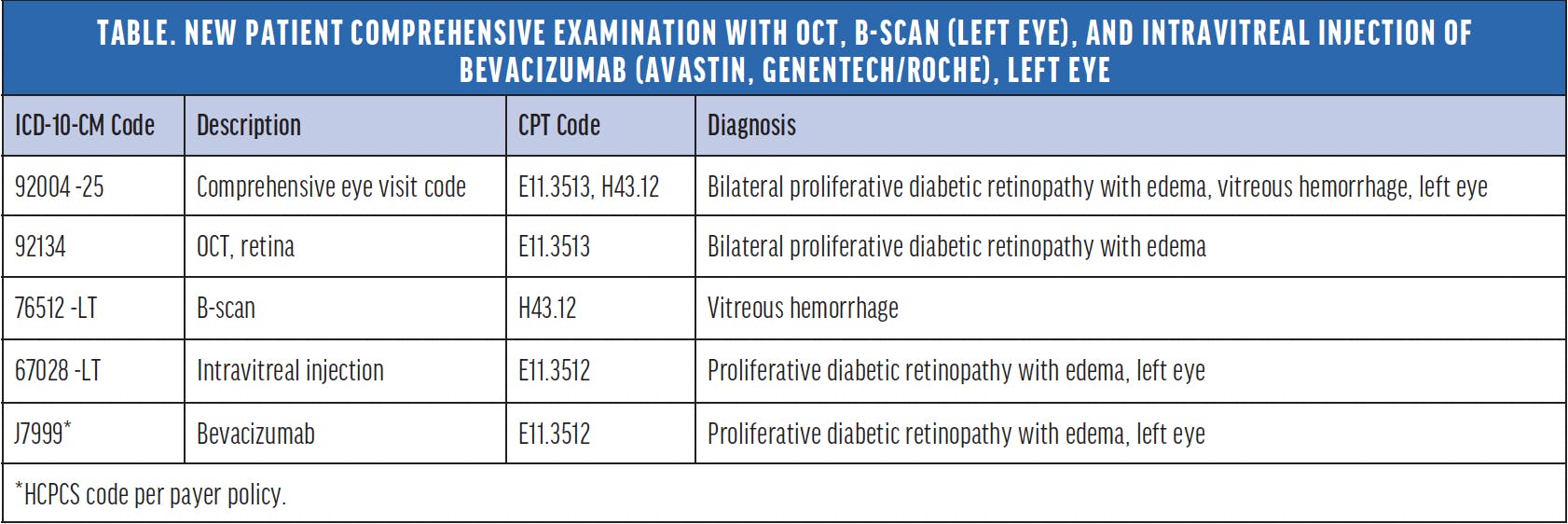
On the CMS-1500, or electronic equivalent, each CPT code reported is linked to a specific ICD-10 code(s). All of the ICD-10-CM codes for the date of service are listed in item 21 and designated with an alpha letter (A-L). In item 24e, the diagnosis pointer field, the appropriate ICD-10-CM code per CPT code is linked.
QUICK TIPS
- When two conditions cannot occur together, such as a congenital form versus an acquired form of the same condition, this is identified in ICD-10-CM as an Excludes1 note. Many commercial payers have applied Excludes1 notes in their claims processing system.
- On the CMS-1500, or electronic equivalent, each CPT code reported is linked to a specific ICD-10 code(s). The appropriate link is crucial, as it supports the medical necessity for the service reported.
- When reporting ICD-10-CM codes on a claim, code to the highest level of specificity. When applicable, report laterality, stage, or eyelid, as appropriate. Some payers will deny claims due to lack of specificity.
The appropriate link is crucial, as it supports the medical necessity for the service reported (Table). If an incorrect link is designated, the claim could be denied or could trigger a focused medical review.
For example, incorrectly linking intermediate dry AMD, left eye (H35.3122) to CPT code 67028 for an intravitreal injection, right eye for wet AMD, can prompt a claim rejection or a post-payment audit.
BE SPECIFIC
When reporting ICD-10-CM codes on a claim, code to the highest level of specificity. When applicable, report laterality, stage, or eyelid, as appropriate. Some payers will deny claims due to lack of specificity.
Consider avoiding H33.30-, unspecified retinal break, which is not the highest level of specificity; instead, replace it with a horseshoe tear (H33.31-), round hole (H33.32-), or multiple defects (H33.33-).
Avoid unspecified macular degeneration (H35.30) and report nonexudative (H35.31) or exudative (H35.32). Additionally, report the stage and laterality; for example, intermediate nonexudative macular degeneration in the right eye (H35.3112) is coded to the highest level of specificity. Visit aao.org/icd10 for a decision tree for coding macular degeneration specifically, along with other useful tools for correctly coding ICD-10-CM.
OTHER REMINDERS
Follow these basic ICD-10-CM coding principals to ensure correct claim reporting:
- Code to the highest degree of accuracy. The best code is a precise diagnosis. The next best code is “other” or a sign or symptom.
- Do not code “probable,” “suspected,” “possible,” or “rule out” conditions until they are established.
- Report only diagnosis codes that pertain to that day’s encounter. Do not report ICD-10-CM codes that no longer exist or were not assessed during the visit.
1. 2022 ICD-10-CM for Ophthalmology: The Complete Reference. 2022 ed. American Academy of Ophthalmology. https://store.aao.org/2022-icd-10-cm-for-ophthalmology-the-complete-reference.html


