


AT A GLANCE
- With an estimated 1.4+ million self-identified transgender or gender nonbinary (TGNB) Americans in 2015, a practice with just a few hundred patients will statistically encounter at least a handful of TGNB individuals every year.
- Organization-wide diversity and inclusion training ensures everyone has a similar knowledge base and provides a foundation from which to grow.
- Organizations must learn to recognize and avoid the influence of unconscious (or implicit) bias in the hiring process.
Of all the marathons I’ve run, I cannot recall my pulse racing as much as it did when I walked through the doors of the American Society of Retina Specialists Women in Retina (WinR) meeting room. I crept in, hoping no one would notice me, because I was self-conscious about my appearance and unsure if I really belonged. “Hi Vivienne!”, I heard from behind. I turned and saw a familiar face that I had not seen since I started living as my authentic self. I raced through my thoughts trying to remember if we had already talked about my transition or my new name and realized we had not. Yet, she was treating me as if we were simply picking up where we had last left off years ago. She happened to be one of the leaders on the WinR board whom I’ve always admired for her leadership within the field. “I’m so glad you could join us. You look wonderful by the way. So, how’s your daughter?” And so, the conversation continued as old friends. My pulse slowed to normal, and I felt the comfort and warmth of acceptance and inclusion (Figure 1).
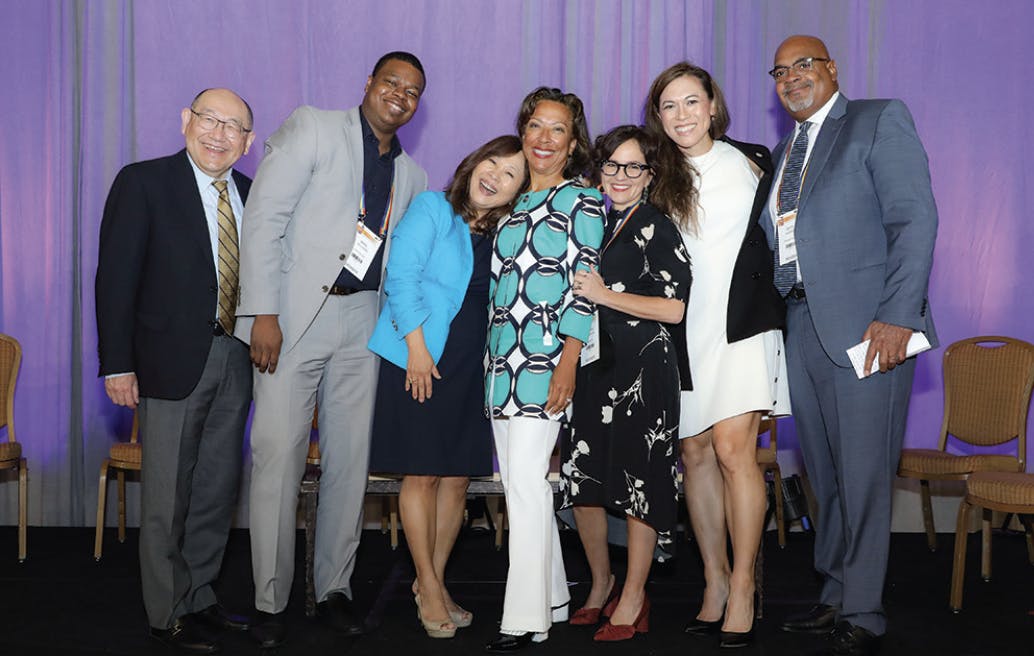
Figure 1. Two years after attending an event at which Dr. Hau wasn’t even sure she fit in, she found herself an invited panelist at ASRS’ 2021 WinR/Diversity, Equity, and Inclusion ad-hoc committee luncheon—and newly elected as co-chair of the Diversity, Equity, and Inclusion ad-hoc committee. Pictured here (left to right) are Paul P. Lee, MD, JD; Basil K. Williams Jr, MD; Judy E. Kim, MD; Tamara Fountain, MD; Audina M. Berrocal, MD; Dr. Hau; and Keith A. Warren, MD.
For the first 40 years of my life, the fear of not being accepted as my authentic self as a woman (assigned male at birth) kept me from living my full potential. I learned at a very young age from those close to me that being Vivienne would not be tolerated, so I suppressed these feelings as long as I could. But you can’t run from who you truly are. Like running a marathon, you’ll eventually hit a wall. Once I did, I finally accepted myself and was ready for the world to see the true me for the first time. To feel that sense of welcome at WinR, and eventually with everyone close to me, was the greatest gift of support I could ever ask for.
Acceptance is absolutely fundamental to our well-being. The lack thereof is strongly associated with poor mental health, depression, and anxiety.1 Demonstrating acceptance is the most significant way a friend, relative, colleague, or medical professional can help a transgender or gender nonbinary (TGNB) individual such as myself feel at ease and build connections.
TRANSITIONING IN SOCIETY
With an estimated 1.4+ million self-identified TGNB Americans in 2015, representing 0.7% of the overall population,2 a practice with just a few hundred patients will statistically encounter at least a handful of TGNB individuals every year. You may not even realize your patient is TGNB, as nearly one-third of 2015 US Transgender Survey respondents reported that their health care provider did not know they were TGNB.2 A 2017 survey showed that 12% of millennials—who happen to be many of our current residents, fellows, and early career physicians today—identified as TGNB.3 Additionally, a 2020 survey showed that one in four lesbian, gay, bisexual, transgender, and queer (LGBTQ; now including intersex and asexual, or LGBTQIA+) youth use pronouns or pronoun combinations other than male and female.4 As for our colleagues themselves, the 2021 Association of American Medical Colleges Matriculating Student Questionnaire found that self-identified TGNB medical students represented 1.2% of all students, which more than doubled from 5 years ago in 2016 (0.5%) and increased by a third from the year prior (0.8%).5-7 Personally, I find this heartwarming that our trainees today can embrace their authenticity. When I was a medical student, I knew of only two or three openly TGNB physicians in the United States. I felt very lonely without anyone to talk to, and the medical professionals at that time had very limited knowledge of how to care for TGNB patients. To this day, I am not aware of any openly TGNB retina physicians more senior to me, so I’ve had to find my own way over the years.
The increasing population of TGNB patients and colleagues highlights the need to be inclusive in our clinic policies and procedures to provide a welcoming and accepting environment. This is especially true as many TGNB patients view the clinician’s office as one of the most anxiety-provoking environments due to the vulnerability and sharing of personal information. In fact, one-third of all 2015 US Transgender Survey respondents said that they have had at least one negative experience with a health care provider within the past year, such as harassment, disrespect, or even refusal of treatment. What’s worse, 2% reported physical or sexual assault in the health care environment. Half of the respondents had to teach the clinicians about the care they needed, and nearly a quarter of respondents purposely avoided seeing a health care professional in the previous year out of fear of being mistreated.2
LGBTQIA+ Resources
- Glossary of Transgender Terms and Definitions
www.glaad.org/reference/transgender - The Human Rights Campaign Foundation’s Template for Gender Transition Guidelines
assets2.hrc.org/files/images/general/Module_4x_Gender_Transition_Guidelines_Template.pdf - 519’s Creating Authentic Spaces: A Gender Identity and Gender Expression Toolkit
www.the519.org/education-training/training-resources/our-resources/creating-authentic-spaces - 4 Ways To Make Your Workplace Equitable For Trans People
www.npr.org/2020/06/02/867780063/4-ways-to-make-your-workplace-equitable-for-trans-people - Creating a Trans-Inclusive Workplace
hbr.org/2020/03/creating-a-trans-inclusive-workplace - Trans Toolkit for Employers
https://www.thehrcfoundation.org/professional-resources/trans-toolkit-for-employers - You Can Get Better at Using the Right Pronouns (Without Being Offensive)
lifehacker.com/you-can-get-better-at-using-the-right-pronouns-without-1848421018 - Communicating With Patients Who Have Nonbinary Gender Identities
www.ncbi.nlm.nih.gov/pmc/articles/PMC6231935
I can certainly relate, since I avoided seeing a physician as much as I could—well into my 20s and even as a medical student because when I trained, being transgender was still listed as a disorder in the DSM IV. I knew that I was different, but I certainly was not a disorder. However, medical professionals like myself were being taught that I was. It wasn’t until the DSM V was published in 2013 and the terminology gender identity disorder was removed that health care providers finally moved away from this thinking. The improvement in patient care and understanding of TGNB folks like myself was immediate.
ACCEPTANCE IN THE CLINIC
Most would agree that a clinic composed of people of different backgrounds and experiences, especially when it’s representative of the patient population, attracts more business. But to really harness the value of diversity, it is essential to establish an inclusive environment where people’s differences are valued and encouraged.
Having experiences in several private practice settings that value diversity, including a large hospital-based system like Kaiser Permanente, I’d like to share seven strategies to help us transition our clinics into more accepting and inclusive spaces for TGNB patients. Of note, Kaiser Permanente has earned a perfect Corporate Equality Index score (a benchmarking tool that measures corporate policies and practices related to LGBTQIA+ employees) by the Human Rights Campaign Foundation for the last 15 years.8
1. Inclusive Language
Be mindful of gendered language in your policies and forms.9,10 Singular gender-neutral pronouns have traditionally been “he” or “he/she.” Consider using “they” as suggested by the 2017 Associated Press Stylebook.11 Most major news outlets already use this terminology. Interestingly, this is not a new-found use for “they.” The singular “they” is used in many notable classics, such as Geoffrey Chaucer’s The Canterbury Tales, William Shakespeare’s Hamlet, and even the King James Bible.12,13
At Kaiser Permanente, we have recently updated our EHR system to allow recording of pronouns, including “they/them/theirs,” and an updated name. Prior to my legal name and gender change, being called by my dead name and assigned sex at birth, while I was clearly dressed otherwise, was extremely upsetting.
At certain local hospitals and the Kaiser Permanente Bernard J. Tyson School of Medicine, we are integrating identification of pronouns as an option on our name badges and in our email signatures. Many of you may already notice that this is fast becoming a normal part of introductions for college-age youth: “Hi! My name is Vivienne Hau, and my pronouns are she/her/hers.”
2. Diversity Education
Organization-wide diversity and inclusion training ensures everyone has a similar knowledge base and provides a foundation from which to grow. Everyone must understand company policies on how we treat people of all backgrounds, genders, ethnicities, ages, and sexual orientation. We can’t expect everyone to be natural leaders on inclusivity without the proper training. While participating in diversity training in my organization, I’ve learned much about my own unconscious biases and privileges that have been shaping my interactions with others. Diversity education can be particularly helpful to teach employees about respectful and harmful language as viewed by some groups.14 Even as a TGNB person, I find the myriad and ever-changing TGNB terms confusing. I am a much better physician, colleague, and friend today because of the training I received at my workplace.
3. Inclusive Policies
Most organizations have an antidiscrimination and harassment policy that outlines their position and expected behaviors. However, does it also specifically include sexual orientation, gender identity, and gender expression as prohibited grounds of discrimination with clear examples? Having it in writing is important to ensure a TGNB employee or patient feels safe and valued in your clinic. The policy should be clear, easily accessible, and define the roles and responsibilities for compliance, should someone encounter discrimination or harassment. Also, this policy should be reviewed and updated on a regular basis as societal norms and expectations change.
Policies on professional attire can be more inclusive. Rather than delineating what is appropriate for women and men, state that all employees must dress to meet professional standards without specifying whether people should wear skirts, pants, blouses, or ties. Gendered language in policies reinforces stereotypes and ignores the existence of gender queer and nonbinary people. For many, the thought of wearing an article of clothing that is not gender congruent can be anxiety-producing or confining. Even the notion of defining professionalism can be problematic as it is often dictated by a select and narrow group’s preferences. Professionalism can mean something very different within other cultures, ethnicities, and genders. Companies should periodically reevaluate policies through a lens of diversity to develop more progressive policies as society evolves. A few years ago, prior to my transition, I was required to wear a tie for my professional photo—something I had not done for years. For someone like myself struggling with gender expression and identity, the edict that I must wear a tie caused me much anxiety and dysphoria.
Having a clearly defined plan and policy in place, should an employee transition, allows you to be proactive and supportive rather than reactive and prone to error. Most people in the workplace are now accepting of LGBTQIA+ people, but the same cannot be said of those who undergo gender transition. Because of discrimination, isolation, and fears in the workplace, the employee will require specific support from their employer. The Human Rights Campaign Foundation’s Template for Gender Transition Guidelines and the 519’s Creating Authentic Spaces: A Gender Identity and Gender Expression Toolkit are two useful tools to help organizations establish gender transition guidelines. Being only the second physician to openly transition at my workplace, I struggled with missteps (ie, losing email access for two weeks and unnecessarily delayed updates on my name change) that created awkward encounters with patients and staff. However, the organization has now put in place new guidelines to help smooth the process for future transitioning employees.
4. Clinic Logistics
One of the most significant ways a clinic can demonstrate support for TGNB patients and employees is by adopting gender-neutral signage for restrooms (Figure 2). One of the most meaningful ways my organization supported me was the conversion to gender-neutral restroom signs across the entire hospital. This happened to coincide with my own transition and sent a powerful message to all my staff and colleagues that the organization was supportive of TGNB patients and staff like myself.
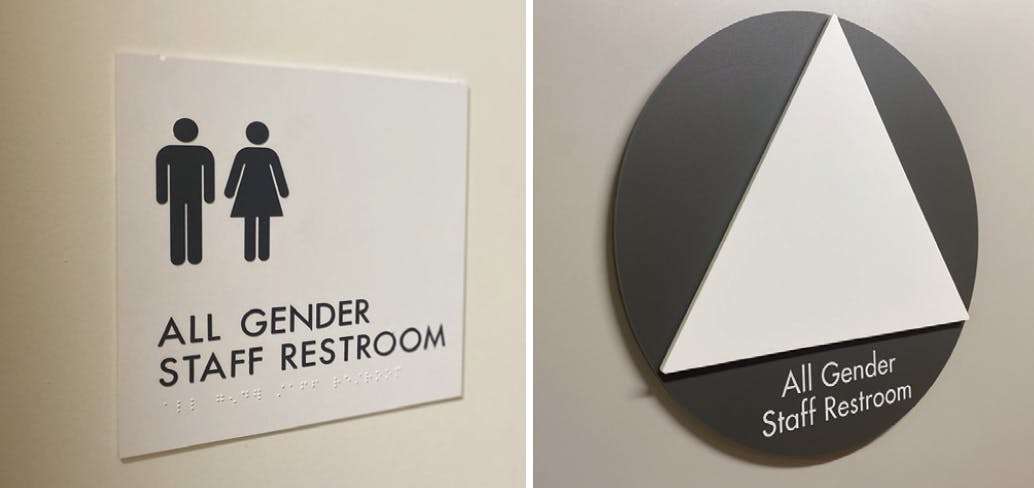
Figure 2. Something as simple as instituting gender-neutral signage for restrooms goes a long way toward sending an organization-wide message of support for TGNB patients and staff.
5. Recruiting and Hiring
Studies show that having a more diverse workforce, which includes LGBTQIA+ employees, leads to higher revenues, increased innovation, improved morale, less turnover, greater productivity, and enhanced hiring competitiveness—and a strong, productive practice attracts more patients.15,16 Kaiser Permanente is a model organization for its diversity and inclusivity efforts. Many leaders, even at the highest levels, are openly LGBTQIA+, and the contributions of several TGNB faculty members have been essential in developing innovative educational opportunities in TGNB care at the Kaiser Permanente Bernard J. Tyson School of Medicine.
Organizations must also learn to recognize and avoid the influence of unconscious (or implicit) bias in the hiring process. There are many unconscious biases that are beyond the scope of this article, but they can include such things as gender bias, name bias, halo/horns effect, confirmation bias, conformity bias, and affinity bias.17 Strategies to avoid these types of biases can include a diverse hiring panel and a defined ideal candidate profile prior to interviewing. Organizations will have a hiring process they can be proud of if they: evaluate all candidates against the same standard, create diversity goals, use name-blinding software, avoid the use of candidate photos (if virtual), use anonymous surveys for interviewers, and standardize interview questions.
6. Inclusive Benefits
An organization’s benefits package must take into account the needs of all employees, including those who are TGNB. Although there are TGNB people who do not seek medical or surgical transition, a comprehensive benefits package that includes coverage for transition-related care such as gender-affirming hormone therapy and surgeries demonstrates the organization’s willingness to invest in and retain a diverse workforce. One of my constant concerns has always been where I would find care and whether it would be covered. Now, I am fortunate to work with an organization that promotes and prioritizes TGNB care, and the peace of mind I have is demonstrative of the value of comprehensive care provided by a supportive employer.
7. Workplace Culture
Perhaps one of the hardest changes may be shifting the day-to-day dialogue away from inappropriate comments and jokes. What was once funny as a group may no longer be so as societal norms and attitudes change. Many are unaware of how some informal jokes and comments are viewed by others. Given the statistics mentioned above, it’s likely that you have already worked with or cared for a TGNB person without knowing it. I practiced for several years before I transitioned and held positions of leadership in our field with very few colleagues privy to my gender identity. Transphobic and homophobic jokes and demeaning references like “tranny,” “it,” or “he/she” were not uncommon. While these individuals did not intend to insult, and perhaps would’ve chosen their words more carefully had they known, I felt ostracized and it heightened my fears of nonacceptance should I come out in the future. We as health care professionals must hold ourselves to a higher standard to ensure we care for our patients in the most respectful manner possible.
EMBRACE CHANGE
One of the greatest blessings of living as my authentic self has been the deepening of my personal relationships. Vulnerability, which is a necessary part of transition, breaks down barriers that we unconsciously put up around us. This allows us to be our true selves with each other and helps us connect on a deeper level. This is also what we hope for as medical professionals with our patient relationships; we want to earn their trust so we can provide the best possible care. I finally found this connection in my professional and personal life, which includes a few of you reading this article now.
I hope the guidance provided here, along with my personal reflections, will help you become an even greater ally to colleagues like myself and a more empathetic medical professional for your TGNB patients.
1. DeWall CN, Bushman BJ. Social acceptance and rejection: the sweet and bitter. Current Directions in Psychological Science. 2011;20(4):256-260.
2. James SE, Herman JL, Rankin S, et al. The Report of the 2015 U.S. Transgender Survey. National Center for Transgender Equality. 2016.
3. Accelerating Acceptance Survey 2017. GLAAD. Accessed January 21, 2022. www.glaad.org/publications/accelerating-acceptance-2017
4. The Trevor Project. 2020 National Survey on LGBTQ Youth Mental Health. Accessed January 21, 2022. www.thetrevorproject.org/survey-2020/?section=Introduction
5. Association of American Medical Colleges. 2019 AAMC matriculating student questionnaire. December 2019. Accessed January 21, 2022. www.aamc.org/media/38916/download
6. Association of American Medical Colleges. 2020 AAMC matriculating student questionnaire. December 2020. Accessed January 21, 2022. www.aamc.org/media/50081/download
7. Association of American Medical Colleges. 2021 AAMC matriculating student questionnaire. December 2021. Accessed January 21, 2022. www.aamc.org/media/57926/download
8. Human Rights Campaign. Corporate Equality Index 2021. Accessed January 21, 2022. www.hrc.org/resources/corporate-equality-index
9. Goldhammer H, Malina S, Keuroghlian AS. Communicating with patients who have nonbinary gender identities. Ann Fam Med. 2018;16(6):559-562.
10. Rossi AL, Lopez EJ. Contextualizing competence: language and LGBT-based competency in health care. J Homosexual. 2017;64(10):1330-1349.
11. Easton L. Making a case for a singular ‘they’. Associated Press. March 24, 2017. Accessed January 21, 2022. blog.ap.org/products-and-services/making-a-case-for-a-singular-they
12. Okrent A. Another major style guide has accepted singular ‘they’. Mentalfloss.com. March 27, 2017. Accessed January 21, 2022. www.mentalfloss.com/article/93725/another-major-style-guide-has-accepted-singular-they
13. University of Pennsylvania. “Singular they”: God said it, I believe it, that settles it. Language Log. September 13, 2006. Accessed January 21, 2022. itre.cis.upenn.edu/~myl/languagelog/archives/003572.html
14. Sallans RK. Lessons from a transgender patient for health care professionals. AMA J Ethics. 2016;18(11):1139-1146.
15. Picincu A. What are the advantages of a diverse workforce? Chron. July 6, 2020. Accessed January 21, 2022. smallbusiness.chron.com/advantages-diverse-workforce-18780.html
16. Rust G, Strothers H. Strategies for expanding your patient base in diverse communities. Fam Pract Manag. 2000;7(5):31-35.
17. 19 unconscious biases to overcome and help promote inclusivity. Asana.org. May 17, 2021. Accessed January 21, 2022. asana.com/resources/unconscious-bias-examples


_1784132761.jpg?auto=compress,format&w=75)





