


AT A GLANCE
- Recent data from real-world studies and post-hoc analyses of phase 3 clinical trials suggest treatment outcomes for diabetic macular edema may differ by race.
- A cohort study of 31 ophthalmology clinical trials found that Black, Hispanic, and Latinx patients were underrepresented in enrollment compared with expected disease burden in the United States.
- Phase 4 trials aimed at recruiting underrepresented subgroups in ophthalmology are planned.
Racial differences in the prevalence and severity of ophthalmic diseases, including diabetic retinopathy (DR) and diabetic macular edema (DME), have been identified in several population-based studies.1,2 For instance, the prevalence of DR and DME is higher in Black and Hispanic patients compared with White patients in the United States, and the risk of sustained vision loss may be higher in Black and Asian patients compared with White patients (Figure).3 Compounding these observations, non-White racial and ethnic subgroups remain underrepresented in ophthalmic clinical trials, limiting the availability of prospective data to ensure outcomes are generalizable for all patients.4 Thus, several recent studies have sought to assess the effect of race on vision outcomes.
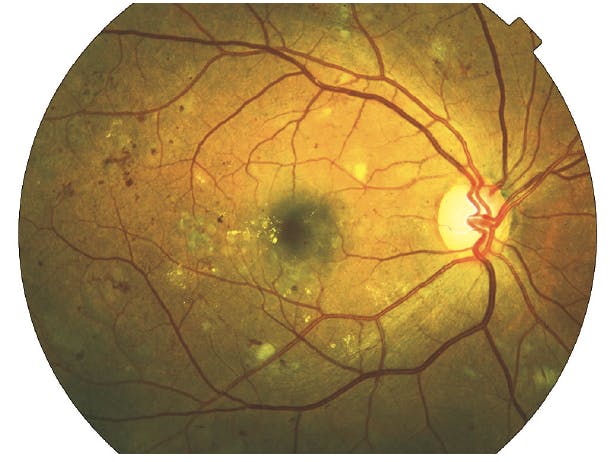
Figure. This 45-year-old Black patient presented with nonproliferative DR and DME in the right eye. Note the presence of dot hemorrhages and hard exudates.
REAL-WORLD DATA
Two recent studies have evaluated treatment outcomes in DR and DME as stratified by race. In a retrospective study, Osathanugrah et al found that Black patients had lower odds of vision improvement compared with Hispanic and White patients after one (odds ratio [OR], 0.480; P = .006) and three injections (OR, 0.342; P = .008) of intravitreal bevacizumab (Avastin, Genentech/Roche).5 These differences persisted when controlling for age, sex, hemoglobin A1c, baseline central macular thickness, and baseline visual acuity.
In addition, Malhotra et al evaluated presenting visual acuity and DR severity in patients who initiated anti-VEGF therapy for DME between 2012 and 2020 in an analysis of the Intelligent Research in Sight database.6 The authors found that Black and Hispanic patients had greater baseline DR severity compared with White and non-Hispanic patients (OR, 1.23 and 1.71, respectively; P < .01).6
CLINICAL TRIALS
Data from phase 3 clinical trials also suggest that vision outcomes may differ by race. In a post-hoc analysis of the DRCR Retina Network (DRCR.net) Protocol T, investigators assessed associations between baseline characteristics and vision and anatomic outcomes in eyes receiving anti-VEGF treatment with bevacizumab, ranibizumab (Lucentis, Genentech/Roche), or aflibercept (Eylea, Regeneron). While cautioning against firm conclusions given the post-hoc nature of the analysis, the study authors noted that Black patients, despite being found to have the largest central foveal thickness reduction, trended toward less visual acuity improvement compared with Hispanic and White patients.7
More recently, investigators evaluated the effect of race on vision outcomes in DME patients treated with ranibizumab. In a meta-analysis of five phase 3 clinical trials—RISE, RIDE, and DRCR.net Protocols I, S, and T—a total of 181 Black and 928 White patients who received ranibizumab were compared at month 24.8 BCVA and change in BCVA were the main outcomes of interest. When adjusting for differences in baseline BCVA, mean BCVA change from baseline was lower in Black versus White patients (7.8 vs 10.0 letters; P = .04). In addition, more White patients gained 15 letters at month 24 than Black patients (35% vs 27.6%; P = .05).8
The investigators noted that a majority of the letter gain difference between White and Black patients was observed in the RISE/RIDE trials. A clear trend was not present across all five trials. To further investigate this, propensity score matching was completed within RISE/RIDE to balance baseline features, including age, gender, baseline hemoglobin A1c, central subfield thickness, BCVA, number of ranibizumab injections over the study period, and total number of study visits. When matched for these baseline covariates, mean BCVA change from baseline was similar between Black and White patients (10.6 vs 10.1 letters; P = .83).8 The lack of consistency across the included trials and lack of difference in letter gain observed with propensity matching in RISE/RIDE suggest that additional, prospective data in larger cohorts are necessary to determine the effect of race on outcomes.
IMPLICATIONS FOR FUTURE TRIALS
The studies discussed here underscore the significance of the observed disparity between disease burden and clinical trial recruitment in phase 3 clinical trials.
In a recent cohort study, Berkowitz et al reviewed data from 31 ophthalmology clinical trials leading to FDA approvals between 2000 and 2020 and noted that Black, Hispanic, and Latinx patients were underrepresented in enrollment compared with expected disease burden in the United States.4 Moreover, the study authors noted that there was a decrease in Black patient participation in DR clinical trials from 2011 to 2020 compared with the decade prior.
Barriers to recruitment of underrepresented races and ethnic subgroups in clinical trials have been well described.9,10 Poor access to trial sites and providers, opportunity costs (such as travel distance and time away from work/home obligations), language barriers, and perceived mistrust in clinical trial participation, amongst others, may make enrollment challenging. Working to address these barriers will be critical to improved recruitment of diverse populations in future trials. Potential steps include: a standardized method of reporting demographics across trials; a review of current trial sites to evaluate access for underrepresented communities; assembling research teams with investigators and staff representative of underrecruited communities; and initiation of post-market or confirmatory phase 4 studies with larger cohorts of underrepresented subgroups, to name only a few.
Encouragingly, researchers in ophthalmology are already taking action. For instance, a phase 4 study looking to assess DME treatment response to faricimab (Vabysmo, Genentech/Roche) in underrepresented patients is slated to begin enrollment in Spring 2022.11
Existing data from real-world studies and post-hoc analyses of phase 3 clinical trial data suggest that additional study is warranted to assess the effect of race on DR and DME outcomes—and likely other ophthalmic diseases as well. Increased enrollment of racial and ethnic subgroups in future clinical trials will be critical to help researchers determine the magnitude of the effect of race on treatment outcomes.
1. Varma R, Bressler NM, Doan QV, et al. Prevalence of and risk factors for diabetic macular edema in the United States. JAMA Ophthalmol. 2014;132(11):1334-40.
2. Wong TY, Klein R, Islam FMA, et al. Diabetic retinopathy in a multi-ethnic cohort in the United States. Am J Ophthalmol. 2006;141(3):446-455.
3. Wykoff CC, Khurana RN, Nguyen QD, et al. Risk of blindness among patients with diabetes and newly diagnosed diabetic retinopathy. Diabetes Care. 2021;44(3):748-756.
4. Berkowitz ST, Groth SL, Gangaputra S, Patel S. Racial/ethnic disparities in ophthalmology clinical trials resulting in US Food and Drug Administration drug approvals from 2000 to 2020. JAMA Ophthalmol. 2021;139(6):629-637.
5. Osathanugrah P, Sanjiv N, Siegel NH, Ness S, Chen X, Subramanian ML. The impact of race on short-term treatment response to bevacizumab in diabetic macular edema. Am J Ophthalmol. 2021;222:310-317.
6. Malhotra NA, Greenlee TE, Iyer AI, Conti TF, Chen AX, Singh RP. Racial, ethnic, and insurance-based disparities upon initiation of anti-vascular endothelial growth factor therapy for diabetic macular edema in the US. Ophthalmology. 2021;128(10):1438-1447.
7. Bressler SB, Odia I, Maguire MG, et al. Factors associated with visual acuity and central subfield thickness changes when treating diabetic macular edema with anti-vascular endothelial growth factor therapy: an exploratory analysis of the Protocol T Randomized Clinical Trial. JAMA Ophthalmol. 2019;137(4):382-389.
8. Khan MA. Impact of race on vision outcomes in ranibizumab-treated patients with diabetic macular edema: a meta-analysis of 5 clinical trials. Paper presented at the ASRS Annual Meeting; October 9, 2021; San Antonio, Texas.
9. Unger JM, Cook E, Tai E, Bleyer A. The role of clinical trial participation in cancer research: barriers, evidence, and strategies. Am Soc Clin Oncol Educ Book. 2016;35:185-198.
10. Editors, Rubin E. Striving for diversity in research studies. N Engl J Med. 2021;385(15):1429-1430.
11. A study to investigate faricimab treatment response in treatment-naive, underrepresented patients with diabetic macular edema. Accessed February 15, 2022. clinicaltrials.gov/ct2/show/NCT05224102


_1784132761.jpg?auto=compress,format&w=75)





