


A 30-year-old woman came into our clinic with a complaint of low visual acuity in the left eye since anesthesia recovery after cosmetic surgery (liposuction and breast implant) 2 days prior. On examination, her BCVA was 20/20 OD and counting fingers OS.
The anterior segment was unremarkable in each eye. Fundus examination and OCT imaging of the left eye revealed a preretinal hemorrhage (Figure 1).
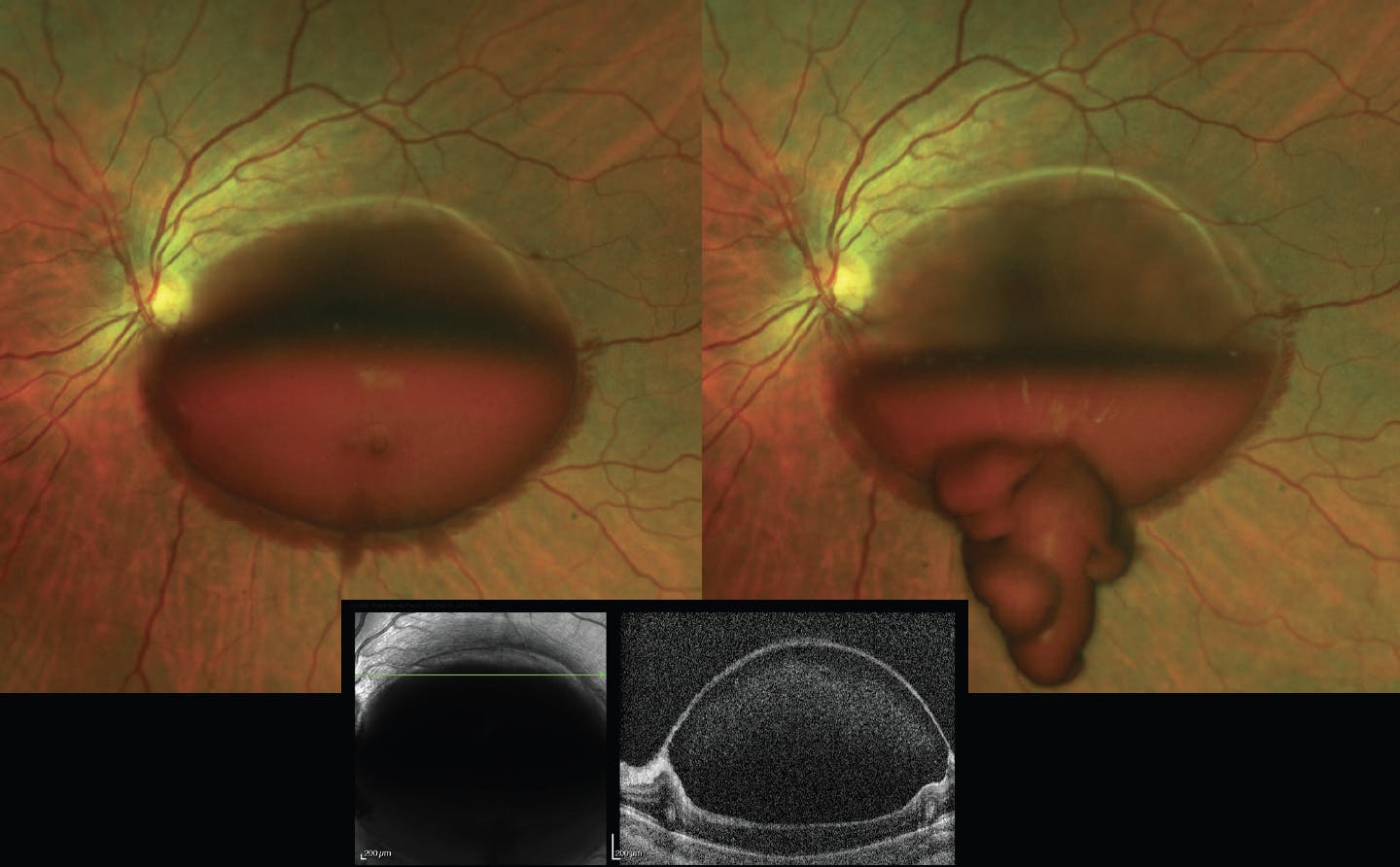
Due to recent hospitalization, the patient was unwilling to undergo surgery. We performed a hyaloidotomy using the 1,064 nm Nd:YAG laser (Optimis II, Quantel Medical). After pupil dilation and topical anesthesia, we used a macular lens and performed the laser just anterior to the inferior part of the detached hyaloid; the focus was adjusted 125 mm anterior to the spot, and power was raised from 4 mJ until the hyaloid break at 7 mJ.
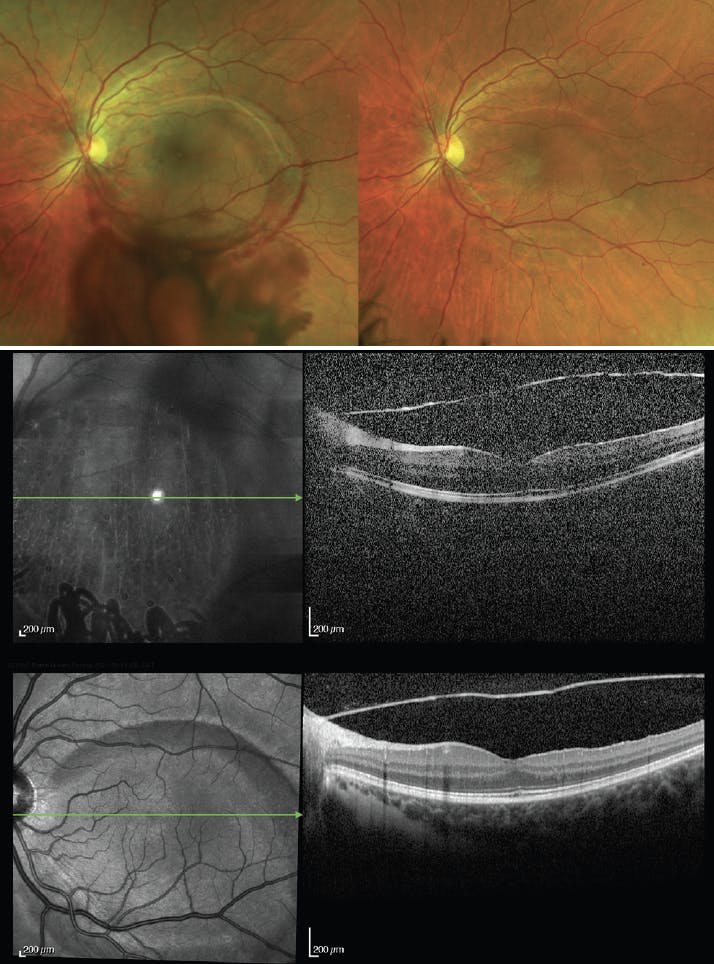
The patient’s VA improved to 20/25 OS at the next-day follow-up and was 20/20 at the 1-year follow-up (Figure 2).
DISCUSSION
Subhyaloid hemorrhage is a localized detachment of the vitreous from the retina due to the accumulation of blood.1 It usually occurs secondary to retinal vascular disorders, such as retinal vein occlusion, macroaneurysm, or arterio-venous communication of the retina; or hematological disorders, such as aplastic anemia and leukemia. It may also occur after retinal vascular rupture associated with physical exertion or general anesthesia, with Terson syndrome, or with Purtscher retinopathy.2
A conservative approach to treating subhyaloid hemorrhage is justifiable if the macula is not involved; however, macular involvement may result in epiretinal membrane formation and permanent vision loss due to macular retinal pigment epithelium changes and possibly toxic damage to the retina.3,4 Other described techniques for treatment of premacular subhyaloid hemorrhages include pneumatic displacement of the hemorrhage (with or without tissue plasminogen activator) and pars plana vitrectomy. These procedures may have complications, such as cataract formation and retinal detachment.5
Nd:YAG laser hyaloidotomy is a noninvasive approach enabling rapid drainage of the obstructed macular area and improved vision within a day, based on the authors’ experience. Nevertheless, it is essential to consider reported complications, such as macular hole and vitreomacular traction syndrome.
Choosing a treatment is challenging because literature comparing the different treatment modalities is still not thoroughly established.
When considering Nd:YAG laser hyaloidotomy, it is vital to have good clinical judgment, use appropriate technique with ideal visualization, ensure adequate positioning of hyaloidotomy, be prudent on laser energy, and take into account the timing of symptoms to ensure that added photodisruption has the maximum benefit. Delay in laser treatment may lead to failure or only partial success of the procedure due to blood clotting under the internal limiting membrane.
If you have an image or images you would like to share, email Dr. Nagpal.
Note: Photos should be 400 dpi or higher and at least 10 inches wide.
1. Agarwal M, Gupta C, Ranjan R, Kumar B, Shrivastav A, Kumar S. Multimodal imaging of pre-macular subhyaloid hemorrhage managed with Nd:YAG laser hyaloidotomy. Indian J Ophthalmol. 2019;67(7):1185.
2. Bouladi M, Mghaieth F, Bouraoui R, Zerei N, Chaker N, El Matri L. Valsalva retinopathy occurring after general anesthesia. Tunis Med. 2019;97(4):595-598.
3. Khan MT, Saeed MU, Shehzad MS, Qazi ZA. Nd:YAG laser treatment for Valsalva premacular hemorrhages: 6 month follow up: alternative management options for preretinal premacular hemorrhages in Valsalva retinopathy. Int Ophthalmol. 2008;28(5):325-327.
4. Khadka D, Bhandari S, Bajimaya S, Thapa R, Paudyal G, Pradhan E. Nd:YAG laser hyaloidotomy in the management of premacular subhyaloid hemorrhage. BMC Ophthalmol. 2016;16:41.
5. Ulbig MW, Mangouritsas G, Rothbacher HH, Hamilton AM, McHugh JD. Long-term results after drainage of premacular subhyaloid hemorrhage into the vitreous with a pulsed Nd:YAG laser. Arch Ophthalmol. 1998;116:1465-1469.


_1784132761.jpg?auto=compress,format&w=75)




