



AT A GLANCE
- In 2020, women accounted for 53.6% of new matriculants and 51.5% of total enrollment in US medical schools—that’s up from 48.4% of matriculants in 2010.
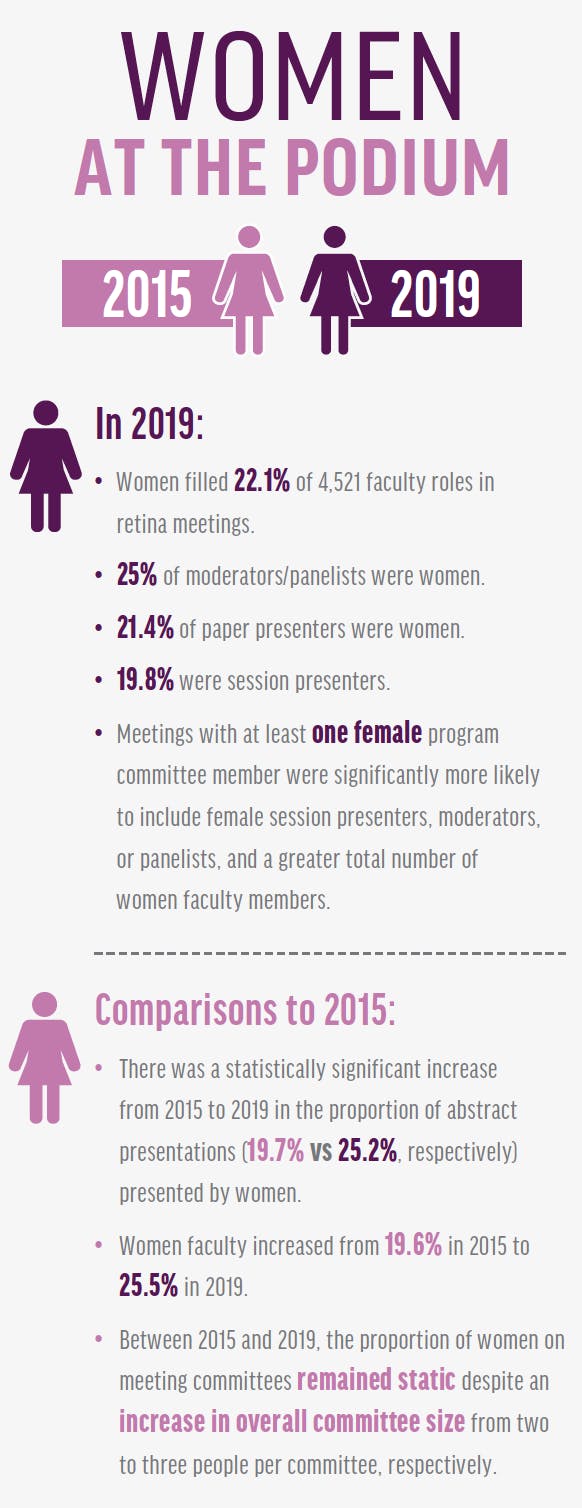
- Meetings with at least one female program committee member were significantly more likely to include female session presenters, moderators, or panelists, and a greater total number of women faculty members.
- Efforts to accommodate all lifestyles will likely yield a more diverse and supportive culture in the vitreoretinal specialty.
Gender diversity in medicine has always had room for improvement, with large gaps in female representation across many medical specialties and within their respective leadership positions. The causes behind this continued discrepancy in gender representation are complex and multifactorial, including male-dominant leadership, social influences, and personal preferences, to name only a few.
Recent numbers give us optimism that these gaps are gradually closing. The percentage of women entering US medical schools has increased steadily over the past decade. In 2020, women accounted for 53.6% of new matriculants and 51.5% of total enrollment in US medical schools—that’s up from 48.4% of matriculants in 2010.1,2 As the selection pool for new residents becomes increasingly female, increased gender diversity in traditionally male-dominated specialties, including ophthalmology, will likely follow. In 2019, 41.2% of the Accreditation Council for Graduate Medical Education residents and fellows training in ophthalmology were women.3
Although steadily increasing, the percentage of female ophthalmology residents lags behind that of female medical school matriculants. Even more remarkable is the 2018 data from the American Board of Ophthalmology that indicated only 19.8% of practicing board-certified self-identified retina and vitreous specialists were women.4 Nonetheless, with an increasing number of female medical students and ophthalmology residents, improvement in gender diversity within the vitreoretinal specialty is on the horizon.
PRESENCE IS NOT ENOUGH
Of course, gender diversity extends far beyond just the presence of women in each specialty. It must also involve the inclusion of women in the leadership and advancement of the field. Camacci et al reported that, in 2018, 95.8% of the editors-in-chief of major ophthalmology journals and 86.7% of ophthalmology society presidents were men.5 Patel et al found that only 30.5% of speakers at national ophthalmology meetings from 2015 to 2017 were women; within the retina specialty, that percentage was 18.4%.4
Given this obvious deficit and the complexities surrounding this issue, research on this specific area of need is especially useful. We sought to obtain a more accurate impression of women’s representation at vitreoretinal meetings and investigate targets for improvement through a retrospective observational study.6 Discussion of these research findings is crucial to the pursuit of gender diversity.
OUR FINDINGS
The study includes analysis of the six best-attended vitreoretinal meetings between 2015 and 2019. The data points were gathered to give a snapshot of how vitreoretinal meetings are performing concerning gender inclusion. A total of 4,521 faculty roles were included for analysis. In total, women filled 22.1% of those roles. Women were more likely to be included as invited moderators or panelists (25.0%) than as paper (21.4%) or session (19.8%) presenters.6 When we examined the trends of various faculty roles filled by women, we found a statistically significant increase from 2015 to 2019 in the proportion of abstract presentations (19.7% vs 25.2%, respectively) but a nonstatistically significant increase in invited presentations and moderator or panelist roles.6
Overall, the trend was toward an increased proportion of women faculty, with a significant increase from 19.6% in 2015 to 25.5% in 2019, which was higher than the number of board-certified female ophthalmologists identifying as vitreoretinal specialists.6 This is promising, as it may suggest that non-board-certified trainees are becoming part of the pool of podium contributors. Seeing younger colleagues invited to the podium early in their careers bodes well for the future of women’s representation.
We also investigated factors responsible for variable female participation across different meetings. Meetings with at least one female program committee member were significantly more likely to include female session presenters, moderators, and panelists, and a greater total number of women faculty.6 Not surprisingly, women’s representation at the leadership level trickles down. However, meetings with at least one female committee member were not more likely to have a greater proportion of female abstract speakers. This may be due to the more impartial and objective grading involved in the selection, which would eliminate gender biases. Many meetings mask abstract graders to the identity and institutional affiliation of submitting authors.
Nonetheless, these data provide a cogent yet simple argument that having more women in organizational and leadership positions is an effective means to improve women’s representation overall. Between 2015 and 2019, the proportion of women on meeting committees remained static, despite an average increase in overall committee size from two to three people per committee, respectively.6
These data, while enlightening, provide only a snapshot of women’s representation at vitreoretinal meetings. Not all vitreoretinal meetings were included due to the vast variability in conference setup, attendance, and frequency. As the gender composition of vitreoretinal specialists and trainees changes, future research should reevaluate women’s representation. Many retina physicians and societies, such as the Vit-Buckle Society and Women in Ophthalmology, are strong proponents for improving gender diversity, and it is important to acknowledge that these efforts are likely influencing the positive trends.
As we gain a more comprehensive understanding of the deficits in diversity within medicine, there will be more targeted data to tackle these disparities. Future studies should not only expand on these findings but also examine the inclusion of underrepresented minorities on the podium.
MOVING FORWARD
Increasing the number of female vitreoretinal surgeons would be an obvious solution to improving gender diversity at conferences. Yannuzzi et al reported that 25% of vitreoretinal surgical applicants were women between 2015 and 2018.7 Although this percentage is higher than the 19.8% of currently practicing women vitreoretinal surgeons, there still remains a tremendous gap to be addressed.3 Furthermore, increasing the number of women entering the vitreoretinal specialty will require time.
Fortunately, there are solutions to begin bridging gaps in meeting representation now. Vitreoretinal meetings with at least one female committee member boasted significantly more female invited speakers, moderators, and panelists.6 If there is a push for more inclusion at the leadership and organization level at vitreoretinal meetings, discrepancies in gender representation on the podium may diminish. We also found that women were more likely to be a presenting speaker of a submitted abstract than an invited podium speaker in every year studied. One hypothesis for this discrepancy is that abstract submissions are usually open to residents and fellows, a growing proportion of which are female. We can further support this means of representation by encouraging young female trainees and providing them with resources when applying for abstract presentations.
A topic that has not yet been studied is the effect of virtual meetings on women’s representation. The option to attend meetings virtually has become more common due to the COVID-19 pandemic, affording all participants who have home obligations the convenience to access the podium without travel. Traditional meeting structures are in-person and last the full day, if not several days, which may not be conducive to those with childcare responsibilities. More virtual presentation options, meeting dates that correspond with traditional school holidays, and on-site childcare services are all possible means to bolster female participation. It is important to remain cognizant of the many home and professional responsibilities our colleagues are balancing. Efforts to accommodate all lifestyles will likely yield a more diverse and supportive culture in the vitreoretinal specialty.
We in the field of ophthalmology and the vitreoretinal specialty must continue to study and target our weaknesses in gender representation. Gender representation in medicine is dynamic, and all areas of disparity are worthy of attention. Whether it is meeting representation, industry involvement, inclusion in editorial boards, or leadership in societies, there are many avenues for improvement. We are at a pivotal moment and must take full advantage of the potential to initiate lasting change.
1. Association of American Medical Colleges. 2020 fall applicant, matriculant, and enrollment data tables, December 2020. Accessed December 28, 2021. www.aamc.org/media/49911/download
2. Association of American Medical Colleges. Medical Students, Selected Years, 1965–2015. Accessed January 17, 2020. www.aamc.org/system/files/reports/1/2015table1.pdf
3. Association of American Medical Colleges. ACGME residents and fellows by sex and specialty. Accessed December 28, 2021. www.aamc.org/data-reports/interactive-data/acgme-residents-and-fellows-sex-and-specialty-2019
4. Patel SH, Truong T, Tsui I, Moon J-Y, Rosenberg JB. Gender of presenters at ophthalmology conferences between 2015-2017. Am J Ophthalmol. 2020;213:120-124.
5. Camacci ML, Lu A, Lehman EB, Scott IU, Bowie E, Pantanelli SM. Association between sex composition and publication productivity of journal editorial and professional society board members in ophthalmology. JAMA Ophthalmol. 2020;138(5):451-458.
6. Sridhar J, Kuriyan AE, Yonekawa Y, et al. Representation of women in vitreoretinal meeting faculty roles from 2015 through 2019. Am J Ophthalmol. 2021;221:131-136.
7. Yannuzzi NA, Smith L, Yadegari D, et al. Analysis of the vitreoretinal surgical fellowship applicant pool: publication misrepresentations and predictors of future academic output. Retina. 2019;40(10):2026-2033.


_1784132761.jpg?auto=compress,format&w=75)





