


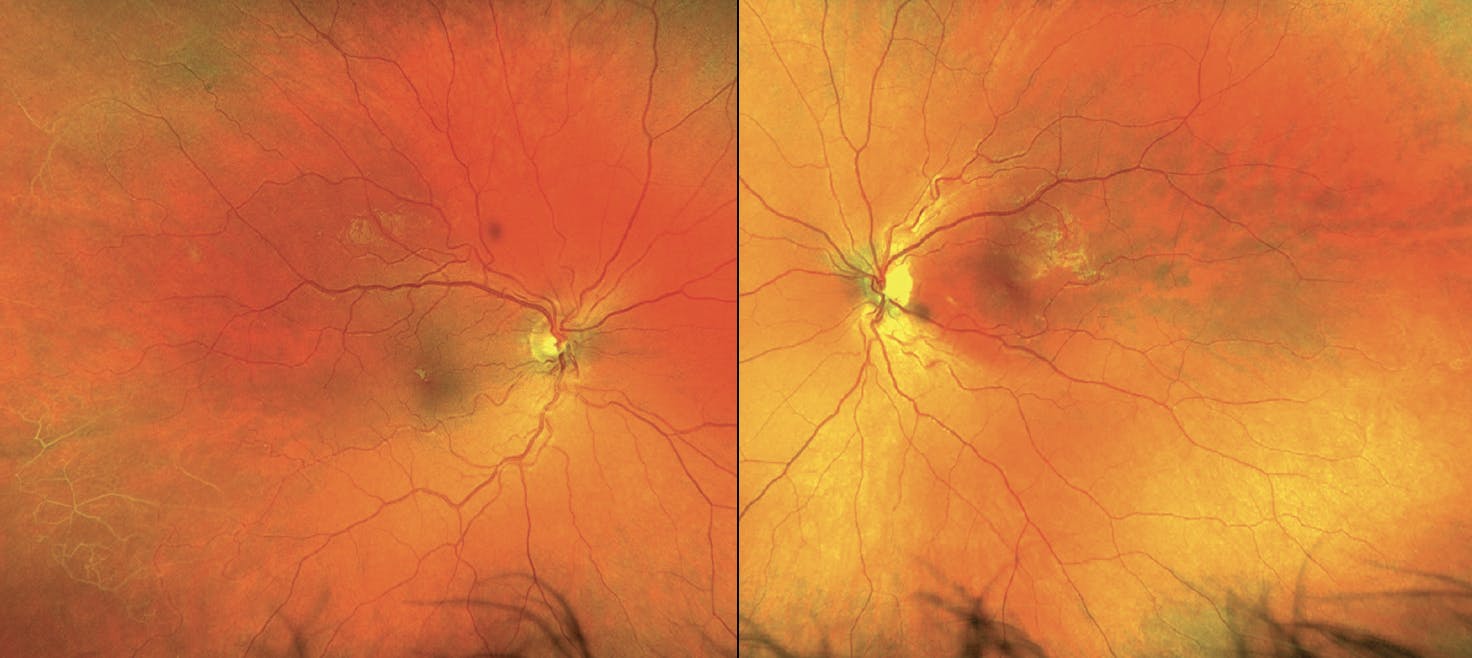
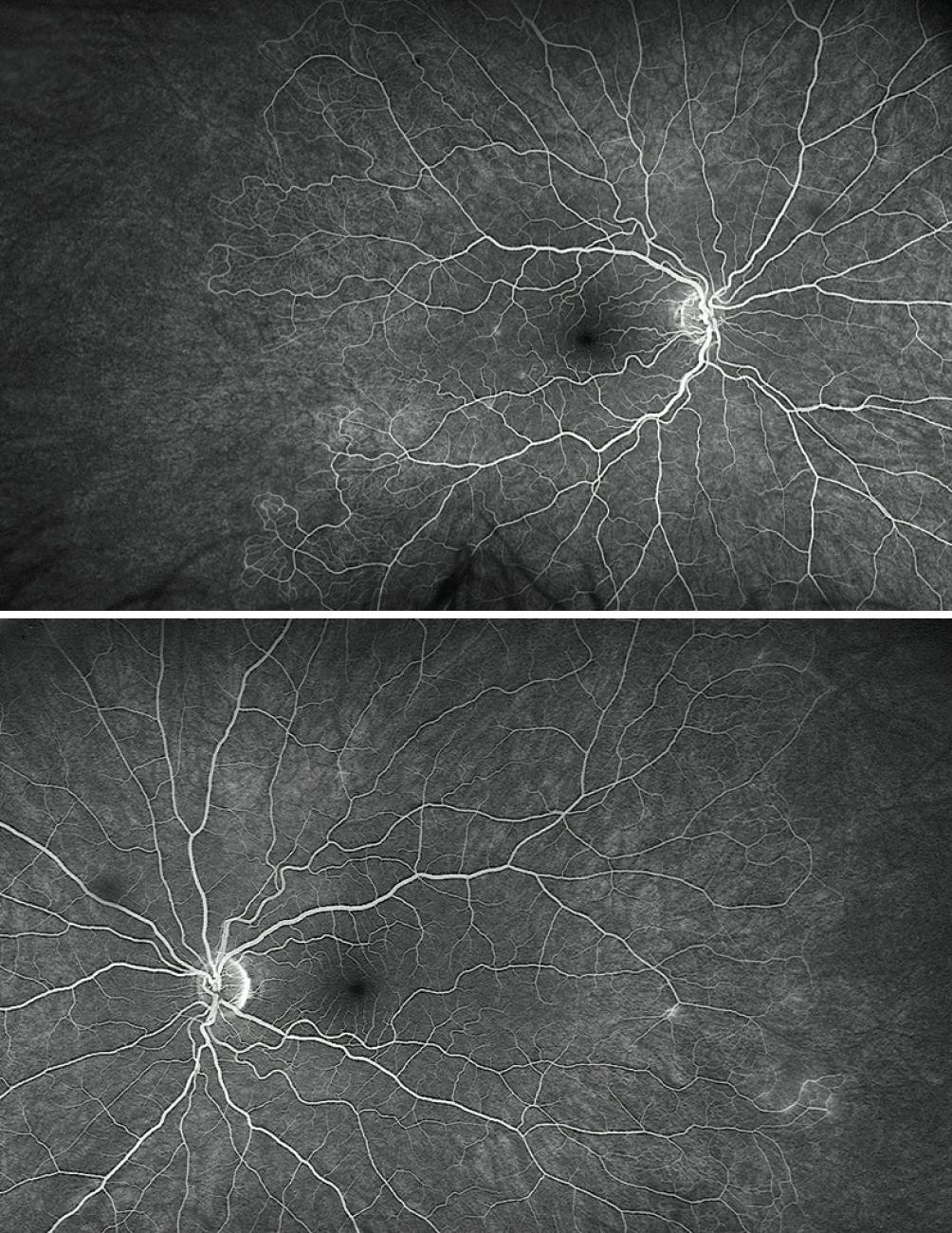
A 20-year-old woman with a history of dyskeratosis congenita (DC) presented with retinal vascular abnormalities. VA was 20/20 OU, and she was experiencing trichiasis and dry eye symptoms. Fundus examination revealed peripheral nonperfusion with sclerotic vessels in each eye (Figure 1). Widefield fluorescein angiography (FA) demonstrated peripheral nonperfusion, telangiectasias, vascular shunting, and mild vascular leakage in each eye (Figure 2). The nonperfusion was mild without signs of neovascularization, so close observation was recommended.
DISCUSSION
Dyskeratosis congenita is a rare genetic condition characterized by telomere shortening that can lead to critical systemic sequelae, including bone marrow failure, pulmonary arteriovenous malformations and fibrosis, and gastrointestinal telangiectatic anomalies. Ophthalmic complications include trichiasis, punctual stenosis, exudative vitreoretinopathy, retinal neovascularization, and tractional/exudative retinal detachment.1-5 Widefield FA is particularly useful for diagnosing and monitoring the associated retinopathy. Nonproliferative vasculopathies may be managed conservatively, but more significant vascular leakage and proliferative neovascular disease would benefit from treatment with laser photocoagulation. Advanced disease with retinal detachment may require surgical intervention.
If you have an image or images you would like to share, email Dr. Nagpal.
Note: Photos should be 400 dpi or higher and at least 10 inches wide.
1. Tsilou ET, Giri N, Weinstein S, Mueller C, Savage SA, Alter BP. Ocular and orbital manifestations of the inherited bone marrow failure syndromes: fanconi anemia and dyskeratosis congenita. Ophthalmology. 2010;117(3):615-622.
2. Higgs C, Crow YJ, Adams DM, et al. Understanding the evolving phenotype of vascular complications in telomere biology disorders. Angiogenesis. 2019;22(1):95-102.
3. Thanos A, Todorich B, Hypes SM, et al. Retinal vascular tortuosity and exudative retinopathy in a family with dyskeratosis congenita masquerading as familial exudative vitreoretinopathy. Retin Cases Brief Rep. 2017;11(Suppl 1):S187-S90.
4. McElnea EM, van der Spek N, Smith O, Fitzsimon S, Patel CK, O’Marcaigh A. Revesz syndrome masquerading as bilateral cicatricial retinopathy of prematurity. J AAPOS. 2013;17(6):634-636.
5. Indaram M, Agarwal S, Yonekawa Y. Exudative vitreoretinopathy in dyskeratosis congenita. Ophthalmology. 2017;124(8):1246.


_1784132761.jpg?auto=compress,format&w=75)




