



AT A GLANCE
- RGX-314 (Regenxbio) for wet AMD is moving into pivotal phase 2b/3 trials comparing subretinal delivery with monthly intravitreal ranibizumab (Lucentis, Genentech/Roche) and bimonthly aflibercept <(Eylea, Regeneron).
- The phase 1/2 FOCUS trial of GT005 (Gyroscope Therapeutics) for geographic atrophy (GA) shows that the treatment is well tolerated, without significant inflammation, and provides sustained complement factor I levels.
- HMR59 (Hemera Biosciences/Janssen Pharmaceuticals) aims to create endogenous expression of an antiinflammatory protein that is under-expressed in retinal cells of patients with both wet AMD and GA.
After a decades-long journey, the 2017 FDA approval of voretigene neparvovec (Luxterna, Spark Therapeutics) provided proof of concept and renewed interest in the retina as an ideal gene therapy target.1,2 Researchers have turned their attention to gene therapies for other monogenic inherited retinal dystrophies (IRDs), as well as more prevalent acquired retinal diseases such as wet AMD and geographic atrophy (GA).
Unlike IRD gene therapy, in which functional proteins are expressed in target cells where they are otherwise absent or aberrant, AMD gene therapies are applied in a gene agnostic fashion. The therapy promotes the formation of an ocular biofactory in which proteins not normally created within the eye are produced (or normal proteins are over-produced). This approach targets either well-established pathophysiologic pathways or theoretically relevant targets. Not treating a specific genetic mutation, as is the case for IRDs, allows potential translation to larger populations.
There are three delivery approaches under investigation: subretinal, suprachoroidal, and intravitreal. Each has certain advantages and requirements based on the features of a specific vector and the potential for triggering an inflammatory response. For example, the challenge of an adeno-associated virus-2 (AAV2) vector is to bypass the internal limiting membrane. Recently, long-term findings in patients dosed with subretinal voretigene neparvovec have furthered interest in alternative delivery approaches, particularly in the case of nonspecific gene therapy.3 Ongoing AMD trials are exploring novel vector constructs and delivery made possible by not needing to target specific cells and their respective monogenic mutations.
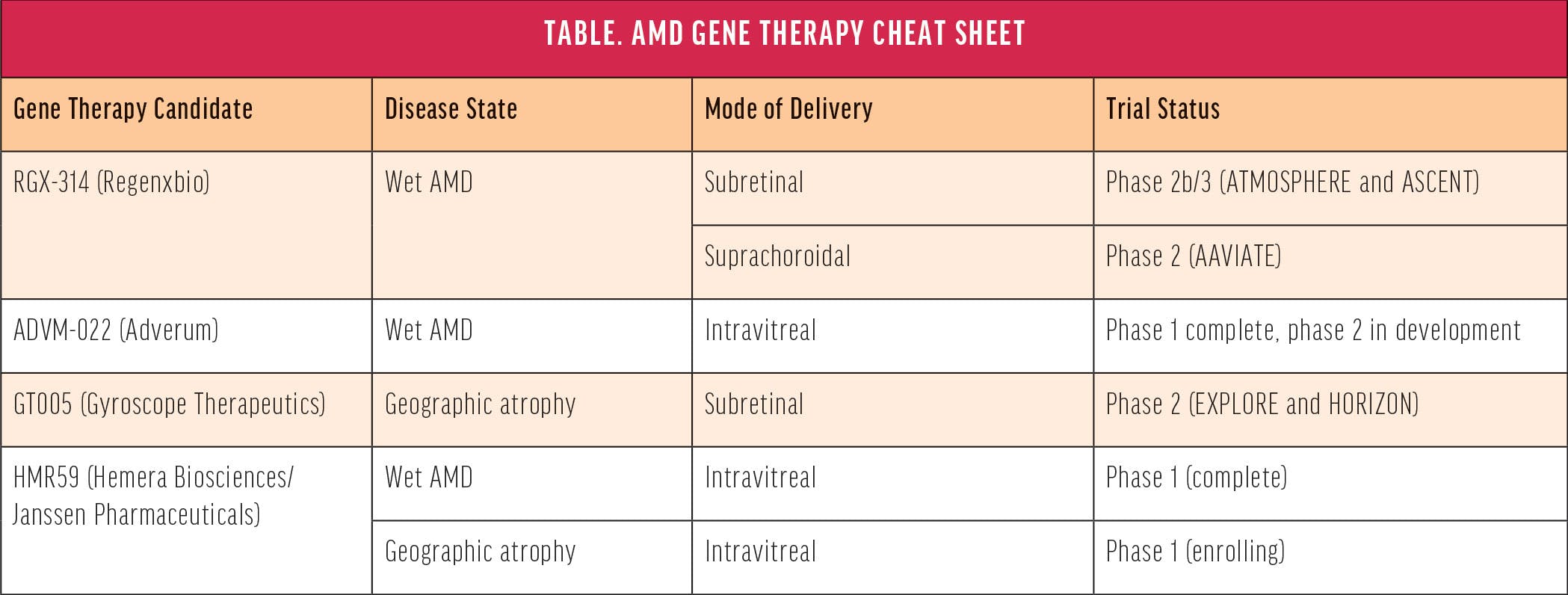
Here, we review some of the efforts that are moving translational medicine forward (Table).
WET AMD
Wet AMD has long been an area of interest for gene therapy. Some of the earliest work looked at intravitreal and subretinal delivery of an AAV2 construct promoting expression of a soluble fms-like tyrosine kinase 1, which decreases endogenous levels of VEGF.4,5 Other work investigated endostatin and angiostatin targets via subretinal delivery of a lentivirus construct.6
While safety and some efficacy were demonstrated, insufficient effectiveness halted further development. More recent efforts are showing promise, although the threshold for success remains high due to the proven standard of care with repeated intravitreal anti-VEGF therapy.
RGX-314
RGX-314 (Regenxbio), in which an AAV8 vector encodes for a monoclonal anti-VEGF antibody fragment, is being investigated with both subretinal and suprachoroidal delivery in wet AMD. The subretinal delivery program completed phase 1/2a in 42 patients with 2 years of follow-up and has demonstrated tolerability, stable to improved vision and retinal thickness, and a meaningful reduction in injection burden with higher doses (patient cohorts 3-5).7 Two pivotal phase 2b/3 trials are enrolling patients: ATMOSPHERE comparing subretinal RGX-314 with monthly intravitreal ranibizumab (Lucentis, Genentech/Roche) and ASCENT (run in partnership with Allergan/AbbVie) comparing subretinal RGX-314 with bimonthly aflibercept (Eylea, Regeneron).
Suprachoroidal delivery moves gene therapy to the office setting and avoids the associated risks of vitrectomy and iatrogenic retinal detachment with subretinal injection. Suprachoroidal delivery of RGX-314 is under investigation in the phase 2 AAVIATE trial, in which patients with wet AMD undergo in-office suprachoroidal injection of RGX-314 with the SCS Microinjector (Clearside Biomedical). Initial results show that suprachoroidal delivery of RGX-314 is well tolerated (n = 50, across three cohorts) and contributed to a 6-month reduction in patient injection burden (cohort 1, n = 15, 75.9% reduction); researchers noted four cases of mild inflammation that resolved with topical steroid drops in cohort 1.8
ADVM-022
ADVM-022 (Adverum) is a novel AAV2.7m8 vector designed to allow enhanced retinal transduction across the internal limiting membrane despite being delivered via a single intravitreal injection for wet AMD. The phase 1 investigation of wet AMD is complete with 30 subjects enrolled across four cohorts. The data show a more than 80% reduction in intravitreal injection burden with sustained aflibercept expression and mild (with one moderate) cases of inflammation, all of which were responsive to topical steroid drops.9 Adverum recently announced that, following FDA feedback, it anticipates completing its investigational new drug amendment mid-2022 with dosing of the first patient in a phase 2 trial of ADVM-022 in the third quarter of 2022.10 This trial is designed to evaluate the previously used 2x10¹¹ vg/eye dose and a new, lower 6x10¹⁰ vg/eye dose of ADVM-022, along with new enhanced prophylactic steroid regimens, including local steroids and a combination of local and systemic steroids, in patients with wet AMD.10
GEOGRAPHIC ATROPHY
GA is an appealing disease target for gene therapy, considering there are no approved therapies for it; therefore, the high threshold for approval in wet AMD does not exist for GA. However, identification of molecular targets for gene therapy has been challenging in the absence of a clinically validated and FDA-approved therapeutic pathway.
GT005
GT005 (Gyroscope Therapeutics) is an AAV2 vector being delivered to the subretinal space via the proprietary Orbit Subretinal Delivery System (Gyroscope Therapeutics) as well as the traditional transvitreal subretinal bleb approach. This gene therapy construct promotes expression of complement factor I (CFI) in the treatment of GA and has been found to be well tolerated without significant inflammation and sustained CFI expression in a phase 1/2 trial (FOCUS).11 Separate phase 2 studies are investigating GT005 in patients with rare CFI variants (EXPLORE) and a larger GA population (HORIZON).12,13 These studies aim to document whether the sustained CFI expression noted thus far translates into clinically relevant slowing of GA progression with continued tolerability and safety.
DUAL TARGETS
HMR59 (Hemera Biosciences/Janssen Pharmaceuticals) is an AAV2 vector that is delivered via a single intravitreal injection. The therapy aims to create endogenous expression of soluble CD59, an antiinflammatory protein that is under-expressed in retinal cells of patients with both wet AMD and GA. For GA, a phase 1 dose-escalating safety and tolerability study (HMR-1001) that enrolled 17 patients is complete with data pending.14
For wet AMD, a phase 1 proof of concept study of a single intravitreal administration of HMR59 (HMR-1002) has enrolled 25 treatment-naïve patients with newly converted wet AMD.15 Interval updates and data are forthcoming.
Because this is a new pathway for wet AMD therapy, all patients meeting the enrollment criteria are treated with a single intravitreal injection of an anti-VEGF agent at day 0 and then treated with HMR59 at day 7. Patients will continue monthly anti-VEGF therapy as needed throughout the 12-month study period.15
HOPE FOR THE FUTURE
Gene agnostic approaches to therapies for acquired retinal diseases have come a long way over the last decade, with numerous targets showing promise as clinical trials progress. Nonetheless, given the excellent safety profile of current anti-VEGF therapies, the threshold for defining success remains high for wet AMD. Refinement of vectors and therapeutic target selection and improvements in vector delivery (both surgical technique refinement and route of administration) have yielded some early phase 1/2 promise. Time will tell if the safety and efficacy profiles prove favorable for these agents and their alternative routes of delivery.
Retina specialists and the broader medical community are eagerly watching.
1. Russell S, Bennett J, Wellman JA, et al. Efficacy and safety of voretigene neparvovec (AAV2-hRPE65v2) in patients with RPE65-mediated inherited retinal dystrophy: a randomised, controlled, open-label, phase 3 trial. Lancet. 2017;390(10097):849-860.
2. FDA approves Spark Therapeutics’ Luxterna (voretigene neparvovec-rzyl), a one-time gene therapy for patients with confirmed biallelic RPE65 mutation-associated retinal dystrophy [press release]. Spark Therapeutics. December 19, 2017. Accessed March 11, 2022. ir.sparktx.com/news-releases/news-release-details/fda-approves-spark-therapeutics-luxturnatm-voretigene-neparvovec
3. Gange WS, Sisk RA, Besirli CG, et al. Perifoveal chorioretinal atrophy after subretinal voretigene neparvovec-rzyl for RPE65-mediated Leber congenital amaurosis. Ophthalmol Retina. 2022;6(1):58-64.
4. Heier JS, Kherani S, Desai S, et al. Intravitreous injection of AAV2-sFLT01 in patients with advanced neovascular age-related macular degeneration: a phase 1, open-label trial. Lancet. 2017;390(10089):50-61.
5. Rakoczy EP, Magno AL, Lai CM, et al. Three-year follow-up of phase 1 and 2a rAAV.sFLT-1 subretinal gene therapy trials for exudative age-related macular degeneration. Am J Ophthalmol. 2019;204:113-123.
6. Campochiaro PA, Lauer AK, Sohn EH, et al. Lentiviral vector gene transfer of endostatin/angiostatin for macular degeneration (GEM) study. Hum Gene Ther. 2017;28(1):99-111.
7. Ho A. Subretinal delivery of RGX-314 for neovascular AMD: end of phase I/IIa study results. Presented at the Retina Society Meeting; September 29-October 2, 2021; Chicago, IL.
8. London NJS. Suprachoroidal delivery of RGX-314 for neovascular AMD: Initial results from the phase II AAVIATE study. Presented at the Retina Society Meeting; September 29-October 2, 2021; Chicago, IL.
9. Pieramici D. ADVM-022 intravitreal gene therapy for neovascular AMD–phase 1 OPTIC study. Presented at the Annual Meeting of the American Society of Retina Specialists; October 8-12, 2021; San Antonio, Texas.
10. Adverum Biotechnologies proceeds with IND amendment for ADVM-022 phase 2 trial in wet AMD after receiving requested type c meeting feedback from the FDA [press release]. Adverum Biotechnologies. April 6, 2022. Accessed April 19, 2022. investors.adverum.com/news/news-details/2022/Adverum-Biotechnologies-Proceeds-with-IND-Amendment-for-ADVM-022-Phase-2-Trial-in-Wet-AMD-After-Receiving-Requested-Type-C-Meeting-Feedback-from-the-FDA/default.aspx
11. Waheed N. CFI supplementing gene therapy in geographic atrophy: FOCUS phase 1/2a clinical trial update. Presented at Angiogenesis, Exudation, and Degeneration; February 11-12, 2022; Virtual.
12. EXPLORE: A phase II study to evaluate the safety and efficacy of two doses of GT005 (EXPLORE). Clinicaltrials.gov. Accessed March 28, 2022. clinicaltrials.gov/ct2/show/NCT04437368
13. HORIZON: A phase II study to evaluate the safety and efficacy of two doses of GT005. Clinicaltrials.gov. Accessed March 28, 2022. clinicaltrials.gov/ct2/show/NCT04566445
14. Treatment of advanced dry age related macular degeneration with AAVCAGsCD59. Clinicaltrials.gov. Accessed March 28, 2022. clinicaltrials.gov/ct2/show/NCT03144999
15. AAVCAGsCD59 for the treatment of wet AMD. Clinicaltrials.gov. Accessed March 28, 2022. clinicaltrials.gov/ct2/show/NCT03585556


_1784132761.jpg?auto=compress,format&w=75)





