


AT A GLANCE
- It is crucial that we all adopt the Beckman classification of AMD to avoid ambiguity as to the staging of AMD.
- The Classification of Atrophy Meetings have provided the consensus terminology and criteria for defining atrophy based on OCT imaging.
- Nascent GA is a strong predictor of the development of GA and may be a potential surrogate endpoint in future clinical trials.
We appear to be on the cusp of a new era that will include novel treatments to slow the growth of atrophic lesions in AMD. Soon, we may be able to treat the disease before clinically visible signs of atrophy are present because the first signs of cell death are discernible on OCT imaging. To ensure we are all ready for these advances, we must share a common terminology to describe the anatomical signs that are present in retinal images, as well as have a common understanding of their significance.
To start, we need to use the same framework to describe the clinical phenotypes and stages of AMD. The Beckman Initiative for Macular Research Classification Committee published a consensus paper in 2013, outlining a clinical classification of AMD that was designed to provide definitions that were universally accessible to all clinicians (Table, Figure 1).1 The Beckman classification only requires either a clinical examination or color fundus image to classify AMD patients. Despite this initiative, a lack of uniformity on how we classify AMD disease stages remains.
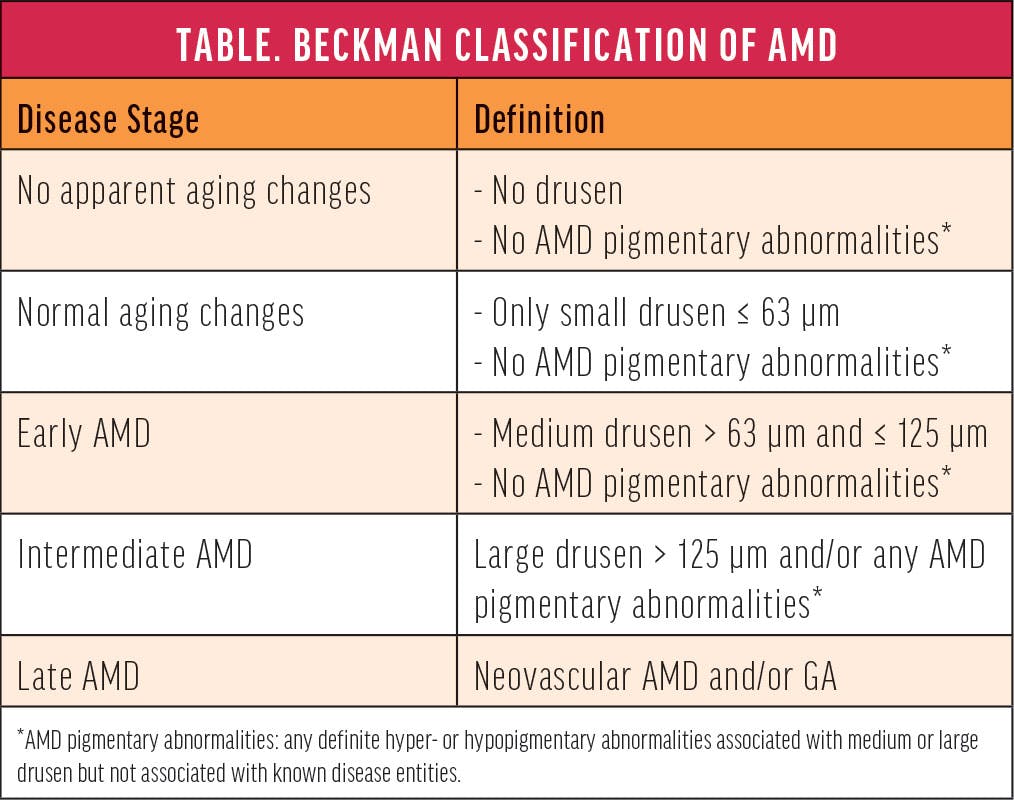
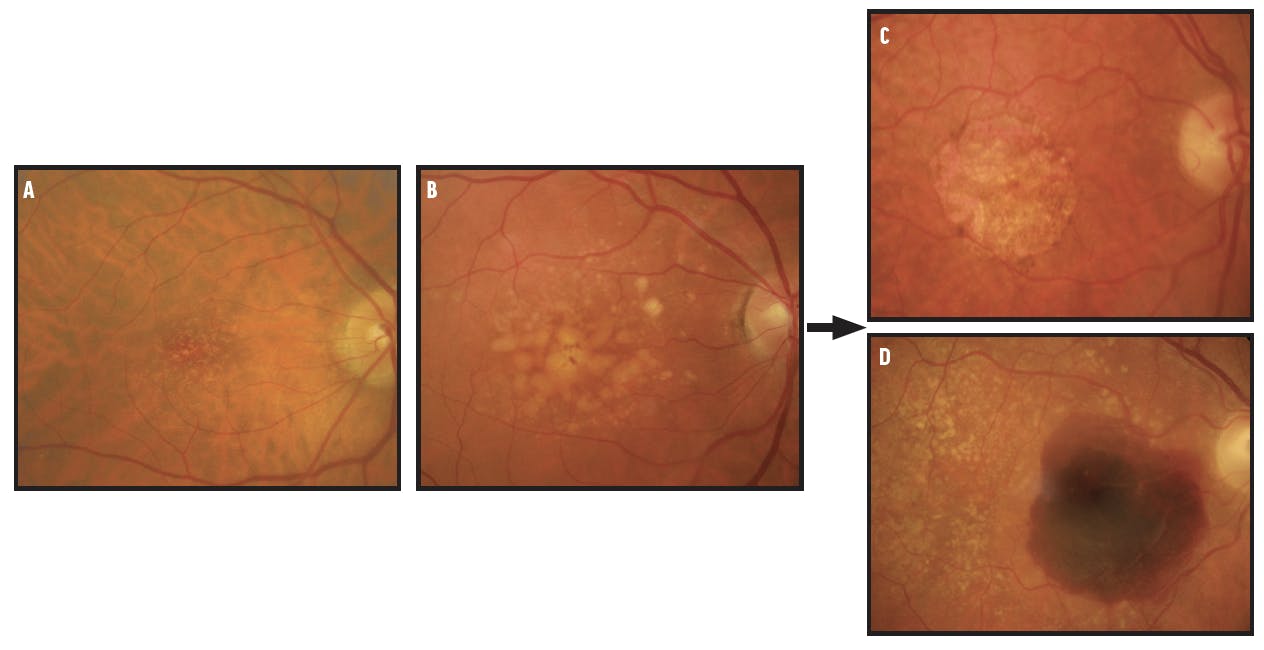
Figure 1. These fundus images demonstrate each of the Beckman stages: early AMD (A), intermediate AMD (B), and late AMD, either GA (C) or neovascular AMD (D).
TIME TO GET ONBOARD
On the verge of a therapy for geographic atrophy (GA), it is crucial that we all adopt the Beckman classification to avoid ambiguity as to the staging of AMD. Based on this classification, the stages of AMD are early, intermediate, and late. Late AMD has two forms: neovascular and GA. The Beckman classification recognizes an increasing risk of developing late AMD and includes categories of no apparent aging change and normal aging change, both of which signify very low risk of vision loss from AMD.
The Beckman group considered the terms wet and dry as lay terms that should only be used to describe the two late forms of AMD, neovascular (wet) and GA (dry), rather than earlier stages of AMD. Agreeing to use this terminology and refraining from the use of terms such as early dry AMD would end much confusion. This is an essential step forward as we begin to identify patients for trials and interventions designed to enroll only at a certain stage of progression.
OCT NOMENCLATURE
Advances in multimodal imaging provide more insight into patients’ disease severity and risk of progression to late AMD, and we can now go further than the Beckman classification in determining stages of AMD. OCT has become an essential imaging tool to evaluate the macula and is now ubiquitous in retinal clinics. OCT macular images have revealed near histological details of what appear to be the first signs of cell loss and the beginning of atrophy in eyes with AMD that only have drusen and pigmentary abnormalities (ie, in patients with early/intermediate AMD) before clinically apparent signs of GA.
An international group of retina specialists, image reading center experts, retinal histologists, and optics engineers convened to agree upon the nomenclature to describe these changes. The Classification of Atrophy Meetings (CAM) have garnered several manuscripts that describe the consensus terminology and criteria for defining atrophy based on OCT imaging.2,3 The group surveyed the literature, performed masked analyses of longitudinal multimodal imaging, and met to identify areas of agreement. The CAM group then proposed a classification system based on OCT as the reference image. In addition, other imaging modalities, such as fundus autoflourescence (FAF), near-infrared reflectance, and color fundus photography, were included to provide complementary and confirmatory information.
The result was a lexicon around the anatomical signs that portend the development of GA and relate to the loss of photoreceptors and retinal pigment epithelium (RPE). The terms complete RPE and outer retinal atrophy (cRORA) and incomplete RPE and outer retinal atrophy (iRORA) were proposed. The specific OCT criteria that designate a lesion as cRORA are:
- a region of hypertransmission at least 250 µm in diameter,
- a zone of attenuation or disruption of the RPE at least 250 µm in diameter,
- evidence of overlying photoreceptor degeneration, and
- absence of scrolled RPE or other signs of an RPE tear.
The criteria for iRORA are identical to cRORA, except that the dimensions of the RPE and choroidal hypertransmission are less than 250 µm. The CAM investigators also recognized that even before all four criteria of cRORA/iRORA are present, there will be OCT scans in which some, but not all, signs are present. These eyes should be considered as having risk factors for the progression to GA.
The CAM classifications are a more granular representation of AMD changes than those detectable in color fundus photography alone. They will allow us to better follow the course of disease progression, stage it more precisely, and determine subsequent risk of progression.
By providing a common lexicon, the CAM group hopes to enable the research community to explore these novel anatomical signs and collect longitudinal information to determine the increased risk of vision loss.
NASCENT GA: A POTENTIAL SURROGATE ENDPOINT
Currently, the rate of enlargement of atrophy as determined by FAF is a regulatory agency-approved anatomic endpoint for clinical trials. Thus, trial designs require the presence of a reliably measurable atrophic lesion on FAF imaging at baseline so that its enlargement can be accurately determined over time. As such, intervening any earlier in the disease process still requires investigators to follow the trial participants until this FAF endpoint can be demonstrated. Such a trial design would require many participants who are followed for many years, which is not feasible and comes with significant costs. However, OCT may be able to demonstrate anatomical changes in individuals with intermediate AMD to provide robust earlier anatomical endpoints for clinical trials, facilitating earlier disease clinical trial design.
In 2014, our group described changes on OCT imaging that we believe stand as robust biomarkers for the potential risk of developing GA; we coined the term nascent GA (nGA) based on our findings. The data we used were collected from a large cohort of participants with drusen greater than 125 µm in at least one eye, who were assessed cross-sectionally and longitudinally, with a subset of participants seen every 3 months for up to 30 months.
The signs observed in regions that went on to develop atrophy (and are required for nGA to be present) were subsidence of the outer plexiform layer and inner nuclear layer and/or development of a hyporeflective wedge-shaped band within Henle fiber layer, within the limits of the outer plexiform layer (Figure 2).4 Upon further analysis of data from the Laser in Early Stages of AMD (LEAD) study,5 we found that, following detection of nGA, the probability of progression to GA after 24 months was 38%. The development of nGA was associated with a markedly increased risk of progression to GA compared with those who did not develop nGA (adjusted hazard ratio, 78.1; P < .001). In addition, the development of nGA explained 91% of the variance in the time to GA development.4 Thus, this study demonstrated that nGA was a strong predictor of the development of GA, providing supportive evidence of its potential value as a surrogate endpoint in future trials for early stages of AMD.
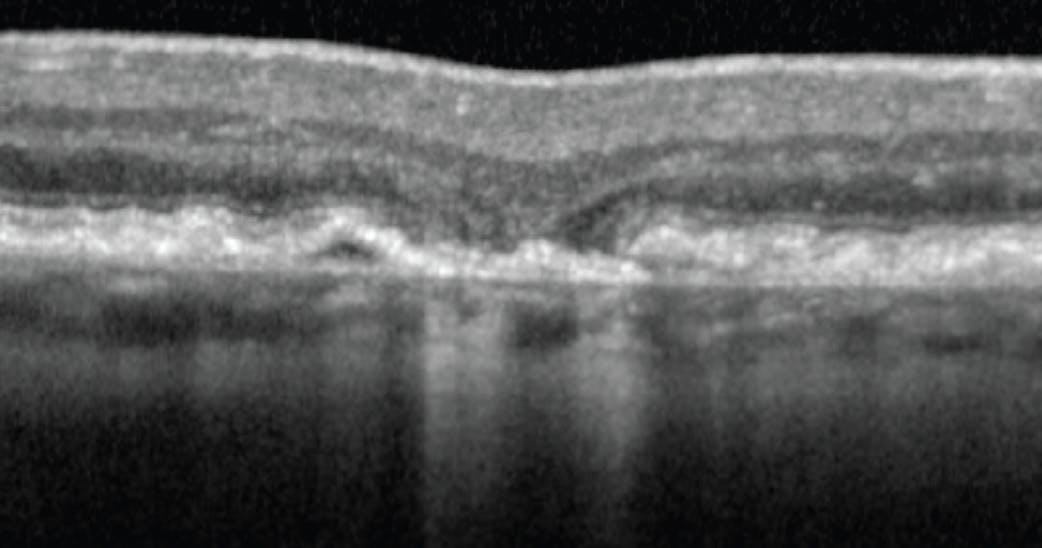
Figure 2. nGA showing the required features of subsidence of the outer plexiform layer and inner nuclear layer and/or development of a hyporeflective wedge-shaped band within Henle fiber layer, within the limits of the outer plexiform layer.
In CAM 3, the group suggested that we continue to use the term GA, but only in a subset of cRORA in the absence of choroidal neovascularization (CNV) and where evident in color fundus photographs. The group recommended macular atrophy as the term to encompass atrophy both with and without CNV. Thus, nGA was suggested to be used as a more general term to describe iRORA in the absence of CNV. However, nGA, as originally defined, required specific signs of photoreceptor loss and comes with a high rate of progression to GA. Not all cases of iRORA have these signs, and iRORA appears more frequently in a cohort of patients with intermediate AMD compared with nGA, as originally defined.
NEXT STEPS
Moving forward, the field will likely rely on artificial intelligence and algorithms that segment each layer of the retina. Studies and clinical trials will need to define which signs of cell loss to include or exclude from their cohorts and what changes would constitute evidence of progression.
Until then, we must be able to reliably grade each of the signs that are required for these definitions. The CAM 6 paper, which reports on inter-reader agreement when assessing these OCT signs, begins to address this issue.6
Regulatory authorities will likewise need to consider these new AMD staging characteristics and determine which changes provide robust biomarkers to act as surrogate endpoints, once their relationship with GA is well-established.
For now, we must all become familiar with these OCT signs of atrophy to help everyone prepare for treatments that are surely headed our way.
1. Ferris 3rd FL, Wilkinson CP, Bird A, et al. Clinical classification of age-related macular degeneration. Ophthalmology. 2013;120(4):844-851.
2. Sadda SR, Guymer R, Holz FG, et al. Consensus definition for atrophy associated with age-related macular degeneration on OCT: classification of atrophy report 3. Ophthalmology. 2018;125(4):537-548.
3. Guymer RH, Rosenfeld PJ, Curcio CA, et al. Incomplete retinal pigment epithelial and outer retinal atrophy in age-related macular degeneration: classification of atrophy meeting report 4. Ophthalmology. 2020;127(3):394-409.
4. Wu, Z, Luu, CD, Hodgson LAB, et al. Prospective longitudinal evaluation of nascent geographic atrophy in age-related macular degeneration. Ophthalmol Retina. 2020;4(6):568-575.
5. Guymer RH, Wu Z, Hodgson LAB, et al. Subthreshold nanosecond laser intervention in age-related macular degeneration: the LEAD randomized controlled clinical trial. Ophthalmology. 2019;126(6):829-838.
6. Wu Z, Pfau M, Blodi BA, et al. OCT signs of early atrophy in age-related macular degeneration: interreader agreement: classification of atrophy meetings report 6. Ophthalmol Retina. 2022;6(1):4-14.


_1784132761.jpg?auto=compress,format&w=75)





