


Reviewed by Susan Bressler, MD
AT A GLANCE
- A biosimilar is a large molecule considered highly similar (not identical) to the originator biologic.
- Researchers speculate that, between 2020 and 2024, the US health care system could save an estimated $100 billion by using biosimilars as compared to the originator biologics.
- The question of biosimilar adoption within the US ophthalmic community may not ultimately be the clinicians’ choice; payers will likely lead the way as a cost-saving measure.
Anti-VEGF therapy, the mainstay for many retinal diseases commonly seen in a retina practice, can prevent additional vision impairment and restore visual function for many patients with wet AMD, diabetic retinopathy, and macular edema from retina vein occlusion (RVO). Today’s approved agents—ranibizumab (Lucentis, Genentech/Roche), aflibercept (Eylea, Regeneron), and brolucizumab (Beovu, Novartis)—dominate the retina therapeutic market, with ranibizumab sales topping $1.6 billion in 2020 in the United States, and aflibercept approaching $5 billion. Not only that, but the anti-VEGF market remained steady despite the COVID-19 pandemic and a dip in clinic visits.1
Such numbers also highlight how pricy anti-VEGF therapy can be. Thus, several companies are working on biosimilars to compete with these originator biologics. In late 2021, the FDA approved the country’s first biosimilar in the ophthalmic space, ranibizumab-nuna (Byooviz, Samsung Bioepis/Biogen) for the treatment of wet AMD, macular edema following RVO, and myopic choroidal neovascularization.
At least 11 other anti-VEGF biosimilars are in various stages of clinical research, setting the stage for a significant shift in how retina specialists treat patients in need of anti-VEGF injections.2 This article details the growth of the biosimilar market, the differences between an originator biologic and its biosimilar, and what it all means for treating patients.
WHAT’S DIFFERENT
Biologics, generics, and biosimilars each have their own development pathways and research approaches (see The Regulatory Pathway: Biologics Versus Biosimilars). Understanding the similarities and differences between originator biologics and biosimilars will help clinicians make informed decisions about how best to integrate biosimilar products in their patient populations. The entire biosimilar ecosystem involves novel scientific development and legislation, considering biologics (other than vaccines) only appeared in 1982 and the FDA didn’t approve the first biosimilar agent until 2015.3,4
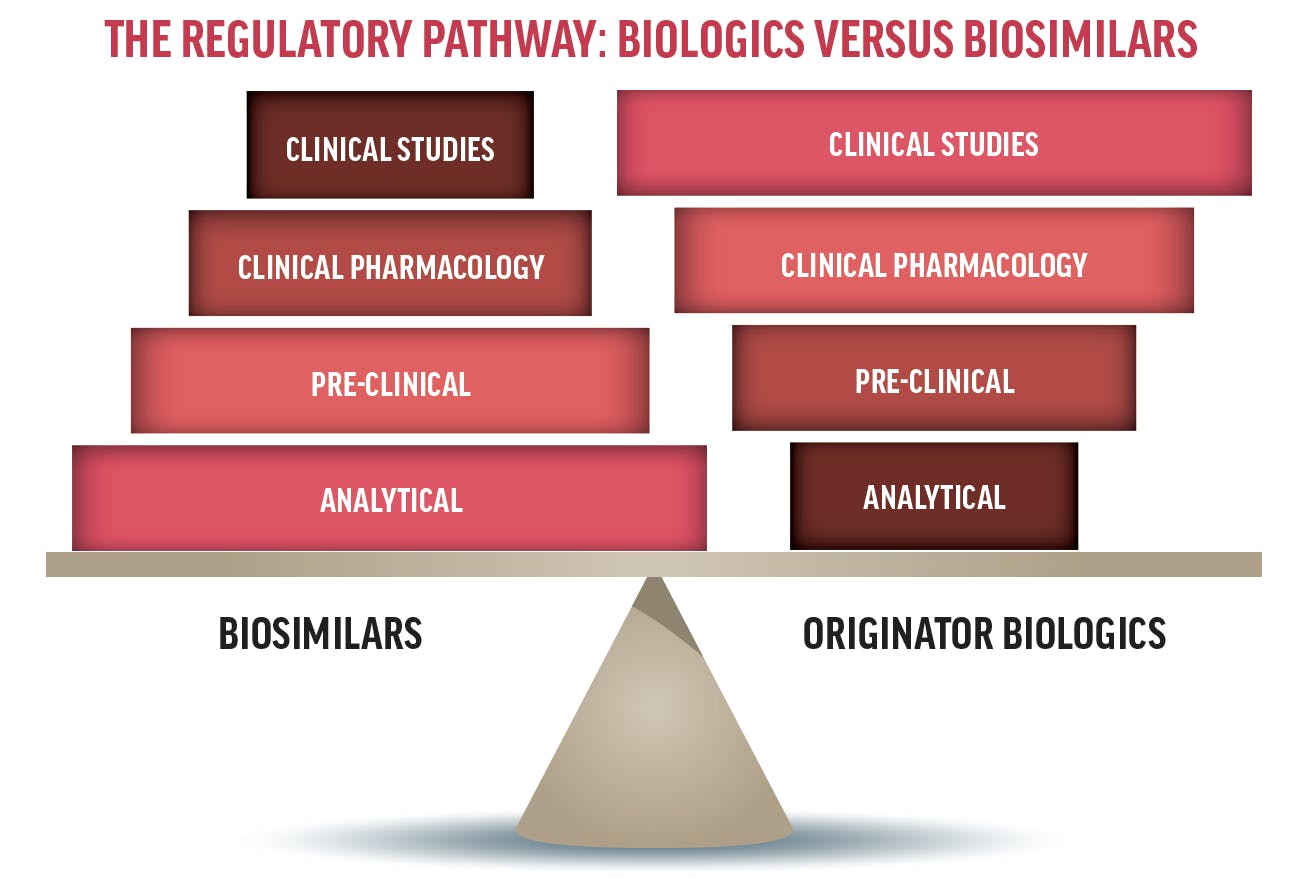
A biologic is a genetically engineered protein that is derived from human genes; those genes are expressed in cell lines that are being asked to produce a large protein. Each biologic has a unique manufacturing process within a living cell line. Researchers first identify the gene sequence that codes for the desired protein and then find an appropriate vector to insert the gene into a cell. The final drug substance has unique biophysical characteristics that may be altered during a detailed manufacturing process.
Because it’s a living system, any given biologic may change over time, creating within-product lot-to-lot variation. In practice, this means a vial of aflibercept manufactured in 2022 may be different from a vial of aflibercept manufactured 1 or 2 years ago. Thus, when a biologic is approved by the FDA, it’s approved for certain indications and its manufacturing process to limit within-product variation.
The entire development process for an originator biologic, the reference product, takes 10 to 15 years and anywhere between $1.2 and $2.5 billion.5
When creating a generic drug, the chemical formula for the original small-molecule drug is in the public domain, and the manufacturer can chemically synthesize an identical twin. A generic drug does not have to be tested for safety or efficacy; developers only must show that it is a bioequivalent agent in healthy volunteer humans. Developing a generic drug takes 3 to 5 years and an investment of approximately $1 to $5 million.5
A biosimilar, however, is a large molecule that is considered highly similar (not identical) to the originator biologic. The manufacturer must demonstrate that a proposed biosimilar is comparable in terms of its physiochemical properties, pharmacokinetic behavior in humans, and pharmacodynamics; a biosimilar must have similar immunogenicity, safety, and efficacy. This is no small feat, considering the complicated development steps for a biologic are not in the public domain—only the gene sequence is.
Rather than simply copying a small-molecule, chemically synthesized drug as generic drugs do, a biosimilar manufacturer must reverse engineer to create a final substance that behaves in a biosimilar fashion. This process may create an agent that has differences from the originator biologic. However, those differences must be in parts of the molecule that do not result in clinically meaningful differences between the proposed biosimilar and the reference product. The manufacturer also must demonstrate a manufacturing process that limits the within-product variability, same as the obligation for the originator biologic.
The research and development required for a biosimilar takes 8 to 12 years and costs $100 to $200 million.5
NOVEL DEVELOPMENT APPROACHES
The bulk of the investment for a biosimilar is in the laboratory research demonstrating the analytical similarity between the proposed biosimilar and the reference product. The development process only requires one randomized clinical trial of the proposed biosimilar compared with the originator in a sensitive disease population using a sensitive clinical endpoint. Data evaluating the pharmacokinetics of the proposed biosimilar are gathered on a subpopulation of clinical trial participants.
Typically, the clinical trial will be performed on a patient population for which the reference product has FDA approval. In retinal diseases, the comparator trial often uses change in visual acuity relative to baseline with a primary endpoint at week 8, rather than week 52—a very new concept for the ophthalmic community. Researchers use an 8-week primary endpoint because the rate of improvement for the originator biologic is particularly steep in those first 8 weeks, which ought to improve the odds of seeing a true difference between the efficacy of a proposed biosimilar and its originator biologic, should one exist. Researchers continue to follow trial participants beyond the primary outcome time point, generally out to 1 year, to enhance the safety database. This also provides longer-term efficacy data, which may provide some comfort to clinicians.
Once a manufacturer shows bioequivalence in one indication, it can apply for extrapolation, which may extend approval for the biosimilar to be used for other indications held by the reference product. Regulators look over an entire portfolio of information for the originator biologic and the biosimilar and determine if they are comfortable granting approval with extrapolation to other disease indications.
If a biosimilar is granted the designation of interchangeability by the FDA, the drug can then be substituted for the originator biologic at the pharmacy level, at least in states in which this is permitted.
To apply for interchangeability, the biosimilar manufacturer must submit data from one or more switching studies; that means: 1) taking patients who are on the originator biologic, like ranibizumab, and switching them to the biosimilar, 2) switching them back to the originator biologic, and 3) switching them back to the biosimilar and comparing the data to those maintained on the originator biologic throughout a similar interval. The goal of the study is to demonstrate results that are as good for switched patients as they are for patients who remained on the originator biologic.
While the FDA may grant interchangeability, it is also governed at the state level, and not all states allow it without a physician specifically prescribing the biosimilar agent.
WHAT BIOSIMILARS BRING TO THE TABLE
Biosimilars offer the prospect for an excellent return on investment for the manufacturer, but they likely provide significant benefits to patients as well. Biologics are very expensive, and biosimilars are likely to enter the market as a more affordable treatment option in the United States and abroad. For example, when biosimilars outside of ophthalmology (most of which are in the field of rheumatology) have launched in the United States, their initial list price has been anywhere from 15% to 30% lower than the originator biologic.6 That reduced price, allegedly, expands the access for that drug to more patients and may improve adherence to treatment schedules because of the lower out-of-pocket cost for patients.
Researchers speculate that, between 2020 and 2024, the US health care system could save an estimated $100 billion by using biosimilars rather than the originator biologics.7
ADOPTION
The question of adoption within the US ophthalmic community may not ultimately be the clinicians’ choice. Payers, both private and government, will likely lead the way as a cost-saving measure mandating the use of biosimilars in lieu of the originator biologics. For example, outside of ophthalmology, biosimilars are set to reach nearly 60% of the volume share of their markets by the end of their second year of availability.7 Whether that will be the case in ophthalmology remains to be seen.
Although the biosimilar development pathway has a sound rationale, the process includes a limited number of patients exposed to the drug from a safety standpoint. Thus, it’s possible that one or more severe adverse events may be associated with a proposed biosimilar that are not identified during the development process. If the true incidence of a severe adverse event is low, it may not be recognized until the biosimilar is used more broadly in community practice. Clinicians should carefully monitor information and share their experiences as biosimilars start to gain traction in the retina community. Growing experience will bring to light any previously unidentified safety signals—and if not, clinicians’ confidence in the new therapeutics will likely grow.
KNOWLEDGE IS POWER
Many of the principles governing the development, approval, and adoption of biosimilars are different from what the retina community is accustomed to for the originator biologics. Thus, education is the first step to prepare clinicians to properly interpret data about biosimilars and determine their place in clinical care.
1. Mishra K, Moujahed AA, Sanislo S, Do DV. The impact of the COVID-19 pandemic on aflibercept and ranibizumab anti-VEGF injections. Invest Ophthalmol Vis Sci. 2021;62:1977.
2. Hua H-U, Rachitskaya A. Expanding your toolbox with biosimilars. Retina Today. 2021;16(8):37-39.
3. Chan JCN, Chan ATC. Biologics and biosimilars: what, why and how? ESMO Open. 2017;2(1):e000180.
4. Raedler LA. Zarxio (Filgrastim-sndz): first biosimilar approved in the United States. Am Health Drug Benefits. 2016;9(Spec Feature):150-154.
5. Sharma A, Kumar N, Kuppermann BD, Bandello F, Loewenstein A. Understanding biosimilars and its regulatory aspects across the globe: an ophthalmology perspective. Br J Ophthalmol. 2020;104(1):2-7.
6. Medgadget. Europe biosimilars market sales size clinical trials USD 10 billion opportunity. August 18, 2021. Accessed April 6, 2022. www.medgadget.com/2021/08/europe-biosimilarsmarket-sales-size-clinical-trials-usd-10-billionopportunity.html
7. Biosimilars in the United States 2020-2024: competition, savings, and sustainability. IQVIA. September 29, 2020. Accessed April 6, 2022. https://www.iqvia.com/insights/the-iqvia-institute/reports/biosimilars-in-the-united-states-2020-2024
The author would like to thank Susan Bressler, MD, for reviewing this article. Dr. Bressler is the Julia G. Levy, PhD, Professor of Ophthalmology at the Wilmer Eye Institute of Johns Hopkins University in Baltimore. Dr. Bressler is a consultant for Amgen. The Johns Hopkins University School of Medicine has received grant support from Bayer, Biocon, Biogen, Boehringer-Ingelheim Pharma, EyePoint, Genentech/Roche, Mylan, Notal Vision, Novartis, and Regeneron.


_1784132761.jpg?auto=compress,format&w=75)





