
_1670422193.png)

_1670422224.png)
Release Date: November 30, 2022
Expiration date: December 1, 2023
This activity is provided by PRIME Education. There is no fee to participate.
This activity is supported by educational grants from Janssen Pharmaceuticals, Inc., administered by Janssen Global Services, LLC and Spark Therapeutics.
Statement of commercial support:
This activity is provided by PRIME Education. There is no fee to participate. This activity is supported by educational grants from Janssen Pharmaceuticals, Inc., administered by Janssen Global Services, LLC and Spark Therapeutics.
Activity Description: This supplement focuses on inherited retinal diseases (IRDs) reviewing the inheritance patterns and classifications of IRDs, diagnostic evaluation, genetic testing approaches, and the latest advances in gene-based therapies for IRDs.
Target Audience:
This certified CME activity is designated for retina specialists, general and pediatric ophthalmologists, and their clinical teams (PAs, NPs, nurses, and pharmacists), optometrists, low vision specialists, and genetic counselors involved in the treatment and management of patients with IRDs.
Learning Objectives
- Examine known mutations, inheritance patterns, and clinical presentations of most common types of IRDs
- Apply evidence-based recommendations for genetic testing and counselling for patients suspected for IRDs
- Evaluate emerging gene therapies for IRDs based on mechanism of action, safety, and efficacy
Accreditation Statement:
Joint Accreditation Statement
In support of improving patient care, PRIME® is jointly accredited by the Accreditation Council for Continuing Medical Education (ACCME), the Accreditation Council for Pharmacy Education (ACPE), and the American Nurses Credentialing Center (ANCC) to provide continuing education for the healthcare team.
Physician Credit Designation Statement
PRIME® designates this Journal-based CME activity for a maximum of 1.0 AMA PRA Category 1 Credits™. Physicians should claim only credit commensurate with the extent of their participation in the activity.
Physician Assistant Accreditation Statement
PRIME® has been authorized by the American Academy of PAs (AAPA) to award AAPA Category 1 CME credit for activities planned in accordance with AAPA CME Criteria. This activity is designated for 1.0 AAPA Category 1 CME credit. PAs should only claim credit commensurate with the extent of their participation.
Nurse Practitioner Accreditation Statement
PRIME Education is accredited by the American Association of Nurse Practitioners as an approved provider of nurse practitioner continuing education. Provider number: 060815. This activity is approved for 1.0 contact hour (which includes 0.1 hour of pharmacology).
Pharmacist Accreditation Statement
This Application-based activity has been approved for 1.0 contact hour (0.1 CEUs) by PRIME® for pharmacists. The Universal Activity Number for this activity is JJA0007144-0000-22-187-H01-P. Pharmacy CE credits can be submitted to the NABP upon successful completion of the activity by providing your NABP ID & DOB, which must be submitted within 60 days of completion. Pharmacists with questions can contact NABP customer service (help@nabp.pharmacy).
Nurse Accreditation Statement
PRIME® designates this activity for 1.0 contact hour.
This course has been accredited for 1.0 hour of Continuing Education credit by COPE. Activity/Event Number: 124936, Course ID#: 81533-TD.
Credit Instructions:
In order to receive CE credit for this program, you must complete the following:
1. Read the entire supplement
2. To complete the post-test, direct your web browser to https://primeinc.org/credit/97PR221 and enter program code 97PR221.
3. Complete the online program evaluation form following the post-test.
Upon successful completion, you will have the option to print your CE statement. Your CE credits will be automatically archived and tracked on the PRIME website (www.primeinc.org). For pharmacists, PRIME will submit earned credits to NABP after program evaluations are completed.
All information is kept confidential.
Disclosures:
Branham has served as a consultant or on the advisory board or panel for Janssen, Biogen, and ProQr Therapeutics. Jain has served as a consultant for Verana Health. Suh has nothing to disclose.
Off-Label Statement:
This article and continuing education activity include discussion of off-label use of products that are investigational and/or unapproved by the FDA. Please refer to the official prescribing information for each product to review approved indications, contraindications, and warnings.
Introduction
Inherited retinal diseases (IRDs) are genetically and clinically heterogeneous disorders of vision. Together, they have an estimated incidence of 1 in 2000 and are a leading cause of vision loss in persons between 15 and 45 years old.1 IRDs can be clinically classified based on disease progression and the retinal cell types that are primarily involved in disease pathogenesis. More than 300 IRD entities are caused by variations in more than 270 genes.2 Identification of these genes and the improvement of clinical laboratory techniques have led to the identification of the genetic basis of disease in 56%-76% of patients with IRDs.3–6 Despite these advances, it is unknown how many genes are involved in IRDs because the genetic basis for the disease is not identified in all patients, which clearly emphasizes the importance of continued research into IRDs and potential IRD therapies.
IRDs can be stationary, as observed in most cases of congenital stationary night blindness and achromatopsia, or progressive, as in retinitis pigmentosa, cone-rod dystrophy, and Stargardt disease. A few phenotypes, such as choroideremia and recessively inherited Stargardt disease, are caused by mutations in single genes, CHM and ABCA4, respectively.7 In most IRDs, mutations in many different genes can cause similar phenotypes. For example, mutations in at least 84 different genes underlie retinitis pigmentosa; 33 genes are implicated in cone dystrophy/cone-rod dystrophy; 20 genes are involved in macular dystrophies; 15 genes are involved in congenital stationary night blindness; and, 9 genes are mutated in familial exudative vitreoretinopathy.7
In the field of IRD, recent developments have advanced the understanding of the mechanisms that are responsible for vision loss, creating new opportunities to intervene with novel therapeutic approaches.
IRD Categories
The inheritance patterns of IRDs are categorized three ways:
- Autosomal dominant, accounting for 25% of IRDs, eg, Best disease
- Autosomal recessive, accounting for 70% of IRDs, eg, Lebercongenital amaurosis
- X-linked or mitochondrial diseases, accounting for the remainder.
There are four broad subtypes of IRDs.8,9
- Rod-cone degenerations, the most common of the IRDs, is the subtype that comprises retinitis pigmentosa in its various forms. Rod-cone degeneration presents with nyctalopia and peripheral visual field loss earlier in disease due to preferential degeneration of rod photoreceptors, followed by loss of central visual acuity and color vision later as cones become affected. Retinitis pigmentosa may show different inheritance patterns; the disease is autosomal recessive in 50%-60% of cases, autosomal dominant in 30%-40% of cases, and X-linked in 10%-15% of cases. Mutations in more than 84 genes have been reported to cause retinitis pigmentosa.
- Cone-rod degenerations initially present with reduced color vision, photophobia, and/or reduced visual acuity. Cone-rod degenerations are commonly caused by a mutation in the ABCA4 gene. More than 30 genes are associated with cone-rod dystrophy and have a key role in ensuring the correct structure and function of the light-sensitive rod and cone photoreceptor cells. As the name suggests, cone cells are the first to degenerate. Cone-rod dystrophies can be inherited in autosomal recessive, autosomal dominant, X-linked, and mitochondrial patterns.
- Chorioretinal degenerations have variable presentations but typically present with nyctalopia and peripheral field loss with progression to central vision loss later in life. Choroideremia is characterized by progressive chorioretinal degeneration in affected males and milder signs in heterozygous (carrier) females. Typically, symptoms in affected males evolve from night blindness to peripheral visual field loss and central vision preserved until late in life. Choroidal degenerations are inherited in autosomal recessive patterns, X-linked, and autosomal dominant patterns.
- Macular dystrophies, such as Stargardt dystrophy, usually result in symptoms of metamorphopsia, reduced visual acuity, and progressive central and paracentral scotomata, while the peripheral vision is typically spared.
Other disease categories include achromatopsia, congenital stationary night blindness, and hereditary vitreoretinopathies.
In addition to their ocular manifestations, many IRDs are associated with systemic disease. Usher syndrome, the most well-known, is an important cause of childhood sensorineural deafness.10
A Diagnostic Odyssey: Evidence-Based Clinical Diagnostic Evaluation for IRDs
An early and precise diagnosis of an IRD is crucial for patients and their families. Clinical characterization of an IRD is accomplished by clinical history, determination of visual function, electrophysiologic tests, and imaging, especially optical coherence tomography (OCT), and fundus autofluorescence imaging.11
A thorough ocular and medical history and pedigree documenting family history of eye disease should be obtained at the initial visit and updated at subsequent visits. History-taking should include prior and current medications to exclude the possibility of a medication toxicity. The clinical evaluation should include visual acuity testing, biomicroscopy, measurement of intraocular pressure, and dilated ophthalmoscopy to identify ocular features.
Standard color or wide-field fundus photography [Figure 1] can be performed at the initial visit to provide documentation of disease state and provide the context to align and compare data from other fundus modalities such as autofluorescence fundus images. For patients with nyctalopia and/or peripheral visual field loss, wide-field imaging has advantages because the primary site of disease may not be in the macula in early disease. Fundus autofluorescence imaging is particularly helpful in revealing the pattern and extent of disease, often demonstrating changes that are out of proportion to the fundus examination findings.
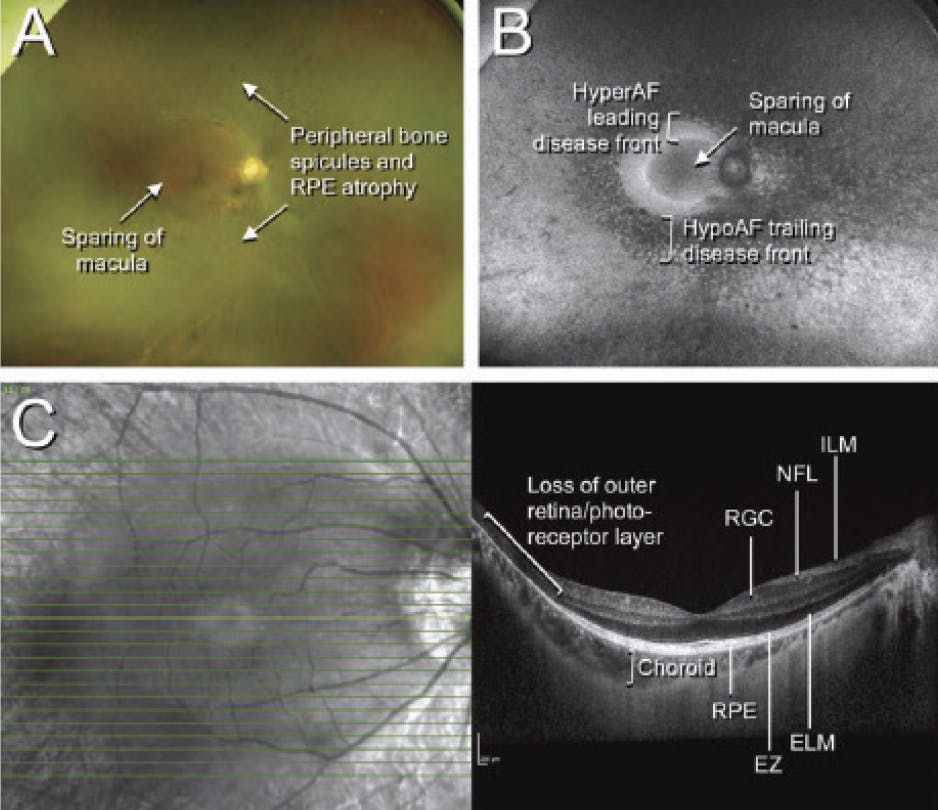
Figure 1. Color fundus photographs, autofluorescence, and OCT of retinitis pigmentosa.
(A) Fundus imaging shows peripheral bone spicule-like pigmentary retinopathy with outer retinal atrophy and sparing of the macula; (B) fundus autofluorescence highlights the areas of disease: the hypoautofluorescent (hypoAF) trailing disease front appears as dark areas and the hyperautofluorescent (hyperAF) leading disease front appears as brighter areas; (C) horizontal cross-sectional OCT at the level of the fovea shows intact retinal layers at the fovea with loss of the outer retina and photoreceptor layers in the periphery. Selected retinal layers relevant to gene-based therapy are shown: ILM, internal limiting membrane; NFL, nerve fiber layer; RGC, retinal ganglion cell layer; RPE, retinal pigment epithelium; EZ, ellipsoid zone (photoreceptor inner/outer segments); ELM, external limiting membrane. Image © 2022 Fenner, Tan, Barathi, Tun, Yeo, Tsai, Lee, Cheung, Chan, Mehta and Teo. CC BY 4.0 license.9
OCT [Figure 1] provides cross-sectional imaging of the retina and retinal pigment epithelium (RPE).12 High-density volume scans provide a useful baseline for monitoring progression in structural features and assisting in monitoring cystoid macular edema or macular schisis.
Visual field testing is helpful to document the functional impact of disease and for determination of legal blindness and disability and to monitor for progression. Static visual field testing has the advantages of automated indices of sensitivity loss, performance parameters to assess reliability, newer perimeters that can test the entire field, and digital data that can be exported into other applications for specific purposes such as modeling of sensitivity and assessing the function of cones and dark-adapted rods. There are perimeters that allow static testing well beyond the 60° range. Although the static perimetry using the HVF30-2 protocol is acceptable in the federal registry for the determination of legal blindness and vision-related disability, kinetic perimetry is the most common method used to assess peripheral vision and for licensing requirements for driving, disability evaluations, and legal blindness status. Fundus-guided perimeters are particularly useful for measuring macular function in patients with eccentric viewing due to maculopathy. Patients with advanced disease and impaired fixation who cannot perform standard visual field testing can be followed with the full-field stimulus test.
The full-field electroretinogram (ERG) is helpful for diagnosis and staging of disease and is useful for many patients with diffuse photoreceptor disease to evaluate the retina-wide function of rods and cones. The International Society for Clinical Electrophysiology of Vision has published and updated standards that enable recordings to be compared between institutions and examiners.13 Multifocal ERG testing can be useful for detection and monitoring disease progression for diseases that primarily affect the macula. However, its accuracy can be limited in those patients with notable loss of central vision who are unable to maintain steady foveal fixation.
Genetic Testing
The American Academy of Ophthalmology Task Force on Genetic Testing14 and the European Network for Rare Eye Diseases15 recommend genetic testing for all individuals with presumed or suspected IRDs for which a causative gene or genes have been identified. This is usually accomplished using next-generation sequencing (NGS). Copy number variant detection using NGS-based algorithms is a reliable method that greatly increases the genetic diagnostic rate of IRDs. Experimentally validating copy number variants helps to estimate the rate at which IRDs might be solved by a copy number variant plus a more elusive variant.16,17
Several different approaches can be considered for genetic testing of patients with different IRDs—each with varying benefits and limitations. These approaches may include single variant testing, single gene testing, small or large NGS panels, whole exome sequencing (WES), or whole genome sequencing (WGS).18 In cases in which the genetic cause of disease is known within a family, other family members could be tested for the single familial variant. For a very limited number of conditions, such as X-linked retinoschisis and Best macular dystrophy, testing of a single gene may be sufficient to confirm a patient’s clinical diagnosis. For other conditions, such as achromatopsia, in which a small number of genes are known to cause disease, testing of a small panel of genes may be sufficient to identify the cause of disease. In some cases, targeted sequencing of a disease-specific panel may be an economically efficient method for testing. Due to the extreme phenotypic and genotypic heterogeneity and overlap of these, testing on a larger NGS panel, eg, a retinal dystrophy panel as opposed to a macular dystrophy panel, may have a better chance of detecting the cause of disease.
This targeted sequencing is an economical method of focusing sequencing capacity in smaller genomic regions, including noncoding regions, and therefore, maximizing the coverage of clinically relevant genes. Shortcomings of a targeted sequencing strategy are that it often involves multiple gene panels for different conditions and if new IRD genes are identified or new variant associations are made for genes outside of the panel, a panel redesign is required to include them. Targeted sequencing can be used to detect indicators of large structural variants; however, such genomic breakpoints would likely have to occur within the captured loci, reducing the likelihood of identification.
WES has increased in popularity and has many advantages over the targeted sequencing approach. Although WES is not capable of detecting deep intronic mutations without modifying the method, it enables exonic variants to be detected even if their relevance is not entirely elucidated at the time of capture. This provides the potential for future interrogation of WES data as new IRD genes are discovered. Thus, WES allows for the potential future resolution of a previously unsolved diagnosis.
For genetically undiagnosed cases following targeted sequencing and WES, more comprehensive sequencing procedures may be useful. WGS facilitates the identification of noncoding variants, now widely considered a prominent cause of a wide spectrum of IRDs.18
Many challenges remain for genetic screening of IRDs; in approximately 40% of screened patients causative genetic elements are yet to be established. Many of these cases may be resolved in the future as more comprehensive techniques, such as WGS, are more routinely utilized. As such data become available, our knowledge of genetic elements that have a modifying effect on IRD manifestations and severities undoubtedly will increase.
Genetic Counseling
Genetic counseling is an essential component of genetic testing; patients should identify a genetic counselor before undergoing testing to ensure access to an appropriate resource to understand their test results and discuss potential next steps. Responsibilities of a genetic counselor include family history taking; pedigree drawing; risk assessment; discussion of the natural history of the condition; psychosocial impact of the diagnosis; patient education; discussion of options; ethical issues; psychosocial assessment; and psychosocial support.19 Genetic counselors with expertise in IRDs may also be able to provide patients with information on relevant ongoing clinical trials. They also are well positioned to discuss potential IRD risks for parents who are considering having additional children.
Genetic Counseling in IRDs: Working Together as a Team
Although more retinal specialists are recognizing the importance of performing genetic testing, they may not have the training in genetics to do counseling. It can be very valuable for clinicians to know that they can turn to a counselor who is not only trained to interpret genetic testing but also trained to talk to patients about results that can be difficult for the patient to understand. These are not always easy conversations. There are significant emotional aspects associated with being diagnosed with a genetic condition. Genetic counselors are trained to understand and deal with these emotional aspects.
While some genetic testing results may be straightforward, a significant number of results are difficult to interpret. Even when a retina specialist finds the results straightforward, the data may be challenging for a patient to understand. A genetic counselor can be valuable through all stages of testing and interpretation and can help patients, and sometimes even clinicians, understand genetic testing results and their implications.
Patient Testimonial: Role of Genetic Counselor
"We were introduced to a genetic counselor, who was a really calming presence during a very stressful and challenging time. She spent a huge amount of time with us that day helping us out in-between the tests that they ran. And she was a wealth of knowledge, which was just a huge benefit to us. We came with tons of questions, and she patiently sat there [and], answered every single one of them."
– Patient living with Stargardt disease, Personal Communication
with PRIME on August 15, 2022
Factors that make genetic counseling difficult are the extreme genetic heterogeneity, multiple inheritance patterns, and diverse phenotypic features of several IRDs, which can pose challenges for providing accurate genetic counseling and recurrence risks before counseling.20 Further, variants of unknown significance can confound counseling efforts.
Unfortunately, of the 5000 certified genetic counselors in the United States, less than 1% have expertise in ophthalmology.
Emerging Therapies for IRDs
Gene Therapies
The historic U.S. Food and Drug Administration approval of voretigene neparvovec-rzyl for RPE65-associated Leber’s congenital amaurosis has spurred tremendous optimism surrounding retinal gene therapy for various other monogenic IRDs.21 Novel disease-causing mutations continue to be discovered, and targeted genetic therapy is now under development in clinical and preclinical models for many IRDs. Numerous clinical trials for other IRDs are ongoing or have recently been completed. Disorders currently targeted for genetic therapy include retinitis pigmentosa, choroideremia, achromatopsia, Leber’s hereditary optic neuropathy, Usher syndrome, X-linked retinoschisis, and Stargardt disease.
Three strategies are being incorporated into these trials:22
- Gene augmentation, or gene replacement, delivers a functional copy of a gene to affected cells in order to restore expression of an inadequately functioning gene. Voretigene neparvovec-rzyl used this strategy, as do the majority of gene therapy trials for ocular disease.
- Gene editing, or genome surgery, aims to directly correct the mutation in the target cell’s genomic DNA sequence. The most sophisticated and specific genome editing technology is CRISPR-associated Cas proteins.
- Gene-specific targeted therapy suppresses the faulty gene to restore normal function. The most successful technique is antisense oligonucleotides.
The challenges of developing gene therapies vary with different IRDs, based on differences in the therapeutic transgene, the intended target cell type, and clinical course, among many other factors. Further, viral vectors such as adenovirus, adeno-associated virus, and lentivirus differ in their gene-carrying capacity, cellular tropism, immunogenicity, and mutagenicity.
Delivery of Gene Therapy
Most studies of gene delivery and gene therapy in the retina use one of three types of viral vectors: adenovirus, lentivirus, and adeno-associated virus. The size and biochemical properties of the capsid determine its distribution in the retinal tissue, its tropism towards various cell populations, and immunologic profile influencing the longevity of gene expression in transduced cells. The different viral vectors differ in their gene-carrying capacity, cellular tropism, immunogenicity, and mutagenicity.
The most appropriate method of administration depends on the area of the eye to be targeted for therapy. For retinal gene therapy, two local routes of delivery are preferred: intravitreal or subretinal.22,23 A suprachoroidal approach has also been suggested more recently. Subretinal injection delivers the virus to the subretinal space. Intravitreal injection is a less invasive, in-office procedure whereby the vector is delivered via a pars plana injection into the vitreous cavity. In the process of transduction, the viral vector enters the target cell and releases the transgene.
Stem Cell Transplantation
Stem cells may provide a promising new therapeutic approach for the treatment of multiple inherited retinal conditions.24 There have been numerous clinical trials examining the ability of stem cells to treat the geographic atrophy found in advanced dry age-related macular degeneration, but fewer clinical trials have specifically examined stem-cell therapy for IRD. Moreover, it remains to be seen if human stem cells will be able to regenerate the lost retinal cell populations that represent a final common pathway for most of the IRDs, or if stem cells will secrete a neuroprotective paracrine factor that will delay progression of these diseases.
Clinical Trials of Gene Therapies for IRDs
Since the benchmark was set by the success of voretigene neparvovec, the pipeline of clinical trials for other IRDs is expected to yield further insights. There are more than 30 trials of gene-based therapies for IRDs in progress, including for X-linked retinitis pigmentosa, achromatopsia, Leber congenital amaurosis, and retinitis pigmentosa due to a variety of genes.22
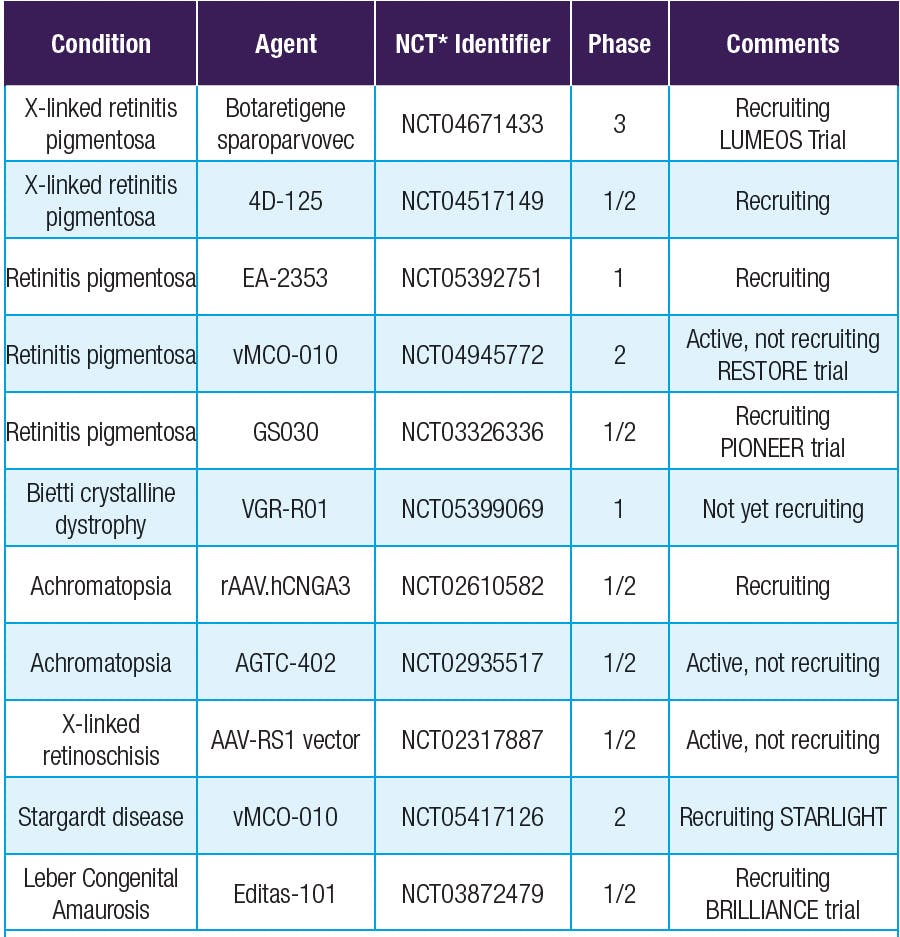
*National Clinical Trial. A complete list of clinical trials is available at https://www.fightingblindness.org/clinical-trial-pipeline.
Three categories of end points are being evaluated in IRD clinical trials:25
- Functional assessments, or performance-based end points, are clinically meaningful end points of retinal function that may include the mean change or mean rate of change of best corrected visual acuity, retinal sensitivity with static perimetry (including topographic analysis of the hill-of-vision), multiluminance mobility testing, and electrophysiologic assessments.
- Structural assessments can be used for patient stratification and treatment monitoring. In progressive disorders, halt of retinal degeneration is an important potential outcome. Moreover, it is part of a desired safety profile, with no acceleration in anatomic loss due to intervention. Depending on the disease natural history, different outcomes and different imaging modalities are being explored.
- Patient reported outcomes provide invaluable patient-centered data. Objective assessment of retinal function and structure allows the clinician/researcher to recognize the biologic effect (or the lack) of treatment. However, the observed changes, even if they reach statistical significance, may not translate to being meaningful for the patient.
IRD Gene Registries
Registries are helpful resources to obtain insight into the natural history of specific IRDs and to collect information on the impact of different interventions (both disease-modifying and supportive) on patients’ experiences and ability to perform daily activities.
The My Retina Tracker registry (https://www.fightingblindness.org/my-retina-tracker-registry) is designed to achieve several objectives that will expand the collective understanding of IRDs and how to treat them. These objectives include gaining a better understanding of the heterogeneity of IRDs and the prevalence of the different diseases and gene mutations, assisting with the establishment of genotype-phenotype relationships, and improving the understanding of the natural history of specific IRDs.
Early diagnosis in the pediatric population provides an opportunity to better understand the natural history of early disease stages when intervention may have more impact. Insights gained from analyzing registry data may accelerate research and development of clinical trials for treatments, and it may also provide a mechanism that facilitates more rapid recruitment for research studies and clinical trials.
My Retina Tracker collects data across an array of IRDs, but other IRD-specific registries and natural history studies are also available. In the instance of rare disease such as IRDs, registry information and natural history studies across multiple centers ae essential in gaining natural history data. The Foundation for Fighting Blindness Clinical Consortium is a network of 39 sites across the globe, formed to conduct natural history studies of IRDs. Thus far, studies have been completed or are in process for patients affected with IRDs due to ABCA4, USH2A, EYS, and PCDH15. Other registries exist for several IRDs, including choroideremia, Usher syndrome (USH Trust), CRB1-related LCA/retinitis pigmentosa, and blue cone monochromacy.
Patients who choose to participate in these registries can make valuable contributions to our collective understanding of IRDs, and they may benefit by being notified when any clinical trial appropriate for their specific genetic mutation becomes available.
Availability of Ophthalmic Genetic Testing: Initiatives
The availability of ophthalmic genetic testing has transitioned from being available primarily in specialized labs in academic medical centers to also being available from larger commercial genetic testing laboratories that offer ophthalmic testing as part of their genetic testing menus.
The eyeGENE program at the National Eye Institute26 is a nationwide government-sponsored program that has enrolled patients for many years to create a repository of valuable clinical and genetic information. It is no longer enrolling patients but does continue to analyze samples. Two other programs—My Retina Tracker and ID your IRD—do large, comprehensive IRD panel testing. Different laboratories are involved in each program and have slightly different genes available on the panels. The latter initiatives are for IRDs only and are only enrolling people from the United States.
Future Prospects for IRDs
The next steps for ophthalmic genetics lie in the development of therapies for these blinding disorders as they are relatively good targets for gene therapy. The eye and retina are accessible and relatively isolated from the rest of the body, and photoreceptors appear transduceable with genetic material using a variety of virus-based vectors. The X-linked and recessive varieties of disease represent good candidates for gene augmentation approaches. The treatment of dominant retinal dystrophies will typically require different approaches because a dominant negative or gain-of-function variant may have to be addressed.
Other strategies under investigation to treat IRDs include the use of growth factors to slow down or stop the process of photoreceptor degeneration, gene-editing approaches, cell-based approaches, and other small-molecule approaches such as visual cycle modulators. These approaches will not only benefit those currently impacted by IRDs, but the techniques and knowledge will be applicable to other aspects of more common human disease.
1. Berger W, Kloeckener-Gruissem B, Neidhardt J. The molecular basis of human retinal and vitreoretinal diseases. Prog Retin Eye Res. 2010;29(5):335-375. doi:10.1016/J.PRETEYERES.2010.03.004
2. Fielding Hejtmancik J, Daiger SP. Understanding the genetic architecture of human retinal degenerations. Proc Natl Acad Sci U S A. 2020;117(8):3904-3906. doi:10.1073/pnas.1922925117
3. Sharon D, Ben-Yosef T, Goldenberg-Cohen N, et al. A nationwide genetic analysis of inherited retinal diseases in Israel as assessed by the Israeli inherited retinal disease consortium (IIRDC). Hum Mutat. 2020;41(1):140-149. doi:10.1002/humu.23903
4. Carss K, Arno G, Erwood M, et al. Comprehensive rare variant analysis via whole-genome sequencing to determine the molecular pathology of inherited retinal disease. Am J Hum Genet. 2017;100(1):75-90. doi:10.1016/j.ajhg.2016.12.003
5. Whelan L, Dockery A, Wynne N, et al. Findings from a genotyping study of over 1000 people with inherited retinal disorders in Ireland. Genes (Basel). 2020;11(1). doi:10.3390/genes11010105
6. Stone EM, Andorf JL, Whitmore SS, et al. Clinically focused molecular investigation of 1000 consecutive families with inherited retinal disease. Ophthalmology. 2017;124(9):1314-1331. doi:10.1016/j.ophtha.2017.04.008
7. Cremers FPM, Boon CJF, Bujakowska K, Zeitz C. Special issue introduction. Inherited retinal disease: Novel candidate genes, genotype-phenotype correlations, and inheritance models. Genes (Basel). 2018;9(4). doi:10.3390/genes9040215
8. Wert KJ, Lin JH, Tsang SH. General pathophysiology in retinal degeneration. Dev Ophthalmol. 2014;53:33-43. doi:10.1159/000357294
9. Fenner BJ, Tan TE, Barathi AV, et al. Gene-based therapeutics for inherited retinal diseases. Front Genet. 2022;12. doi:10.3389/fgene.2021.794805
10. Fuster-García C, García-Bohórquez B, Rodríguez-Muñoz A, Millán JM, García-García G. Application of CRISPR tools for variant interpretation and disease modeling in inherited retinal dystrophies. Genes (Basel). 2020;11(5). doi:10.3390/genes11050473
11. AAO Quality of Care statement. https://www.aao.org/clinical-statement/recommendations-on-clinical-assessment-of-patients. Accessed October 6, 2022.
12. Ratra D, Ozdek S, Raviselvan M, Elchuri S, Sharma T. Approach to inherited retinal diseases. Indian J Ophthalmol. 2022;70(7):2305-2315. doi:10.4103/ijo.IJO_314_22
13. McCulloch DL, Marmor MF, Brigell MG, et al. ISCEV Standard for full-field clinical electroretinography (2015 update). Doc Ophthalmol. 2015;130:1-12. doi:10.1007/s10633-014-9473-7
14. Stone EM, Aldave AJ, Drack A v, et al. Recommendations of the American Academy of Ophthalmology Task Force on Genetic Testing. http://www.acmg.net. Accessed October 6, 2022.
15. Black GC, Sergouniotis P, Sodi A, et al. The need for widely available genomic testing in rare eye diseases: an ERN-EYE position statement. Orphanet J Rare Dis. 2021;16(1). doi:10.1186/s13023-021-01756-x
16. Ellingford JM, Horn B, Campbell C, et al. Assessment of the incorporation of CNV surveillance into gene panel next-generation sequencing testing for inherited retinal diseases. J Med Genet. 2018;55(2):114-121. doi:10.1136/jmedgenet-2017-104791
17. Zampaglione E, Kinde B, Place EM, et al. Copy-number variation contributes 9% of pathogenicity in the inherited retinal degenerations. Genet Med. 2020;22(6):1079-1087. doi:10.1038/s41436-020-0759-8
18. Fadaie Z, Whelan L, Ben-Yosef T, et al. Whole genome sequencing and in vitro splice assays reveal genetic causes for inherited retinal diseases. NPJ Genom Med. 2021;6(1). doi:10.1038/s41525-021-00261-1
19. Skirton H, Cordier C, Ingvoldstad C, Taris N, Benjamin C. The role of the genetic counsellor: A systematic review of research evidence. Eur J Hum Genet. 2015;23(4):452-458. doi:10.1038/ejhg.2014.116
20. Branham K, Schlegel D, Fahim AT, Jayasundera KT. Genetic testing for inherited retinal degenerations: Triumphs and tribulations. Am J Med Genet C Semin Med Genet. 2020;184(3):571-577. doi:10.1002/ajmg.c.31835
21. Ameri H. Prospect of retinal gene therapy following commercialization of voretigene neparvovec-rzyl for retinal dystrophy mediated by RPE65 mutation. J Curr Ophthalmol. 2018;30(1):1-2. doi:10.1016/j.joco.2018.01.006
22. Hu ML, Edwards TL, O’Hare F, et al. Gene therapy for inherited retinal diseases: progress and possibilities. Clin Exp Optom. 2021;104(4):444-454. doi:10.1080/08164622.2021.1880863
23. Botto C, Rucli M, Tekinsoy MD, Pulman J, Sahel JA, Dalkara D. Early and late stage gene therapy interventions for inherited retinal degenerations. Prog Retin Eye Res. 2022;86. doi:10.1016/j.preteyeres.2021.100975/p>
24. Singh MS, Park SS, Albini TA, et al. Retinal stem cell transplantation: Balancing safety and potential. Prog Retin Eye Res. 2020;75. doi:10.1016/j.preteyeres.2019.100779
25. Georgiou M, Fujinami K, Michaelides M. Inherited retinal diseases: Therapeutics, clinical trials and end points—A review. Clin Exp Ophthalmol. 2021;49(3):270-288. doi:10.1111/ceo.13917
26. National Eye Institute. EyeGENE.® Envisioning Cures for Rare Inherited Eye Disorders. https://www.nei.nih.gov/sites/default/files/2020-05/Eyegene_Virtual_version_2020-05-27_FINAL.pdf. 2020. Accessed October 6, 2022.
