


AT A GLANCE
- Most retina specialists have a low threshold to treat center-involving or center-threatening diabetic macular edema, especially for patients with perceived vision loss.
- The traditional treatment paradigm for patients with nonproliferative diabetic retinopathy has been observation and systemic risk factor control.
- Improvements in durability for the treatment of diabetic eye disease are expected with emerging delivery methods.
The decision to treat diabetic retinopathy (DR) and diabetic macular edema (DME) is complex, and physicians must consider several factors beyond the underlying severity and presentation of the pathology. These factors include the likelihood that the patient will adhere to the treatment plan, socioeconomic factors, access to care, and patient preference. In addition, retina specialists have an ever-expanding toolkit to treat diabetic eye disease. Here I explore when and how to intervene for the treatment of DR and DME.
WHEN TO TREAT
Diabetic Macular Edema
Most retina specialists have a low threshold to treat center-involving or center-threatening DME, especially for patients with perceived vision loss (Figure). The Early Treatment Diabetic Retinopathy Study (ETDRS) group was one of the first to document decreased vision related to the duration and severity of DME. In patients with a VA of 20/40 or better at baseline, the proportion of 3-line losers over 3 years increased from 5% of patients who did not develop severe DME to between 15% and 25% of those who developed severe DME for a duration of 4 to 12 months. In patients who developed severe DME for 28 to 36 months, 61% had moderately severe vision loss at 3 years.1
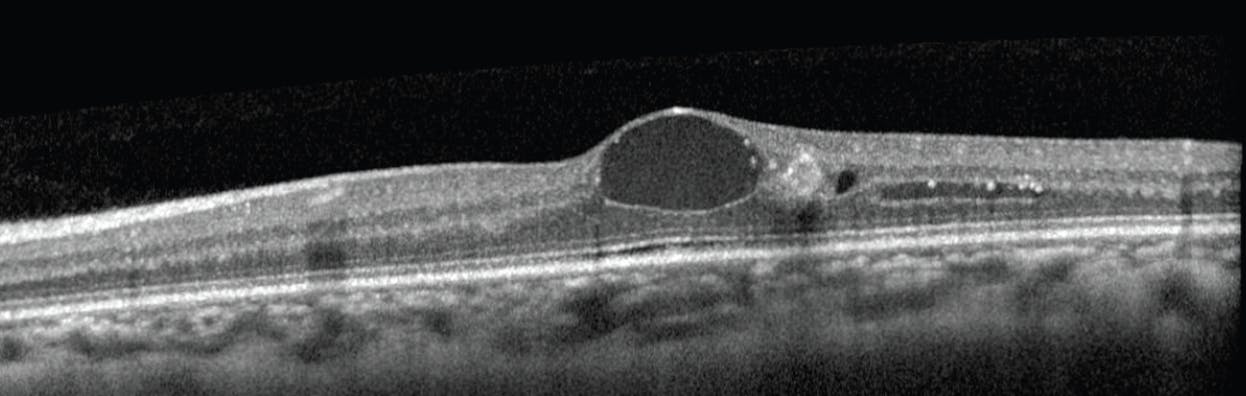
Figure. When a patient presents with clear signs of DME on OCT imaging, clinicians have a low threshold to consider treatment with anti-VEGF agents, laser therapy, steroids, or PPV.
A strong argument for earlier treatment is made based on data from the phase 3 RISE/RIDE trials, which included true sham control groups that were not eligible to cross over to the ranibizumab (Lucentis, Genentech/Roche) groups for 24 months from the time of enrollment. The baseline upper VA limit for inclusion was 20/40 in these trials. Once sham patients finally received anti-VEGF treatment, visual acuity gains were modest at 4.3 to 4.7 letters, despite improvements in anatomy that were similar to patients receiving ranibizumab treatment from the start of the trial.2
An argument for delaying treatment in select patients is made based on the results of the Diabetic Retinopathy Clinical Research (DRCR) Retina Network’s Protocol V. This trial demonstrated that patients with center-involving DME and a VA of 20/25 or better did not benefit from early treatment with aflibercept (Eylea, Regeneron) in the 2-year follow-up period.3 Post-hoc analysis identified risk factors associated with the need for rescue, including the need for DME treatment in the fellow eye, baseline central subfield thickness (CST) ≥ 300 µm, and baseline DR severity score (DRSS) ≥ 47.4 Clinicians should consider these factors when deciding which patients with center-involving DME to treat.
Diabetic Retinopathy
The traditional treatment paradigm for patients with nonproliferative DR (NPDR) is observation and systemic risk factor control with reactive anti-VEGF agents and/or laser treatment if and when patients develop proliferative DR (PDR) or center-involving DME. The Diabetes Control and Complications Trial and the United Kingdom Prospective Diabetes Study demonstrated that intense glycemic control helped to reduce the risk of developing DR and slowed the progression of DR.5,6
Unfortunately, many patients progress even with good glycemic control, and the rate of conversion to PDR in eyes with level 53 severe NPDR is approximately 50% in 1 year. This number increases to more than 75% at 5 years.7-10
Moreover, the DRCR Retina Network’s Protocols S and W and the PANORAMA trial demonstrated the benefits of treatment with anti-VEGF agents in DR patients.11-14 With a large and expanding body of literature supporting the treatment of DR, there have been calls to shift the treatment paradigm for certain patients with higher-level NPDR to a more proactive treatment with intravitreal anti-VEGF agents. The ability to improve DRSS with VEGF suppression and ultimately reduce vision-threatening complications is significant.
However, a contentious debate continues regarding when and which patients to treat, especially in the absence of center-involving DME, and whether various approaches are cost-effective. Vision outcomes, quality-of-life improvements, and both short- and long-term dosing are all points to consider in this current debate.
HOW TO TREAT DME
Traditional treatment for DME with focal laser has been largely supplanted by intravitreal anti-VEGF therapy. While many patients respond well to anti-VEGF therapy, a subset of patients experience suboptimal or no response. Alternatives to anti-VEGF therapy include intravitreal corticosteroids and, to a lesser extent, pars plana vitrectomy (PPV).
Anti-VEGF Therapy
Most providers consider anti-VEGF agents as a first-line treatment for DME because they are effective for most patients and have a relatively favorable side effect profile.
As mentioned above, ranibizumab was shown to be an effective treatment for DME in the phase 3 RISE/RIDE trials.2 Patients who were dosed with monthly intravitreal 0.3 mg ranibizumab gained an average of 10.9 and 12.5 letters compared with 2.3 and 2.6 letters in the sham groups in RIDE and RISE, respectively.4
Patients in the phase 3 VIVID and VISTA trials for aflibercept were randomized to receive 2 mg aflibercept every 4 or 8 weeks after five monthly loading doses or focal laser as controls. At week 148, visual acuity gains were significantly better in the aflibercept groups compared with the control group at 10.4 (4-week group), 10.5 (8-week group), and 1.4 (laser) letters.15
In the YOSEMITE and RHINE trials for faricimab (Vabysmo, Genentech/Roche), patients were randomized to 6.0 mg faricimab dosed every 8 weeks after six monthly loading doses, 6.0 mg faricimab dosed according to a personalized treatment interval after four monthly loading doses, or 2.0 mg aflibercept every 8 weeks after five monthly loading doses. At 1 year, faricimab was found to be noninferior to aflibercept with 11.8- and 10.8-letter gains in the 8-week and personalized treatment interval groups, respectively, compared with a 10.3-letter gain in the aflibercept group.16
In the KITE and KESTRAL trials for brolucizumab (Beovu, Novartis), patients were randomized to 6.0 mg brolucizumab with five loading doses every 6 weeks followed by every 12-week dosing, with the option to drop down to every 8 weeks if necessary, compared with 2.0 mg aflibercept with five loading doses every 4 weeks followed by fixed every 8-week dosing. At 52 weeks, brolucizumab was demonstrated to be noninferior to aflibercept in terms of mean change in BCVA. A lower proportion of patients in the brolucizumab arms had intraretinal and/or subretinal fluid at week 52 versus eyes treated with aflibercept (KITE, 54.2% vs 72.9%, and KESTREL, 60.3% vs 73.3%, in the brolucizumab vs aflibercept arms, respectively).17
Steroids
While most patients have good results with anti-VEGF therapy, those who do not may require adjunctive therapy with corticosteroids. These agents have found an ever-growing niche in the treatment of DME owing to a broader effect on the “other” cytokines implicated in DME.18 The known side effects of increased rates of cataract and potential increases in IOP have kept corticosteroids as a second-line treatment for most providers. The most common corticosteroids used for DME include triamcinolone acetonide, the dexamethasone implant (Ozurdex, Allergan), and the 0.19 mg fluocinolone implant (Iluvien, Alimera Sciences).
Surgery
In cases of refractory nontractional DME, several authors have published on improvements in edema and anatomy following PPV.19 While the mechanism of action is unclear, one theory focuses on the increased oxygenation to the retina following vitreous removal. Decreases in histamine, free radicals, and VEGF have also been proposed as possible mechanisms for improvements in DME after PPV.20 DME patients with subfoveal serous detachments have been shown to potentially have the greatest benefit in terms of vision and anatomy following PPV.21
HOW TO TREAT DR
As mentioned, the historical treatment of NPDR in the absence of DME has been observation with systemic risk factor control. This includes glycemic, hypertension, and hyperlipidemia control. Laser photocoagulation has been a mainstay of treatment for patients with proliferative disease, and the Diabetic Retinopathy Study also recommended laser treatment in one eye for patients with bilateral severe NPDR, eyes with severe retinal ischemia, and for patients with conditions that could accelerate DR, such as pregnancy or renal failure.22 The ETDRS evaluated early versus deferred laser photocoagulation in patients with moderate to severe NPDR and early PDR and found that rates of vision loss were similar in patients with early and deferred photocoagulation, 2.6% and 3.7%, respectively.7
The ability of anti-VEGF agents to improve DRSS and reduce vision-threatening complications is a compelling argument in favor of considering early treatment for patients with NPDR without DME, especially for patients with DRSS levels 47 and 53.
The treatment regimen, including early and late dosing strategies and the duration of treatment, remains unclear. In the phase 3 DME registry trials, patients were treated for DME as frequently as monthly and did quite well in terms of DRSS secondary endpoints. However, monthly treatment, in often asymptomatic DR patients without DME, is generally considered untenable. The data from PANORAMA demonstrates that treatment as infrequently as every 16 weeks after initial loading doses improves DRSS and provides significant protection from DR complications.14 Treatment with intravitreal aflibercept in the PANORAMA trial reduced vision-threatening complications by 77% when dosed every 16 weeks compared with sham at 100 weeks.14
The DRCR Retina Network’s Protocol W also demonstrated similar results, showing a 16.3% risk of vision-threatening complications in diabetic patients treated with aflibercept compared with 43.5% of patients in the sham group.13
Ultimately, many other patient-specific factors play a role in the decision to treat with anti-VEGF agents, including cost considerations and quality-of-life improvements.
The therapeutic pipeline for diabetic eye disease is robust and centers on more durable treatments. Durability improvements are expected with emerging delivery methods, including devices such as the port delivery system with ranibizumab (Susvimo, Genentech/Roche) and, potentially, gene therapy. Interim data from the phase 2 Altitude trial demonstrated a 47% ≥ 2-step improvement in DRSS in patients dosed with a single suprachoroidal injection of RGX-314 (Regenxbio) at baseline.23
Key Takeaway
End-stage DME and DR can be devastating and often blinding conditions. Fortunately, retina specialists have a growing number of tools at our disposal to prevent and treat them. Thoughtful and timely treatment for our patients with diabetes using the tools we have is of utmost importance.
1. Gangnon RE, Davis MD, Hubbard LD, et al. A severity scale for diabetic macular edema developed from ETDRS data. Invest Ophthalmol Vis Sci. 2008;49(11):5041-5047.
2. Brown DM, Nguyen QD, Marcus DM, et al. Long-term outcomes of ranibizumab therapy for diabetic macular edema: the 36-month results from two phase III trials: RISE and RIDE. Ophthalmology. 2013;120(10):2013-2022.
3. Baker CW, Glassman AR, Beaulieu WT, et al. Effect of initial management with aflibercept vs laser photocoagulation vs observation on vision loss among patients with diabetic macular edema involving the center of the macula and good visual acuity: a randomized clinical trial. JAMA. 2019;321(19):1880-1894.
4. Glassman AR, Baker CW, Beaulieu WT, et al. Assessment of the DRCR Retina Network approach to management with initial observation for eyes with center-involved diabetic macular edema and good visual acuity: a secondary analysis of a randomized clinical trial. JAMA Ophthalmol. 2020;138(4):341-349.
5. Stratton IM, Kohner EM, Aldington SJ, et al. UKPDS 50: risk factors for incidence and progression of retinopathy in Type II diabetes over 6 years from diagnosis. Diabetologia. 2001;44(2):156-163.
6. Effect of intensive diabetes treatment on the development and progression of long-term complications in adolescents with insulin-dependent diabetes mellitus: Diabetes Control and Complications Trial. Diabetes Control and Complications Trial Research Group. J Pediatr. 1994;125(2):177-188.
7. Early photocoagulation for diabetic retinopathy. ETDRS report number 9. Early Treatment Diabetic Retinopathy Study Research Group. Ophthalmology. 1991;98(5 Suppl):766-785.
8. Fundus photographic risk factors for progression of diabetic retinopathy. ETDRS report number 12. Early Treatment Diabetic Retinopathy Study Research Group. Ophthalmology. 1991;98(5 Suppl):823-833.
9. Ip MS, Domalpally A, Hopkins JJ, Wong P, Ehrlich JS. Long-term effects of ranibizumab on diabetic retinopathy severity and progression. Arch Ophthalmol. 2012;130(9):1145-1152.
10. Mitchell P, McAllister I, Larsen M, et al. Evaluating the impact of intravitreal aflibercept on diabetic retinopathy progression in the VIVID-DME and VISTA-DME studies. Ophthalmol Retina. 2018;2(10):988-996.
11. Gross JG, Glassman AR, Jampol LM, et al. Panretinal photocoagulation vs intravitreous ranibizumab for proliferative diabetic retinopathy: a randomized clinical trial. JAMA. 2015;314(20):2137-2146.
12. Gross JG, Glassman AR, Liu D, et al. Five-year outcomes of panretinal photocoagulation vs intravitreous ranibizumab for proliferative diabetic retinopathy: a randomized clinical trial. JAMA Ophthalmol. 2018;136(10):1138-1148.
13. Maturi RK, Glassman AR, Josic K, et al. Effect of intravitreous anti-vascular endothelial growth factor vs sham treatment for prevention of vision-threatening complications of diabetic retinopathy: the Protocol W randomized clinical trial. JAMA Ophthalmol. 2021;139(7):701-712.
14. Brown DM, Wykoff CC, Boyer D, et al. Evaluation of intravitreal aflibercept for the treatment of severe nonproliferative diabetic retinopathy: results from the PANORAMA randomized clinical trial. JAMA Ophthalmol. 2021;139(9):946-955.
15. Heier JS, Korobelnik J-F, Brown DM, et al. Intravitreal aflibercept for diabetic macular edema: 148-week results from the VISTA and VIVID studies. Ophthalmology. 2016;123(11):2376-2385.
16. Wykoff CC, Abreu F, Adamis AP, et al. Efficacy, durability, and safety of intravitreal faricimab with extended dosing up to every 16 weeks in patients with diabetic macular oedema (YOSEMITE and RHINE): two randomised, double-masked, phase 3 trials. Lancet. 2022;399(10326):741-755.
17. Brown DM, Emanuelli A, Bandello F, et al. KESTREL and KITE: 52-week results from two phase III pivotal trials of brolucizumab for diabetic macular edema. Am J Ophthalmol. 2022;238:157-172.
18. Dong N, Xu B, Wang B, Chu L. Study of 27 aqueous humor cytokines in patients with type 2 diabetes with or without retinopathy. Mol Vis. 2013;19:1734-1746.
19. Haller JA, Qin H, Apte RS, et al. Vitrectomy outcomes in eyes with diabetic macular edema and vitreomacular traction. Ophthalmology. 2010;117(6):1087-1093.e3.
20. Christoforidis JB, D’Amico DJ. Surgical and other treatments of diabetic macular edema: an update. Int Ophthalmol Clin. 2004;44(1):139-160.
21. Ichiyama Y, Sawada O, Mori T, Fujikawa M, Kawamura H, Ohji M. The effectiveness of vitrectomy for diffuse diabetic macular edema may depend on its preoperative optical coherence tomography pattern. Graefes Arch Clin Exp Ophthalmol. 2016;254(8):1545-1551.
22. Moutray T, Evans JR, Lois N, Armstrong DJ, Peto T, Azuara-Blanco A. Different lasers and techniques for proliferative diabetic retinopathy. Cochrane Database Syst Rev. 2018;3(3):CD012314.
23. Dhoot D. Suprachoroidal delivery of RGX-314 for diabetic retinopathy without CI-DME: Results from the Phase II ALTITUDE Study. Presented at ARVO 2022; May 1-4; Denver.


_1784132761.jpg?auto=compress,format&w=75)




