



AT A GLANCE
- Each patient with diabetic retinopathy is unique and presents an equally distinctive challenge in achieving optimal control of the retinopathy.
- Studies suggest that it may not be of any visual benefit to treat patients with nonproliferative diabetic retinopathy with prophylactic intravitreal anti-VEGF injections.
- Eyes with diabetic retinopathy that are lost to follow-up do better when treated with PRP compared with anti-VEGF injections alone.
The management paradigm for diabetic retinopathy (DR) is very different than it is for other vitreoretinal disorders. For example, patients with rhegmatogenous retinal detachments (RRDs), macular holes, or epiretinal membranes typically require surgery if intervention is warranted. Patients with wet AMD are routinely treated with intravitreal anti-VEGF injections.
Each patient with DR, however, is unique and presents with an equally distinctive challenge in achieving optimal control of the retinopathy. Physicians treating DR have a multitude of treatment strategies to choose from, including intravitreal anti-VEGF injections, steroid injections, laser treatment, or even pars plana vitrectomy (PPV). The choice hinges on specific clinical and imaging parameters.
The management of DR, and diabetic macular edema (DME) in particular, was revolutionized with the advent of intravitreal anti-VEGF agents and steroid injections.1,2 The Diabetic Retinopathy Clinical Research (DRCR) Retina Network’s Protocol S popularized the use of anti-VEGF injections for the management of proliferative diabetic retinopathy (PDR).3 PPV is often reserved for tractional retinal detachment (TRD) or non-clearing vitreous hemorrhages. However, early vitrectomy is an option for patients with advanced disease or burdening PDR who may be at risk for loss to follow-up and may even provide a lower socioeconomic cost over the life of the patient.4,5
In addition to the clinical presentation, many patient-centric factors guide the decision-making process, including socioeconomic status, systemic comorbidities, hemoglobin A1c levels, and type of diabetes, to name a few. The following cases help illustrate the decision-making process when treating patients with DR.
CASE NO. 1
A 56-year-old phakic man presented with moderate nonproliferative DR (NPDR) in each eye and center-involving DME in his left eye (Figure 1). He had been diagnosed with type 2 diabetes 10 years prior, and his most recent hemoglobin A1c was 10.4. He reported blurry vision in his left eye for approximately 6 months.
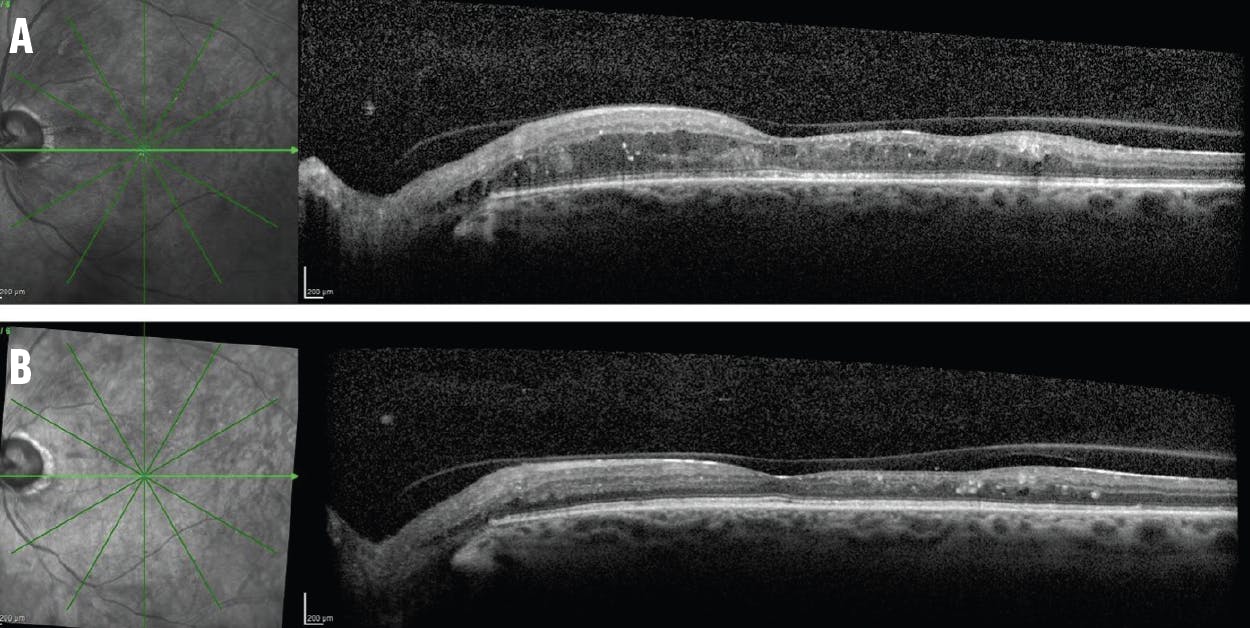
Figure 1. This 56-year-old man with moderate NPDR in each eye and center-involving DME in his left eye (A) did well with intravitreal anti-VEGF injections with resolution of the majority of the DME (B).
Treatment pearl:
Given the results of the PANARAMA trial and DRCR Retina Network’s Protocol W, it may not be of any visual benefit to treat patients with NPDR with prophylactic intravitreal anti-VEGF injections.6,7 Of course, as longer data becomes available, that decision may change.
The patient’s VA was 20/40 OS, and given the central location of the DME, I elected to treat with monthly injections of intravitreal bevacizumab (Avastin, Genentech/Roche). This may seem like a routine decision, but the patient’s entire clinical picture must be evaluated before settling on this approach: his type of diabetes, duration of the disease, most recent hemoglobin A1c, lens status, IOP, duration of symptoms, and any systemic comorbidities.
Treatment pearls:
DRCR Retina Network’s Protocol V showed that patients with a VA of 20/25 or better had no difference in vision loss at 2 years whether they were initially observed, underwent focal laser therapy, or received prompt intravitreal anti-VEGF injections.8 DRCR Retina Network’s Protocol T found no difference between aflibercept (Eylea, Regeneron), ranibizumab (Lucentis, Genentech/Roche), or bevacizumab, unless the presenting VA was 20/50 or worse—those eyes had better visual acuity gains when initially managed with aflibercept compared with bevacizumab but showed no difference at 2 years when compared with ranibizumab.9 Additionally, steroids may not be the best initial option for phakic patients with uncontrolled IOP. Lastly, patients with other systemic complications, such as renal disease, may have difficult-to-treat DME, and some diabetic medications such as thiazolidinediones may exacerbate DME.
After 6 months of monthly bevacizumab injections, the patient’s VA improved to 20/25 OS, and he continues to receive intravitreal bevacizumab injections.
CASE NO. 2
A 73-year-old pseudophakic woman presented to the clinic with DME in each eye. Her VA was 20/60 OD and 20/50 OS, IOPs were normal, and cup-to-disc ratios were 0.3 OU. Her right eye had massive intraretinal fluid into the fovea that was not responding to monthly aflibercept injections, while the left eye had a small amount of temporal intraretinal fluid that was managed with aflibercept injections every 6 weeks (Figure 2).
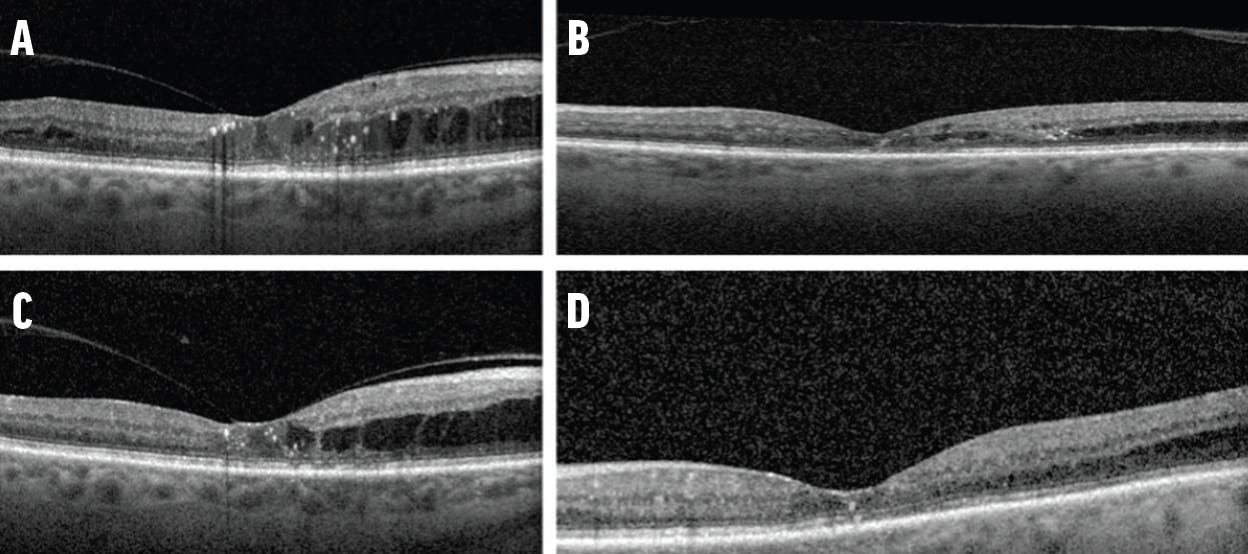
Figure 2. This 73-year-old patient presented with DME in each eye (A, B). The right eye had massive intraretinal fluid in the fovea and nasally (A) that was not responding to anti-VEGF injections; only after intravitreal steroid did she begin to see an improvement in the DME. The left eye had a small amount of temporal intraretinal fluid and underwent focal laser therapy (C) and has not received further treatment for 6 months (D).
Given that the right eye was not improving with anti-VEGF therapy, I trialed intravitreal dexamethasone (Ozurdex, Allergan/Abbvie). Although her IOP, cup-to-disc ratio, and lens status (with intact posterior capsule) made her an ideal steroid candidate, I still had an extensive discussion about the risks of ocular hypertension with intravitreal dexamethasone.
Treatment pearl:
If intravitreal dexamethasone is not a viable option, an injection of shorter-acting triamcinolone is a good alternative. If dexamethasone works well, patients also may be candidates for the fluocinolone acetonide intravitreal implant (Iluvien, Alimera Sciences), which can last up to 3 years with few rescue injections needed.
The patient’s left eye was doing well and, given that she had a few temporal microaneurysms (MAs), I proceeded with focal laser therapy to the left eye and stopped anti-VEGF injections.
Treatment pearl:
Focal laser therapy is a great choice for patients with parafoveal MAs; make sure to avoid targeting MAs within a disc diameter of the foveal center.
The patient had an excellent response to dexamethasone, and the stubborn intraretinal fluid was finally shrinking with no IOP spike. Further injections of a longer-acting steroid are planned in hopes of continued improvement. The patient’s left eye has now gone 6 months without any further treatment following focal laser therapy.
CASE NO. 3
A 63-year-old woman was referred for a DR evaluation. Fluorescein angiography revealed several areas of neovascularization elsewhere (NVE) in each eye (Figure 3), and OCT imaging showed trace DME in each eye. VA was 20/20 OU, so I decided to treat both eyes with panretinal photocoagulation (PRP). This patient has done well for a year now while maintaining a VA of 20/20 with regression of the NVE in each eye.
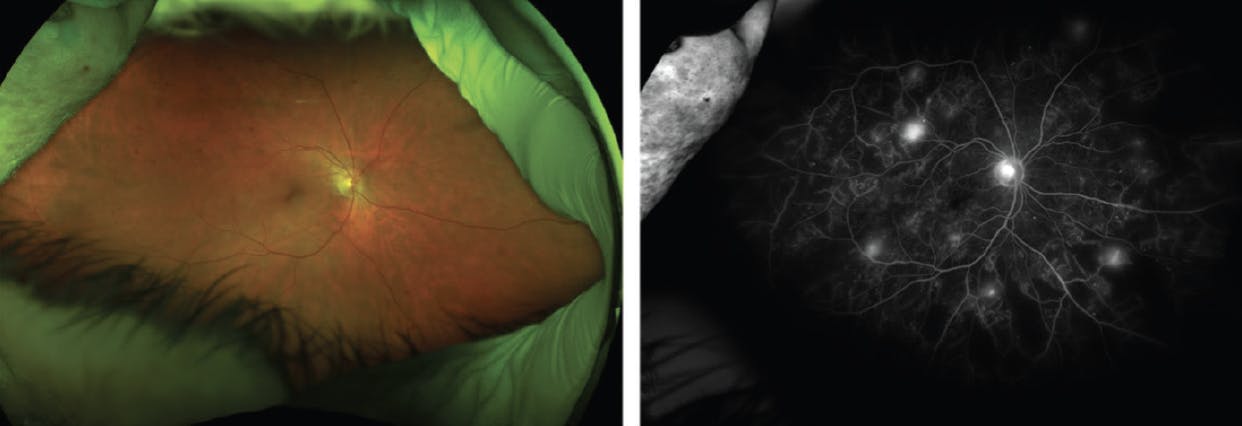
Figure 3. This 63-year-old woman with DR in each eye presented with NVE in each eye and subsequently underwent PRP in each eye, leading to the regression of the NVE.
Treatment pearlS:
Counseling patients on the risks of each option—anti-VEGF or PRP—for PDR is important, as is taking into consideration the patient’s systemic comorbidities and ability to follow up. Patients with PDR often miss appointments due to frequent medical appointments (eg, for dialysis) or hospitalization. Studies show that eyes that are lost to follow-up did better when treated with PRP compared with those treated with anti-VEGF injections alone.10
CASE NO. 4
A 27-year-old phakic woman with type 1 diabetes and a hemoglobin A1c of 9.4 presented, stating that she had lost vision in her left eye 3 months prior. VA was 20/20 OD and counting fingers OS. The fundus examination revealed a macula-on temporal and superior TRD with no previous PRP in the right eye; in the left eye, there was a table-top macula-off TRD with scant peripheral PRP (Figure 4). I elected to perform PPV in the left eye with intraoperative PRP in the right eye.
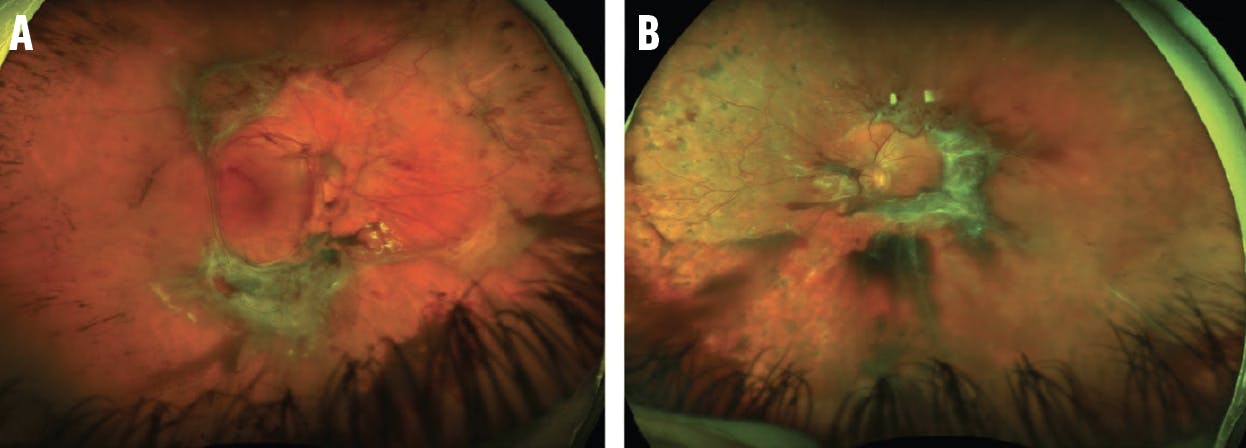
Figure 4. This 27-year-old woman with type 1 diabetes presented with a macula-on temporal and superior TRD with no previous PRP in the right eye (A). The left eye had a table-top macula-off TRD with scant peripheral PRP (B).
The patient received medical clearance from her primary care physician 1 week before surgery, and she received an intravitreal injection of bevacizumab in the left eye 4 days before surgery.
Treatment pearl:
A patient must receive medical clearance before receiving any preoperative intravitreal injection because if the patient receives an injection but does not undergo surgery, they are at an increased risk of further contraction or “crunch” of the fibrovascular membranes, often leading to irreparable damage.
When performing PRP in the patient’s right eye, I avoided the areas of detachment to reduce the risk of contracture of the membranes and propagation of a TRD. The left eye underwent careful internal limiting membrane peeling, 360° PRP, and silicone oil. One month after surgery, the subretinal fluid had progressed closer to, but not involving, the fovea in the right eye, and the left eye remained attached. Given that the fovea was still attached 1 month after surgery, I decided to observe the right eye. I did not recommend intravitreal medications due to the risk of crunch, and I needed more follow-up before committing the patient to surgery in the right eye.
One month later, there was no progression of the subretinal fluid in the right eye, and I continued to observe the patient. Eight months after PRP, I noted regression of the TRD in the right eye and a VA of 20/20 (Figure 5). The left eye underwent oil removal 5 months after the initial repair; 3 months after the oil removal, the retina was attached, and VA improved to 20/70 OS.
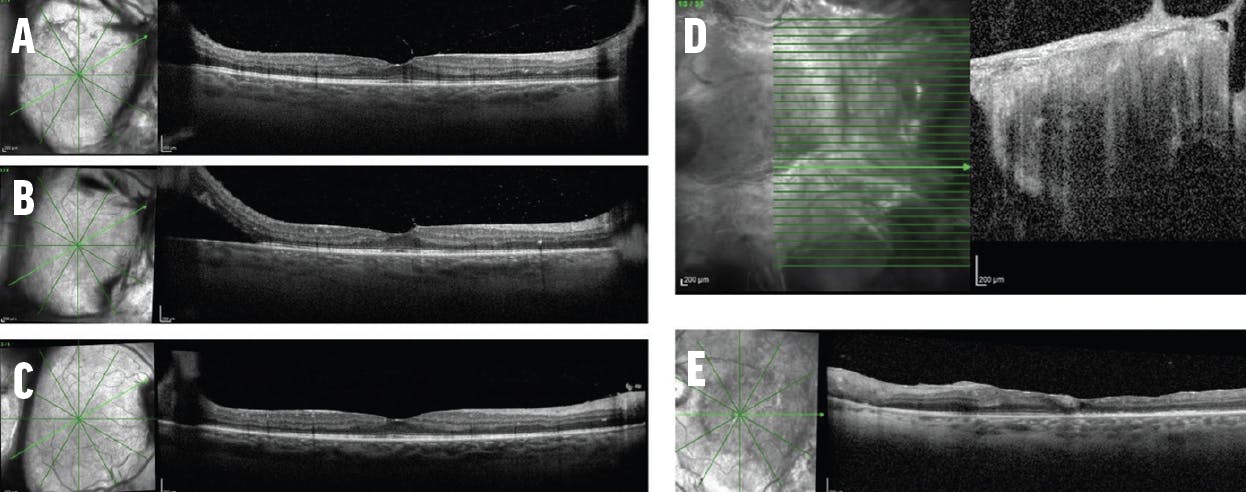
Figure 5. The initial OCT scan of the right eye of the patient in Figure 4 (A) showed minimal subretinal fluid that slightly progressed 1 month after PRP (B), but regressed over time. The subretinal fluid was out of the macula and the patient was stable 8 months after presentation (C). The OCT scan of the left eye at presentation (D) and 8 months later after surgical repair (E). VA in that eye improved from hand motion to 20/70 at the last visit.
FINAL THOUGHTS
Each of these patients presented a unique scenario and required a tailored treatment plan. It is imperative that we treat patients with DR using a systematic approach and integrate their medical history into our decision-making process. We have many different tools at our disposal to help us manage patients with DR, and with further advances in retina, surely, new treatment paradigms will arise.
1. Brown DM, Schmidt-Erfurth U, Do DV, et al. Intravitreal aflibercept for diabetic macular edema: 100-week results from the VISTA and VIVID studies. Ophthalmology. 2015;122(10):2044-2052.
2. Nguyen QD, Brown DM, Marcus DM, et al. Ranibizumab for diabetic macular edema: results from 2 phase III randomized trials: RISE and RIDE. Ophthalmology. 2012;119(4):789-801.
3. Network WC for the DRCR, Gross JG, Glassman AR, et al. Panretinal photocoagulation vs intravitreous ranibizumab for proliferative diabetic retinopathy: a randomized clinical trial. JAMA. 2015;314(20):2137-2146.
4. Glassman AR, Beaulieu WT, Maguire MG, et al; DRCR Retina Network. Visual acuity, vitreous hemorrhage, and other ocular outcomes after vitrectomy vs aflibercept for vitreous hemorrhage due to diabetic retinopathy: a secondary analysis of a randomized clinical trial. JAMA Ophthalmol. 2021;139(7):725-733.
5. Berrocal MH. The benefits of early surgical intervention for diabetic retinopathy. Retina Today. 2021;16(9):25-27.
6. Brown DM, Wykoff CC, Boyer D, et al. Evaluation of intravitreal aflibercept for the treatment of severe nonproliferative diabetic retinopathy: results from the PANORAMA randomized clinical trial. JAMA Ophthalmol. 2021;139(9):946-955.
7. Maturi RK, Glassman AR, Josic K, et al. Effect of intravitreous anti-vascular endothelial growth factor vs sham treatment for prevention of vision-threatening complications of diabetic retinopathy: the Protocol W randomized clinical trial. JAMA Ophthalmol. 2021;139(7):701-712.
8. Baker CW, Glassman AR, Beaulieu WT, et al. Effect of initial management with aflibercept vs laser photocoagulation vs observation on vision loss among patients with diabetic macular edema involving the center of the macula and good visual acuity: a randomized clinical trial. JAMA. 2019;321(19):1880-1894.
9. Wells JA, Glassman AR, Ayala AR, et al. Aflibercept, bevacizumab, or ranibizumab for diabetic macular edema two-year results from a comparative effectiveness randomized clinical trial. Ophthalmology. 2016;123(6):1351-1359.
10. Obeid A, Gao X, Ali FS, et al. Loss to follow-up in patients with proliferative diabetic retinopathy after panretinal photocoagulation or intravitreal anti-VEGF injections. Ophthalmology. 2018;125(9):1386-1392.


_1784132761.jpg?auto=compress,format&w=75)




