


The differential diagnosis for bilateral choroidal tumors includes several life-threatening conditions, such as choroidal metastasis, lymphoma, and melanoma.1 However, there are benign choroidal lesions that can present bilaterally, including choroidal nevus and, rarely, vortex vein varix (VVV). This finding carries little to no risk for thrombosis but can simulate other choroidal tumors with serious clinical implications, including choroidal metastasis and melanoma.1 Therefore, it is important to understand the imaging features of VVV to clearly differentiate this condition from potentially malignant lesions.1
Herein, we describe a rare case of bilateral VVV and discuss the imaging features that helped to characterize it.
CASE REPORT
A 46-year-old White female was referred to our ocular oncology service for evaluation of pigmented choroidal lesions with suspicion for choroidal melanoma or metastasis in each eye. Her family history and past medical history were noncontributory. On examination, her BCVA was 20/25 OD and 20/30 OS. IOP was within normal limits in each eye. Dilated fundus examination of the right eye revealed a subtle, superonasal, brown-red mass at the vortex vein ampulla measuring 3 x 3 mm in basal diameter and an estimated 2 mm in thickness (Figure 1A). Examination of the left eye revealed a similar brown-red mass at the superonasal vortex vein ampulla measuring 5 x 5 mm in basal dimension and an estimated 2 mm in thickness (Figure 1B). The mass became more apparent and appeared thicker when the patient’s gaze was directed superonasally towards the lesion in each eye.
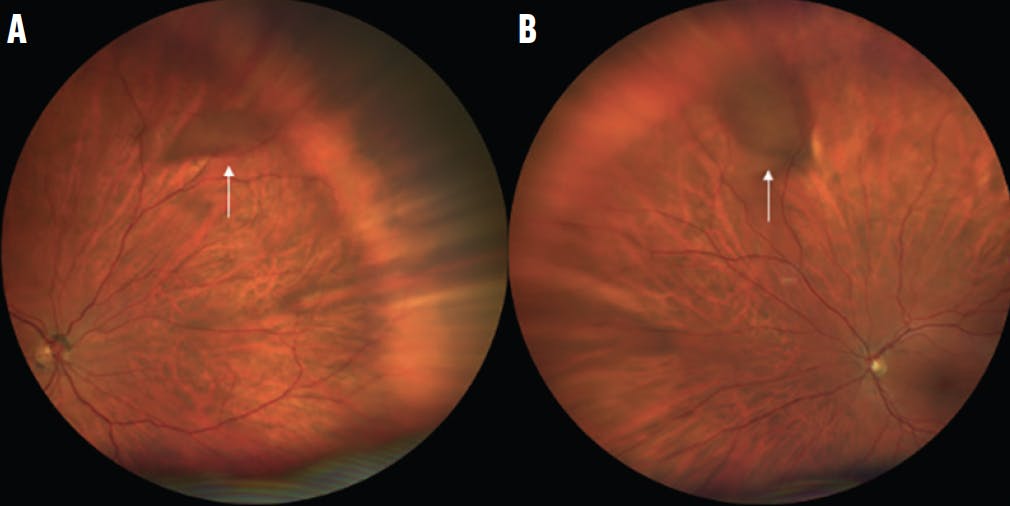
Figure 1. The fundus photograph at presentation showed brown-red subtle VVV in the superonasal quadrant (arrows) of both the right (A) and left (B) eyes, simulating choroidal melanoma.
Ultrasonography confirmed the presence of an expansile mass with low internal reflectivity. The mass in the left eye demonstrated fluctuations in thickness ranging from 1.12 mm to 2.06 mm (Figure 2). The lesion spontaneously deflated in primary gaze and disappeared when digital pressure was applied to the eyelid onto the globe.
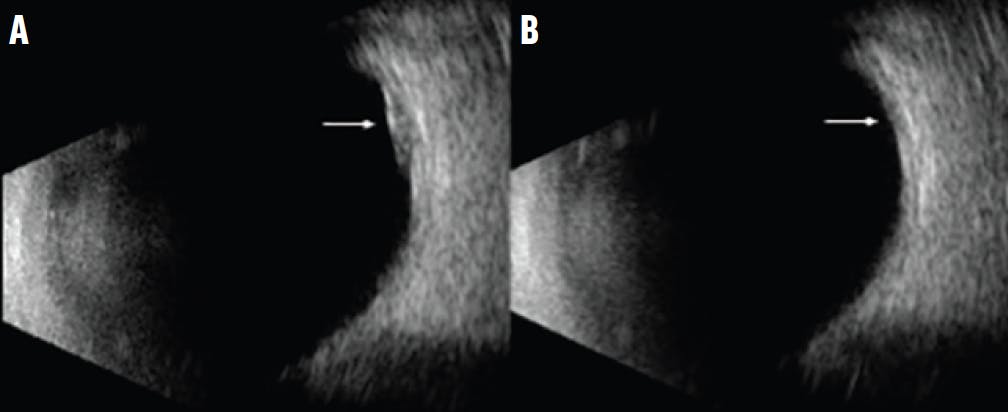
Figure 2. Ultrasonography showed dynamic fluctuations of the VVV in the left eye (arrows) with the lesion filling with blood up to 2.06 mm in thickness when the eye was positioned in the direction of the lesion (A) and draining down to 1.12 mm upon primary gaze (B).
A pigmented choroidal mass that fluctuates in thickness or appearance with changes in gaze or with digital pressure is suggestive of VVV. Thus, a diagnosis of bilateral VVV was rendered, and the patient returned for 1- and 5-year follow-up appointments without change in the appearance of the vascular lesions in either eye.
DISCUSSION
VVV is almost always unilateral, making this bilateral case particularly unusual. The patient was referred for possible choroidal melanoma, but melanoma is rarely bilateral, estimated to occur in only 1 in 50 million people.2 However, underlying conditions, such as oculodermal melanocytosis and BAP-1 cancer predisposition syndrome, can promote bilateral choroidal melanoma.3,4 Clinicians must also consider other bilateral pigmentary conditions in the differential diagnosis, such as choroidal nevi, choroidal freckling in neurofibromatosis type 1, choroidal hemorrhage in the elderly population, cutaneous melanoma metastasis to the choroid, and bilateral diffuse uveal melanocytic proliferation.
Literature Review
A PubMed search of keywords bilateral and vortex vein varix yielded few cases of bilateral VVV. One case by Osher et al described a 69-year-old male patient with dome-shaped, elevated VVV at the superonasal vortex ampulla in each eye.5 Another case by Higham et al described a 7-month-old infant with Donnai Barrow syndrome who had giant vortex veins at the posterior pole.6 The presence of multiple VVV within a single eye has been rarely observed.1
VVV is believed to be related to an aneurysmal dilation of the choroidal venous system, specifically the vortex vein ampulla, particularly if the episcleral vortex vein is kinked when the patient gazes in the direction of the ampulla.1 This mass is usually seen in adults 45 years of age and older, and it occurs most frequently in the superonasal quadrant of the eye and near the globe equator, the anatomic location of the vortex vein ampulla.1,5,7-9
The specific etiology of VVV is not completely understood; however, there is a reported case in which VVV spontaneously resolved, leading to the hypothesis that venous congestion and venous collateralization could be the respective initiator and alleviator of this condition.10 Fortunately, there are no known ocular complications, such as thrombosis or hemorrhage, or systemic conditions associated with VVV.11 Thus, management involves annual monitoring.12
Distinguishing Features
The most important clinical implication of a bilateral VVV case is that it can resemble serious bilateral choroidal lesions, such as small choroidal metastasis, melanoma, nevus, and, rarely, circumscribed hemangioma.13 On fundus examination, VVV presents as a brown-red nodule elevating the retina, reaching up to 6 mm in basal diameter and 2.5 mm to 3 mm in thickness.1 On ultrasonography, the lesion may appear solid with medium internal reflectivity; the fluctuating nature is suggestive of a vascular, not solid, mass.7 OCT of VVV typically demonstrates dilation of a choroidal vessel with a low reflectivity, suggestive of an ectatic vessel rather than a solid mass.13 ICG angiography (ICGA) of VVV shows early hyperfluorescence with slow pooling of dye over 40 seconds.1,8
The most important differentiating feature of VVV is the unique tendency to fluctuate in size when filling with and draining blood, suggestive of a varix.1 For example, on fundus photography, the VVV can be made to appear more prominent by having the patient look in the direction of the lesion; then, it disappears upon return to primary gaze.1 Similarly, ICGA of VVV reveals gaze-evoked fluctuation of hyperfluorescence within the mass, and subsequent decreased hyperfluorescence upon return to primary gaze or with application of digital pressure to the globe.1,7,8 Additionally, B-scan ultrasonography documents the waxing and waning of VVV with ocular movements.1 Performing a Valsalva breath hold can also inflate the lesion on dynamic ultrasound imaging.9
FLUCTUATION IS KEY
VVV is a benign condition that can present bilaterally and may resemble other choroidal lesions, including melanoma. Implementing strategies to differentiate these conditions, including recognizing the fluctuating appearance of VVV, can lead to an accurate diagnosis.
Support provided in part by the Eye Tumor Research Foundation, Philadelphia, PA (CLS). The funders had no role in the design and conduct of the study, in the collection, analysis and interpretation of the data, and in the preparation, review, or approval of the manuscript. Carol L. Shields, MD, has had full access to all the data in the study and takes responsibility for the integrity of the data.
1. Gündüz K, Shields CL, Shields JA. Varix of the vortex vein ampulla simulating choroidal melanoma: report of four cases. Retina. 1998;18(4):343-347.
2. Shammas HF, Watzke RC. Bilateral choroidal melanomas. Case report and incidence. Arch Ophthalmol. 1977;95(4):617-623.
3. Honavar SG, Shields CL, Singh AD, et al. Two discrete choroidal melanomas in an eye with ocular melanocytosis. Surv Ophthalmol. 2002;47(1):36-41.
4. Masoomian B, Shields JA, Shields CL. Overview of BAP1 cancer predisposition syndrome and the relationship to uveal melanoma. J Curr Ophthalmol. 2018;30(2):102-109.
5. Osher RH, Abrams GW, Yarian D, Armao D. Varix of the vortex ampulla. Am J Ophthalmol. 1981;92:653-660.
6. Higham A, Hildebrand GD, Graham-Evans KAJ, et al. Ectopic vortex veins and varices in Donnai Barrow syndrome. Ophthalmic Genet. 2022;43(2):248-252.
7. Singh AD, De Potter P, Shields CL, Shields JA. Indocyanine green angiography and ultrasonography of a varix of vortex vein. Arch Ophthalmol. 1993;111(9):1283-1284.
8. Veronese C, Staurenghi G, Pellegrini M, et al. Multimodal imaging in vortex vein varices. Retin Cases Brief Rep. 2019;13(3):260-265.
9. de Carlo TE, Mieler W. Dynamic echography of varix of the vortex vein ampulla. Retin Cases Brief Rep. 2021;15(5):548-551.
10. Weidmayer SL, Demirci H. The spontaneous resolution of a vortex vein varix: case report. BMC Ophthalmol. 2021;21(1):101.
11. Vahdani K, Kapoor B, Raman VS. Multiple vortex vein ampulla varicosities. BMJ Case Rep. 2010;2010:bcr0820103223.
12. Ismail RA, Sallam A, Zambarakji HJ. Optical coherence tomographical findings in a case of varix of the vortex vein ampulla. Br J Ophthalmol. 2011;95(8):1169-1170.
103 Rayess H, Ehlers JP. Utilization of peripheral optical coherence tomography to optimize diagnosis of a vortex vein varix. Retina. 2015;35(4):838-839.


_1773249222.png?auto=compress,format&w=75)




