


As new FDA-approved drugs to treat retinal diseases are introduced, physicians and their staff face increasing challenges to ensure prompt reimbursement. The pathway to consistent payer policies, permanent HCPCS codes, and prior authorization or step-therapy implications can be difficult to navigate.
As with any aspect of health care billing and reimbursement, coding requirements can change frequently, and it is crucial that physicians stay informed to avoid errors and denials. Using a consistent implementation checklist will assist in the process, and referencing the new medications and current coding guidance will provide perspective.
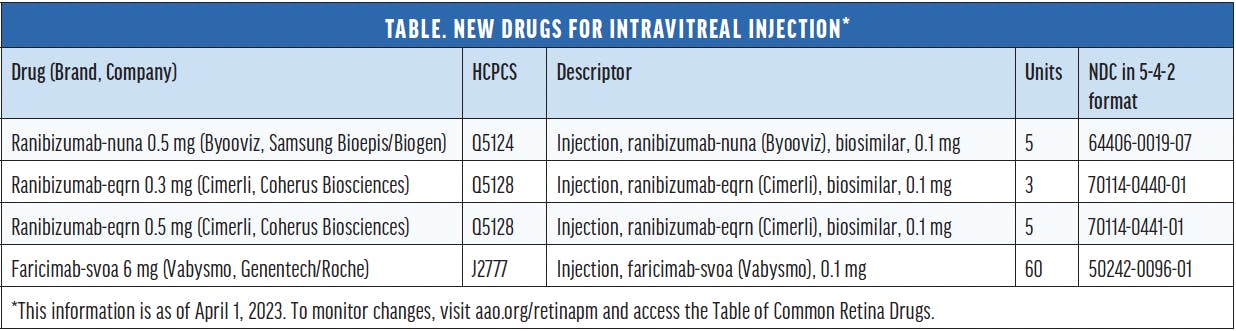
For example, there are currently two FDA-approved ranibizumab biosimilars with the same indications as the brand name ranibizumab (Lucentis, Genentech/Roche). Ranibizumab-nuna (Byooviz, Samsung Bioepis/Biogen) has been approved for the same indications as ranibizumab 0.5 mg/0.05 mL. Alternatively, ranibizumab-eqrn (Cimerli, Coherus Biosciences) offers 0.3 mg/0.05 mL and 0.5 mg/0.05 mL dosages for the same conditions as the brand name drug.
Additionally, the novel dual inhibitor faricimab-svoa (Vabysmo, Genentech/Roche) entered the retina space last year and targets both angiopoietin-2 and VEGF.
To help accurately reference new medications such as these, a modifiable reference guide can be useful for tracking the current coding guidance and any future updates (Table).
STEPS TO SUCCESS
Regardless of the type of new medication, there are essential steps to follow for coding and reimbursement success. Here are six steps to review and implement in your practice:
1. Review the FDA label and identify the indications for and frequency of the treatments, as this may vary from other medications currently used in the practice. For example, based on the FDA label, when treating diabetic macular edema with brolucizumab-dbll (Beovu, Novartis), the first five doses would be every 6 weeks (approximately 39–45 days) followed by an injection every 8–12 weeks. This is a different interval than anti-VEGF treatments that are often provided every 28 days.
2. Identify any published payer policies for the new drug and any unique documentation guidelines or required HCPCS codes. Some payers may designate a specific “not otherwise classified” NOC HCPCS code to report in their policy. For Medicare Part B policies, visit aao.org/lcds.
3. Audit chart documentation during internal chart reviews and confirm all requirements are included. The best practice would be completing an initial weekly audit to confirm the medical record and the procedure note templates are complete, followed by quarterly audits. You can double-check your work using the AAO's Intravitreal Injection Documentation Checklist.1
4. Report new drugs initially with the NOC HCPCS code J3490, J3590 (office setting) or C9399 (facility) until a permanent code is assigned. Faricimab-svoa, for example, was initially reported with an NOC HCPCS code until a permanent HCPCS code was published on October 1, 2022.
5. Confirm that the CMS-1500 includes the required information for the following items:
- Item 19 or EDI equivalent: medication name and dosage in mg/ml and invoice amount.
- Item 24a or EDI loop 2410: the unique national drug code for the medication in 5-4-2 format, proceeded by the “N4” qualifier, and the unit of measure (UOM).
For example, for 0.5 mg ranibizumab-eqrn, the national drug code should be “N470114044101” and the UOM should be “ML0.05.” Not appropriately reporting this additional claim information will cause claim denials.
6. Use a quick reference guide for physicians and staff to track the current coding guidance for each drug used. This guide should be a “living document” so that when permanent HCPCS codes are assigned, you can update your internal resources. To watch for changes, visit aao.org/retinapm and access the Table of Common Retina Drugs.
7. Monitor remittance advice for appropriate reimbursement and create audit reports to monitor correct coding and payer allowables. Find case studies and audit reports in the Profitable Retina Series: Medication Inventory Management module.2
CODING QUICK LINKS
AAO Intravitreal Injection Documentation Checklist
Profitable Retina Series: Medication Inventory Management Module
PRIOR AUTHORIZATION AND STEP THERAPY POLICIES
As new therapeutics are introduced, payers will revise prior authorization requirements. Additionally, step-therapy policies may be updated. For example, instead of just requiring bevacizumab (Avastin, Genentech/Roche) as an initial step—before aflibercept (Eylea, Regeneron Pharmaceuticals), ranibizumab, or faricimab-svoa—payers may add another step and document the failure of a ranibizumab biosimilar.
Missing a crucial update to a prior authorization or step-therapy policy will result in denied claims, often without retroactive resolution or appeal options.
New therapies are a welcome addition to the retina clinic, as they can provide significant hope for patients unhappy with their current treatment plan. At the same time, retina practices must integrate new options carefully to ensure the practice is also happy from a reimbursement standpoint.
1. Practice Management for Retina. American Academy of Ophthalmology. Accessed March 2, 2023. www.aao.org/practice-management/coding/retina
2. The Profitable Retina Practice: Medication Inventory Management. American Academy of Ophthalmology. store.aao.org/the-profitable-retina-practice-medication-inventory-management.html


_1784132761.jpg?auto=compress,format&w=75)





