



AT A GLANCE
- Fundus autofluorescence (FAF) is key in the evaluation of patients with inherited retinal diseases.
- Certain FAF patterns can narrow the diagnosis to a specific type of inherited retinal disease.
- Widefield FAF can provide an estimate of the amount of retina affected, and its findings can correlate with visual field defects.
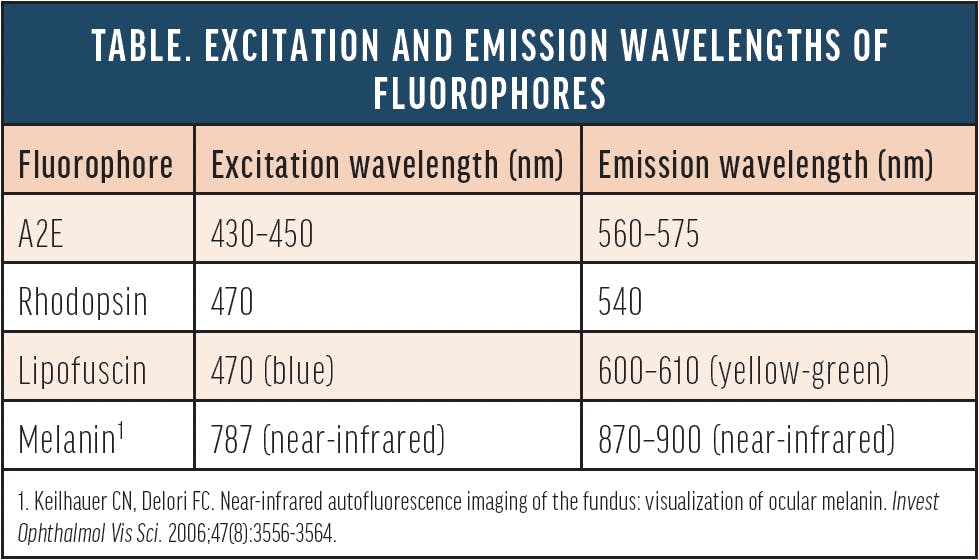
Fundus autofluorescence (FAF) is a noninvasive imaging technique that predominantly highlights the distribution of fluorophores in the retinal pigment epithelium (RPE), such as lipofuscin.1 Other fluorophores, such as rhodopsin, melanin, N-retinylidene-N-retinylethanolamine (A2E), or optic disc drusen, also produce changes in autofluorescence and have various excitation and emission wavelengths (Table).
FAF can be useful in the diagnosis and monitoring of inherited retinal diseases (IRDs). For example, in the early stages of these diseases, FAF can show abnormalities when the dilated fundus examination and OCT are unremarkable. FAF is also a useful tool for monitoring disease progression or stability in patients with an IRD, such as tracking the progression of atrophic noncentral lesions in Stargardt disease. In addition, clinical trials use FAF findings as outcome measures in response to investigational therapies.
In this article, we provide an overview of the use of FAF imaging in various IRDs.
MACULAR DYSTROPHIES
ABCA4-related diseases. Stargardt disease is most commonly an autosomal recessive condition caused by a pathogenic ABCA4 gene variant. The condition leads to outer segment degradation, lipofuscin accumulation, and damage to the RPE and photoreceptor layer. In the early stages of the disease, FAF shows a hyperautofluorescence, indicating an accumulation of lipofuscin. As the disease progresses, FAF shows macular hypoautofluorescence surrounded by pisciform flecks of hyperautofluorescence with peripapillary sparing (Figure 1). In advanced disease, FAF shows hypoautofluorescence from diffuse atrophy of RPE cells and photoreceptor death.2
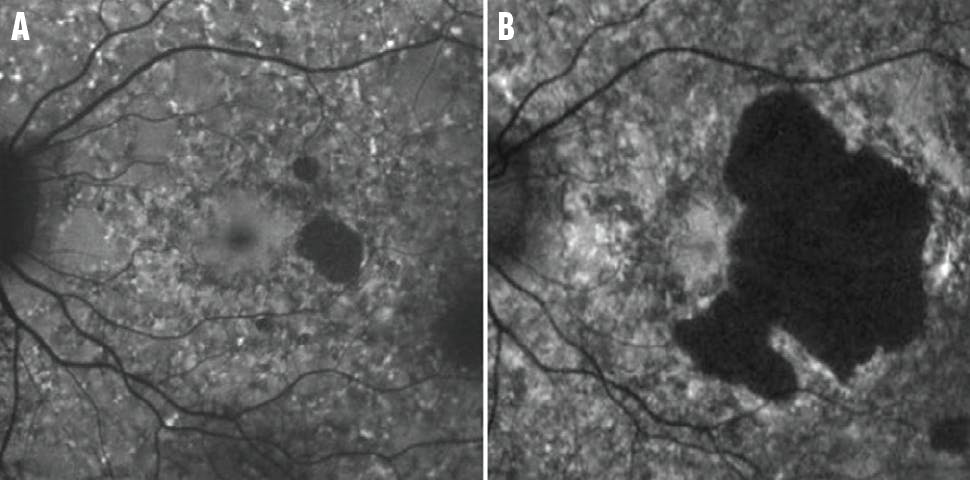
Figure 1. Baseline FAF imaging of a patient with Stargardt disease who has two pathogenic ABCA4 variants shows small patches of hypoautofluorescence (A). Seven years later, FAF shows that the hypoautofluorescent areas have significantly increased in size (B).
FAF seems to correlate with visual function based on visual acuity and electroretinography findings,3 which can help with the timely identification of progression. Klufas et al described three ultra-widefield FAF patterns in this disease4: type I (lesions are localized to the macula); type II (macular atrophy with variable peripheral FAF flecks and atrophy); and type III (macular and peripheral atrophy, which is further divided based on the extent of atrophy).
BEST1-related maculopathies and retinopathies. Best disease, an autosomal dominant condition, is caused by mutations in the BEST1 gene and leads to accumulation of lipofuscin and photoreceptor material in the subretinal space. There are five stages of disease, according to the Gass classification, each presenting with different FAF patterns5:
- Stage 1: The previtelliform stage shows minimal to no change in hyperautofluorescence.
- Stage 2: The vitelliform stage demonstrates a homogenous hyperautofluorescent lesion in the macula.
- Stage 3: The pseudohypopyon stage shows isoautofluorescent fluid on top of a hyperautofluorescent layer.
- Stage 4: The vitelliruptive stage shows a hypoautofluorescent lesion bordered by hyperautofluorescence.
- Stage 5: The atrophic stage shows diffuse hypoautofluorescence due to chorioretinal atrophy.
A study by Parodi et al identified six qualitative patterns on FAF in various stages of Best disease: normal, hyperautofluorescent, hypoautofluorescent, patchy, spoke-like, and multifocal.6 In autosomal recessive bestrophinopathy, FAF can show the extent of abnormal lipofuscin accumulation in a pattern that appears pathognomonic.7 Autosomal recessive bestrophinopathy shows more extensive and variable FAF findings that can include hyperautofluorescence in areas of vitelliform deposition, zonal areas of hyperautofluorescence and mottled hypoautofluorescence, or a combination of these patterns. Acute exudative polymorphous vitelliform maculopathy is characterized by exudative retinal detachment with subretinal lesions. On FAF, the subretinal material initially appears hyperfluorescent and, as lesions resolve, there is a decrease in autofluorescence.8
Pattern dystrophies. These are commonly caused by mutations of the PRPH2 gene, which encodes a membrane protein responsible for the function of photoreceptor outer segments. This group includes adult-onset vitelliform macular dystrophy, multifocal pattern dystrophy, butterfly pigment dystrophy, reticular pattern dystrophy, and fundus pulverulentus. These dystrophies typically have a clinically stable and benign course. Adult-onset vitelliform macular dystrophy is characterized by yellow-white subfoveal lesions and variable FAF patterns. Parodi et al described normal, focal hyperautofluorescent, or patchy autofluorescent patterns, while Furino et al described three FAF patterns, including patchy, ring-like focal, and linear.6,9 All these patterns are likely representations of different disease stages.
Cone dystrophies. These are part of a heterogeneous group of IRDs that affect the cone cells and include achromatopsia, incomplete achromatopsia, blue cone monochromatism, and X-linked progressive cone dystrophy. They are divided into stationary and progressive forms, and some are inherited while others occur sporadically. Affected patients experience photophobia, reduced visual acuity, and color perception deficiencies. From the stationary group, achromatopsia classically has a normal fundus, but FAF can detect photoreceptor disease at the fovea by demonstrating abnormal hyperautofluorescence (Figure 2).10,11
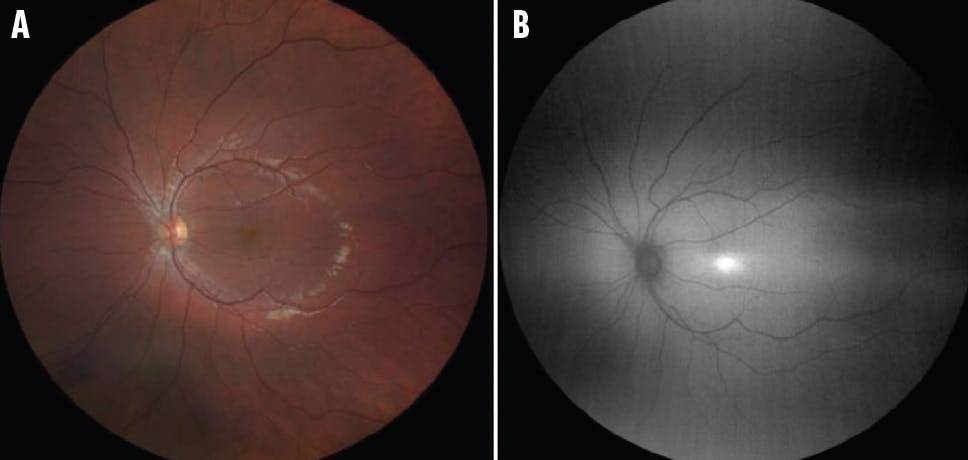
Figure 2. Widefield fundus photography does not show any abnormalities in a patient with achromatopsia (A). Widefield FAF shows subclinical findings, demonstrating hyperautofluorescence at the foveal center (B).
Panretinal photoreceptor dystrophies. Autosomal dominant retinitis pigmentosa (RP) is commonly caused by mutations in the rhodopsin gene, autosomal recessive RP is caused by USH2A gene mutations, and X-linked RP is due to RPGR and RP2 gene mutations. While electroretinography is the standard for diagnosis and monitoring of this disease, FAF can be helpful in phenotype-genotype correlation. On FAF, a hyperautofluorescent parafoveal ring known as a Robson-Holder ring can be seen.12 The ring corresponds to outer segment dysfunction and lipofuscin production. In addition to RP, an autofluorescent ring can also be seen in Leber congenital amaurosis,13 Best disease, cone–rod dystrophies, and X-linked retinoschisis—suggesting a common mechanism.14 Monitoring changes in the size of the ring could be a good outcome marker for rod–cone dystrophies. Outside of this ring, retinal sensitivity is affected, and photoreceptor loss can be seen on OCT; inside the ring, the retina may be normal. Visual fields correlate to the size of the ring.15 Progression of disease may be marked by constriction of the ring, although the ring may expand in cone–rod dystrophy.16 Peripheral hypoautofluorescent changes can be seen in rod–cone dystrophies and are best visualized on ultra-widefield FAF (Figure 3). These changes correlate with visual field constriction and can be used to monitor progression over time.
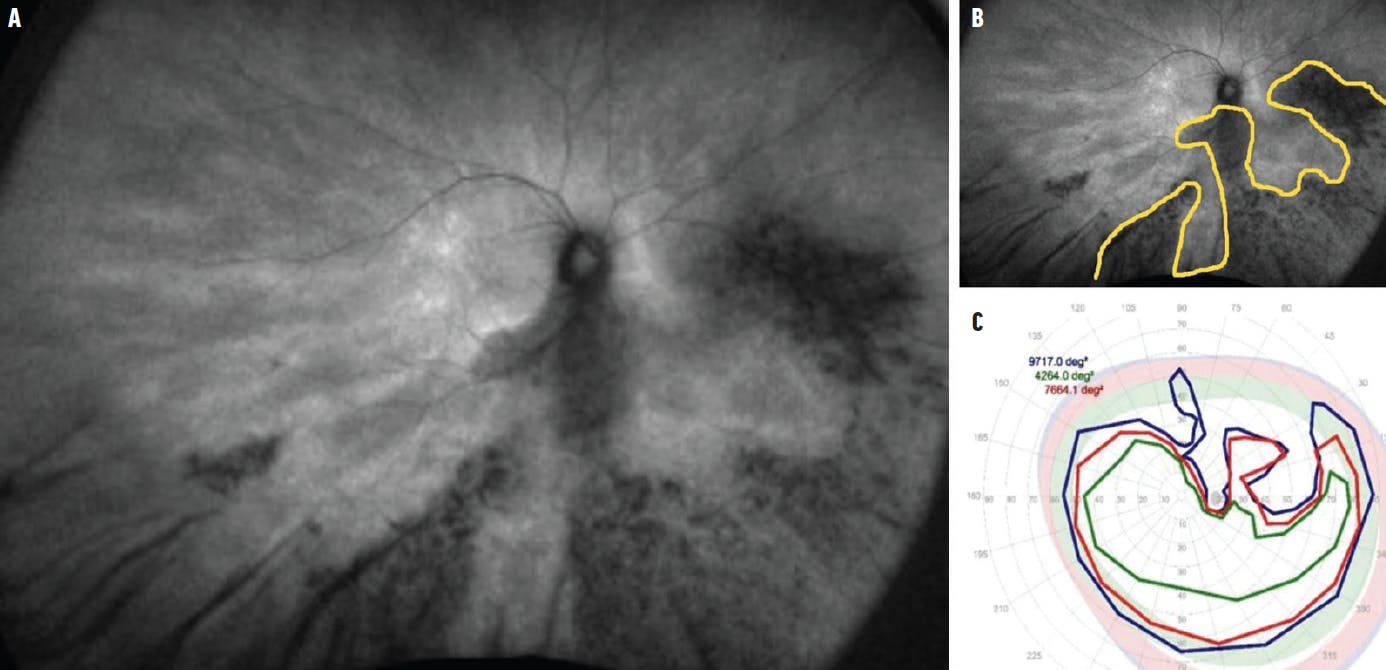
Figure 3. Ultra-widefield FAF imaging in a patient who is a carrier of an RPGR pathogenic variant (A) shows hypoautofluorescence in the inferonasal retina (B, yellow border), which correlates with Goldmann perimetry that demonstrates superotemporal visual field constriction in all isopters (C).
Choroideremia. This condition has an X-linked recessive inheritance pattern and is caused by a mutation in the CHM protein. FAF patterns are characterized by bilateral, midperipheral areas of hypoautofluorescence representing areas of RPE atrophy with scalloped edges. Usually, there is an area of central stellate autofluorescence that is preserved.17 With the progression of the disease, the areas of hyperautofluorescence expand and involve the fovea. FAF can be used to monitor disease as it correlates with vision and age. Female carriers also show FAF changes, such as a peripheral speckled pattern of hyperautofluorescence and hypoautofluorescence.18
FUTURE DIRECTIONS
Deep-learning algorithms evaluating FAF images in IRD patients are being explored. Miere et al developed a deep convolutional neural network that classified IRDs, including RP, Best disease, and Stargardt disease, using FAF images, and it performed well.19 In another study, a deep-learning algorithm used FAF and fundus images to predict causative genes in IRDs and showed a mean overall sensitivity of 81.3% and 81.8% when using FAF alone and both imaging tools, respectively.20 In addition, artificial intelligence has been employed to evaluate structural changes seen on FAF. For example, Charng et al used a deep-learning algorithm to segment hyperautofluorescent fleck lesions in Stargardt disease to evaluate fleck count and area. This may one day affect disease monitoring and clinical trial endopoints.21
1. Delori FC, Dorey CK, Staurenghi G, Arend O, Goger DG, Weiter JJ. In vivo fluorescence of the ocular fundus exhibits retinal pigment epithelium lipofuscin characteristics. Invest Ophthalmol Vis Sci. 1995;36(3):718-729.
2. Yung M, Klufas MA, Sarraf D. Clinical applications of fundus autofluorescence in retinal disease. Int J Retina Vitr. 2016;2(1):12.
3. Lois N, Halfyard AS, Bird AC, Holder GE, Fitzke FW. Fundus autofluorescence in Stargardt macular dystrophy-fundus flavimaculatus. Am J Ophthalmol. 2004;138(1):55-63.
4. Klufas MA, Tsui I, Sadda SR, Hosseini H, Schwartz SD. Ultrawidefield autofluoresence in ABCA4 Stargardt disease. Retina. 2018;38(2):403-415.
5. Querques G, Zerbib J, Georges A, et al. Multimodal analysis of the progression of Best vitelliform macular dystrophy. Mol Vis. 2014;20:575-592.
6. Parodi MB, Iacono P, Campa C, Del Turco C, Bandello F. Fundus autofluorescence patterns in Best vitelliform macular dystrophy. Am J Ophthalmol. 2014;158(5):1086-1092.e2.
7. Jacobs M, May ER, Nicholas F, Belinda S, John K, Ramiro SM. Anatomical and functional outcomes of bevacizumab treatment in pediatric autosomal recessive bestrophinopathy [published online ahead of print December 8, 2022]. Retin Cases Brief Rep.
8. Vaclavik V, Ooi KGJ, Bird AC, Robson AG, Holder GE, Webster AR. Autofluorescence findings in acute exudative polymorphous vitelliform maculopathy. Arch Ophthalmol. 2007;125(2):274-277.
9. Furino C, Boscia F, Cardascia N, Sborgia L, Sborgia C. Fundus autofluorescence, optical coherence tomography and visual acuity in adult-onset foveomacular dystrophy. Ophthalmologica. 2008;222(4):240-244.
10. Michaelides M, Hunt DM, Moore AT. The cone dysfunction syndromes. Br J Ophthalmol. 2004;88(2):291-297.
11. Aboshiha J, Dubis AM, Carroll J, Hardcastle AJ, Michaelides M. The cone dysfunction syndromes. Br J Ophthalmol. 2016;100(1):115-121.
12. Murakami T, Akimoto M, Ooto S, et al. Association between abnormal autofluorescence and photoreceptor disorganization in retinitis pigmentosa. Am J Ophthalmol. 2008;145(4):687-694.
13. Scholl HPN, Chong NHV, Robson AG, Holder GE, Moore AT, Bird AC. Fundus autofluorescence in patients with Leber congenital amaurosis. Invest Ophthalmol Vis Sci. 2004;45(8):2747-2752.
14. Fleckenstein M, Charbel Issa P, Fuchs HA, et al. Discrete arcs of increased fundus auto-fluorescence in retinal dystrophies and functional correlate on microperimetry. Eye. 2009;23(3):567-575.
15. Popović P, Jarc-Vidmar M, Hawlina M. Abnormal fundus autofluorescence in relation to retinal function in patients with retinitis pigmentosa. Graefes Arch Clin Exp Ophthalmol. 2005;243(10):1018-1027.
16. Schuerch K, Woods RL, Lee W, et al. Quantifying fundus autofluorescence in patients with retinitis pigmentosa. Invest Ophthalmol Vis Sci. 2017;58(3):1843-1855.
17. Syed R, Sundquist SM, Ratnam K, et al. High-resolution images of retinal structure in patients with choroideremia. Invest Ophthalmol Vis Sci. 2013;54(2):950-961.
18. Preising MN, Wegscheider E, Friedburg C, Poloschek CM, Wabbels BK, Lorenz B. Fundus autofluorescence in carriers of choroideremia and correlation with electrophysiologic and psyochophysical data. Ophthalmology. 2009;116(6):1201-1209.e1-2.
19. Miere A, Le Meur T, Bitton K, et al. Deep learning-based classification of inherited retinal diseases using fundus autofluorescence. J Clin Med. 2020;9(10):3303.
20. Fujinami-Yokokawa Y, Ninomiya H, Liu X, et al. Prediction of causative genes in inherited retinal disorder from fundus photography and autofluorescence imaging using deep learning techniques. Br J Ophthalmol. 2021;105(9):1272-1279.
21. Charng J, Xiao D, Mehdizadeh M, et al. Deep learning segmentation of hyperautofluorescent fleck lesions in Stargardt disease. Sci Rep. 2020;10(1):16491.


_1784132761.jpg?auto=compress,format&w=75)





