


AT A GLANCE
- Research shows differences in the diagnosis of plus disease, leading to real-world treatment differences.
- Disease severity is more easily tracked and monitored with the superior accuracy of imaging versus retina drawings.
- One quantitative approach to the diagnosis and monitoring of retinopathy of prematurity is to measure the plus disease spectrum using a vascular severity score.
Screening for retinopathy of prematurity (ROP) is a high-stakes endeavor, with decisions that can determine a lifetime with either functional vision or blindness; thus, a timely and accurate diagnosis is essential. Current management is guided by the landmark Early Treatment of ROP study, which provided the modern definition of treatment-requiring ROP, and most infants who are treated on time do well.1 However, imaging advances have exposed challenges to consistently and accurately determining a diagnosis based on the clinical examination alone, whether via ophthalmoscopy or digital imaging.
Despite standardized published photographs of plus disease, research shows differences in diagnosis between individuals and groups of individuals across geographic boundaries; over time, this has led to real-world treatment differences.2-4 Although the International Classification of ROP seeks to be a relevant and applicable resource for clinicians at the bedside without any additional imaging techniques,2 several newer modalities and approaches may lead to changes not only in disease diagnosis and management but also classification.
ADVANTAGES OF IMAGING
While the ophthalmoscopic examination has long been considered the standard, with certain advantages over available imaging devices, traditional contact-based widefield fundus photography offers several advantages. For one, disease severity may be more easily tracked and monitored with the superior accuracy of imaging versus retina drawings.4 Clinicians are far better at determining changes in relative disease severity than they are at determining the disease category at a single point in time. Photodocumentation facilitates the direct comparison of prior disease severity in the same eye, which may be most important for aggressive ROP. Although the term implies rapid progression, this has yet to be formally included in the diagnostic criteria.2 Aggressive ROP is defined by plus disease out of proportion to the typical peripheral stage and a preponderance of flat neovascularization that may be difficult to notice without high magnification but can rapidly progress to retinal detachment.2 Comparing progression using retina drawings or clinician memory is notoriously impractical, especially when different clinicians examine the same infant over time. This may contribute to missing these important clinical signs of disease progression and risk.
PLUS DISEASE SPECTRUM
The recently updated International Classification of ROP introduced the concept of a plus disease spectrum to the vernacular (Figure 1)2; this classification recognizes that there is good agreement at the ends of the spectrum, but clinicians must factor in other features for presentations that are in the middle of the spectrum to determine if treatment is needed. While this presents some challenges to the application of evidence-based treatment guidelines from the Early Treatment of ROP study, the classification acknowledges the current state of practice and opens the door for quantitative approaches to the diagnosis and monitoring of ROP.
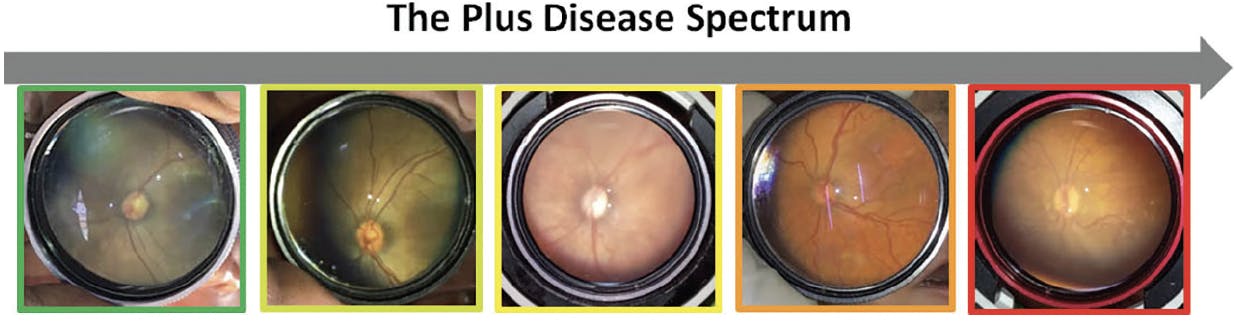
Figure 1. These fundus photographs of neonates undergoing ROP screening (as viewed through a standard 28 D lens) are representative samples of patients who span from no plus (left) to plus (right), with intermediaries along the spectrum of disease. Images courtesy of Parag Shah, MD
One such quantitative approach is to measure the plus disease spectrum using a vascular severity score (VSS), which either the clinician or, in the future, artificial intelligence (AI) algorithms can assign.5,6 Research demonstrates that higher VSS is associated with more posterior disease and a higher stage and extent of stage 3 disease, providing a measurable biomarker for overall disease severity.7 The VSS concept does not solve the problem of determining when treatment is needed consistently, but it provides an objective framework to help do so in the future. Moreover, it facilitates objective monitoring of disease progression, which may help identify infants who are already progressing toward treatment-requiring ROP before diagnosis. Conversely, the VSS may help clinicians identify treatment failure and disease reactivation after anti-VEGF therapy. The strong connection between posterior vascular features and peripheral pathology is an active area of investigation that may significantly improve how we screen and decide to treat ROP.
TELEMEDICINE
Objective diagnosis through ophthalmic imaging and AI also facilitates AI-assisted telemedicine. Globally, we are experiencing a third epidemic of ROP, where very premature neonates in low- and middle-income countries have improved survival, leading to higher rates of ROP.7 However, there is a shortage of trained clinicians globally to perform clinical examinations on all neonates in need, making telemedicine with widefield fundus photography the only solution in many settings.
Studies suggest that AI-assessed disease severity early in the disease course may be used in a predictive model to rule out a high-risk disease with 100% negative predictive value.7 This may, in turn, reduce the need for repeated examinations in lower-risk infants, both in high-income and, importantly, low- and middle-income populations.
AI models that work on lower-cost imaging devices are critical to enabling us to scale these technologies globally to the areas of greatest need. Although many of these devices have a lower field of view, with further validation, the VSS concept may complement lower field of view imaging systems to enhance the sensitivity and specificity of ROP screening where widefield imaging is not available.6,7
ULTRA-WIDEFIELD OCT
Ultra-widefield (UWF) OCT, still in the research setting for ROP, is offering new insights, including the understanding that stage exists along a spectrum (Figure 2).8 Specifically, UWF OCT can detect the thickness of the ridge and show that it correlates continuously with the clinical diagnosis of stage.8 Further, UWF OCT may be able to detect the progression of the stage earlier than a clinical examination or traditional fundus photography.8 Quantitative and objective biomarkers, such as ridge thickness, have the potential to eliminate the problems with interrater reliability.
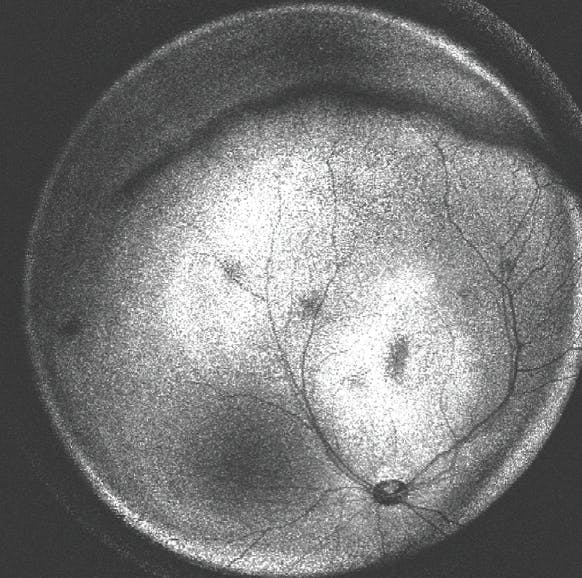
Figure 2. En face ultra-widefield OCT clearly demonstrates the ridge in a neonate with stage 2 ROP. Image courtesy of Yifan Jian, PhD, and Mani Woodward
This technology, if brought to market, could have tremendous utility in creating objective markers for staging disease, tracking progression earlier, and determining the incidence of neovascularization.
PERSISTENT AVASCULAR RETINA
Persistent avascular retina is an increasingly recognized phenomenon in many infants who were screened for but never diagnosed with ROP.9 UWF fundus photography and fluorescein angiography have demonstrated that the rate of persistent avascular retina is very high in patients with a history of ROP. These patients often develop severe vitreoretinal complications such as retinal breaks, vitreous hemorrhages, and tractional, rhegmatogenous, exudative, or combination retinal detachments at a young age. There is still insufficient evidence on whether laser photocoagulation is indicated for these patients because many may have no clinical sequelae; still, monitoring and future study will be important to observe for vision-threatening complications.
NEXT STEPS
As imaging technology advances, we will learn more about the natural history of ROP, fine-tune our ability to predict patients who are at risk for the development of this treatment-requiring disease, and achieve the goal of preventing blindness in this vulnerable population.
1. Good WV; Early Treatment for Retinopathy of Prematurity Cooperative Group. Final results of the Early Treatment for Retinopathy of Prematurity (ETROP) randomized trial. Trans Am Ophthalmol Soc. 2004;102:233-48; discussion 248-50.
2. Chiang MF, Quinn GE, Fielder AR, et al. International Classification of Retinopathy of Prematurity, Third Edition. Ophthalmology. 2021;128(10):e51-e68.
3. Cole ED, Park SH, Kim SJ, et al. Variability in plus disease diagnosis using single and serial images. Ophthalmol Retina. 2022;6(12):1122-1129.
4. Fleck B, Williams C, Juszczak E, et al. An international comparison of retinopathy of prematurity grading performance within the Benefits of Oxygen Saturation Targeting II trials. Eye. 2018;32:74-80.
5. Gupta K, Campbell JP, Taylor S, et al. A quantitative severity scale for retinopathy of prematurity using deep learning to monitor disease regression after treatment. JAMA Ophthalmol. 2019;137(9):1029-1036.
6. Taylor S, Brown JM, Gupta K, et al. Monitoring disease progression with a quantitative severity scale for retinopathy of prematurity using deep learning. JAMA Ophthalmol. 2019;137(9):1022-1028.
7. Campbell JP, Kim SJ, Brown JM, Ostmo S, Chan RVP, Kalpathy-Cramer J, Chiang MF; of the Imaging and Informatics in Retinopathy of Prematurity Consortium. Evaluation of a Deep Learning-Derived Quantitative Retinopathy of Prematurity Severity Scale. Ophthalmology. 2021 Jul;128(7):1070-1076.
7. Coyner AS, Chen JS, Singh P, et al. Single-examination risk prediction of severe retinopathy of prematurity. Pediatrics. 2021;148(6):e2021051772.
8. Nguyen TP, Ni S, Ostmo S, et al. Association of optical coherence tomography-measured fibrovascular ridge thickness and clinical disease stage in retinopathy of prematurity. JAMA Ophthalmol. 2022;140(11):1121-1127.
9. Hanif AM, Gensure RH, Scruggs BA, Anderson J, Chiang MF, Campbell JP. Prevalence of persistent avascular retina in untreated children with a history of retinopathy of prematurity screening. J AAPOS. 2022;26(1):29-31.


_1784132761.jpg?auto=compress,format&w=75)





