


Second-year retina fellows gathered in early December for some much-anticipated learning and connecting. As the first class to interview for their fellowship virtually (thanks to the COVID-19 pandemic), the attendees were eager to spend time with each other and foster the lasting relationships that help define the field of retina. The 23rd annual Retina Fellows Forum, organized by Carl C. Awh, MD, FASRS; David R. Chow, MD, FASRS(C); and Tarek S. Hassan, MD, FASRS, was packed with panel discussions, case presentations, clinical lectures, and—as always—a few games.
This year’s distinguished speaker was David S. Boyer, MD, FASRS, who spoke to the fellows about what he knows best: how to thrive in private practice (Figure). Dr. Boyer organized his lecture around the three As of success: availability, affability, and ability.
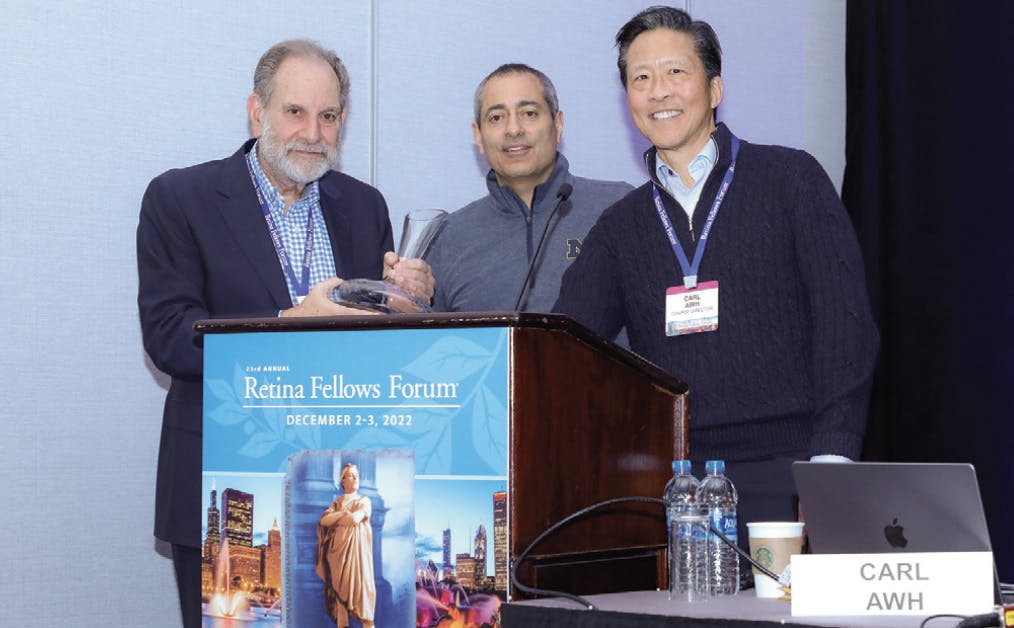
Figure. Drs. Hassan and Awh present Dr. Boyer with an engraved wine decanter as a thank you for attending the Retina Fellows Forum as the 2022 distinguished guest speaker.
“Everyone here has ability, so we won’t talk about that,” he quipped. Below are his pearls for practice success in any setting.
ANSWER YOUR PHONE!
Availability is key, he began. Most patients work from 8 AM to 5 PM, as do their optometrists, so consider seeing patients earlier or later, Dr. Boyer suggested. “Saturdays are busy for optometrists, so being available for them is a significant referral driver.”
Taking calls is the best way to build your practice and meet doctors in the community, he added. Many well-established retina specialists are too busy for new referrals—but those who are new to practice may not be. “If you are available to the referring physician when others are not, you can get those first few referrals,” Dr. Boyer explained. “And if you do a good job, they will likely keep sending patients to you because you answer their calls and are available when they need you.”
“Fellows Forum was a fantastic experience. It was wonderful to network with industry, learn crucial practice pearls from leaders in the field, and connect with colleagues we didn’t have the opportunity to meet in person during the virtual interviews due to COVID-19. What made it even better was the relaxed atmosphere. It was the perfect way to end the 2022 meeting series for fellowship.”
– Maxwell Wingelaar, MD, Vitreoretinal Surgery Fellow, The Retina Institute, St. Louis, Missouri
And those emergency calls at 10 PM? Take them. “Accept emergency patients with a smile and be happy, even if the emergency referral wasn’t actually an emergency,” Dr. Boyer explained. “Be grateful that the doctor thought of you as the right person to see their patient.”
COMMUNICATE WITH KINDNESS
Constant contact with staff, patients, colleagues, and referring doctors is one of the most important parts of the job, but you must go about it the right way, he added. To build a successful practice, you must communicate with referring doctors about each patient’s case, diagnosis, and ongoing care. “Some just want you to take care of the patient and leave them alone, but most doctors want communication,” Dr. Boyer noted. “Whether you text, fax letters, or call, make sure you tell them what happened.”
Treat staff with respect, he continued. “Yelling at them will not make them go faster,” Dr. Boyer noted. “Really think before you blow up, and never have a confrontation in front of other employees. In the OR, the nurses are your friends, and upsetting them will only make the case take longer.” Treating all the staff with respect will go a long way, he advised, eliciting agreement from the panel.
Dr. Boyer then spent time discussing the ins and outs of patient communication because that can make or break a practice. The number one thing to remember is that you should be a haven for your patients, he said. These patients are very upset, and they cling to every word, so be careful what you say. “Whatever you are going to do, make sure you are both on the same wavelength and the patient understands exactly what is going to happen,” Dr. Boyer advised. Patients need to know what medicine they are getting, why they are getting it, and why you are prescribing a certain drug. You do not want your idea of success to be different from theirs, he warned—that’s a recipe for disappointment.
“This was one of my favorite meetings of the year! They kept us motivated and engaged throughout the weekend and incorporated friendly competition through the surgical videos contest—Fellows Fighting at the Forum. This meeting is an invaluable resource to all senior surgical retina fellows.”
– Hong-Uyen Hua, MD, Vitreoretinal Surgery Fellow, Cleveland Clinic Cole Eye Institute, Cleveland
If you do have a patient with a bad result, take extra care of them. “Don’t let them sit in the waiting room,” he warned. “Never rush them through because you feel bad and don’t want to be reminded of the bad outcome.” Instead, face the patient, make eye contact, and let them speak. Your body language is important, so don’t spend the entire time caring for the computer, he joked.
That brought the conversation around to second opinions. Not only should you have a low threshold to seek a second opinion if the patient is dissatisfied, but also never speak ill of another physician if you are the one providing the second opinion. “You weren’t there, you don’t know what happened, and you should never say that you could have done better,” Dr. Boyer explained. “Don’t dwell on what occurred; instead, tell the patient what you are going to do to help them.”
“The Retina Fellows Forum is a one-of-a-kind meeting that lets the brightest next-generation retina specialists learn from and engage with leaders in the field. But equally as special, it fosters lifelong friendships among contemporaries—it brought back a lot of fun and nostalgic memories from my own experience 9 years ago!”
– Christina Y. Weng, MD, MBA, Retina Fellows Forum Faculty and Associate Professor, Ophthalmology, Baylor College of Medicine, Houston
FOSTER HOPE
Here, Dr. Boyer touched on an important aspect of patient care that can get lost in the shuffle of a busy practice: Give the patient hope. “Even if they will likely have monthly injections for life, you can share information about gene therapy or longer-acting drugs,” he explained. “Patients don’t want to hear that they are going blind from AMD, because they won’t—the lights won’t go out in the traditional sense, and they likely won’t have problems for years, so give them hope.” Even if he is seeing a trauma patient with little to no treatment options, he shares information about investigational technology if he can. This means that you must stay abreast of new treatments that you can share with your patients, he added.
EXTRA PRACTICE PEARLS
Throughout the session, Dr. Boyer provided many practice-building tips, including the following:
- As a new doctor, you have about 9 months to build your potential referral services. Talk to doctors in your own practice and meet with local doctors in the community.
- To start a clinical trial center, you must have complete buy-in from your partners. Once you have the green light, pick trials that benefit your patient population.
- Use your new office’s billing practices; with coding, you don’t want to stand out.
- Make handouts and use the AAO’s handouts to educate patients; it helps them better understand the postoperative course and improves compliance.
- Don’t talk about a previous patient in front of another patient; they internalize your words and assume that’s how you talk about them once they leave.
- Don’t be afraid to ask for help from your partners, who have likely seen plenty of uncommon cases.
- Stay active and engaged with the community and the field; write papers, attend meetings, go to society dinners, speak at hospitals, and meet with doctors in your area.
Most importantly, under promise and over deliver.
SAVE THE DATE
24th Annual Retina Fellows Forum
January 26-27, 2024
Check medconfs.com for details about registration information.


_1784132761.jpg?auto=compress,format&w=75)





